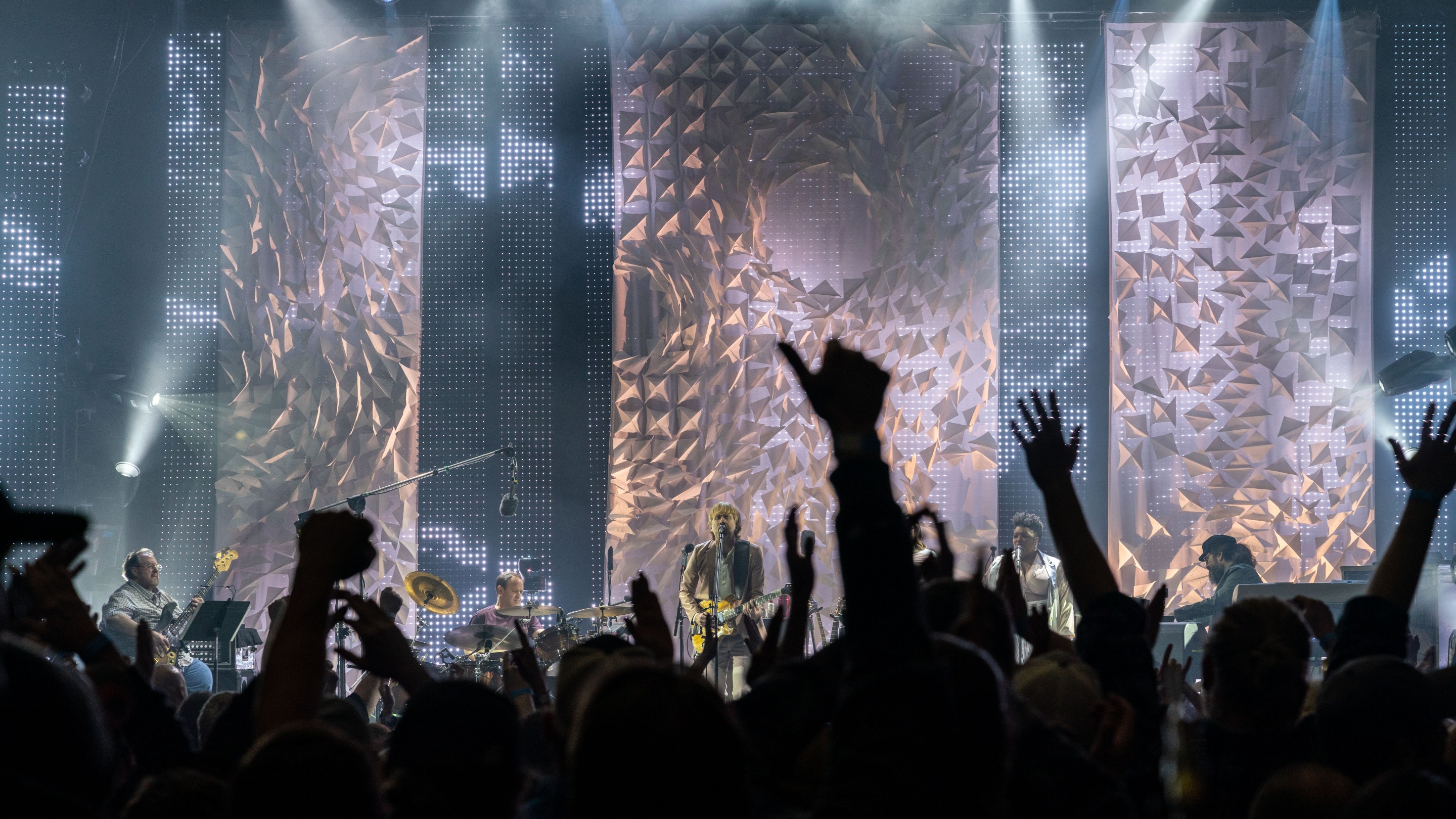
Opening night at State Theatre in Portland, ME (Photo credit: Patrick Jordan)
Here is the final installment of a four-part series that explores how Trey Anastasio’s Ghosts of the Forest project came to fruition. In case you missed the initial pieces, you can look back at part one, part two and part three.
***
The live show took a little over a year todevelop. In typically backwards Phish-world fashion, the proper studiorecording released midway through the tour turned out to only be anintermediate phase. In some ways, despite polish and overdubs and additionalvocalists and arrangements, it was no more finished than Abbey Holmes’ssketches for the show itself.
The only element of the setlist to changethroughout the run, was the solo piano pieces played each night as the bandtook the stage, composed by Anastasio and recorded the week before the tour ona grand piano by Jeff Tanski, otherwise known as the Ghost behind the curtain.Acting as a “one-man pit orchestra” during Phish’s “Petrichor” New Year’s piecethat ushered in 2017, Tanski filled out various roles in Ghosts of the Forest,adding the sounds of owls and birds and bells. During the project’s titletrack, Anastasio’s voice echoes itself imperfectly with Tanski adding recordedphrases to the confusion.
Trey Anastasio: Jeff was extremely helpful to me throughout theentire process. He was involved from the very beginning. I would make changesin the arrangements and he would make a new chart that reflected the changes.Then I would change my mind and change it again. By the time we were done,there was a stack of charts that had grown thicker than War and Peace,which Jeff and I both thought was really funny.
Abigail Holmes: During the piano pieces which started the show, the panels are very, very slowly lit, just shown as they are, and on the first note of “Ghosts of the Forest,” they shift into tints of green and leaves, as does the stage. It really changes the feel of the stage, and hopefully takes the audience on a first step into this shared place where the show will take place.
Jon Fishman: I love Chris Kuroda’s light show [for Phish], but there’s a lot ofkinetic-ness to it. Whereas this was the exact opposite. It was very slow andelegant. This was more of a set piece.
Jennifer Hartswick: Part of what I loved about this whole projectwas having [Abbey’s] new energy in the fold. Part of the joy was seeing thevisual part unfold through Abbey’s eyes. She’d done some work with Phishbefore, but she’s also new. It was really interesting to see her take on thiskind of music. I thought it was so beautifully done, and so elegantly. It wasrock and roll when it needed to be rock and roll, but it wastestosterone-driven lights flashing in your face. It was a more beautiful take.She brought this breath of fresh air into it.
Jon Fishman: I liked the trajectory of the whole thing, and I like thewholeness of it. I like that there’s a beginning, a middle, and an end. And Ifelt like I could really get behind everything that was being said. It relatedto my own life.
Hearing Trey sing those words every night in [in“Brief Time”] about how “we’re here for such a brief time,” I think maybethere’s an appreciation for knowing you still have enough of your youth toreally put out some good some stuff, and your body still feels good.
Fifteen years from now, I’m going to be 70, andbasically that goes by in a flash. I had 15 years go by on me twice already,really fucking fast. So there’s an urgency -- with Kasvot Växt, or this tour.Maybe there’s a certain urgency to make hay while he can. I’m practicing nowand enjoying practicing more now than I ever have. Look, I’m a lifer. I knew Iwas a lifer ever since I was 10 years old. But now that life’s limitations arestarting to show, that’s when the lifer in you really comes out. I’ve alwaysknown I’m a lifer, but now I can see the sand running out of thehourglass.
Ray Packowski: I don’t think I thought about [my being sick] that much. I was just happy to be there, and that everything had worked out for me, that everything was good. But every time we would play that song “Friend,” I was crying at the end. It was just such a powerful song. It always just moved me, the lyrics and the music.
“Friend” from the Orpheum in Boston
Trey Anastasio: “A Life Beyond The Dream” is the stone killer emotionally for me. The floodgates opened, and as was with the case with About to Run, I was writing about other people and feelings and memories from my life, beyond Chris specifically.
Fish really liked it when he heard it, and saidthat it conjured up thoughts that “this is the dream”, what we view as realitymight be the dream.
My interpretation in writing it was far morepersonal, but singing it for him and hearing his interpretation gave me theconfidence to allow myself to go there and be honest. I was comforted knowingthat a song can conjure up different personal interpretations. I don’t want thesongs to be glued to my own personal experience.
Abigail Holmes: The first night was an amazing experience. There was a room full of people who had not heard any of the music before. It was really interesting, you could feel people listening in a different way, not expecting the next sounds, but taking them in as they happened. Of course, people were listening to the streams afterwards, so no other night was quite like that.
Jon Fishman: I don’t think Phish has ever played the same show twice in a row.Maybe, if we did, we did it as a gag or something. So I didn’t really thinkabout the experience of playing the same show every night. There’ve been a lotof times in Phish where we’ve made comments like, “Boy, it’d be really hard togo out and play the same show every night. Can you imagine how bored you’dget?”
But I really found that I loved playing the sameshow every night. It was a short tour, so you really felt like you wanted toimprove night to night. Trey would always try to come with notes, and he woulddial certain things in at rehearsals and soundcheck. And I think each time itdid get better. I think every individual had certain things they wanted to dobetter every night. Even though it’s the same songs in the same order, itreally didn’t feel the same. And I think the recordings show that, too.Different nights, different songs would stretch out or sort of find theirpersonality.
The process was a real joy because my warm-ups weretotally different. I focused on my hands and feet and just the looseness. Ididn’t have to review material, like before Phish. And there somethingcreatively freeing about not having to review as much material and being ableto focus on other developmental drum things that I’ve been working on, and thentrying to work that into the material.
All ‘round, I think it just makes me a bettermusician. I definitely had to learn a bunch of drum stuff that I can now bringto the context of Phish -- just coordination stuff, certain grooves, ways ofgoing from an upbeat to a downbeat. I can play a quarter-note triplet on myhi-hat over a seven feel now. My vocabulary increased.
Jennifer Hartswick: Playing the same set every night, I loved. Partof what Trey’s obviously known for is never playing the same set twice. But tosay “this is what it is, and that’s okay,” was an eye-opening thing for him,that people would want to come see the set again. Working with him there’salways this, “oh shit!” moment, when he calls some song you haven’t played insix months or a year-and-a-half. There’s an element of stress that comes withit. And that part was completely annihilated because we knew exactly what thesetlist would be. We got to dig in and be a little more comfortable. When youplay the same thing every night, it starts to sink in to your DNA, and there’sa sense of ownership and comfort with the parts, and maybe a little morespontaneous enjoyment, where maybe Celisse and I will make something up in themiddle of a song. I think that happened by the fourth or fifth show of thetour.
Ray Paczkowski: It always made me think of that Robert Frostquote that he said once, supposedly. At the time, he was writing in a formalway, but free verse was getting big in the ‘50s and ‘60s, where they threw allthe rules out. He said “free verse is like playing tennis without a net, what’sthe point?” His meaning was that where there are rules and structure,inspiration can come. I felt that way with Ghosts of the Forest. You could useyour brain in a different way, and concentrate less on “How does this song go?”and more on what you can actually do in the song.
Abigail Holmes: I operated the lighting and video for all of theperformances. I definitely continued to tweak and rework the both the lightingand the video, changing the lighting looks, and remaking and adding to thevideo pieces, especially the jam sections. Some portions of the show werefairly consistent, but the instrumental and jam sections were all executed froma manual, improvisational playback set-up for lighting and especially forvideo. Those portions of the show were improvised in the moment, and weredifferent from night to night.
Ray Paczkowski: “Wider” has a fertile feel to it. It can reallygo anywhere. Fishman does all these different time signatures within the 4/4and we would just kind of link up and stretch out. At the end of whatever thecycle was I would look up at Fish, who always has his head turned to the left,and I can never tell who he’s looking at. But we would always look at eachother there. It was a joyful thing.
Trey Anastasio: Everything was a new song at some point, but thefirst night it was like 20 new songs, which is pretty bizarre. They got so muchbetter. Some of them probably went too far and then we had to reel it back in.But you’d find places to improvise in places where you weren’t improvisingbefore, like “Drift While You’re Sleeping,” that wasn’t happening early on. Ijust started to discover that “Ghosts of the Forest” could’ve been stretchingout. If we’d had one more show, it was about to. More importantly, we wouldmake tiny changes every night. Every morning, I would come in with notes orsomebody else would say something, or we would adjust where the vocals go. Itgot so tight.
It made me sort of sad about how many songsPhish have. If you have 8,000 songs, you play ‘em once a year. It made me missthe times that we used to “You Enjoy Myself” every night. “Foam” was so tight.“Bouncing Around the Room” is probably a better example. If you listen to theSomerville Theatre [from 1991], I think that might be as good as that song evergot. We got so good at it. It was weird. And that’s such a simple song. That’swhy that’s almost a better example than the complex ones.
I think that’s what I was experiencing with this-- how it’s so good to be able to focus on these tunes every night and be like,‘OK, this is the section that always throws me, I’m gonna make this much bettertomorrow night.”
Jon Fishman: I was really proud of Trey in a way that I don’t know that I’vebeen before. And on another level I was really grateful and proud to be part ofit, and glad he asked me to be part of it. It was one of my favorite musicalprojects I’ve ever been involved in, in my whole life.
What I liked about it was that I was with one ofmy bandmates I’ve been playing with for 35 years and, on a certain level, whatwe did [with Ghosts of the Forest] was so totally different than what Phishdoes -- yet, a lot of it we can bring to Phish. I hope some of these songs weplay with Phish. But you’re playing with this person for a whole 35 years. Andthen you turn around and are able to do something that’s so totally differentin a lot of ways from what you normally do together.
Celisse Henderson: Trey works differently than any artist I’veworked with. He somehow has the ability to be so open and available to whereversomething wants to go. If there’s an idea in the room he’s willing to try it.But, in the same breath, he also has a really clear cut vision for things. Forhow in the moment everything is, it takes so much work to actually get to aplace where you can let go. That’s what I enjoyed about this style of music,changing your perspective on what your goal is onstage. The ideal thing isn’tthat everything is executed in one way. It’s about the prep, and the beliefthat if you do all the work, it’s really about the six of us connecting andgoing wherever that moment goes. It really affected me a lot. There’s an aspectthat’s a life lesson: You do the very best you can and you do all the work youcan, but the most important thing is what’s happening right now, thething happening in this moment. And the most exciting thing is the next moment.It was pretty revolutionary to me, it’s not the way most people work, and Ithink it gave me a key to a new freedom.
Tony Markellis: Trey has never been one to sit still -- he'sconstantly studying, learning, and absorbing new information. He forgetsnothing. Every project he's been involved in along the way combines with everypast project to shape and inform the next. Ghosts of the Forest is no exception-- elements from Phish, Trey Anastasio Band, Hands on a Hardbody,orchestral works, and everything else he's ever played or heard got folded intothe mix. There are Afro grooves, jams, R&B rave-ups, deep, soulful, bluesyballads -- it's all there. Unlike most album projects, this wasn't just acollection of songs, but rather a cathartic emotional story with an actual arcto it. I was impressed, but not surprised, that Trey managed to paint from asmuch of the musical palette as he did in order to tell the story.
Ghosts of the Forest was a new kind of ghoststory, with such vast sadness and vast happiness that it became alive again. Itgrew to a full-spectrum performance, stretched between the celestial shimmer of"Beneath a Sea of Stars" and the soaring chorus of "In LongLines," from the existential yawp of "About to Run" to thestrange and stretching groove of "Wider," all in Anastasio's distinctcompositional voice, leaving room for through-written turns and open doors thatbeckon.
“Listen to that sustain,” was a common refrainof Cottrell and Anastasio’s musical friendship, particularly when listening toJimi Hendrix. “Not just sustain of one note,” Anastasio wrote in a Facebookpost after Cottrell died, “but the way Jimi always kept the energy flowing likea torrent... like whitewater rafting, how he would sustain a roaring rapid ofsustain.”
If the energy flow ofGhosts of the Forest wasn't a whitewater torrent, the sustain was just as real.This sustain was its own kind of line, the exact thread from memory to musicand back, connecting the past and future by way of the nearest local now,whenever the recordings are heard, the videos are watched, and the ghosts areobserved and acknowledged.
Listen to Ghosts of the Forest: Beneath a Seaof Stars. Recorded live onthe final night of the tour at the Greek Theatre in Berkley, CA.