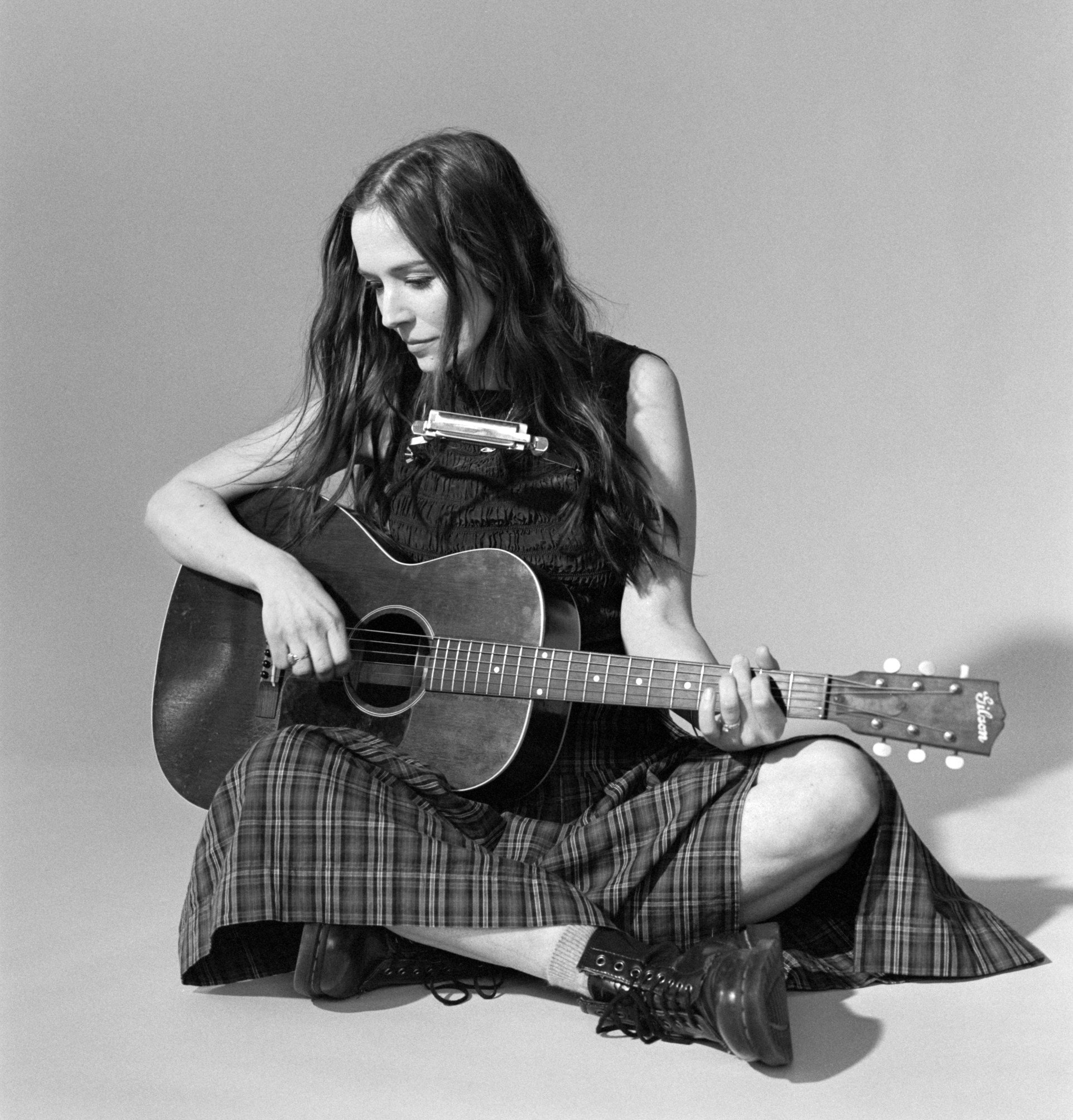
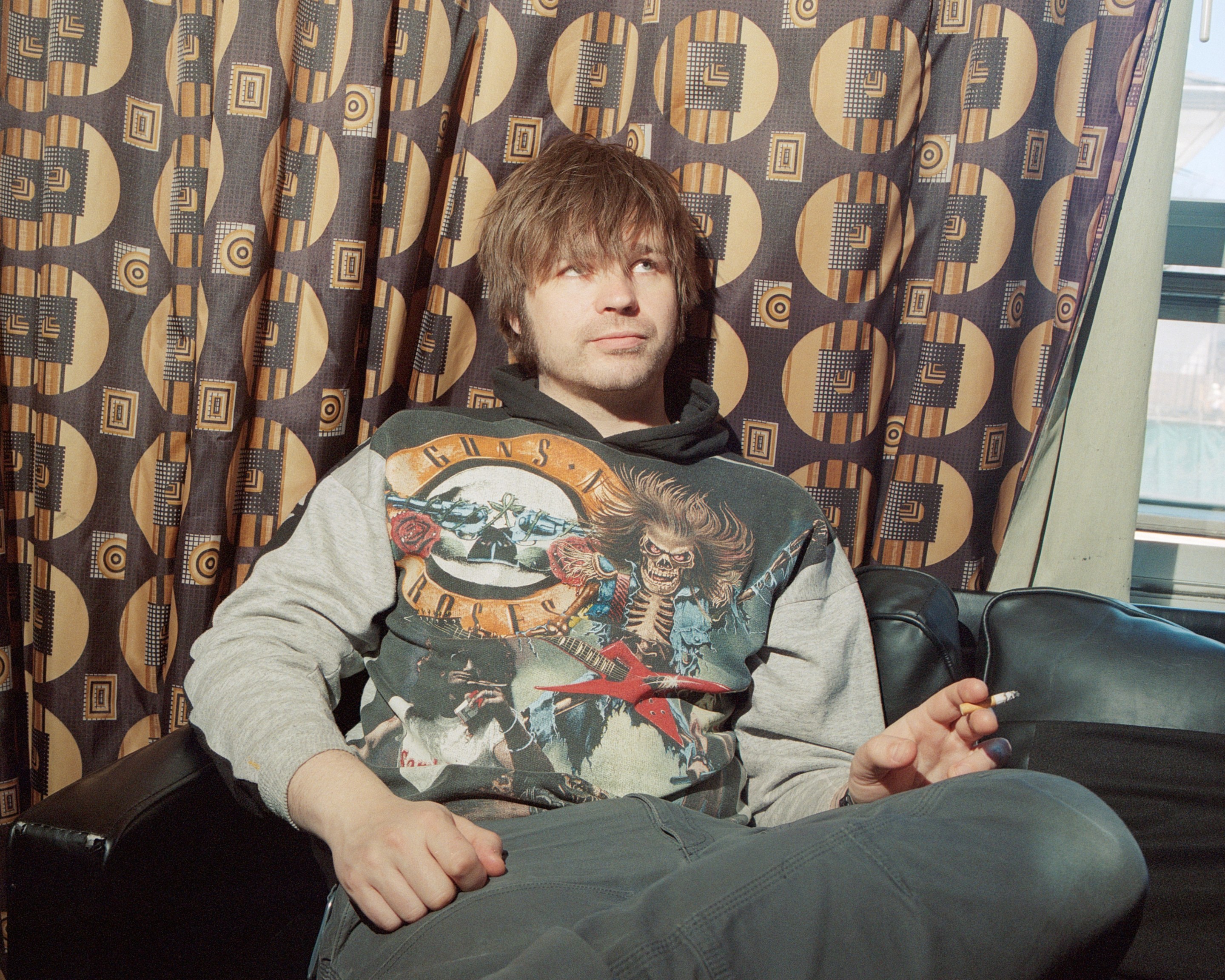
Nate Amos may finally be right for his Grateful Dead phase. Or, perhaps, he’s already too busy observably listening to Tool to devote that time of deep listening to another band. Either way, after focusing much of his energy in the studio, the 35-year-old songwriter believes the time is right for his oft-malleable solo vehicle This Is Lorelei to enter its live era.
The St. Johnsbury, Vt.-bred musician, who has emerged as one of his generation’s most melodic and hook-driven indie-rock songsmiths in recent years, originally conceived This Is Lorelei as a side-project and opportunity to workshop ideas and motifs for Water From Your Eyes, his long-running, richly experimental Chicago art-rock project with his onetime partner Rachel Brown. However, over time and through a treasure-trove of Bandcamp recordings and independent releases, This Is Lorelei has grown into the more folky, jangly of his two bands. 2024’s Box for Buddy, Box for Star, the first full-length This Is Lorelei album, was a warm, honest set of original songs that pivoted between electropop beats, indie-pop honesty and Bruce Hornsby-approved melodies. The next year, he followed up that set with another strong, independent effort, Holo Boy, which features new versions of material he issued through DIY channels between 2014-2021, and a super deluxe version of Box for Buddy, Box for Star, featuring new takes on his material by buzzy friends like MJ Lenderman, Waxahatchee, Jeff Tweedy, Snail Mail, Tim Heidecker and more. That album helped earn Amos some crossover appeal and his latest set, The Singer in My Band, arrived on vaunted alternative label Matador in September.


Informed by his recent travels and life on the road, The Singer in My Band leans into the musician’s bluegrass bones, featuring contributions from his sister and father Bob Amos, the singer/guitarist in the Colorado-bred country act Front Range. It’s also his tightest collection of originals yet, featuring choice hummable numbers like “The Kid With the Crown” and “Billy Came Back.”
Amos also remains committed to Water From Your Eyes, who dropped It’s a Beautiful Place on Matador last year and played some high-profile dates with Hayley Williams this year, and is now part of a constellation of rising art-rock musicians that includes Lenderman, Waxahatchee, Wednesday and others. Yet, as he explains here, he still thinks of himself largely as a solo recording artist, even as he’s made more and more friends in recent years.
You have described your new album, The Singer in My Band, as a “road album.” Can you start by walking us through when you began writing toward this record in specific—your first for Matador—and how being on the road informed your approach?
Nate Amos: I think that’s part of it right there. It wasn’t written in a live sense. It was a unique experience for me in terms of making music because I was in a totally different environment than I’d ever made music in before. Partially, that’s because it was the first time I’d written new Lorelei material that I knew was going to come out on any sort of platform. With Box for Buddy, when I was making that, it was for me and for my friends—and maybe friends of friends—and that’s it.
On top of that, it felt like “time to write.” I get blocked up because I wrote so consistently for so long. And I’m not good at sitting down with a guitar in a hotel room and writing something. Maybe at some point I’ll crack that. I usually make music in a stationary place, with a bunch of stuff to make music with. But my instinct to write was kicking in because I was in the zone of making music from playing live—but the performances were really the only times I was actually playing music. So the songs developed out of a combination of boredom and frustration.
It was a different process because I was also thinking a lot about the Holo Boy record, which was all re-records. There were songs from all these different periods of time, so it was like, “What’s going to be the common thread if it’s not that they were written in the same period?” It ended up being that they were essentially performed at the same time. So I treated that almost like a live set, where I did pretty much one take of everything—all the guitars in an afternoon, all the basses in an afternoon.
I applied that process to recording The Singer in My Band and also to the specifics of the arrangements. As soon as I sat down and began actually committing to ideas, all the decision-making was very fast and instinctual.
You mentioned that this was the first time you actually sat down and wrote an album knowing that it was going to be released, at least on a label versus simply for your own sake or Bandcamp. Were there elements of the project’s famously eclectic sound that you decided to hone in on this time around, both knowing that this music would see the light of day and that your other project, Water From Your Eyes, is also continuing to simultaneously release new music?
Nate Amos: Not really. With both my projects, the golden rule seems to be—”Don’t fuck with it, just let it be whatever it is.” I try to keep my relationship with my own creative process as subconscious as possible. I’ve tried before to shoot for a specific thing, and it never works.
For me, creativity is an exercise in controlled failures and capitalizing on accidents. I’m really bad at making something I set out to make in a particular way. And honestly, when it does work and you make exactly what you set out to make, that’s the least fun outcome. The whole joy of the creative process comes from the things you didn’t expect. It doesn’t come from things you know you can do. It comes from things where you’re confused about how you did it in the first place.It comes from the ether.
Stepping back for a moment, and for readers discovering your music for the first time or who don’t know the relationship between your two projects, can you talk a little about how Lorelei started and how you see that solo vehicle in relation to Water From Your Eyes, which formed in Chicago and was a lynchpin in that musical community for a time.
Nate Amos: I moved from Vermont to Chicago when I was 20. That’s where Water From Your Eyes got going with Rachel [Brown, in 2016]. After high school, I went to Burlington, and it just wasn’t quite far enough to do that thing you have to do at that age. I needed it. But Lorelei was actually born out of visits I made back to Vermont. The first two or three Lorelei things were EPs I made between Christmas and New Year’s, when I was visiting family. Because it existed in that space, it was never a primary focus where I was actually living. It was very much a secret side project—a sandbox for ideas, a testing ground for things to use in other projects.
Water emerged as the primary project at a certain point. For a while, Lorelei was where I messed around with ideas for Water. All the microtonal serialism stuff—what I think of as the defining compositional element of Water From Your Eyes—I was messing around with in Lorelei about two years prior. Then around 2019 or 2020, without me realizing it, Lorelei began to develop its own distinct identity, very separate from Water From Your Eyes. And it’s continued on that thread. I never would have guessed this is where it would go.
It’s interesting because the early Lorelei stuff was considered the more experimental side of your recorded output. There’s still a lot of experimentation, and a lot of hooks, in all your music, but Lorelei became the more accessible of the two bands at some point.
Nate Amos: It’s become the more hook-forward one. The way I’ve come to think about it, Water From Your Eyes is a complicated engagement. If you’re interfacing with it and you’re not already used to that kind of music, it’s a puzzle to figure out. That’s the intention. With Lorelei, the intention is to remove all prerequisites, so it’s something that can be communicated easily. Lorelei is about removing the boundary. Water From Your Eyes is about embracing the boundary and playing with it in a funny way.
It’s about seeing the forest for the trees, in a sense. You eventually relocated to New York and started playing out on the DIY music scene. What were your early Lorelei live shows like?
Nate Amos: Way back in the day, there was a really chaotic Lorelei live band. There were maybe nine or 10 people who all kind of knew the songs. As long as the drummer was available, I’d say yes to shows and tell everyone else, “Whoever can show up, show up.” It wasn’t a disaster—it was fun—but it wasn’t a real band. The first couple of shows I played in New York, I would take all the backline the venue had and build a wall, and I’d sit behind it and perform. I’m thinking of one in particular—I think it was [the Brooklyn space] Gold Sounds.
I was building structures on stage to hide inside of. Then, at one point, I thought, “This is probably not the healthiest way to do this.” It felt like leaning into my insecurities instead of doing anything about them. Those sets were mostly singing over tracks, sometimes with guitar.
So I completely flipped it. I started rolling up with a laptop and taking requests. I’d Google my own lyrics because I didn’t know any of them and sing along with the recordings. I’d never just stood with a mic by myself, so it was a kind of exposure therapy. It really sucked. I hated it for a while, but I made myself do it, and I slowly got more comfortable.
In that sense, your performance voice emerged literally through the chaos. Going back to The Singer in My Band, there are some really great melodies, and I’ve heard some nods to your family’s bluegrass roots baked in. Can you talk a little about growing up the child of a bluegrass musician? Bluegrass is a very specific art form that’s back in vogue now, but it hasn’t always been as popular. Did you always embrace elements of that music or was it more the collective wall you bounced off of?
Nate Amos: Bluegrass is a significant portion of my musical DNA. It’s always felt very familiar and comfortable to me as a listener. I participated as much as I could. The only instrument I can really hold my own on, in a bluegrass setting, is the upright bass.
The level of musicianship is high enough that you have to really commit to that world and your craft, and you really need to drill it. I always loved it. It was not an easy sell to my friends as a kid. But I never really gave a shit what anyone thought about the music I was into. I remember I really loved Stevie Ray Vaughan, and there was this kid who made fun of me about it mercilessly. Then about four years later, he did his big eighth-grade thing on Stevie Ray Vaughan. But, no hard feelings—shout-out to Josh.
Did you play out with your dad, or with other members of his bluegrass community?
Nate Amos: When I was in high school, he had a family-band type of thing—him, me, my sister, and usually another person or two. I had bands I was trying to do in high school, but most of my early performing experiences came from playing music with him. Also, most of my early studio work came from playing with him—he had a home studio and had me doing studio drum work. Having a dad who was a musician and actively encouraged me to do music in different capacities was huge for me.
I don’t really know enough about it culturally to talk about it, but there are a lot of musical families in bluegrass. Honestly, I’m into the really old shit—the mid-to-later-period stuff. But I also really love Tony Rice, and that [self-titled] J.D. Crowe & the New South album from 1975 or so—the one with Jerry Douglas on it as a teenager. That shit just rips. But I don’t really know much about what’s going on in bluegrass now because I’ve never known much about the intersection between the bluegrass scene and the jam scene. It seems like the big boost bluegrass has gotten, culturally, recently is largely thanks to the jam scene—the part of it I’m personally less familiar with.
You came of age in Vermont during the height of the jamband boom in the ‘90s and early 2000s. Because of that, did your younger self naturally rebel against that scene and style?
Nate Amos: Especially because I went to UVM for a semester in Burlington—the jamband culture was so intense that, as a pissed-off 19-year-old kid, it was the most obvious thing to rebel against. I wasn’t a hater, I was just on another tip. That being said, I did spend a fair number of evenings on acid in the basement of Slade [Hall], in the room where Phish played some of their early shows.
But I never really fell into it when I was there. To be entirely honest, I always wonder if I’m ever going to go through a Dead phase. Sometimes I feel like I was ready for a Dead phase, but I found Tool first. Tool fills my Dead hole. When I first got really into Tool, I thought, “This must be how my friends who got really into the Dead feel.”
I’m wearing a Moody Blues tie-dye shirt now. It’s an eBay find. I feel like I hit a point where I was like, “Ah, I’m over band shirts. I gotta stop wearing band shirts.” And then I had this kind of boomerang moment where I was like, “You know what? Fuck it. I’m gonna get more into band shirts.” [Laughs.]
Actually, I just found this shirt that I bought. I don’t have it yet, but I found what I think might be my holy grail t-shirt, which is from the seven-show run that Tool and King Crimson did together in 2001. I was like, “I didn’t even know that this existed, this is insane.”
It was a great era for Tool and a not-so-great era for King Crimson, but what are you gonna do? It’s still King Crimson.
Though both of those bands are stylistically different from the Dead, they have built their own worlds, musically, which has helped them nurture passionate fanbases.
Nate Amos: It’s funny because Crimson and Tool are both so different from what I do. I don’t worry about the fact that the music I make and the music I consume are drastically different. I listen to music all day, every day, and I honestly can’t tell you the last time I listened to indie rock. But everything goes into the stew.
The conceptual depth of Tool—the way it’s simultaneously very real and serious but also very self-aware and kind of funny—that balance and depth is something I think about a lot. They’re a band that does that really well. And Robert Fripp is just my favorite guitar player. He’s my dude, at the end of the day. He’s an inspiring figure—the level of practice and discipline that guy committed to, the refusal to do anything that wasn’t asking to be done, the way he allowed that band to be reinvented repeatedly through time. I think it’s really remarkable. And when I look at the quality of the work that he was putting out, and then all the stories about him being really demanding and difficult to work with, it makes me wonder, “Man, am I too chill? Maybe I should be pushing my band harder.”
He puts everything into a project. I can’t do that shit. I can’t be too much of a taskmaster.
Shifting back to your latest batch of songs, the bluegrass roots you describe are more produced on The Singer in My Band.
Nate Amos: Totally. The sense of melody from bluegrass is definitely deeply ingrained in me. But one of the really interesting things about bluegrass is that it’s such a particular formula, and every instrument has a crucial role to play. If one instrument isn’t holding it together, the whole thing falls apart. So the concept of role and responsibility within a functioning musical mechanism is something I’ve always thought about, probably because of that.
That’s a reason the jamband community, the bluegrass community and bands like Tool have always had a like-minded approach—everyone is an essential piece of the puzzle versus a more traditional rock band, where there’s a prominent singer-songwriter or guitarist and everyone else is kind of backing them up.
Nate Amos: Exactly.
Many fans first found your music through your 2025 releases, Holo Boy, which consists of rerecorded versions of songs from your EPs and Bandcamp releases, and the super deluxe version of Box for Buddy, Box for Star. The latter set also features contributions from some prominent friends and supporters. How did you select the guests for the sessions? Were they mostly close collaborators or musicians you admired and hoped to work with?
Nate Amos: A combination. A lot of them were friends, and some were new friends. I think I’d met everybody on it before they got chosen. It was really cool how it came together.
Honestly, at first the reason it happened was that, about six months after Box for Buddy came out, I listened to it and had two specific—not full-on regrets, but pangs of, “Did I make the right decision here?” One was the aggressive aesthetic “Dancing in the Club” was treated with on the album, with the Auto-Tune and the hyper production. The other was “Two Legs.” I’d messed around with different ways to record the vocals and ended up going with the double-tracked, high, white-dude vocals. That worked really well, but it meant that any time the song came up in conversation, everyone was distracted by the fact that it sounded like Elliott Smith, instead of really talking about the song.
So the initial idea was to have new versions of those two songs. I asked Jake [MJ Lenderman] if he would just record new vocals for “Dancing in the Club,” and I think he said something about not being able to sing that fast. It was his idea to build it from the ground up. Originally, I was just thinking about keeping the same tracks with guest vocalists on a few songs. When we did that “Dancing in the Club” version, it kind of opened the door because, at that point, it could be a full-on reinterpretation of each song.
But really, there was demand for the MJ version of “Dancing in the Club” on vinyl, and the album, as it already was, pretty much filled up a vinyl. So we were like, “OK, if we’re going to do a whole thing, we might as well use all the space and do the whole album.” It took a little while.
It’s pretty funny that the new album is The Singer in My Band.
Your live band has come a long way since the karaoke-style performances you described earlier. You played some big shows this summer, including at the Newport Folk Festival, where you also sat in with Hayley Williams. How did you envision your live show going forward?
Nate Amos: I’ve wanted to get Lorelei into normal, four-piece-rock-band, no-backing-track territory for a while now. With Water From Your Eyes, the backing track is necessary because the sound design is half the composition. Since Lorelei and Water had the same live band, with [bassist] Al [Nardo] and [drummer] Bailey [Wollowitz], it was just economical to use the existing Water From Your Eyes infrastructure. We did a double Australia tour where we didn’t have to switch up people—we just got Rachel over there for Water.
But that was feeling less and less natural for Lorelei, and I wanted to put together a truly live band. So Bailey, who had been drumming for Lorelei, has moved over to keyboards full time, which is pretty much what makes it possible. The way I tend to write, there are still songs where special things need to happen. Bailey not only knows the songs really well from playing drums on them but was also the person running the backing tracks at the last live shows, so they know what to do on the songs where we used to have backing tracks. Al’s playing bass, and my friend Cameron [Wisch]’s playing drums. It’s a four-piece. I’m really excited to play more—it was kind of a tease having practices and then only getting to play Newport.
This is Lorelei started as a true home-recording solo project and has remained your solo mouthpiece, even as you have collaborated with different players on stage and in the studio. At the same time, you are also part of a rapidly expanding network of musicians who have all broken through in various ways in recent years. Do you consider yourself part of a larger artistic community at this point or still a lone wolf, so to speak?
Nate Amos: I’ve definitely made a lot of friends. There are lots of people I feel connected to on a personal level. But I’m so bad at evaluating what I’ve made. It’s weird—the process of trying to write in simpler, more traditional ways with Lorelei has turned into an almost holographic-perception thing for me. Because things are so simple, there’s space to assign conceptual weight to every individual thing you notice. When I hear my own music, I’m not even really sure what it sounds like. It’s a very complicated feeling.
There are a lot of people around whose music I like, and there are lots of people I love bumping into. But there’s no one I’ve bumped into where I’ve been like, “Hell yeah, this person’s on the exact same mission as I am.” Then again, I don’t know what my mission is anyway. Maybe there is someone out there.