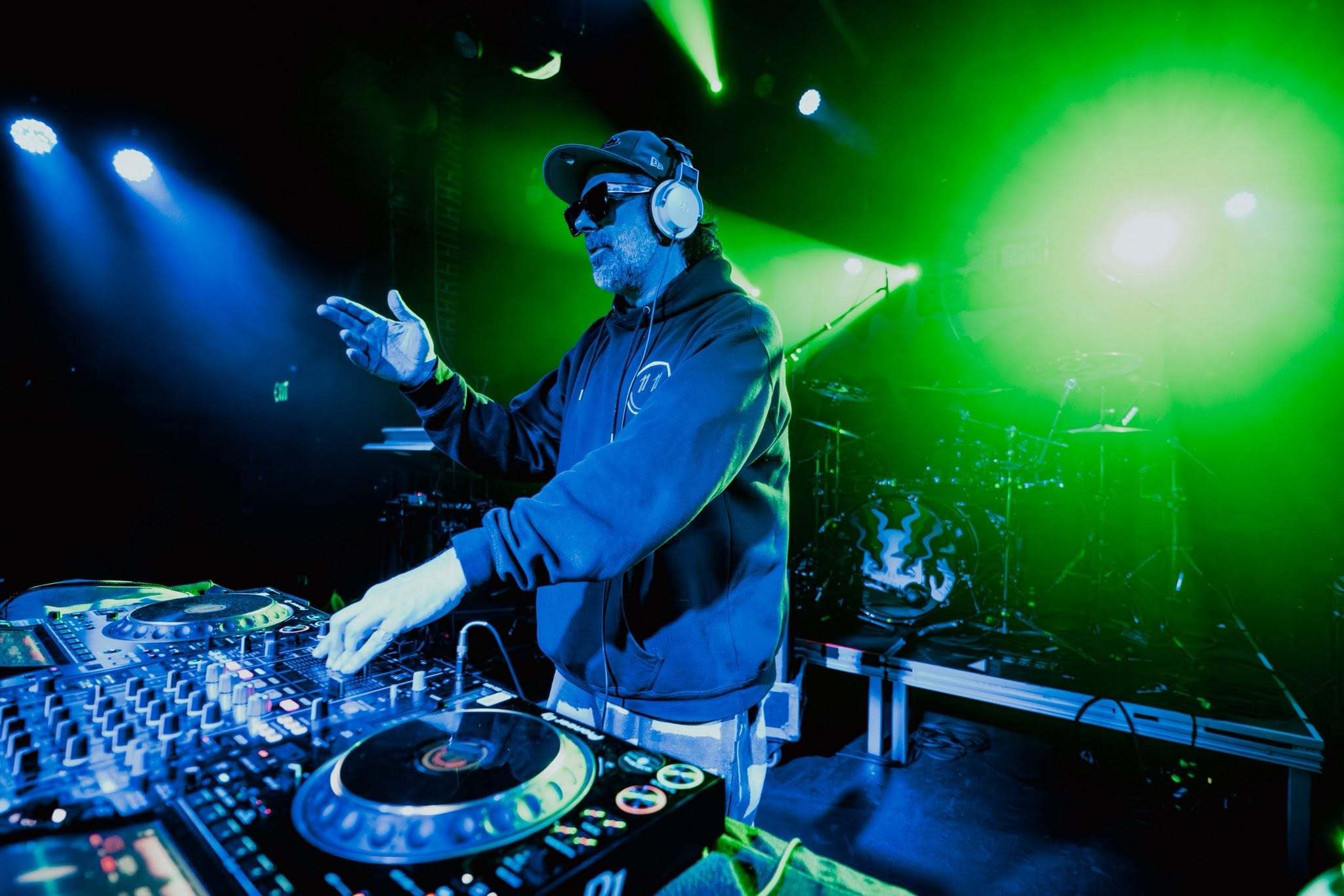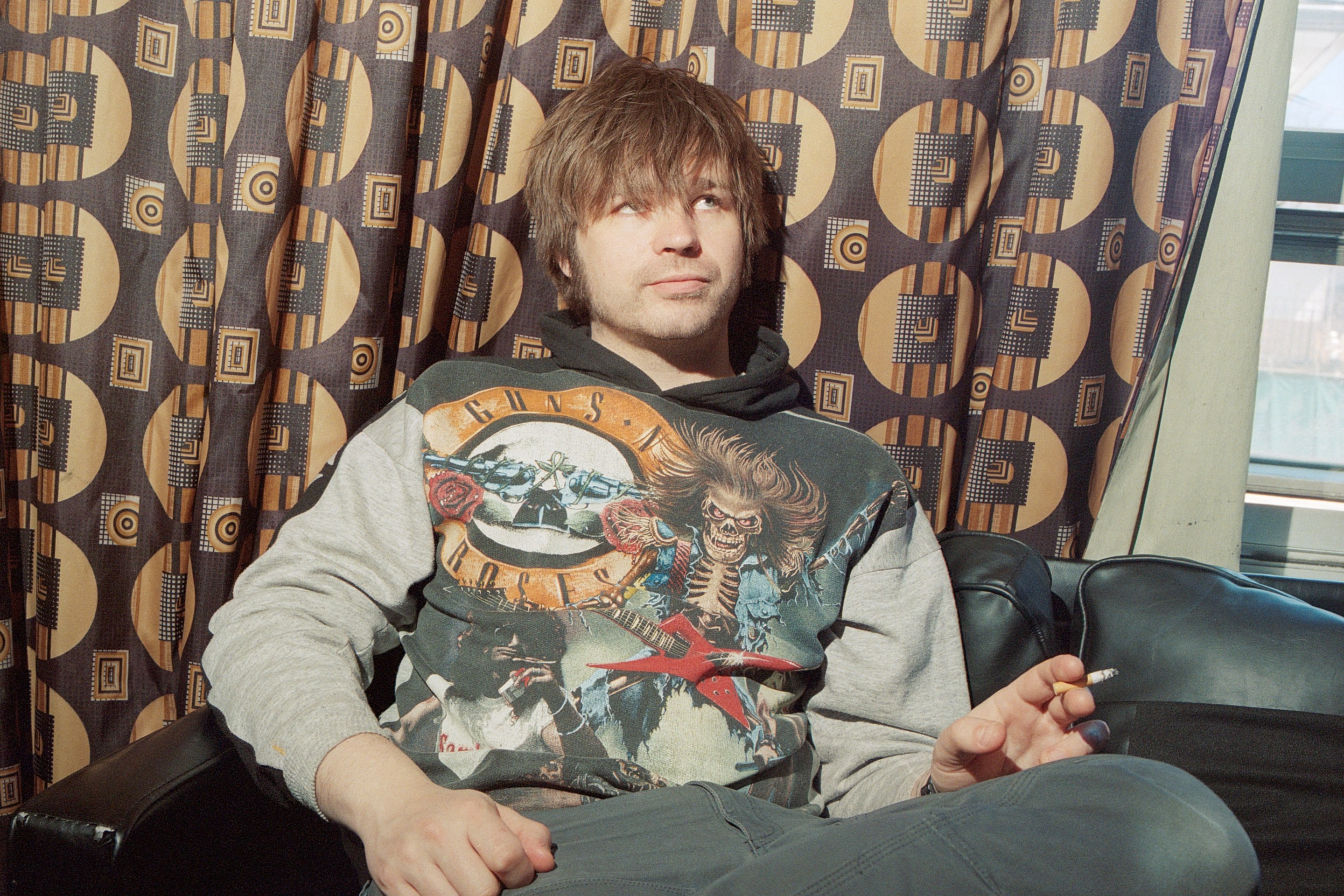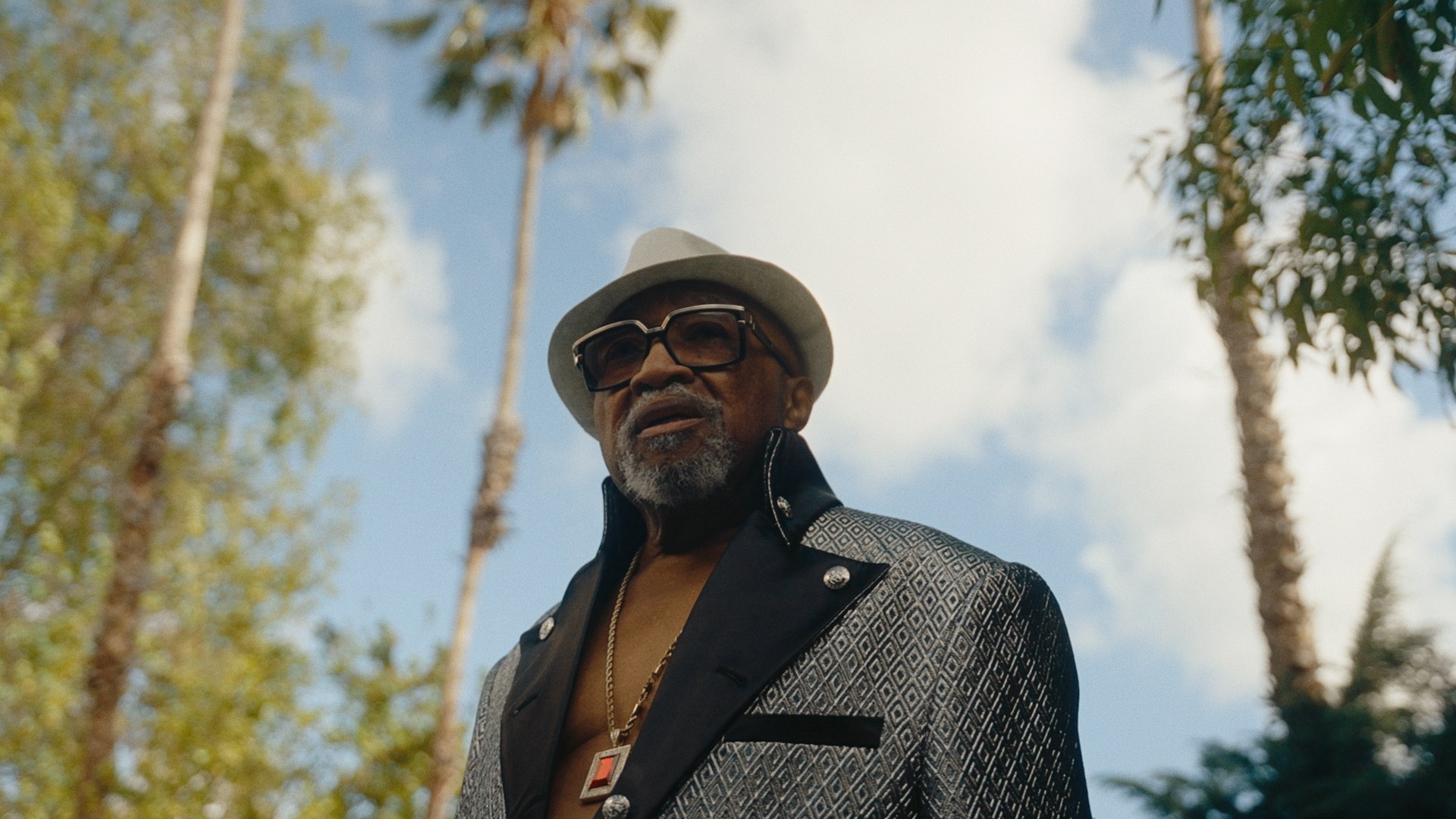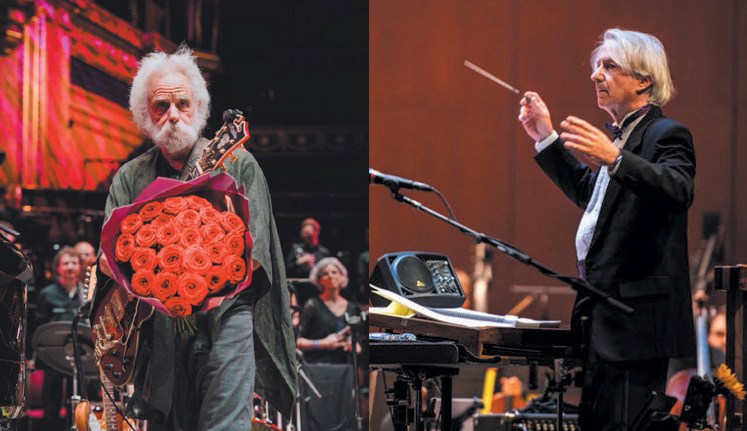
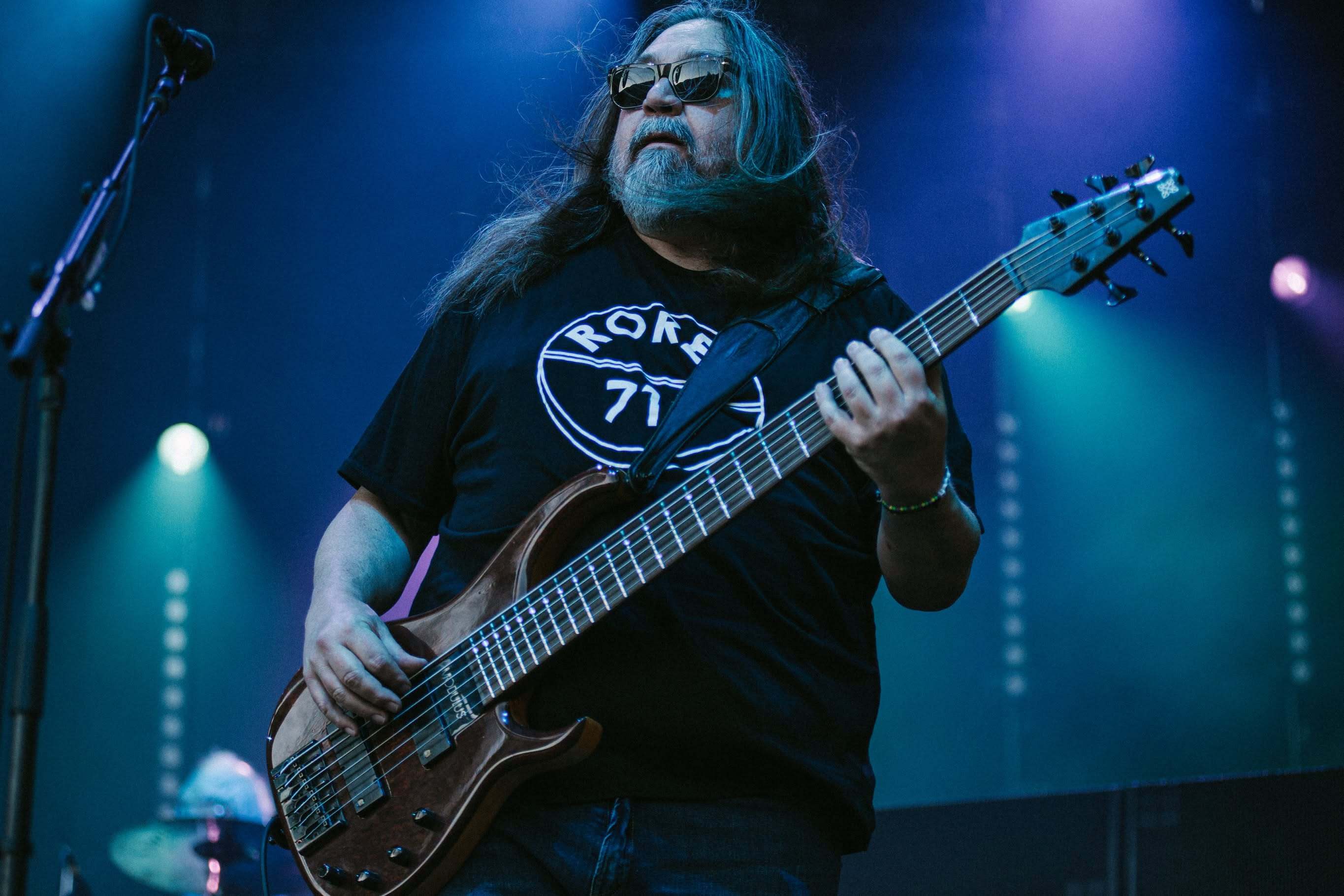
“When I think about this it scares me. I’m usually the bass player in the back or I’m running the show from the other side of the control room glass,” Dave Schools acknowledges, even as he avidly anticipates the two shows under his own his own name that will take place at New York’s Brooklyn Bowl on Thursday, November 5 and Saturday, November 6. These Dave Schools and Friends gigs will feature the bassist alongside his boon companions Steve Kimock, Tom Hamilton, Jennifer Hartswick, Alex Koford, John Morgan Kimock and Adam MacDougall.
“But how often do I get to bring all of these people together who I love and respect, so we can actually hang out? Otherwise it’ll be something quick backstage while some band is headlining and creating a bunch of noise. You can't really sit down, talk and play some music,” he remarks.


Schools will have ample opportunity for collegiality and creative expression over the next week. Prior to the Bowl dates he will perform a two-night Halloween run in New Orleans with Widespread Panic.
In the following conversation the bassist looks back on Panic’s All Hallows' Eve performances, muses on the ingenuity of his Friends, describes his production work with the band Wolph and offers some insight into his own studio endeavors.
As for the Dave Schools and Friends shows, he encourages folks to attend and participate in what he pledges will be a combustive experience. “Anyone who’s there will be as lost in the woods as we are,” he says. “So come along and find out what happens. We’re going to throw around some matches and see what burns.”
With Halloween fast approaching, I’ve been thinking about the year that you guys did the Andy Kaufman theme. [Note: In 2019 at Lakefront Arena in New Orleans, Widespread Panic’s encore began with Schools offering a nod to Kaufman’s classic performance of “I Trusted You” by domineering the stage. Then JoJo Hermann came out as Tony Clifton, the loudmouth lounge singer character created by Kaufman but occasionally portrayed by Bob Zmuda in Kaufman’s presence to demonstrate that Kaufman wasn’t Clifton. At the Panic show Clifton (Hermann) appeared for the encore, berated the audience as well as his fellow musicians before the evening ended in chaos.] Your bit was awesome and then JoJo’s Tony Clifton was just spot-on. Does he do a lot of impressions?
He does butI've never seen him go that deep in a character. We once did a zombie attack kind of Halloween. I literally defended myself the whole first set against crew members who were zombies. They finally got me at set break and dragged me off stage. Then I went right into makeup and came out chewed up and bleeding, playing the second set as a zombie. That Halloween, JoJo did a Liverace thing, which was a drunk Liberace character.
Since JoJo’s tech Paul can play, JoJo was able to dress in one costume for the majority of the show on that Andy Kaufman night, then switch into Tony Clifton, while Paul assumed the role of JoJo the piano player. So it was like Tony Clifton came out of nowhere. It was brilliant and amazing. JoJo is canny in that way. I think Bob Zmuda even got in touch with us.
Remember, it’s trick or treat and that whole thing was the trick. When we came out it looked like we were going to do a New Orleans thing. We brought out George Porter and I was dressed like someone working at Café du Monde.
Then we slowly moved into this Kaufman-esque thing and people at the show didn't know what was going on. They were like, “What just happened? Who is this guy and who is he insulting? Why are the lights on?” As we walked off stage, Mike Mills was standing there with our manager Buck, and Mike asked him, "Did I just see Widespread Panic troll an entire arena of their fans?" Buck was like, "Yeah, you did." We issued an apology immediately through our social media to continue the Kaufman-esque gag.
Then the texts started coming in from people asking, “Are you guys okay? What happened?” People had heard there was a riot and we didn't get to finish the show. JoJo was so pleased with it and we were all really happy. It's one of my favorite things we've ever done.
When it comes to Halloween, how far in advance will you begin thinking about whatever it is you're going to do?
It could start literally on Halloween the year before, where we’ll put all our thoughts into something, then at the last second we’ll ask ourselves, "What if we had done this?” Then we’ll spin that off for eight months of discussion. We're talking about Halloween all year because we love it.
The way we stumbled onto it was we were playing on October 30th in 1987. Friends of ours in this band White Buffalo threw a house party in the yard. They lived on Tibbetts Street right by the railroad in Athens.
We each set up and played. While we were jamming out and doing our usual Widespread Panic thing this punk rock kid with dreadlocks came up to us. He name was Spider— I don't know if he spelled it with an Y or an I—but he worked with this band Porn Orchard and also at the Uptown. He asked us, “Do you guys do any Sabbath?" Well of course we did. Mikey and I were huge Sabbath fans. So we started jamming on “Paranoid” and Spider sang it.
Then the next night was actual Halloween at the Uptown Lounge. We played “Paranoid” again, as well as the Black Sabbath song “Black Sabbath.” That was the beginning of the musical costume.
I'm not a big costume costume guy, but John Bell really is, JoJo really is and Duane really is. Duane goes all out with fat suits, muscle suits, things that make me ask, "How could you even play in that?" One year he dressed up like Santa Claus. He was sweating his ass off and I asked him, “What are you doing in this red fur, long-sleeve thing?" He told me, "I don't know, but I love it." He has so much fun.
So we love Halloween and we’ll approach it all sorts of ways. By the time we’re a month or so out there's usually an email thread that goes to the crew because we have to get them in on any stage dressings and production stuff.
We don't want it to be too ridiculously overblown but I like the idea of creating an environment that extends outside of the arena. In some cases it’ll go out into the parking lot or the area around the arena where people are like, "What's going on?" We like to create this environment. It's more like a fun house than a spectacle, although sometimes we're like, "Let's just play some really cool songs that nobody sees coming."
Remember it’s trick or treat. That Kaufman one is my favorite because we did a trick Halloween. [Laughs.]
After your Halloween weekend, you’re off to New York where you’ll be back in action on Thursday and Friday at Brooklyn Bowl with Dave Schools and Friends. You played a show last November with this same personnel. That one wasn’t publicly announced in advance because it was part of the Music Club series. What prompted you to give it another go in this setting?
Well, we had a lot of fun with it. All the folks—the Kimocks, Jen Hartswick, Alex, Tommy and Adam—they're close friends and have been for a long time. They're musical cohorts and there's so much love and respect. It's sort of the Magnificent Seven kind of thing. Or I'm Mr. Phelps picking out the agents I need for this impossible mission. It's like, “Oh, here's the master of disguise, here's the electrician, here’s the explosives expert…”
I didn't want it to be a pickup band because you’ll see that in so many situations. If you play gigs around Jazz Fest or Mardi Gras, there's a New Orleans songbook and you can put together a band where everybody knows how to play “Iko Iko” and all the Meters tunes and that songbook.
There's also a jamband Americana songbook. These folks are involved with Trey's band and Oteil’s band and JRAD and Phil Lesh & Friends, so they’re familiar with all that.
There's always a ton of material, but going back to last year, the question was, “How can I involve myself? I've done some projects over the years. How can I integrate some of that?” So, for instance, some Panic songs were done in a different way.
I tried to make it seem like less of a thrown-together band of hot shots. So I asked everybody what they wanted to do. That way they’d have skin in the game beyond a bunch of homework.
So Alex performed the song “Mercury.” Robert Hunter had written the lyrics for that.
Jen Hartswick was like, "I've always wanted to sing ‘Gimme Shelter.’”
Tommy Hamilton asked, "Do you think we could play ‘Echoes?’" Then Adam McDougall went ping on the piano. He's like, "Yeah, we can play ‘Echoes.’"
Of course, Kimock knows everything.
So everybody understood the assignment. It was like, "We're going to play stuff. It's not going to necessarily be stuff from those books, although we have that material available to us if we feel like it.” Could we whip out ‘Not Fade Away’ if we wanted? Absolutely. We could also knock out “West L.A. Fadeaway” or “Bird Song.”
We could do a Jimmy Cliff song and decide whether we wanted to do it the way he did it or the way the Garcia Band did it. All that’s available.
I learned a couple things from what we did in Charlotte. For instance, we should go after some Panic stuff but from another perspective. We reinterpreted “All Time Low,” which we came up with at the last minute. I think Jen was like, "This song ‘All Time Low’ is really cool." So we started playing it with a different groove and she sang it. I realized, "Wow, this new way to approach it is pretty cool. I could get behind this." So I've taken a look at some stuff and found some things that Widespread Panic never played on stage for whatever reason.
I threw one of those songs to Tommy and he was like, "Are you open to interpreting this? Because I have ideas." I was like, "Ding, ding, ding. Yes, please.”
That's the way the Hard Working Americans material worked. It's the way Widespread Panic has approached cover songs. It's the same way Led Zeppelin would appropriate songs, deconstruct them and then rebuild them, which I think is really cool.
With the Hard Working Americans, [Todd] Snider said to us, "Here are some songwriters I think are great. Let's do this Kevn Kinney song “Straight to Hell." I was like, "Okay, but let's change the key and put it in a gospel vibe instead of this two beat country sing-along." That worked because it was a great song.
So that's something I can get behind and I think everybody's into it because it asks for more creativity and we all just want to create.
Alex Koford asked me, "Hey, I've been playing this baritone guitar and I've got this unusual take on this song. What do you think?" I’m not going to tell you the song but my reaction was: “Sounds great. Let's try it. What do we have to lose?"
In addition to playing with him, you’ve produced Alex’s music as well. How did you first cross paths?
It was at Terrapin. He grew up with Grahame. Then when Phil started Phil Lesh University—PLU, as Jimmy Herring would call it—there was a whole generation of kids interested in music who were Brian and Grahame Lesh's age. Phil gave them tutelage at Terrapin where they had a place to learn to play together and jam. Alex was one of them. Phil encouraged it, God bless him. I mean, he really tied some stuff together. There was a new scene happening around it that reinvigorated the North Bay.
It was really cool and I miss it now that Terrapin Crossroads has gone out of business. That’s how I met Alex. It was just some pickup gig kind of thing. I can't remember if Chris Robinson put it together or it might have been one of Scott Law and Ross James Cosmic Twang things.
I came up to do it and Jay Lane or somebody was playing drums. Alex showed up to play percussion and sing. I immediately thought, "This guy's great."
We just became friends. I see a lot of myself in him. I'm very drawn to his sensibility. He's just got this brilliant melancholy thing that translates in his music and he worshipped Neal Casal. He's also the only person other than Neal I've worked with who can literally come in and sing all the background harmony parts—stacked three-part harmony against himself—and do a whole record's worth in three hours.
He's very talented. He's a great drummer. He's a great guitar player. Half the time, I don't even want to play bass on some of his songs because I’m like, “Dude, you just do it yourself. You can provide what you hear in your head.” If I’m playing too much like Dave Schools, I can hand over the bass and we’ll knock it out in one take. We can move on and get an extra song on the record.
So Alex is great and they’re all that way. When I produced that Satellite City record for Steve, I had played some with Johnny and I knew that he had worked with Duane and had been around. Then I saw the potential just by talking about what kind of music he liked and the way he responded to production instruction in the studio. Johnny stood behind what he believed. He wasn't cowed by the fact that I was producing and he wasn't really cowed by the fact that his old man was the namesake of the band because Steve was like, "We call it Kimock, but Johnny's a Kimock."
He has a great sense of exploration and he's not scared of danger. In fact, he's very attracted to danger and out of the box production. I'm just like, "Dude, you're going to be an amazing producer."
So when I'm talking to him, I'm like, "Bring some of the Johnny stuff to this project." He's like, "Can I bring my laptop? Are you into that?" I'm like, "Absolutely."
I want everybody's input. I want it to be fun but I also want to take a chance. I think we’re all willing to fail doing something unexpected that interests us.
When did you first meet Steve Kimock? Was it through a Widespread Panic/Zero bill back in the day?
No, I don't even know if there was a Panic/Zero bill.
Jerry Joseph was close with Steve but the first time I really got to see and hear him was when I was playing with Gov’t Mule after Allen Woody died. There was a couple of shows where Steve had a trio. I think it was Rodney Holmes playing drums and Alphonso Johnson playing bass.
They opened a couple gigs for the New School of Mule. Then he moved back to Sebastopol and we both started showing up at TRI where we were part of the house band for the Weir Here TV show. Bobby would grab Jay and he'd grab me and Jason Crosby and sometimes Jeff Chimenti and Steve, and we would back the house band if there was a musical guest. Or we’d be there if there was no musical guest and Bobby just wanted to play a couple songs with this band.
Steve and I started talking and then we began doing these Voodoo Dead things. It was like a quartet—me, Billy Kreutzmann, Jeff Chimenti and Steve. We were applying voodoo and New Orleans to Grateful Dead music. It's like, "Wow, Steve is a master. He’s a guitar monk.” Isn't that what Selvin called him in that book [Fare Thee Well], the guitar monk?
Steve is so advanced musically and such a student of music from across the ages—from Gregorian chant to some of the most obscure classical guitarists and plain-song, traditional vocal music from Appalachia. He takes it all in and he's so knowledgeable that I'm like, "What do you see in playing with a blockhead like me? I drop bricks all the time." Then I realized he's so used to people who know as much of the rule book as he does that someone playing what could be considered a mistake is an inspiration that spins him into a different place musically. So it intrigues him.
In that spirit, we have found a lot in common. I've learned so much from playing with him or just talking to him. It's incredible and that all comes into this thing we're doing. When I say, "Steve, what would excite you to play? Sure, you can play the guitar part on this Circles Around the Sun song that I want to do because I like it and it gives Adam a showcase, but what would you like to do?" Then he'll tell me and we'll do it. It just makes us happy.
With Steve, it got to the point where I'd bring my mom to California for Christmas and Steve and Jen and their kids would come over. We'd cook and hang out. Steve and Miles would sit and play acoustic guitars. That was the music for the day. We weren't listening to Christmas music on the stereo or anything. These guys were sitting around playing, hanging out, cooking food and it was great. It's family. To me, that's really important.
I do anything that I can do for Steve. I'll try to do something I can't do with Steve because I'm going to learn something and he's going to be patient and put up with it because he gets something from that. Maybe he's just laughing at me and that pleases him, but I'm there for it.
Jumping back to what you said about Phil Lesh University, Phil’s goal beyond educating musicians, was to pass along a certain repertoire and an ethos to audiences. Do you feel an affirmative duty to present a particular musical idea or approach to listeners who might not otherwise have been exposed to it?
It pleases me to create sounds with other people that evoke in the listener the feeling that sound had on me. With me, it was like a physical thing that was tied to an emotional thing. When I was a kid and I heard music there was a feeling associated with the air moving through the speakers or playing a low note on the piano with my head pressed up against the box feeling the vibration.
So I think I have a duty to myself and to the potential person out there who could be struck similarly where something hits them in a vibratory physical way that evokes an emotional sense.
I think that can be accomplished through improvisation in a lot of ways because you're not creating a formula derived from certain expected elements.
The idea of people taking chances and being open to things beyond the knowledge we have academically is what I took from Phil. He was very adamant about this when we talked about it—to be open, to listen and to respond in the moment. To drop the patterns.
The only time you ever heard Phil repeat something was if it came to him that repetition was the thing required in that moment.
I think it creates this sort of intoxicating brew. If it can be created without too much thought other than being open and having all of your training lead up to that moment, then something is created that lands with someone out there.
I know how the moments that made me want to be a musician went down in real time. My mom was the dance critic for the Richmond newspaper, so she would drag me to a performance, whether it was some weird-ass modern dance or Alvin Ailey. The dance was amazing but I was exposed to so much music. This performance art troupe called Mummenschanz came over and they were performing to this crazy experimental electronic music. I saw all kinds of stuff like that and it really struck me.
At that point I started going to rock shows. I saw Cheap Trick at the Hampton Coliseum. They were touring on that live At Budokan record when they blew up and it was like, "This is amazing. Look at these guys."
Then, heaven help me, I was at the Grateful Dead show at the Hampton Coliseum in 1981. There was a moment in “Let It Grow” when the band was locked in and no one was trying, but everybody felt it. It's that X factor you can't write into the show. You can't plan for it. You can only allow it to happen. You can only put yourself in a place of being available for that spirit to work through you.
It turned my head around because up until then I was like, “These guys have lasers” or with Cheap Trick, Rick Nielsen was throwing a guitar across the stage at the same time his roadie was throwing a guitar at him. The guitars crossed in midair, then they both caught them, which was pretty cool. But being 16 years old and seeing what happened with the Grateful Dead was something else. It was life changing. Life affirming.
I can remember growing up in New England and not quite connecting with bluegrass because my lone exposure was Hee Haw where I was often distracted by the humor, which I didn’t always enjoy. Then in my late teens I finally came to appreciate the music by hearing some of my favorite artists draw on that repertoire. In a somewhat similar way, perhaps akin to what you said about Todd Snider shining a light on certain songwriters, will some of those considerations weigh into your decision-making process when it comes to selecting songs for the Friends band?
It would never be about exposing people to something. It would be more about having a chance to celebrate an artist that really struck a chord with me. If it makes me feel good, then I want to play that song. Then it might turn over some rocks for other people.
I mean, gatekeeping works both ways. You can let stuff out through your gate and be sort of a curator because there's a whole lot of choice out there. There's a forest of amazing music created over the last several hundred years. If you have the streaming service or the knowhow, you can access all of it. But how could you even begin such a task? So mentors and gatekeepers have always been important.
But then there's also me as a teenager buying Europe ’72 and looking at this song “Morning Dew.” Then I wanted to know, “Who's Bonnie Dobson? Who's Tim Rose?”
I can recall arguing with certain Deadheads: “No, they did not write ‘Not Fade Away.’ I'm sorry, that was Buddy Holly.” They were like, “Oh man, but they put it on a record. That means they wrote it. They played it tonight.”
I mean, yeah, they're making it their own and they're rewriting it every night, but in a way they’re just playing music that they love and they're sort of paying it forward.
There's a reason ”Morning Dew” was played every year that band was in existence and beyond. In fact, it was the last song I ever heard Jerry Garcia sing live. That was at the Sam Boyd Silver Bowl in Las Vegas during the spring of ’95.
At that time it was fairly obvious to me that they were reaching the end of their rope and I was like, “Well, if that's the last song I ever hear him sing, then that's good with me.” He put something into it every time he sang it and there's a reason. That's the example I use because it struck me as a teenager. They didn't write this song, but they owned it and it meant something to me and it made me want to look deeper. I think that's a gift.
That's what I'd like to impart as discovery for someone. It serves me because I enjoy the song so much that I want to play it. That's what I get out of it. Then maybe someone else gets something completely different out of it, but it leads to happiness and exploration or even just experiencing an emotion.
It's like you were saying about the bluegrass stuff. You said Hee Haw, which is funny because I loved Dolly Parton. It wasn't necessarily my kind of music, but it was ubiquitous and we were exposed to it. My dad loved Dolly. Bill Schools loved Dolly. He loved country music and we watched Hee Haw together. This was in a sort of a toxic, weird household where mom and dad were already headed towards divorce. I was a little kid who could sort of feel that.
Bill Schools was gone most of the time, but when he would come home on the weekend, there were two things we watched together where it was peaceful. I felt safe and it was fun. One was Mission: Impossible and the other was Hee Haw. Dolly was always on Hee Haw, but so was Roy Clark and Chet Atkins and these badass pickers and these amazing songwriters and there was comedy and I was like, “This is kind of cool.”
When Dolly died, I had met her, I knew what she stood for. She was an amazing talent, a force of nature. But after she passed away, I was putting a playlist together for myself and I could not stop crying every time I heard her sing. I was like, "What's going on?" because I'm sort of old and cynical and an emotional chunk of coal. But I was bawling and laughing at the same time. It was the weirdest outpouring and it finally dawned on me: "Oh shit, I am mourning a sense of comfort and safety that I had at the feet of my father when I was five or six years old, watching her on Hee Haw and feeling like everything was okay in the world." That's an emotional connection music can give anyone.
It doesn't have to evoke that feeling. That's my personal experience. For someone else it might evoke a sense of a time when they felt free and easy and everything was fun or even something negative, but it's a feeling.
In this forest of instant dopamine gratification, what's going to make someone stop and think and feel and maybe get curious about something and want to dive deeper?
Billy Strings is delivering opportunities in all kinds of ways because he loves so much music and it's obvious that he loves so much music. He brings it all in.
There are very few people I have met who are that talented and charismatic and natural and have such an appreciation for so many types of music. I think people like Dolly Parton had that. Great songwriters have that. They filter what they see and what they experience and put it in something that can be taken in by someone else and have meaning.
Then, if there are people like Todd Snider who see a feeling or see the value in the craft of the songwriting, it's heavy duty. It's distillation and it's emotional. Sometimes people take away parts of themselves in order to build them into a song and you can see the toll that it takes on them. So appreciate it, interpret it and pass it on. Allow someone else to experience it.
Todd had the idea of doing that Gil Scott-Heron tune (“Work For Peace (The Military & The Monetary)") which really wasn't a tune, it was more poetry set to music. Some people were like, "This doesn't make sense. This isn't a country song. This isn't an Americana song. This isn't a Will Kimbrough song." But that doesn't matter. Todd felt it, so we helped him get it out and it landed. It's like “the military and the monetary, are you kidding?” When I hear that now I'm like, "How prophetic. Why does this continue to be prophetic?” But here we are.
You mentioned “Morning Dew.” One thing I’d do as a Deadhead that would run counter to the spirit of the band is if they hadn’t played the “Dew” for a few nights, I would actively root for it to be the Jerry ballad out of “Drums” and “Space.” I was otherwise pretty good at staying in the moment but with that one I could get caught up in my own head. Of course, when they hit it just right, juxtaposed with whatever came before, that was something else.
It really was, and that speaks to the emotional connection the song had with Garcia and the band. Jerry Joseph always talks about delivering a song but he uses the word sell, like, "I’ve got to sell these lyrics.” JB is the same way, but he would never use the word sell. He would be like, "Can I get behind these words?" Neal Casal would listen to something he did in the studio and go, "Okay, I believe that guy." These concepts are like having skin in the game. It isn't just performing a piece of music. It's trying to push however you feel when you recorded it or are performing it into those who are listening.
That's why you would be like, "I'm rooting for ‘Morning Dew.’" You might not think about the fact that it has some super significant meaning to Garcia and the artists performing it or else they wouldn't put that much spirit into it. Then that's what translates. That's the thing.
At least for bands like us, it's a performance and there's a lot of production value behind it that’s designed to enhance it all and make it a big experience. But at the core, it's a bunch of guys or a person playing music that means something to them, whether they wrote it or they're interpreting it.
All the other stuff is supposed to enhance that and get the quality across. If there's an emotional impact that happens when the performer conceives of something and it can translate out of the speakers and into the ears of the listener in a way that is equally viable emotionally, then that’s success.
You produced the debut album from Wolph, which came out a couple weeks ago. How did that relationship develop?
I was back in Virginia a few years ago dealing with my mother's estate and I've never lost touch with these friends from my high school band. They still play gigs, and I went to see my bass-playing friend Tom Crosby and my old guitar player John Leedes play with their band Kooler Heads. Then at set break and I see this older guy with an amp on a dolly weaving through the crowd over to the side of stage.
When the Kooler Heads come back on for the second set there's this 14 or 15 year old kid with glasses on stage wearing a brand new Santana Tour t-shirt. I know Santana had just been through town so the kid went to the show and bought it. They’re all up there and my old guitar player, who's a badass, tossed the solo to this kid. I was like," Wow, okay.” He could play. After the show, he came up to me and was like, "You're in Widespread Panic, aren't you?" His name was Dylan and we talked for a bit.
So a year goes by and he's got this band Wolph, with his friend Josh and my friend Tom Crosby is playing bass for them.
I went to see them and they played “Tackle Box Hero,” a Widespread Panic song we had just released as a single. I don't think we’d played it live yet. They played that and then they played “Terrapin.”
I was like, "These kids are 16 years old and they do not care." I mean that in the best way possible. After the show, they were all around me and I was like, "You guys don't give a fuck, do you?" They were like, "What do you mean?" I said, "You just want to play the music. I heard mistakes. Nobody was throwing looks on stage. You don't give a fuck." They were like, "Oh yeah, I guess we don't." So I asked them, "Are you writing original music?" They said, "Here and there." Then I told them, "Well, when you write some original music that you want me to hear, let me hear it."
Then another year went by and they're like 17 or 18, at which point I started hearing some original music come out of them. So I asked them, "Okay, do you want me to produce a song for you?" They came for the meeting to talk about that straight from their high school graduation. They skipped out of the parties after the graduation to drive up to Richmond from Toano, this town where they lived between Richmond and Williamsburg.
Then the next thing you know, we're at Spacebomb in Richmond with Alex DeYoung engineering and we're recording. I think the first song we recorded was “Cold Rain Coal Train.” I was like, "Holy shit!"
The young thing can only last for so long. Hanson's going to grow up. It's something to talk about, though. These kids are in high school and they're writing original music and they're traveling around and playing it. They’ve also gotten to the point where they've taken chances and jammed in the studio and learned some techniques and what you can and can't do.
I've just been helping them and I’ve been amazed watching them learn and try things. It reminds me so much of Widespread Panic, but they're starting younger. They're learning how maybe the hang is more important than getting it right or letting the feeling translate to the tape rather than something that shows what a badass you are as a musician. They’re allowing mistakes to become part of the personality and also learning from those mistakes. They just played Garcia's in Chicago and I was like, “Wow, they're going for it.”
They're great. The record is available on streaming and they took chances on that record. I guided them when they wanted guidance, but mostly I was there as a cheerleader. I would ask Dylan, “What story are you trying to tell with this guitar solo? Think about it because you're telling a story.” So I just offer up my experience, the things that I learned the hard way. I put those out there and they can choose to take them in or ignore them, just like any band.
Finally, do you have something in the works of your own that you’ve been doing in the studio? Maybe with the folks who are playing with you at the Bowl?
I already have something done and it's going to be coming out at some point in the next few months. It's a project called Bass Mountain—BassMtn all jammed together like one word. It's from years of sessions, jams, improvs in the studio with a lot of these people. MacDougall and Johnny Kimock and Alex have been parts of it. So has Jason Crosby and Sikiru Adepoju and Mikaela Davis. They're all part of this cinematic sonic quilt.
It’s sort of the same idea as the Slang records I did around the turn of the millennium with Layng Martine, but it’s less in the electronica vibe. It’s more like “We're going to jam and we're going to find the feeling and we're going to sit on a jam and I'm going to think about it for a while. Then I'm going to edit it and do some other stuff.”
I might pass it around and have somebody overdub a part on it, but I won't allow them to hear it and come in with a part. I want to hear the right side of their brain improvising when they don't know what's coming and then I'll edit that.
So it's called BassMtn. It's instrumental and hopefully people like it. I like it and I had fun making it. So there it is.
Are we going to perform some of that stuff? I don't know that it can be performed but we can take a vibe and a spirit and use the tools that people like John Kimock and Adam MacDougall and Jennifer Hartswick have at hand when it comes to improvising.
That is part of the book that we all really understand, where we can walk out on stage and say, “Okay, somebody start playing something. Let's jump on and see where it goes.” That's always a possibility.
These are first gigs I ever really put my name on. I've toured around the world with J Mascis and Warren Haynes and Jerry Joseph and Todd Snider and Mickey Hart. But this has my name on it. Even with the record, I'm hiding behind a band, but it says Dave Schools Presents BassMtn. So here we go…