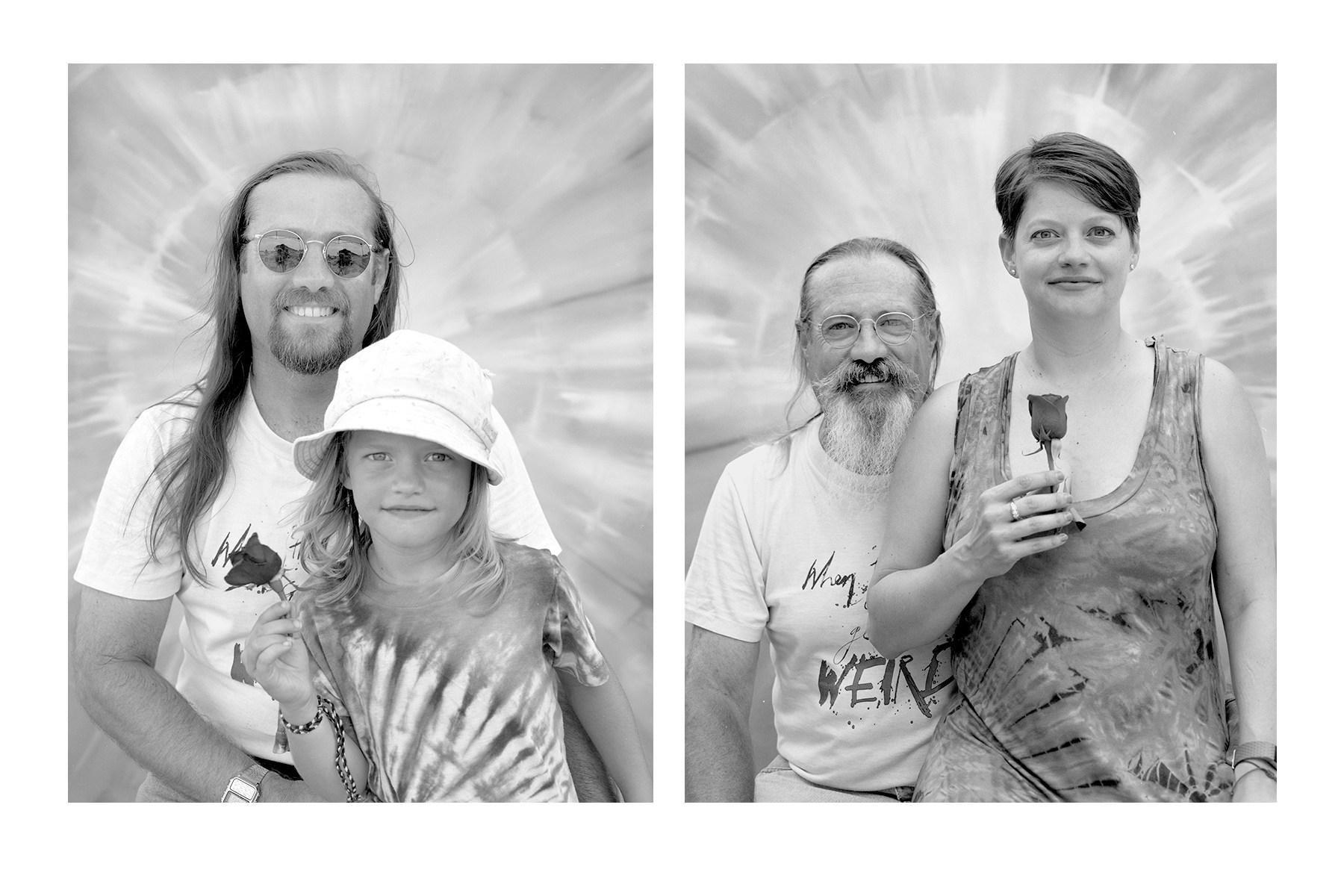
During the summer of 1988 Bill Lemke first brought his large format camera to the parking lot of a Grateful Dead show at Alpine Valley Music Center in East Troy, WI. There he began taking portraits of Deadheads, who were seated in front of a tie-dye canvas backdrop. He continued to do this over the three years to follow, while attending performances in Wisconsin, Illinois and Indiana.
The resulting images are expressive and absorbing.
“My earliest thoughts were that I’d like to have an exhibition of the work, mainly just to have people see this culture,” Lemke recalls.
Relix ran a selection of images a year after he started this endeavor, in a piece titled “Jerry’s Kids: Portraits of Deadheads in America.”
Lemke also exhibited the images at the Wustum Art Museum in Racine, WI. The photographer remembers, “It was a fun event. I had incense burning and Grateful Dead music playing. They printed up a nice little brochure with images in it and we had a good turnout.”
The project later took on additional depth and resonance after one of the original subjects reached out to him. “I received a call in 2015 from a guy named Jeffrey, who I had photographed with his daughter, Hannah,” Lemke explains. “I had previously sent prints to the people I had photographed. He called me and said, ‘My daughter's grown up now. She's living in Chicago. She would really like a print.’ I told him that wouldn’t be a problem, and then he said, ‘You're not far from Chicago. What if I met you there and maybe you could re-photograph us.’
“I thought that sounded cool, so my wife and I drove down, then spent the whole afternoon with Jeffrey, his wife, his daughter and son-in-law. The whole experience was really wonderful. That’s where the idea came from to try to find these people and hopefully photograph them again.”
The challenge was that Lemke’s contact info was decades old. However, his wife Carmen quickly took to the challenge. “She started posting things on all these Grateful Dead sites, Facebook sites, hoping somebody would recognize someone, possibly even themselves,” he notes. “Then she would follow up whatever leads she discovered. We ended up re-photographing just over 40 people.”
The corresponding paired images appear in his marvelous art book Aging Gratefully: Deadheads There and Now (which is now available through Lemke’s website). Beyond the photos, renowned journalist David Gans interviewed the participants who offer personal accounts of their initial connection to the Grateful Dead, memories of their earlier sessions with Lemke and reflections on where life had carried them over the intervening years.
In his foreword to Aging Gratefully, McNally, the band’s longtime publicist and biographer observes, “One thing you see when you look at these pairs of pictures separated by decades—perhaps a little less hair in some cases, and sometimes even longer dreads!—is that the smiles don’t vary. Clearly, these people are happy to represent Deadheads. Because it’s a family, among other things. Individuals pass, and we have lost so many, but families continue. And this family remains grateful no matter what the age of the person.”
Gans offers, “In September of 2024 I got an email from Carmen Rivers, describing her husband’s photo project and inviting me to help with a book. She sent a few pairs of images—Deadheads photographed in the ‘80s and then again in the ’10s and ’20s—and I found the concept irresistible. I spent several months interviewing people who were in the photos, including a couple of people who were kids in the original images and pretty much grew up in that scene.
“It was a delightful experience in every way! So many of the people in these photos were inspired by the Dead to do creative work of their own, and everybody had warm memories of their Deadhead experiences to share. There’s one couple who were designing, producing and selling shirts on the lot back then, and they're still in the same business today: doing merch for a Dead cover band in their hometown!
“Dennis McNally helped Bill to get permission to set up his studio on the lot back in the day, so he was a perfect choice to write a foreword. Dr Rebecca Adams was on the road studying Deadheads at the same time Bill was making his portraits at Alpine; she contributed an excellent introduction. Collaborating with the Lemkes was an entirely pleasant experience, and I could not be more proud of the book.”
This is an apt sentiment for such a poignant yet playful work.
Aging Gratefully offers insight on the potency of music, the passage of time and the power of community.
**
Before we talk about the Grateful Dead, let’s start with your photography. When did you begin and what led to the large style format that you use?
Bill Lemke: When I was in high school, my plan was to be an auto mechanic. Then, during my senior year, I took a class in graphic arts and part of that was photography. As soon as I picked up a camera, I knew that's what I wanted to do to make a living. I thought, “There's got to be a way I can do this and maybe have some clients that'll pay for me to travel around the world.” It turned out that’s what happened. It worked out well.
I attended Milwaukee Area Technical College and I also did some workshops with Ansel Adams. Then I worked for a commercial studio for a little while before I went out on my own and did freelance work. I have a client who would send me to Korea, Singapore, Thailand, down to South America to photograph buildings for them. So it all came to happen.
I started with 35mm and I liked it but I wanted to make bigger prints with more detail. Ansel Adams’ work made me want to use a bigger camera, something that would give me a large negative with incredible detail and beautiful middle tones. Early on, there was a camera store going out of business and I saw this 4” by 5” view camera that they had severely discounted and I thought, "Well, this is my chance. I think I'll get one and learn how to use it." That was the start of it.
After doing that, it was really hard to go back to a smaller format because I'm so used to this incredible detail and those beautiful gray tones. That's what I really seek out when I make prints.
What were some of the major challenges you faced when moving to that format?
BL: Well, you have to work slow. With landscape photography, it's often easy to do that, but then if the light is changing, you need to pick up the pace. So you’ve got to be very proficient at what you do.
There's something about working with that camera. It's a beautiful instrument to start with and I enjoy being meticulous about how I crop an image on the ground glass. There can be a little bit of a problem at first because when you look at the ground glass, the image is backwards and upside down. So you're working with composing and creating this composition with an image that appears that way, but eventually you get used to it. I also often see things in black and white when I view them. I see a colorful world, but I'm always looking at tonalities and how this will translate into black and white.
How heavy is the camera?
BL: I have a backpack in which I carry the 4” by 5” camera and some lenses and stuff. It probably weighs upwards of 25 pounds. I've carried it all over Europe and into Asia. When I was doing all of these architectural shots in other countries, that's the camera I worked with because it's designed to handle architecture. You can keep all the lines vertical on a building. You don't have to worry about it looking smaller at the top.
I also have an 8” x 10” camera which is probably 50 pounds in its case. So that one doesn't get real far from my vehicle.
Let’s talk about your connection to the music of the Grateful Dead. When did that begin?
BL: I hung around with people in high school that were either into cars or they were into music. As the years went on, I really gravitated more to music people. My best friend was a bass player in a really good band and I liked hanging out with people like that. A lot of my friends weren't that familiar with the Grateful Dead because the band didn't have big hits. They knew the Rolling Stones, they knew the Beatles, but the Grateful Dead was a little different for them. I played around with the guitar a little bit back then and I really liked that music. So I was kind of isolated, but when I went to see the Dead, all of a sudden it was like, “This is my tribe here.”
My first show was Alpine Valley in Wisconsin 1980. I knew the music before that, but when I walked the parking lot and then went inside, I was like, “Man, these people are so wonderful and welcoming.” I was getting hugs from people and it was just so much fun.
I ended up seeing over 100 shows with Jerry Garcia. I’d go to Alpine Valley every time they played and stayed for the weekend. I’d also head down to Chicago or to Deer Creek. However, I had a commercial business that I started as a freelance photographer, so I couldn’t just take off and go on tour for months on end.
What led you to start this photography project?
BL: For a while I thought, “I need to document this culture somehow.” It took me a few years before I came up with the way I wanted to approach it.
I hadn't been a photographer of people up until that point. What finally led me in that direction was I went to the art museum in Madison and there was a Richard Avedon exhibition. He did these photographs in the West of coal miners and people working in slaughter houses. What he did was he put up this plain white background and photographed everybody in front of that background with a large view camera, which is what I work with too.
I was so inspired by seeing those photographs that I was like, “Okay, I want to do something similar.” I didn't want to copy that, so I needed a background that would work with what I was doing. I went to a friend and said, “I’ve got this 8’ by 10’ canvas. Can you paint it to look like a tie-dye t-shirt?” Then I would go to the parking lot and set up my little portable studio with this canvas backdrop and ask people to sit so I could photograph them.
I would go to these shows with my friend, Tom Fritz, who also has some photographs in the book. He did the scenes in the parking lot. We'd go together and just hang out for the weekend. I would set up my little portable studio, and as people were walking back and forth checking things out, I would say, “Hey, do you mind sitting down and allowing me to photograph you?" Most everybody was receptive to it. There were a few who would just say, "No, I don't think so. I don't know if I trust you."
I can imagine some people thinking you were a narc.
BL: That's absolutely true. In 2015 at Chicago during Fare Thee Well there was a woman named Kris who did an event at a warehouse. She's in the book with Panda and Natasha.
She had a simulcast with the concert followed by an after-party, and she asked me if I'd bring some prints down and hang them. I had been in contact about re-photographing her, which I did at that event.
At the after-party, people would walk through and say, "I remember you from the parking lot. I thought you were a narc, and you were just trying to get a picture of me and arrest me." [Laughs.] That would have required going through a lot of trouble with an old camera to try and catch somebody.
Although you didn’t begin your photography project until 1988, you’d been out there in the lots for a while prior to that point. What are your memories of how things changed in ’87 with In The Dark and MTV’s Day of the Dead?
BL: It tended to go a little bit more commercial. It never got really crazy, but there would be more t-shirt vendors and stuff. For a while, they were trying to really crack down on people selling t-shirts in the parking lot.
You still had people selling burritos, or beer for a dollar. I don't think anyone bothered them very much. They were just trying to make some money to get to the next show and they were offering a good service as far as I was concerned.
At a certain point, I got to meet Dennis McNally and I talked to him about the fact that I was doing these portraits. They would have security people coming out and telling people to put their t-shirts away but they never bothered me. Dennis told them, “Leave him alone. He's just doing his thing. He's not selling anything. He's just documenting.” So he was really instrumental in this whole project as well, and he has a bit in the book where he agreed to write something for us.
As you think back on the process of circling back around and photographing people once again is there a moment or a conversation that comes to mind?
BL: We had to go to Thailand to photograph Jody, but I'm never going to turn down a chance to take a trip somewhere if I have a good reason to do it. So we went to Thailand and Cambodia, and we hung out with Jody for a few days in Bangkok, which was so much fun.
There was also this guy who was a hog farmer living in Northern Wisconsin. By the time we tracked him down, he had passed away, but his wife agreed to be interviewed. She told us about how he was in hospice care for 48 hours, and he requested Grateful Dead music to play the entire 48 hours until he passed. It was very sad that he passed but I thought his request was wonderful. His wife sent us a more current picture of him for the book, which was really great.
In terms of the paired images is there one that you particularly enjoy for some reason or another?
BL: I think Glenn and Jerusha. Glenn passed away about two years ago but I had been out to see him several times. I only photographed him once but I would go back and visit him. He’d call me every summer and say, "Bill, why don't you come out with me and we'll go to Burning Man?" I always had art festivals I was doing, so I never was able to go.
The look on his daughter's face in the first image and then the second image, it's definitely the same person, even though she’s so young in the first one. You see it in the eyes, the expression, everything. I love that image. I actually submitted it to an exhibition in Washington DC at the National Portrait Gallery, and it got accepted as a diptych. Both Glenn and Jerusha came down for the opening of that show. Glenn wore the same jumpsuit that he had in both the photographs, and he got far more attention than my photographs. [Laughs.]
I could also step back and see the pictures of him and Jerusha, then look down the hall and there was the portrait of Barack Obama. It was pretty special.
Dhaivyd, the guy on the cover, is a real character too. When I was accumulating all these photographs and decided to do a book, there was no question in my mind who was going to be on the cover. He's got an aura about him that really says a lot about the culture and about Deadheads. I think it makes a great cover. He's also a great guy, although I can't say any of them are not great people because it was fun speaking with everyone I photographed.
At what point in the process did you begin to fathom that this could be a book?
BL: It was pretty soon after Jeffrey contacted me. What's kind of funny is a couple years before that, I got involved with doing some work with the US Geological Survey. This was a project in the Grand Canyon, which I just did again a few weeks back, rephotographing the Stanton Expedition and the Powell Expedition. I would have to find the exact locations then rephotograph them to show vegetation changes. So it was like, “Oh, here's a before and after project I'm doing for the government and it really does tie into what I'm doing with the Grateful Dead.” So that was pretty interesting.
David Gans is also a photographer. Did the two of you have conversations about the medium?
BL: When we started getting together, we did talk about photography. He was familiar with 4” x 5” but had never really used it. So we spoke about the process.
I definitely like what he's done with his photographs as well. We connected on that level as well as the music level. This project brings them together for both of us, which has been fun.
In conjunction with the book release you’ve been involved with some live events. What memorable feedback have you received?
BL: It's been so much fun to hear people’s comments when they look through the book. A number of them have told me that they already have it and they’ll let me know what it means to them. It's been so rewarding to hear that.
Paula, who’s in the book with Pamela, has said how meaningful it is to have a picture from back in that time period because she doesn't have many others. There are so many things that really get to your heart when you start talking to these people.
It's also interesting hearing the stories of what the people I photographed have done with their lives. I think of Michael who has made a career out of therapeutic drumming. He had this concept of something he really enjoyed doing and then to be able to share that with other people and make a living at it is pretty magical.
Something else I’ve seen is the kindness and welcoming feeling from all these people. We have this community and no matter where you go in the country, it's always there.
David recently did four concerts, in which he invited me along to show the book. As I looked around the room I thought, "Look at these people. They're having such a great time together. They're talking to each other and they're dancing with each other." You don't see that that often anymore.
People are kind of isolated in general. They just don't share the same way that Deadheads do. It's the love of the music, but it's also the love of each other.