[This article appears in our special 132-page Bob Weir edition, which presents rare photography, archival interviews and new conversations that pay tribute to an endearing, enduring artist. We previously shared our Sturgill Simpson, Susan Tedeschi, Margo Price and Don Was features from the publication.]
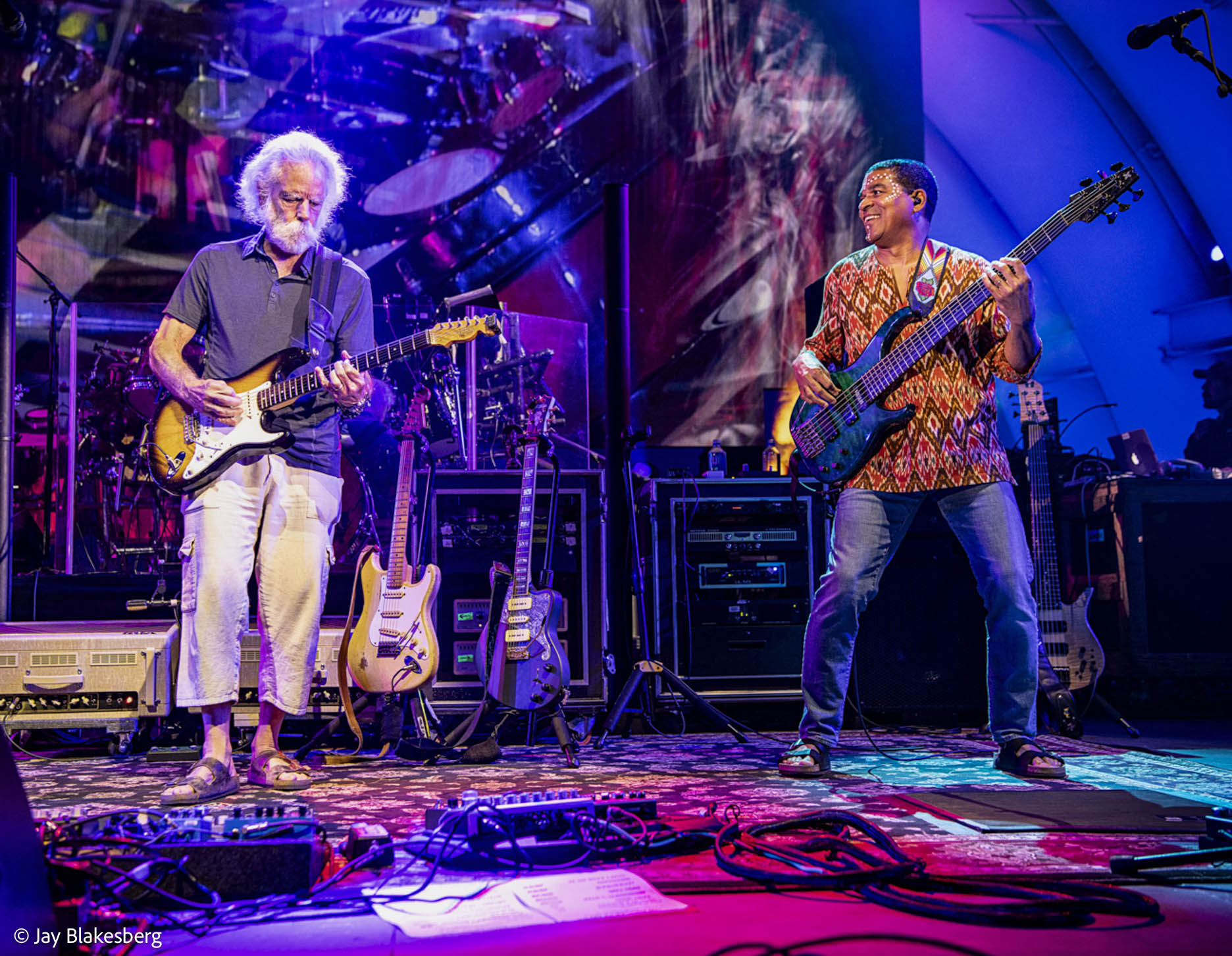
“I didn’t really know Bob until the last 10 years. Even though I met him about 20 ago, I didn’t spend any hangout time with him,” Oteil Burbridge indicates, while chronicling his connection with his Dead & Company bandmate Bobby Weir. “I wasn’t a Deadhead, but I became the bass player because we shared a philosophy. We worshiped the same God and that God is complete musical freedom.”


Burbridge then revisits a memory of performing with Weir during Dead & Company’s initial tour in 2015, which drew on the band members’ collective penchant for creative abandon. He recalls, “In the early days we were trying to find ourselves. It didn’t sound anything like the Grateful Dead, but that was never the goal. We were trying to find out what we did sound like, and we figured that the crowd was going to let us know. Just like pro wrestling, the crowd’s going to let you know immediately if it’s working or not working. It took a little while but sometimes we would build momentum, almost get carried away to the point where it would just explode, and the crowd would just go insane. That was something.”
Shortly after Weir’s death, Burbridge shared an eloquent summation of Bobby’s all-encompassing artistic spirit. At that time, the bass player reflected, “I can’t think of anyone that needed to play live music more than Bob. It went past devotion, past dedication, past obsession. It seemed to me more like self-identification. I think he felt it is what and who he was. I also cannot think of anyone who played more live shows. We could depend on it like the sun coming up. He was so unique as a human and a musician. His mannerisms when he spoke were just as singular as the way he played guitar, sang, composed and lived day to day.”
Weir’s studio recordings continue to resonate with Burbridge, who notes, “There’s this audio of him doing a demo of ‘Weather Report Suite.’ It’s just him and an acoustic guitar. I don’t even think the words are written yet. He’s just singing, ‘La la la…’ I remember when I heard that very early on, it just got me because he was so young and he did something that was already timeless and he didn’t even have the words yet. It’s so pure and just unadulterated and innocent and deep. It’s so young and so old at the same time. It blew my mind, man. It just blew my mind.”
As you’ve said, you didn’t grow up as a Deadhead. Can you talk about your initial approach to the music and how that intertwined with Bobby’s perspective?
Bobby and I share an ethos when it comes to music and freedom. That’s what we have in common, and I think it’s shaped everything that I’ve done.
I could be in a Top 40 cover band and I’d have that exact same ethos. It’s about letting things come out as they are and allowing yourself to be different.
I really appreciate Bob and Phil for the way they see music. I went for broke and I put all my eggs in this basket with that philosophy in mind. It means you don’t have to get stuck in you. You should never be stuck, not even in your own identity. Shed it, or take it to the left, to the right, or down or up but expand it.
I feel like I play much more conventionally than Phil. I think that’s what was so incredible about his approach and why it had such a huge effect on the sound of the Grateful Dead. I’ll approach funk shuffles and New Orleans-type stuff much more conventionally than Phil would because I can’t help the way the rhythms take over. It’s just going to come out that way.
But compared to what a truly conventional person would do, I’m definitely outside that. It’s from playing jazz or African music or playing with the Colonel. Sometimes there’s just going to be bluegrass that comes flying out because it’s stirred up in there. It’s like a gumbo.
That’s the religion. That’s the ethos. It’s supposed to be different. That’s also what saved me because it was like, “You don’t sound anything remotely close to Phil. It’s not going to sound like the Grateful Dead because of who you are, but that’s how it’s supposed to be. So lean into it.”
What role do you think Bobby’s curiosity played in all that?
Oh my God, that was his muse! Curiosity and abiding curiosity is a sign of heightened intelligence. When I hear someone say they’re bored, I’m like, “Well, it just means you’re not curious. Look around you, pick something.” It’s like I’m going to tell my son, “You’ll never believe how much fun you can have with just 12 notes.”
Bob never lost that for one second. That curiosity was about other things, too. That’s why he always loved new toys. He loved looking into the future and asking what’s possible—“Well, if that’s possible, then is this possible? OK, we’ve confirmed that’s possible because we just did it. So now I suspect that this is possible.”
It’s always on to the next mountaintop. Even if he’d been limping slightly in his old age, he was still going to the next hill. It’s just great, man.
That’s an irrepressible spirit. I’m sure there’s a healthy dose of stubbornness in there too but put to good use.
Thinking about Bob’s earliest days, he started out quite young, just like you and your brother did.
When people said that Bob passed away at 78 and it might have seemed early, I was like, “Are you kidding me? Bob was 140, at least.” I would probably say 160. It was double, partially from how bold he was and partially from how young he started. Of course he died young when it comes to his wife and children. That’s too young for them.
With my older brother Kofi, they discovered he had perfect pitch when he was seven years old. Then by the time he was 12, he went off to Russia with this play Inherit the Wind that was at Arena Stage in Washington, D.C. A 12-year-old black kid going to Russia in the ’70s was a very unusual experience. In all the pictures you see of him, he’s 12 and everyone else is an adult. So even though Kofi died young, I was like, “Man, he experienced well more than a single lifetime because he was just accelerated.”
It’s scary because you wonder, “Does that mean people who are like that are going to die young?” But I saw Questlove say as much. He was talking about how he kind of knew that D’Angelo was not going to be an old man. But with Bob, forget about twice, I think he lived five times over.
In considering family, your son was less than a year old when you started with Dead & Company. As you found your way into fatherhood was that ever a topic you’d discuss with Bob?
It’s funny you say that because one thing that we connected on very specifically was that we both had our first kid at the age of 50. That was a thing we shared, and it’s not a thing that most people can share. I know very few men my age who have kids that are the same age as mine. Most of them have grandchildren. When I joined the band and we had our first rehearsal, I think Nigel was like four or five months old. So we could relate in that respect, for sure.
I remember when I was thinking about having kids, I think I was maybe 48. I was teaching at Jorma’s music camp at the Fur Peace Ranch and I said to Jorma, “Man, I’m thinking about having kids. I’m wondering if I’m too old.” He goes, “Ah, get out of here. I’m 67, I just adopted a one year old. You’re fine.” I was like, “Oh shit, I am fine. OK, nevermind.” Now Izze’s grown completely and a musician and really talented. It goes real fast.
I’m psyched when it’s time to pick up the kids from school, even if they come home and ignore me. I’m just glad to get to go over and kiss them on the head and hear their voices while they’re still that size. They’re not like full-size grown voices yet.
On the other side of that I look pretty young for my age, but my hair is starting to turn gray and it kind of freaks my son out a little bit. But Bob really leaned into his aging, which is something I’ll remember. He didn’t let it distract him or get him down. In fact, he was the opposite when it came to his hair and he’d crack me up with that sometimes.
Can you talk about Bobby as a songwriter?
It was the ballads that really got me. I did an album of Garcia Hunter ballads, but I only did just those because those are the ones that I would sing. I was not going to sing the Bob ballads, but his ballads hit me just as hard. “Black-Throated Wind,” “Lost Sailor” and “Looks like Rain.” I mean, come on!
I’ll tell you, there are lots of musicians who are great players. They’re gifted by the forest, God, magic, nature, whatever you want to call it. It’s a gift. But then the music that they write doesn’t move me at all.
I’ve realized that a person’s compositions are a deeper level of seeing who they are inside. You can see what their vision is. It’s kind of a surprise and a letdown when someone’s such an incredibly great player, and then you hear what they write and you’re like, “Wow, that is just not deep.”
I need emotional depth. The songs don’t have to have words. They can be instrumentals, but I need emotional depth and intelligence. You see the inside of a person that way. It’s like how you hear all these stories about Dickey Betts, but then if you listen to “Blue Sky” and “Jessica,” there’s all that gentle sunshine, which is his insides. You get a different peek into a person through the music that they write.
So when it comes to Bob’s music and Bob as a musician, I think of that depth.
You mentioned “Lost Sailor.” For whatever reason, I didn’t appreciate it during the Grateful Dead years, but it was one of my favorites from Dead & Company.
It’s so funny. The good part about getting older is you recognize, “Oh, this is one of those moments. Let me savor this right now. This is way bigger than I thought.” You automatically think, “OK, let me give this a second chance. Let me see how I feel about this. Yeah, I’m totally feeling it!”
With “Lost Sailor,” it’s like, “Hell yeah!” It’s like watching a great movie. It’s cinematic. You get all the emotions, you get the whole thing. I always loved playing that one.
Is there another song that had a similar impact on you?
Oh, there were quite a few. It wasn’t just “Lost Sailor.” There were certain nights when we did “Lost Sailor” > “Saint of Circumstance,” and I felt it in every cell of my body.
That’s how Ralph Towner and Weather Report made me feel when I was young and wanted to start playing music. There’s not really a word for it. Drama’s not the right word. It was a feeling of nature, like if you’ve ever been in a storm in the woods, under the canopy of the woods where you hear the wind on the trees. You’re not getting totally pelted by the water because the trees are taking it, but you get the drama, the gravity, the awe, the immensity of that storm’s power.
Then there were some very sublime moments that just made me cry. I can think of sometimes playing “Looks Like Rain” or “Black-Throated Wind” and feeling like having a good cry. That could have just been on a Thursday, man.