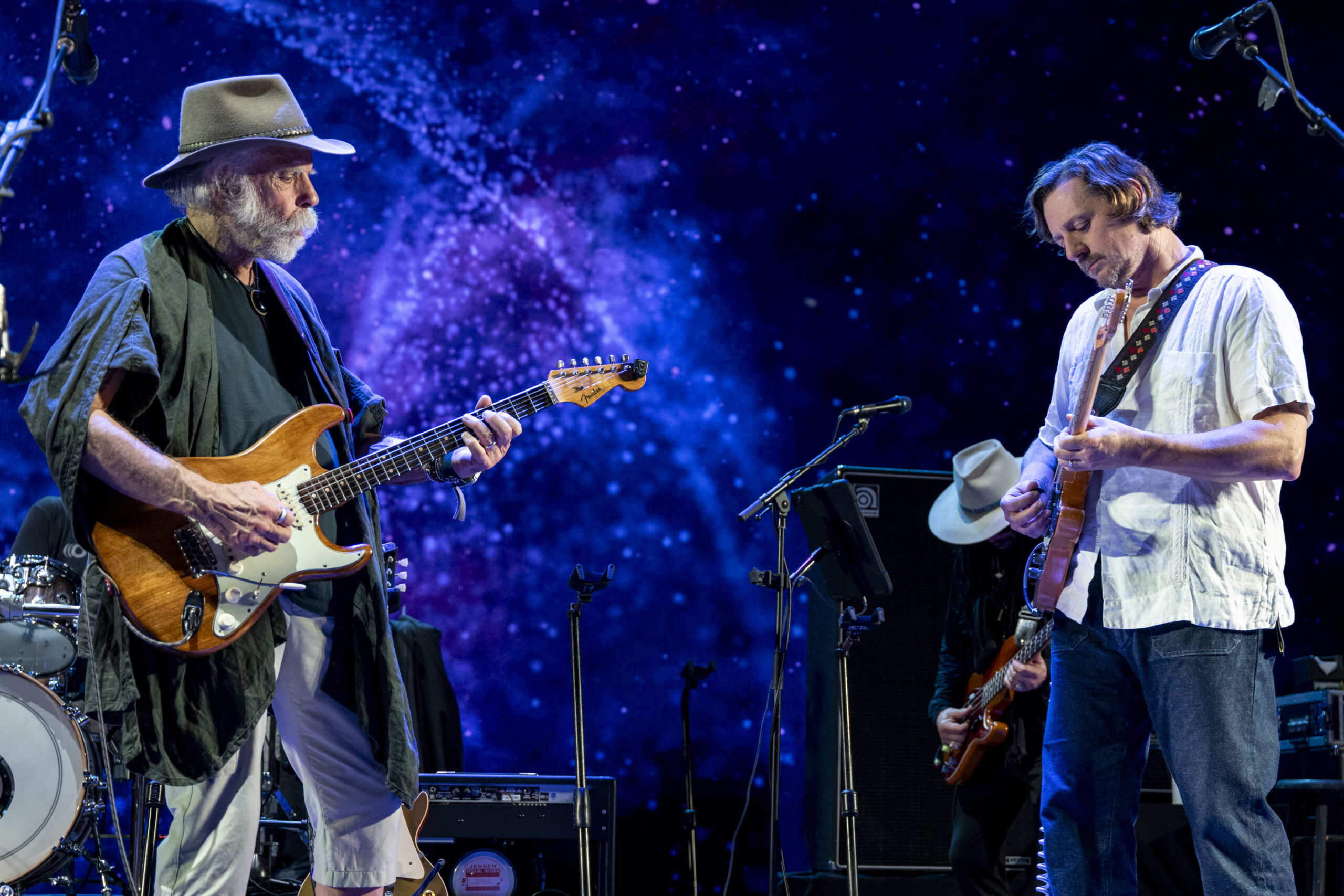
[This article appears in our special 132-page Bob Weir edition, which presents rare photography, archival interviews and new conversations that pay tribute to an endearing, enduring artist.]
***


“I feel like I met him at a time when I really needed to,” Sturgill Simpson says of his fortuitous initial encounter with Bob Weir, which took place at Farm Aid in September 2023. Simpson was still recovering from a vocal cord hemorrhage that had occurred two years earlier and continued to sideline him. However, through Weir’s low-key insistence, he strapped on a guitar and joined Wolf Bros for a three-song set that opened with “Truckin’,” then moved into “Dark Star” and “Not Fade Away.”
Simpson recalls, “The first time I ever played ‘Dark Star’ was the first time I ever heard ‘Dark Star.’ I just wasn’t familiar with it. It was a little nerve-racking but when we were backstage Bob said to me, ‘Sturgill, it’s impossible to make a mistake, so don’t worry.’ I was like, ‘I’m pretty sure I can make mistakes, Bob…’ But it turned out I had a good time.”
That sentiment was reciprocated by Weir, who invited Simpson to be part of his band at the Dead Ahead event which took place four months later in Mexico. This appearance served as a catalyst for Simpson to resume his own touring career and launch his Johnny Blue Skies project. It also bolstered the relationship between the two artists, as Simpson returned the following year for Dead Ahead 2025. Then in August, Johnny Blue Skies opened one of the final Dead & Company shows at Golden Gate Park, with Simpson joining the host band for a stirring, climatic version of “Morning Dew.”
“He was very dialed, and what a life,” Simpson observes with admiration and awe. “The things that we read about, he was literally there. When we’d be on the bus I had so many questions outside of the music, I didn’t know where to start—to literally be on the stage at the Acid Tests, and his threading of the American counterculture, the literary side and all else, you name it. He knew everybody minus the mythology. He was just profoundly heavy, that’s the only word I can think of. Plus, he was a cool dude. The world really lost a piece of American history, not just a guy in a band.”
Your appearance with Bob at Farm Aid took plenty of folks by surprise. How did that come about?
Bob and I had been trying to link up for years. One of my agents was really close with him and he’d reached out a few times over the years asking me to sit in. I was just never in the same place at the same time. It never lined up.
Then I had a real bad vocal injury in 2021, which took me out of things for a couple years. During that time I sunk into a pretty heavy depression, probably the worst I’ve ever dealt with, and things got kind of slippery.
Maybe because of that time away from the stage, I started developing a pretty severe case of imposter syndrome or stage fright or just insecurity about everything that had happened in my life for the past eight or nine years. So every time I would agree to do something, I got into this bad habit of saying yes, then bailing at the last moment because the anxiety would cripple me. I would get caught up in the idea of having to go back out and be him again. I don’t know how to explain it.
So the first time I really met and played with Bob was at Farm Aid in ’23. My friend Kevin and some other people were playing there with their bands and my wife was like, “You should go do this.”
I met Bob and ended up going out there with Wolf Bros, but since they had horns and everything, I didn’t have much space to fill. Lukas Nelson was also sitting in and since he’s a phenomenal guitar player, I could kind of just hang on. Walking back on a stage again for the first time in years was enough sensory overload in itself.
But I had to start somewhere, and that’s where the path to JBS began. Meeting Bob was kind of kismet.
photo: Jay Blakesberg
Following Farm Aid, you took a leap into Bobby’s world with Dead Ahead. Can you talk about that experience and its impact on your artistic path?
In the early winter of ’24, Bob reached out and said, “Hey, we’re doing this thing down in Mexico and I’d really like you to come down, sit in with the band and play guitar.” I told him, “Yeah, just send me the two or three songs you want me to sing.” His response was “No, no, no. I want you to sit in and play guitar with the band for the whole set.”
I did not see that coming. But then I had to tell him with total humility and embarrassment that I wasn’t all that familiar with the songbook. He was like, “Well, then you’ll be perfect.”
So I agreed to do it. Then as time goes by, I’m about to bail again, but my wife is like, “You’re not jumping off this. You have to go do it.” She sent me down there literally with a Telecaster, a toothbrush and a pair of pants.
Two or three days before I got on the plane, Bob sent me the possible setlist and it was like 60 fucking songs. So now the anxiety was exponentially racing to the roof.
I was like, “How am I going to do this?” But I told myself I had to learn the stuff. So I sat at home and played along through the stereo like I used to do as a teenager.
Then as I began digging in with this music for the first time in my life, things made much more sense than I had expected. There was a certain level of immediacy because I realized it was old mountain blues, folk, country and bluegrass structures. Once I understood what Jerry was doing with fusing scales and pulling all of these influences together, I realized, “Oh, this is actually how I play guitar” because I grew up on the same shit. I was immediately hooked.
I learned enough to kind of get through the songbook, but when I showed up and got to the rehearsal, I was like, “Bob, I know the changes, but I’m still kind of shaky.” Then he told me, “Everybody tries to play like Jerry. I didn’t bring you down here for that. I want you to play like you.” When he said that, the weight came off my shoulders and it was one of the most fun times I’d ever had in my life.
When I went back home, I called my agent for the first time in two and a half years, and said, “I want to go on tour.”
To what extent did you speak with Bob about what you had been going through?
Aside from the music, he really was like the Lorax. He would seem like he was on another planet for a few minutes and then he would look at you and say something that was so profound, and with so much levity, that I realized not only had he been listening to me, but that I wasn’t saying anything he hadn’t lived through a thousand times.
He would just put it all in perspective that there was no reason to worry about anything.
With some of our conversations, not only was the music reawakening for me, but he told me that he had also suffered from intense stage fright. So I spoke with him about what I was feeling, and how I was afraid to get back on the train. Then he articulated what the relationship between a musician and the music and the fans should be, as opposed to what it’s become in this content-related era that we navigate. I had pulled away from all of that stuff because I just didn’t want to be that vulnerable anymore. He gave me a lot of really good advice.
I think that’s kind of where the name change thing started to make so much sense to me, along with the idea of just being a guy in the band.
With JBS, it feels like I can be more vulnerable or more free and not have this pressure of feeling like everything has to be a Proustian novel. Sometimes you can just write a song about fucking, you know what I mean?
When we went into the studio, we focused on that immediacy and the energy. The idea was to capture the vibe of this band and the urgency of this moment as opposed to thinking, “Oh, I have to be a songwriter.”
From one record to the next, I’ve never really given a shit what the critics thought, but I always put this insane, unnecessary pressure on myself every time I’d go into the studio. It would make it gratifying, but I wouldn’t necessarily say it was fun or that I was fun to be around in the process.
Bob really is a big part of everything that’s happened in the last year and a half. We played the best tour, the best shows I’ve ever been a part of. The band is on another level right now, and I think it’s because we just removed all the static. I can’t underscore just how much of that came from conversations and time with Bob and learning more about his relationships, especially with Jerry. The man had a very profound effect on my life.
Bob was known to call audibles when it came to songs and setlists. During those two years at Dead Ahead, did he ever throw you?
The whole experience was harnessed chaos. I’m used to that to some degree because I hate rehearsing. I couldn’t sing a song the same way twice if I had to. I play guitar on feeling and mostly aggression— less as I get older—but I’ve never been a guy who felt that everything had to be perfect. Merle Haggard told me one time that there’s nothing more boring than perfect. So I just took that to heart. I don’t give a shit about time. I don’t care if the song speeds up. Bob took that mentality to someplace far beyond the Milky Way.
We’d have a rental house down there, so we’d go rehearse what might be the set for an hour, and then it was, “See you at the soundcheck.” Then at the gig, and this happened more than once, we’d be two minutes away from walking on stage, and when we’d get the setlist there would be something on there I’d never heard of. Bob would be like, “Oh, it’ll be great. We played it the other day.” Then his manager would tell me, “He hasn’t played this since 1974.” But to him, there was no difference.
I remember speaking to Don, who was the coolest fucking cat on earth. We had one of these moments and I kind of looked at him and was like, “Does he do this all the time?” Don was like, “Every night.” I said, “I’m going to look to you for the changes.” He goes, “Just do what I do, man. Just hold the one, stand there and look cool.” That’s the best advice anybody’s ever given me.
How would you characterize Bob as a rhythm guitarist?
Bob changed the way I play guitar because my lead guitar player Laur [Joamets], for my money, might be the best lead player alive on planet earth. He’s the most creative guitar player I’ve ever seen. Him and Derek Trucks occupy a level of alien talent.
In terms of expressionism, Laur can fill space in a way that few players ever fully get to. There’s a lot of guys who are wizards technically, but I if I sit and listen for a while, it’s a bunch of “Look what I can do” and it never really hits me or moves me. When we’re making a record, usually the first pass that Laur takes on a solo will sound like something anybody else spent a week carving out, trying to get this melodic structure.
I’m never going to be like that. I’m more of a feel kind of player. So I realized I have a role in this band to support what Laur’s doing and to lift it or push it or try to stay out of the way and complement it.
I realized after listening to the Dead that Bob was like the best there ever was at that. He would go up the neck and play like 15 inversions of one chord, so it never just sounded like he’s holding it down in first position. He would add so much musicality and support and variety. These flurries and some of his chord voicings on the higher register added so much magic.
That just made me realize, “OK, this is my job. When I’m not singing, I should be doing this to support everything else, because if I’m in first position, that’s the bassist’s register. I’m taking up his sonic airwaves and I don’t need to be there. I need to be in this other hole.” So really listening and studying those early Grateful Dead records and honing in on what Bob was doing changed the way I look at playing guitar in my own band. I don’t think he gets enough credit for that.
After all that you’d been through, in certain respects things came full circle at Golden Gate Park.
That was the culmination of all this, starting with my first experience knowing nothing. We had a great set, then I got to go out and play “Morning Dew,” which of all the songs from this experience that I’ve absorbed and learned, feels like the one I could have written. Given everything in my life that had happened in the years leading up to meeting Bob, and then happened after that, it just perfectly captured my emotional state, my headspace, and the isolation that can come with this job, along with the severe depression. So when Bob said he wanted me to come out and play that song, I felt like it was all just meant to be—that park, that energy, that crowd, the whole thing.
We had talked about doing a project together. With Bob, and this has become a recurring theme in my life, I meet people who are legends or heroes that befriend me. Then, two or three years later I wake up and they’re gone. I just feel really blessed to have known the guy.