“Nobody Ever Knew When Something Should Be Stopped”: Mouse on Mars’ Jan St. Werner on Lee “Scratch” Perry’s Final Full-Length Recording
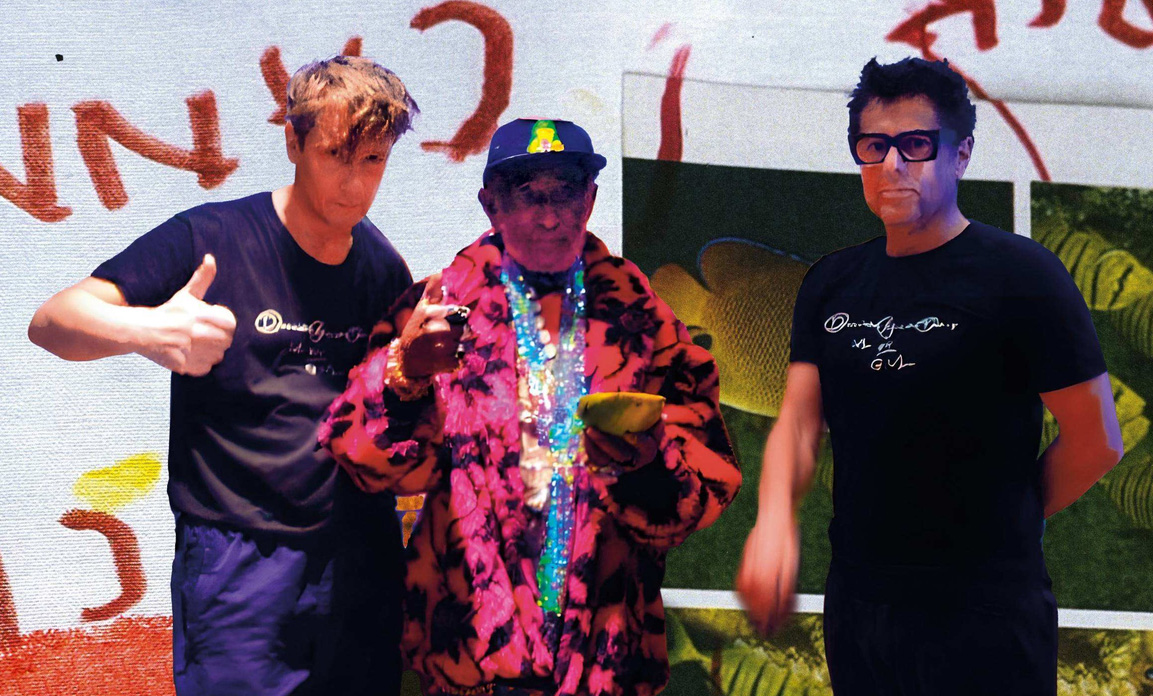
Photo: Constantin Carstens
“Everybody is looking at him and he just bursts out laughing, like somebody tickled him,” says Mouse on Mars’ Jan St. Werner recently. “It was just such an immediate, heartfelt response.”
That’s the scene when dub pioneer Lee “Scratch” Perry met the electronic duo inside a performance space they were playing at in December 2019, an unlikely moment that sparked a collaboration just as unlikely. Perry made a trip to Berlin, Germany for four days to record what became his last full-length recording, Spatial, No Problem with Mouse on Mars. St. Werner still can’t believe this happened, and the duo jumped on the possibility when it was first brought up.
At the time of recording Perry was 83, but listening to his vocals over the 8 songs, you wouldn’t think so. His trademark improvised lyrics capture a legend in fine form in what would be his final full-length recording — a dubby mix of glitchy electronics that feel spacey and futuristic, while rooted in the past. (Perry died in August 2021.)
Relix recently got the inside story from St. Werner of what Lee “Scratch” Perry’s final recording days were like.
Take us through the origins of this relationship. How did this happen?
We have a good friend Elena Poulou, and she has magic ways to connect people. It’s really one of her big skills. We’ve known her for more than 30 years, and she came with this idea: “Would you want to record with Lee ‘Scratch’ Perry?” We were like, “What an absurd question.” Nobody would answer no, but also you wouldn’t think it would be plausible. Eventually he came to Berlin after two attempts that failed.
She goes to the airport, and picks him up. We were playing a little in-store gig and when we were done with the gig, we had a drink, we chatted, and he comes in one of these Japanese little vans, kind of Smurf blue. He steps out, walks into the room, he’s super friendly, very curious, he checks out the gear, we go downstairs.
How do you break the ice with Lee ‘Scratch’ Perry?
We didn’t know much about Lee ‘Scratch’ Perry. We knew about The Upsetters. Our studio is across the street [from where we were playing]. It’s 11 at night, and we were told he worked for three hours a day. No alcohol, no grass, no drugs, keep it modest. Then we recorded until late at night, and then he said, “Please pick me up in the morning from the hotel, 10 o’clock,” and the next session lasted again until the middle of the night. That’s why we have so much material.
Did you all get sleep, or just power through?
We did get some sleep, but we were excited. You can hear in some of the recordings we did late in the session that his voice was tired. He really gave a lot.
It feels like there are threads of dub running through Spatial, No Problem.
Mouse on Mars has a very dub related process . . . it’s playing with effects. It’s the echo. An echo is an interpretation, it’s a version. It’s a means to investigate. We use echo and reverb and all kinds of like granular stuff, but what is really interesting about echo is that you could make another version of that song not just by reinterpreting it, but playing exactly the same tape and highlighting the drums, or taking out the voice, throwing the voice into an echo, bringing it back in, putting a ring modulator on something else. And that’s what we did extensively in the early Mouse on Mars times.
How much music do you think you recorded?
It’s hard to say. We keep discovering recordings which were done with a field recorder or a particular microphone in a corridor. We actually do have a really nice second album that we are working on right now.
There’s a lot of improvisation on the record, and basically everything we recorded was a first take. There was not like, “Oh, this was good, let’s do it again.” He had like these amazing epiphanies about his life or his process or the very moment he was in, but, he kept going, because we had stuff running in loops. Nobody ever knew when something should be stopped.
What are the electronic community’s thoughts on AI these days?
We used AI on the album because there were some sessions where Lee’s voice was really, really quite far in the back and he does a few amazing things, and we just had a field recorder. So we were like, “Okay, we’re going to use some AI and bring the voice up.” It’s not creating. We asked Lee’s widow if it’s okay to do that, because when you do that, the voice is in the machine, you know.
With AI and music, you can build instruments, you can prompt pretty fast, complex things, and a lot of the community that I feel quite close to . . . people who make computer music and program patches, a lot of the skills they learned over decades, you can have those results within seconds. You can vibe code a synthesizer.
Is that a good thing?
No, it’s a bad problem. The machine is just serving.