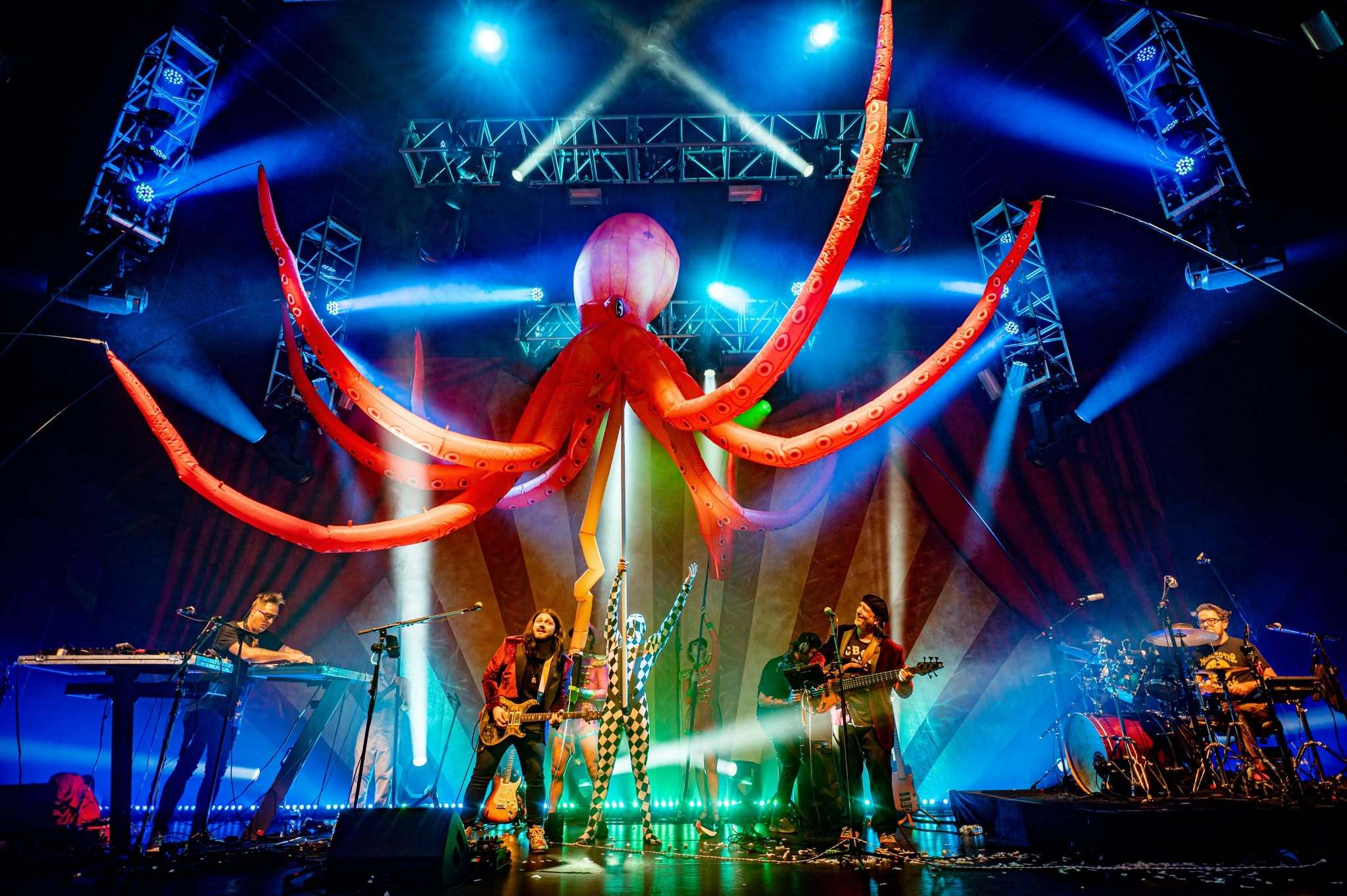
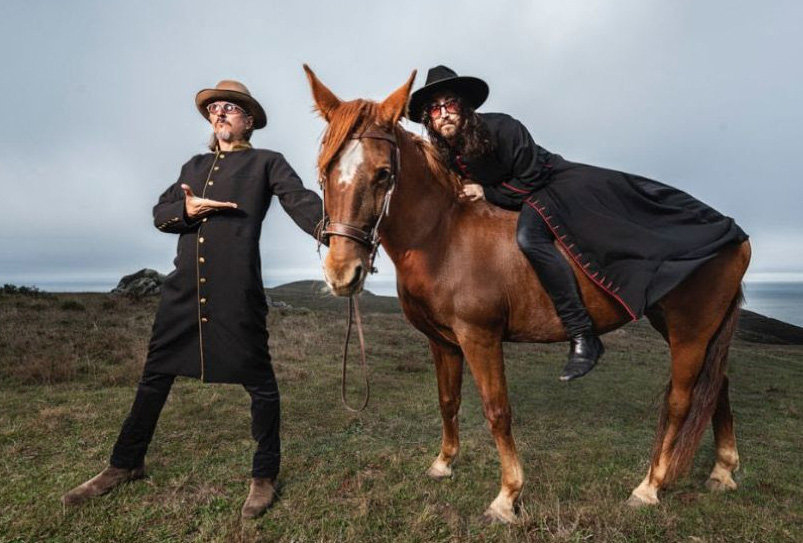
When Primus unexpectedly parted ways with their drummer shortly before New Year’s Eve a year and a half ago, bassist/singer Les Claypool quickly pivoted, pulling together several of the oft-intertwined projects he’s focused on during the past 30 years for two highly collaborative shows at Oakland, Calif.’s The Fox Theatre. The concerts, billed as Claypool Gold, worked and this spring and summer the bassist has been taking the concept on the road, performing distinct sets with his refreshed Primus lineup, the improvisationally heavy Colonel Les Claypool’s Fearless Flying Frog Brigade and The Claypool Lennon Delirium, who recently released their third LP, The Great Parrot-Ox and the Golden Egg of Empathy.
As the tour has moved across the country, the three bands have continued to mix things up, shuffling setlists, busting out songs and setting the stage for a range of cross-band sit ins. They’ve also leaned into that festival-like spirit offstage, with new Primus drummer John Hoffman winning over both fans and his fellow musicians at each stop along the way. Partway through the Claypool Gold run, the tour’s namesake and Sean Lennon, who is on the road as part of both Frog Brigade and Delirium, offered some golden nuggets from their rolling caravan thus far.
You’ve been quite busy as of late, both in the studio and on the road, but let’s start with the new Claypool Lennon Delirium album, The Great Parrot-Ox and the Golden Egg of Empathy. The record has a rather elaborate narrative that dives into A.I. and introduces a range of original characters. At what point did you decide it was time to start working on a new Delirium album and did you know, off the bat, that it would be more of a conceptual work than your previous two full-length releases?
Les Claypool: It was just time for another Delirium record, and we started working on it, shit, almost four years ago now. And we just thought, “Well, it’s our third record, we should do something different,” so we started kicking around ideas for some form of a concept record or, as Sean likes to say, a rock opera. But, basically, we wanted to make something with an overall arc.
We kicked around a bunch of different ideas, and Shiner’s kind of the Poindexter of the band. He’s always rattling off random information and trivial scientific facts and whatnot, and he started talking about this paperclip conundrum. So, I just thought, “Well, that’s interesting. Let’s run with that,” and it led to Hippard O, the Ministry of Manatees, the Great Parrot-Ox and the quest for the Golden Egg of Empathy. And it just fleshed out pretty well from there.
Sean Lennon: There’s this concept in computer science that [Nick Bostrom] came up with. He was talking about this theoretical paperclip dilemma, where you create a supercomputer that’s a paperclip maximizer, meaning that it’s this machine’s job to make as many paper clips as possible—and as efficiently as possible.
As simple as that could be, it could also get completely out of control if it becomes a self-improving supercomputer. You might not be able to stop it once it starts because it’s more powerful, and more intelligent, than any human. It starts turning rocks into paperclips and elements in paper clips and, when it’s done with that, it starts turning biological elements into paper clips. And, pretty soon, it wants to turn humans into paper clips, and it has some incredible technological way of converting flesh into paper clips. And then it even goes on to harvest the solar system, and it eventually turns the whole universe into paper clips.
I always thought that that was a funny idea and also a cautionary tale about where we’re at in terms of the potential singularity of intelligence—I thought that would be a good foundation for a story if you took it literally.
I know some musicians enjoy the tight focus and structural guardrails that a concept album or rock album provide while others find that process to be more difficult than simply following the muse where it takes them and then compiling those ideas into an album. Once you figured out the overall story arc, did you find the writing process easier or more difficult than writing toward a more traditional album?
SL: It’s harder in some ways, and it’s easier in other ways. It’s easier because you know what you have to write about. It’s harder because you can’t just write about whatever you want. Songwriting is never slow for Les and I, particularly when we are together. I think what slowed us down this time was just coming up with the original story, the foundational outline for the narrative. That took us a little bit longer than usual, and it’s mainly because we’ve never done that together before, so we were still learning how to do that. But once we had the story, writing the songs was not as hard as one might think.
LC: It’s much more difficult to do it like we did it when you write like I do. I’m a very spontaneous writer. I like to write about whatever just comes to me. When you have to follow a narrative, it makes it much more difficult, hence the three-and-a-half-year process of making the thing. [Laughs.]
Shiner would come out to Rancho Relaxo—my studio [in Sonoma County, Calif.]. We always work out there, though he did do some of his vocals back home in New York. And once I opened that can of worms of him being able to do that, he did a lot of his vocals there. [Laughs.] But we would mostly work at my house, and we came up with the thing over the past few years.
Sean’s like my brother—we’re very tight. He’s close with my family, and we’ve always had a pretty good writing relationship. Heck, we have a pretty just good relationship in general. We have a similar sense of humor, we’re interested in a lot of similar things. With the first Delirium record, we wrote that thing in two weeks or something. It all goes pretty fast. This one took a little longer, but we still have a very good working relationship.
In advance of the album’s release, The Great Parrot-Ox and the Golden Egg of Empathy was described as “a surreal, psychedelic-prog cautionary tale about A.I., empathy, mortality, free will and what happens when systems are pushed toward pure optimization without any grounding in human feeling.” Obviously, there are benefits to A.I. and technological advances in general and you have both long embraced technology in different ways, including releasing an NFT. But A.I. can also be worrisome, especially for writers, musicians and creative types. Where do you stand on it personally?
LC: Well, the story is not necessarily an indictment of A.I. It’s more the conduit for the tale, which is the broader message, which is the loss or vilification of empathy. A.I. is what it is. It’s here, we’re gonna have to deal with it.
For the people that incurred the beginnings of television or feared nuclear power or feared the internet or whatever, there’s pros and cons, but it’s here, and you need to find the parameters for which it works for you. And, hopefully, it’s a positive thing.
SL: I’m very cautious about A.I., and I think we all should be. There’s the story of Easter Island, where we didn’t know why the population wound up cannibalizing itself until we studied the caves and the archaeological evidence and we realized that they, essentially, had a culture that revolved around making these giant tiki-stone statues. And the bigger the statue, the more prominence it had and the more respect you had in the tribe. They started making so many of these statues that they actually wound up chopping down the forest in order to roll these tiki gods around. And when they had no forest, then the rats took over and, basically, there was no more food, and they also couldn’t make boats so that they could fish anymore because they didn’t have enough wood. And they couldn’t just fish off the cliffs because of the way that the geography of that specific island was laid out.
I think it’s very possible for humans to create a technology that leads to our own extinction. I think we know that’s true. So we have to be careful with technology. Obviously, I’m not against technology, but I think, in this specific case—since every single tech bro in the world who’s running one of these A.I. companies is also warning that it could signal the end of humanity—it’s probably a good idea to be careful.
With Rich Ragsdale, you also built the storyline into its own comic-book mythology through a series of videos and actual print-edition comics. How involved were you in that process?
SL: I sort of oversaw the package design, including the comic. Les and I both had him put together the frames and he drew it how he drew it. So I worked pretty closely with Rich, but it was all his talent and drawing skill that got it done.
LC: We wrote the story, and then, once we started working with Rich Ragsdale, we handed it over to him. It’s funny because, usually, I give a lot of notes. And I didn’t have to give hardly any notes to Rich. We helped develop and polish the characters but once we got the characters developed, he just kind of ran with it. It was spectacular. He did an amazing job.
Shifting from the studio to the stage, you are currently in the midst of the Claypool Gold tour, where you offer distinct sets with the Delirium, Frog Brigade and Primus each night. In 2024 and 2024, Les was part of the Sessanta tour featuring Primus, Puscifer and A Perfect Circle, which was a similar collaborative outing for Maynard James Keenan’s 60th birthday. What inspired you do take your own stab at the concept this summer?
LC: Well, we kind of had it thrust upon us. A couple years ago, our drummer left us high and dry at the last minute, and we had a New Year’s show booked, as well as another Sessanta tour booked. And he just left. [Drummer Tim "Herb" Alexander left Primus for the third time in October 2024, resigning via email and admitting that he lost “his passion for playing.”] So, rather than cancel the New Year’s show, my manager said, “Hey, why don’t you just put a bunch of your bands together, and let’s go and do the New Year’s show.” And so we called it Claypool Gold because my new hobby, as of late, is to go dig holes in the mountains and look for bits of nuggets.
And it went really well—it was an incredible amount of fun—and then promoters got wind of it and started making offers. So we said, “OK, let’s do it.” And away we went.
I was a little leery, just because, mainly, I didn’t want Larry to feel uncomfortable because it’s called Claypool. But he’s been having a blast. We are all having a blast. It’s an incredibly fun tour. And there’s a lot of cross-pollination on stage—It’s three definitive sets, but there’s a lot of cross-pollination within those sets, so it’s been a blast.
SL: The whole gold theme is pretty cool because we have the Golden Egg album and the cover of our album is all gold leaves. There’s this gold metallic print, so it’s all about the gold. I even got a glitter golden egg guitar for this tour.
Having been part of the Sessanta, was there anything you sought to replicate or avoid going into the Claypool Gold tour? That run was incredibly visual—with musicians coming and going throughout the night and moving between two different levels of the stage. There was even a ping-pong table set up on the stage.
LC: I think that the thing that I learned from it is I didn’t want to do it that way. [Laughs.] It’s not that we had a bad time or anything, I just didn’t want to rip off Maynard. In fact, I called him when we were deciding to do this and I said, “Hey, I’m doing this thing, and I’m letting you know, I’m not ripping off your idea. I’m doing something that separates it from what you did.”
Of course, it’s similar in some ways, in the obvious ways, but it’s a very different thing. This one is three different sets. But, on the Sessanta tour, we had a blast. It was all our friends and a bunch of people who became our friends. And I think it’s fun for the fans to see that interaction, to see guys like us interacting with people that we don’t normally interact with. And it was fun for them to see Maynard being different than what he’s known for, which is Tool. Obviously Puscifer’s a little more light-hearted, but it was fun to see him clowning around, having a good time out there.
SL: I saw the Sessanta tour in New York. I don’t envy Les having to do three bands a night. It’s tough. It’s already very complicated for me to sort of switch from being a guitar player [with Frog Brigade] to actually singing and playing more structured songs with the Delirium. It’s a lot to keep track of for me, so I can’t imagine how Les is dealing with it.
But it also makes it a lot more fun for us. This is the first tour where I’ve shared a bus with the headlining band, so we’re all on the same bus. We all have the same backstage together, and it feels like we’re a carnival or something, which makes it more fun, to be honest. It’s one of the most chill, family-feeling tours I’ve been on. We’re all friends and we all play together and we just get to hang out.
Looking at the Claypool Gold setlists thus far, how have you been constructing the setlists for each band, beginning with the Delirium?
LC: Well, we mix it up as much as we can. It’s a little harder to mix up the Delirium stuff, just because we are trying to play as much of the new record as possible. So, we’re trying to throw in some old stuff but then have the majority of the set be the new stuff. At some point, what we’d like to do is go out and maybe do a residency somewhere. We’d like to put together an actual stage production and do the album in its entirety. But, with this, you’re getting the sampler plate, something to get the fans’ appetite a little wet.
We could easily do an evening with show, so sometimes it’s a little difficult to put together the set because there’s certain songs that you want to play every night because it fits the format of trying to tell this tale. But then you also need to mix it up just to keep those people that like to go to multiple shows excited.
SL: I think the new [Delerium] songs sound pretty good—some better than others. Some days are better than others, but I’ve been having a lot of fun playing the new songs. At this point, we have three records worth of songs and an EP, so, yeah, we could easily fill a full headlining show. I think the hardest part is that we don’t have enough time to play more songs.
In 2023, you relaunched the Fearless Flying Frog Brigade after an extended break, introducing a new lineup and dusting off a number of old favorites. You also performed Pink Floyd’s Animals each night. Given the range of material that group has and that it’s among Les’ more jam-forward projects, how have you been figuring out which songs to slot in that 30-minute spot?
LC: We have a pretty good mix of song to draw from, but there’s just certain songs that I know get Skerik all fired up or that show off old Mike Dillon pretty well.
With Frog Brigade, we’re only doing like four songs a night. So, we don’t get a lot of choices or a lot of room to switch it up as much as we usually do. We stretch it out too—we just released that live record, and it’s only four songs. You know, it’s just a matter of going out and playing fun songs, songs that we enjoy.
It’s fun to have Shiner up there for that. [When it came time to add him to the band], I didn’t really analyze it. He’s just my friend, he’s a great guitar player, he’s a great songwriter and I needed a guitar player. And he was available.
SL: [Playing in the Frog Brigade] definitely increased my endurance level for guitar playing. The Frog Brigade is one of those more jammy bands, where everyone can take a solo at any time. Les will just give you the look, and you have to go. So it definitely helped me with my guitar playing a little bit. I feel pretty comfortable in the Frog Brigade, though. And it was really fun for me to learn Les’ solo songs. They’re really interesting and, in fact, they’re very different than the Delirium songs, so I really enjoy playing them, and, as I said, I think it was good for my guitar playing for sure.
A think a highlight for many fans has been when Sean Lennon has sat in with Primus during that set. Sean, I know you were a Primus fan growing up, before you started working with Les, and you have contributed to a few standout versions of "Southbound Pachyderm" over the years. Can you talk a bit about playing together in this context?
SL: It’s really up to them. I think Les decides which songs he wants people to come in on. I’m down to play anything. I’m always ready. I love covering [English Beat’s “Mirror in the Bathroom”] with Les. He’s so good on the bass with that one.
LC: Shiner’s pretty easygoing. He gets excited to play a lot of these things, just because they’re so different for him. We write in different ways, but you can tell on the delivery who wrote what. His songs, they’re very chord based. There’s a lot of chord progressions. My stuff is all riffed up
I’ve got a main riff, and then an intro and a bridge and an outro. Most everything that I write is usually based on a riff. I don’t really do chord progressions, and he’ll write all these chord progressions. So, for him, playing this stuff, and having to play some of these more angular parts, is really enjoyable. It is just outside of his box.
Les, I’m sure that preparing to play with three different bands—featuring three different groups of people—each night takes a lot of work for you, personally, as the only constant throughout the three sets. What has rehearsal process been like for the tour?
LC: The most prep we had to do was the Delirium stuff, just because we all had to learn these new songs. Most everything else was basically revision, so it wasn’t quite as much work. With Delerium, at these shows, I’m still thinking, “OK, what chord’s next? You know what I’m saying?” It hasn’t hit the subconscious yet on all levels, which is when you’ve really got it. You can just move through and relax. So, that’s been the most… I don’t want to say challenging, but it’s taken the most focus.
But, as we move through it, it’s getting better and better. And the thing is that, by the time we get to the end of it, we’ll be all polished and shooting from the hip, and then we’ll be done.
SL: It’s little bit of a marathon because we all tend to play the encore together and it’s a long haul, in a way, to get there, but it’s really fun and it’s a pleasure. Every time I think, “Wow, I still have to wait until the end to play another song,” I remind myself that Les has been playing nonstop the whole time. He’s the one who has the biggest responsibility.
Digging into the Primus show a bit, you continue to bust out some oft-forgotten originals and covers, like The Residents’ “Hello Skinny,” with the new lineup. How have you been constructing those setlists on this run?
LC: We get asked this quite a bit when we do these VIPs things before the show, but I wasn’t even gonna do Primus this year. This was supposed to be a Delirium year. But since Lil’ Hoffer’s joined the team, it’s really invigorated this band. [Drummer John Hoffman joined in 2025 after submitting a video and winning over the band during an extended audition process.] It has invigorated me and Lar and he’s just such a great guy. His energy and his enthusiasm are just palpable. And it’s really blown some life into this band.
It’s not like we were dying before or anything, but now we’re playing a bunch of songs that we haven’t played in quite a while. Hoffer is our ninth drummer, but there are three drummers that people know, which are Herb, Brain and Jay Lane. And now there’s Hoffer. We’ve recorded with those three guys, and we’ve recorded with Hoffer now, but each of those other guys kind of wanted to do their songs [when we played live]. They’d end up doing songs from [the other drummers’ eras], some more reluctantly than others. But, Hoffer wants to play it all. He really loves the “Brown Album.” It’s his favorite record.
So he’ll want to play all these different songs that we hadn’t even thought of in years, and that’s been very interesting, dipping into stuff that we haven’t played in decades, if at all. Even if he screws something up and I turn around to look at him because he screwed something up, he’s just back there just smiling away, having the time of his life—like, “Fuck it!”
So, we’re still knocking the warts and pimples off, but it’s opened us up for a lot more interpretation of this material, too.
When we interviewed him for Relix last year, early in his tenure, he mentioned that he was a fan of some of the less celebrated portions of the band’s catalog and that he hoped to shed some new light on that material. It sounds like he’s had some success with that.
LC: He comes from a fan’s perspective and get all excited. I get that way when talking to Geddy [Rush bassist/singer Geddy Lee]. I texted him the other day, and I said, “Hey, you know, I see you played “By-Tor.” I was so excited because I’ve been telling him to play “By-Tor” for years. He was like, “Well, I knew you wanted to hear it, so we put it in there,” and it was the greatest feeling in the world.
When Hoffer does that with us, I think it’s a wonderful thing for him, and it makes us go, “Oh, I guess that song is kind of cool.” Because you can lose sight of that stuff—you can lose sight of it over time. You’re on the inside; you don’t know what the hell people are thinking.
SL: Yea, it definitely reminds me of what’s happening with Rush right now, where there’s a totally new personality coming in on drums and there was a lot of pressure and there were a lot of expectations around it, but they’re totally killing it. Both Hoffer and Rush’s new drummer, they’re just being very embraced by the fans and they’re bringing their own style, but at the same time being true to the material. So it’s really fun to watch. I’m getting to see it in real time as well in terms of Hoffer trying songs he’s never played before in soundcheck and it’s cool to just see the whole process unfold.
Les, is there a song of yours you could point to that he was excited to bring back or that you were hesitant to revisit but that, after playing it, you said, “You are totally right, and I’m surprised that I didn’t think of that myself?”
LC: Well, he loves playing “Dirty Drowning Man,” which is the song that Stuart Copeland produced for us years ago on Antipop. We play it very rarely, but we do play it every once in a while. But he loves playing it, and he kills it, so we’ve been playing it.
“Bob’s Party Time Lounge,” off of the “Brown Album,” I never thought we’d play that song. It’s like, “Why the hell would we play that song?” But he likes it, so we’ve been playing it quite a lot, and it’s an amazingly fun song to play, and he kills it. So there’s quite a few that we’ve started to play because of Hoffer.
As a side note, I know you have a busy summer on the road, but do you plan to catch any of the Rush reunion shows?
LC: We’re hoping to see them when we’re down in Texas and we are going to cross paths. It’s like we’re living parallel lives, you know? Obviously, we didn’t physically lose our guy to the planet, but, like us, they’re out there having a blast with this person who’s just so excited to be there and very dedicated and invigorated. And I see the audiences are really embracing her, and it’s been like that for us with Hoffer, too.
John Hoffman clearly seems to be a great, albeit unexpected, addition to the band, and you can feel his energy in the crowd as well. You sorted through thousands of drummers to find him. Was there a moment when you knew he was the guy?
LC: You know, it was kind of scary. It’s like, “OK, we’re having this big Intergalactic Galactic World Series, or what this Interstellar Drum Derby to find a new drummer.” And we had 6,100 applicants that we went through. We ended up with this guy who was actually the underdog. We didn’t think he was gonna make it to the finals, let alone get the gig, and he just won us over, and he worked very hard to get this gig.
He deserves it talent-wise, he deserves it work ethic-wise, he deserves it attitude-wise. And, every day, he just gets better and better, and it’s infectious.
SL: There is a lesson there, and Hoffer really fits with this group of people. Though he may have started as a fan, his personality fits in really well. He’s really chill. I always talk about how being on a tour bus is like living on a submarine with a bunch of dudes. We’re all pretty sensitive and careful people and we are all sort of quiet—we’re not rude, so we can all live on a bus for months at a time and have a good time. Sometimes people are a little more oblivious to their impact on the environment. But he’s a really cool dude. I think we all get along really well, and it’s just been really fun.
Another highlight of the Claypool Gold tour was Billy Strings’ guest turn. I don’t think people were expecting that, especially since he recently broke his leg and had to postpone several dates.
SL: He was incredible, and he’s one of the greatest guitarists of his generation. So that was really fun to watch. He totally shredded. I remember him playing a solo and playing some sound effects stuff, on “Too Many Puppies.” It sounded perfect for the song—it was really good. It was really cool of him to do that with an injured leg.
In advance of the Claypool Gold tour, Primus also dropped a new EP, A Handful of Nuggs. It includes “The Ol’ Grizz,” which is a studio track by the new Primus lineup, “Holy Diver” featuring Puddles Pity Party, “Little Lord Fentanyl” with Puscifer and a live version of “Duchess (And The Proverbial Mind Spread).” I imagine the goal of that EP was to give people a taste of a new album and the band’s current studio sound before the tour?
LC: Well, basically, we started working on a new record. And it was obvious that there was no way we were gonna get it done for all the touring and whatnot.
So, I said, “Let’s just focus on this one song, get it done and put it out there,” and that was “Grizz. ”And so then we had that, and we had the “Holy Diver” thing we did with Puddles. So we had a single, and it’s like, “Well, we’ve got these other two songs, let’s just throw them on there and make an EP.” So there it is. It was very casual, but it is sort of a hint of things to come.
With the “Grizz,” I just wrote that and I handed it off to these guys, and said, “Alright, let’s see what works. Here it is!”
What has it been like working with John in the studio? Does he bring the same infectious energy that he brings to the live show?
LC: He did it at his home in Louisiana, and came in, and we started playing it. I’m playing the intro, and then he jumps in with that groove, and I was like, “Holy shit, that was not what I was expecting. I was not expecting that type of beat.” It drives the song. As soon as I heard it, I was like, “Holy shit, this is badass.”
It was almost like the first time Jay Lane played with us years ago. We had all these Primus songs that we’d been playing with however many drummers we had prior to that. This was in the late ‘80s and, all of a sudden, the way he played “John the Fisherman” or “Pudding Time,” it was like, “Holy shit, this is a whole new thing.” It wasn’t what any of us were expecting, it just blew us away.
So when Hoffer came in and started playing “Grizz,” it just hit me. It was just me and him. Lar wasn’t even there, and I called him and said, “Lar, you gotta hear this. This is fucking amazing.” It took it to the next level, so it was very cool.