This article appears in our 60 Years of The Grateful Dead Experience softcover edition. This 160-page publication brings together six decades of the Grateful Dead’s evolution, from the Acid Tests and early club gigs and beyond. In addition to conversations with all the band members, it includes more than 100+ never-before-published photographs from 40 of the world’s most renowned music photographers to honor the art and history that have defined the Grateful Dead’s 60-year journey.
***


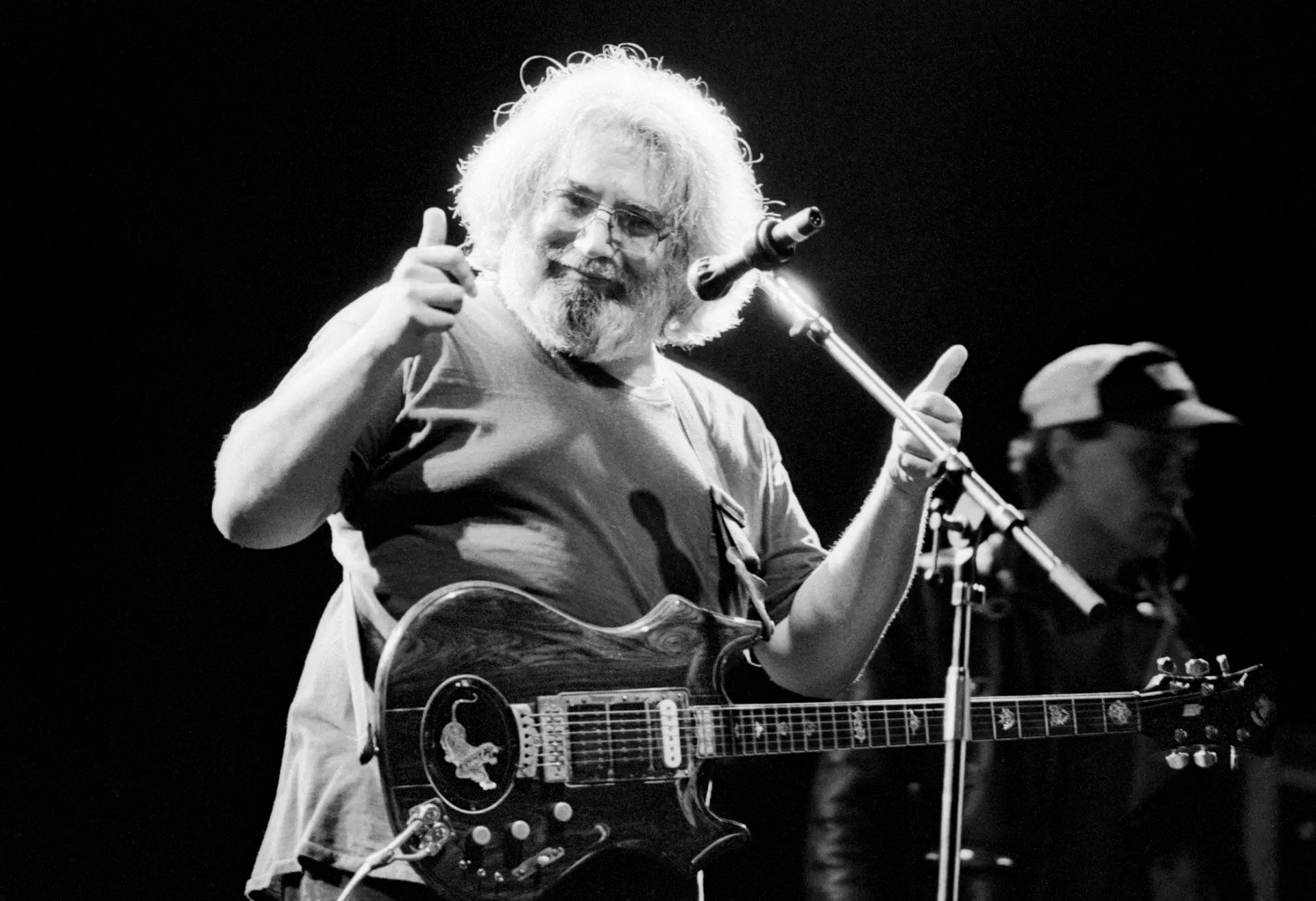
Jerry Garcia ambles into the hotel room overlooking New York’s Central Park. He appears relaxed, although in four hours, he will be on stage at Nassau Coliseum for the second of a three-night stand in mid-May 1980.
Garcia appears happy, and if being a major rock star has ever gotten to his head, he doesn’t show it. He’s as cordial as can be. Does he mind if the photographer shoots a few pics? No, go right ahead. Does he want to do the interview anywhere special? Wherever we want. He’s that kind of person, and as an interview subject is a delight, answering every question in detail, in an honest, forthright manner. And for someone in the eye of the hurricane, he has a remarkably acute understanding of its workings.
I’d like to start off with a general observation and hear any comment you have on it. That is, that most people, after experiencing the Grateful Dead, either love them or hate them. There is no in-between.
Well, that seems pretty cut and dry. [Laughs.] I’m aware of that phenomenon, I guess. What happens is that someone turns their friends on to us in the same spirit or sense that they would turn their friends on to pot. They turn them on because they have a good experience and they have a good time. It used to be real frustrating. I’ve talked to fans about this who have said, ‘Jesus, I invited 20 of my friends to this and you guys played awful!’ [Laughs.] That stuff used to happen to us all the time. We’ve gotten to be a lot more consistent. Now those people can bring their friends and at the very worst, they’ll get a nice, professional show. But I’m aware of that mechanism. The thing is that it’s an ongoing process. Our audience now has a very large number of 15, 16 and 17 year-olds. They’re kids who are obviously not from our generation but are every bit as enthusiastic about what we did as any of our audiences have ever been. Our audience is larger now than it’s ever been. It’s more vital now than it’s ever been, and we’re happenin’.
Do you relate to an audience of 15 and 16 year-olds today the same way you related to the kids that came to see the band in the ’60s, when you were a lot closer to that age yourselves?
Sure, ’cause they’re the same kind of people. They’re people that can dig what we’re doing. And it’s hard not to like someone who likes what you do.
How do you feel about the hardcore Dead fanatics who follow the band on a 25-city tour? Do you think that’s a healthy thing to do?
Well, it’s obviously very important to them. And more than that, it’s giving them an adventure. They have stories to tell. Like, “Remember that time we had to go all the way to Colorado and we had to hitchhike the last 400 miles because the VW broke down in Kansas?” For a lot of people, going to Grateful Dead concerts is like bumping into a bunch of old friends. There’s a vast network of Deadheads. They’re kind of like people who have come to know and recognize each other and it’s like support. Sometimes a person can find a ride across the country with a Deadhead, or stay over at somebody’s house, or any of that. So, that seems to function pretty well for them.
Isn’t it possible, though, that some people might put so much of themselves into the Dead experience that they lost a part of themselves in the process?
Oh, for sure. I know I have, so I’m sure it’s possible. [Laughs.] But our commitment to the idea is as deep as the most crazed Deadhead’s. So I don’t feel as though we’re burning anybody on that level. We continue to do what we’re doing.
It seems there are two basic types of Deadheads in a given audience. There’s the one who goes there to get high, dance around and have a good time, and the one who goes there to analyze, like by saying, “Well, that guitar solo wasn’t quite as good as the one he did in Boston in ’73…”
Right, the scholarly approach. The students of Grateful Dead music.
If you were a member of the Grateful Dead audience, which type do you think you’d be?
I could go both ways. There was a time in my life when I was one of those guys who toted around a tape recorder. I used to follow bluegrass bands around and record them. I was of the analytical bent. I was a comparer— this show was better than that and blah, blah, blah. But that was sort of a different me. I understand, though, and sympathize. I understand both points of view. I understand the sheer joy of being there, even if the music is not the best possible performance. And also, there are those times when it gets lucky, it gets special. Those are worth waiting around for. Those are the glue that holds us together, our glue-on particle, the possibility that something exceptional will happen musically.
How have the audiences changed the most over the years?
They’ve gotten bigger, that’s for sure. But for us, surprisingly, they haven’t changed too much. They respond similarly. The Grateful Dead audience is kind of like the Grateful Dead audience no matter what, and no matter where, either. That’s another interesting phenomena. European Grateful Dead audiences are not that much different than American Grateful Dead audiences.
Or Egyptian Grateful Dead audiences.
Right! Or Egyptian Grateful Dead audiences. It’s an interesting thing.
There’s always a lot of talk about a certain lifestyle or philosophy based around, or rather, attributed to the Dead. In your opinion, does such a lifestyle exist?
No. Not in a dogmatic sense. We don’t sit around and work out Grateful Dead dogma, or catma if you prefer. [Laughs.] Our trip is that everyone is entitled to believe what they want. There’s an old Prankster proverb that goes, “The mind believes what the mind believes.” Our experience has been the more the merrier. Like Hunter and I get reports on the contents of our tunes, which include incredibly complex interpretations of what the lyrics must mean and all that. And we find, “Wow! There was no intention on our part to include those things” but it’s lucky that kind of openness and range is available
That leads to a question I was going to ask later: Do you yourself actually understand all of Hunter’s lyrics?
I edit some of them mercilessly. Sometimes I edit the sense out of them. Sometimes they come to me and they are narrative in intent, but the narration itself will be 90 stanzas. That’s a little cumbersome for a song. [Laughs.] Hunter and I have a trusting working relationship, so he understands when I edit. Sometimes he’ll say, “Well, you’ve taken all the sense out of the song.” And I say, “Trust me, man, it’ll work out.” For me, my own personal preference, because of my background in folk music, is that I always like songs that hint at either a larger story or something behind the scene, shifting around. Maybe something not quite nameable. So I go for that. The raw lyric might be out front, but what we’ll end up with is something slightly more mysterious. And it tends to work out good because it leaves Hunter and me open doors. None of these started as conscious decisions. These are things I’ve noticed in process. Just because I have a preference for the ambiguous.
Is Hunter aware of this when he writes?
Yeah, he’s real aware of my consciousness. Real aware. He writes songs for me that say what I would have said if I had any kind of agility with language, which I unfortunately don’t.
Does Hunter usually write a song with the Grateful Dead in mind, or are some of the songs intended only for his own use?
You never know. Sometimes we’ve written songs and just completely forgotten about them because they just can’t be used. Sometimes we write them and record them and they turn out to be valueless because they can’t be performed. There’s no handle that we can get on them. Then, also, there’s the thing where a song might go into a dormant period, like we’ll record it and maybe forget about it. Then we’ll resurrect it in a few years, and start performing it and find that it has something. So, luckily there’s a lot of material to keep ourselves interested. We have a new guy in the band [keyboardist Brent Mydland] who’s writing. Weir and Barlow have been clicking. So all that is neat. We have more input and more stuff to work with.
A lot of Deadheads probably have some fantasy of what kind of person you are in private. Do you think they’d be disappointed if they knew what your offstage life is like, or would their idea be pretty much on target?
I have a feeling they probably know as much about me as I know about myself. Maybe more. They may be in a better position to be able to see. I might reveal more than I know. It’s difficult for me to know something like that. But when people write us letters I don’t get the sense they’re missing the mark. They know who they’re talking to. So that makes me feel good since our only tool of communication is our music and what we do. And when they speak to what they conceive of as the Grateful Dead consciousness, they’re usually not wrong.
Is there a difference anymore between the New York audience and the San Francisco audience?
Oh yeah. The New York audience is much more [makes a gorilla noise and raises his arms]. The San Francisco audience is equally dedicated, it’s just that the vibe there isn’t so urgent. Here there’s great urgency, all the time. I think life here is more urgent, y’know? So things are like that.
Do you ever format a show according to the location? In other words, are there certain songs you might tend to play in the Midwest or the East that you won’t play in California, or vice versa?
We don’t do it consciously but there’s an unconscious process, yeah. That’s one of the things we try to leave open, and that’s why we don’t plan a show. Like last night [5/14/80], they were ready to accept a radical shift in mood. They didn’t just want to boogie their heads off, which is sometimes the case. They were ready to go in any direction and that’s sort of unusual for a place the size of Nassau Coliseum and for this part of the country.
When you’re touring in tandem with the release of a new album, like you are now, do you ever try to make sure you include a certain percentage of material from the album?
No. [Laughs.] Sometimes that makes Clive [Davis, president of Arista Records, the Dead’s label] pretty unhappy. I remember when Shakedown Street came out, he came to see us one night at Madison Square Garden and we didn’t play a single tune from the album. We don’t do it on purpose. On this tour, we’ve been playing the new material a little more, mostly because we like it.
You’ve been playing with the same musicians for 15 years. Is it still spontaneous every time you get on stage?
It sure is. Totally unpredictable too.
Just from playing together so long, you get to know each other person’s musical habits. Don’t you know when, in a certain jam, Bob is going to do one thing or Phil is going to do something?
Not really. I never know, really, what Bob’s gonna do or what Phil’s gonna do. Those guys have an endless capacity for being able to surprise me. It makes it interesting. Plus, everybody keeps changing, too. So everybody keeps growing and keep changing and the whole thing is dynamic. Luckily, we don’t feel that we’ve peaked. We feel that we’re still on the rise. I have no idea where it’s going.
You were talking before about the shows being more consistent. Is it still obvious to you when a show is especially good or not so good?
No, it’s not so obvious to me anymore. I recognize also that I’m a victim of subjectivity just like we all are in the band. But there’s a great agreement now. For instance, if we have a good night, it’s more likely that we’ll all feel that it’s a good night. Rather than one of us having a great night and the rest of us having a lousy night. We’re all seeing more of the music all the time, so it’s more important how the whole music worked rather than how any one person performed.
Do you think the audiences are more objective now?
We can’t fool them. I don’t think that anything can be concealed. If we had a night that didn’t quite reach escape velocity, or whatever, they know. And it’s nice that they’re as patient and they cut us a lot of slack. We have a lot of slack. They give us a lot of room. We aren’t under any particular pressure to perform the Grateful Dead’s greatest hits, or anything like that. They welcome unfamiliar stuff. And I think any group could have been able to approach their audience in that way. It’s really just the matter of us making the assumption that the audience is intelligent. That’s worked for us. We have great freedom. We can go out there and play anything, really—all new stuff, stuff that nobody’s heard before—and the audience won’t go away angry, or disappointed. As long as they understand that we’re doing the best that we can and that’s our shot.
When the band re-introduces a song that hasn’t been played in a few years, is that ever because of audience demand? Like, if enough people started shouting out for “Dark Star,” would you play it again?
Sometimes that happens. But more often, it’s because we discover something about the tune that would be fun to do again. It comes from us, from our own personal preference. Then the audience is pleasantly surprised, or maybe unpleasantly surprised—"Why did they drag that turkey out again?” That can go either way.
Are there any particular Dead albums that you look back on and are embarrassed by?
All of them to some extent. Well, there’s moments on all of them that I feel good about and moments that I feel bad about. But by now, I’m so far away from the experience of the albums that I no longer remember what it was that used to annoy me so much about some of the records. Sometimes I have to listen to them again and try to reconstruct it, and then I remember, “Oh yeah, that’s right, I meant to do another guitar solo on that one. I didn’t mean to keep that one.” Things like that. They’re so minor. I never felt that we were a very good recording band. I think we’re just starting to get accomplished at that.
Do you see record-making as a necessary evil?
Well, it’s the only other alternative. What do you do with music? You either perform it or you record it. So, there it is, and the fact that there happens to be records and that we happen to be playing music is the only relationship. Otherwise, records are not really an appropriate forum for what we do. For one thing, the time element is not quite right. Our short songs are seven or eight minutes long.
About five years ago, there was some talk about just publicly releasing that huge vault of tapes that the collectors would die to get their hands on. Is that at all feasible as an alternative?
Well, maybe, but the problem is that we don’t have the time to administrate things like that. We have neither the time nor the manpower to do that. So, it’s possible that at some time or another we’ll figure out some way to do that. It doesn’t pay to make real time copies—it takes too long, for one thing. And it wouldn’t work to try to go through and edit things and make discs and pressings out of them, because they would all have to be kind of limited edition things. We haven’t really figured out a way to handle it. So that remains an archive more than a resource.
How would you compare the San Francisco music scene of today to the scene in the late ’60’s?
It’s actually hotter now. I think there are more talented groups and better players now then there were back in the old days. It just doesn’t have the big spotlight of publicity or of national attention focused on it. But it’s a very active scene. There’s that little magazine that comes out there, BAM, and there’s a lot of work around the Bay Area. There’s like 40 or 50 clubs that are open seven nights a week. There are some of the smaller record labels that are local to the Bay Area. It’s a pretty vital scene.
Can you see there ever being another Haight-type scene?
No, I don’t think so. I think the world is too paranoid for that much looseness to start to crop up anywhere, unless it’s very secretive. But, really, a lot of America is sort of transformed into some sort of extension of that. There are a lot of little rural pockets. Like we played up in Maine to all these hippies who ran off to live on the land, and have their little truck gardens and go fishing and all that. They’re basically living that other kind of life. We’re sort of the shock troops of that idea. They’re the support, the country cousins or something like that.
When you look back at some of the excesses in which the Dead indulged in the mid-’70s—the huge sound system, the stadium concerts, the record company you had—what do you think of all that now?
Well, they were good tries. We had to try. And we certainly learned a lot.
Why didn’t that all work out?
For a variety of reasons. We didn’t have the time or the output. For a record company to work, you have to have accounts going with distributors. In other words, they won’t pay you for the records that are coming in. When you send them the new batch of records, they pay you for the ones you already sold. So there’s this long credit overlap. And a lot of times they don’t pay. A lot of times, they burn you. And we got involved with records with uncannily perfect timing, just the year when polyvinyl chloride went up seven million percent and oil shortages started to break in heavy. So all of a sudden here we were having to dicker for virgin vinyl, which there is no more.
Do you listen to the radio? Are you influenced by any of the trends that are around?
Sure. I listen to everything.
Anything particular that’s turned you on lately?
Just the stuff that hit everybody. I like The Wall a lot. Everybody likes that. I’m a big Elvis Costello fan. I like Warren Zevon a lot. I mean, I’ve heard good stuff from almost everybody, just like I’ve heard bad stuff from almost everybody. I don’t think there’s anybody who’s consistently putting out great stuff, time after time after time. But everybody’s got something to say and there’s moments in all of this that are real excellent. I go for the moments. I keep listening till I hear something that knocks me out. Dire Straits—I love that band. It’s hard not to like that band.
Getting to the newest album, Go To Heaven, where did you find Gary Lyons, your producer?
We like his work with Wet Willie and some of the other groups he’s work with. So we invited him out and then we met, we clicked.
A lot of people got worried when they heard you were using the same person who produced Foreigner and Aerosmith. But he didn’t seem to affect the sound in any great way.
No. He understands. He understood what we were getting at musically. I think he’s the best producer we’ve had yet in terms of really having a commitment to the group, getting really into it. He’s not a standoffish guy and he’s not a guy who has a lot of English rock and roll affectations. He’s an easygoing guy.
How would you compare working with him to working with Keith Olsen [Terrapin Station] or Lowell George [Shakedown Street]?
I think that Keith Olsen has a technical upper hand on Gary. When we went to work with Keith, we moved into his world and did things his way. We did his routine based on the reality of what we were. He made an effort to understand who were as individuals, as a group, how the music was going, and so forth. And then, he put together his approach to how he was going to work with us, based on that.
Lowell was real loose, but he was also real busy. He wasn’t around for a lot of the record. The record was basically finished without him. So the production on that was really a three-way job. Lowell was there for the basics, but for the vocals and final overdubs it was really Dan Healy and John Kahn who were more or less functioning in the role of producer.
How has your attitude towards making records changed. Are you more serious about it now?
I sort of went through various cycles. I got to be very involved in knowing the studio. I spent a lot of time learning about it. That’s why I got my own board, my own machines. I function as producer on my own records, more or less. Then I got really bored with it. I think of recording as sort of a necessary evil in a way. I’m looking forward to a time when I can approach it differently, from a point of having more fun, and worrying about it less.
Is the making of a Dead record a democratic process, where everyone has an equal say about what’s going on?
Democratic is the wrong word for it. Anarchic is more like it. People have ideas and various way of bringing them up. Some people have lots and lots of ideas and then they go through the thing of experimenting with each of the ideas and say, “Is this gonna work with the tune, or this gonna work with the tune? Let me try this, let me try that. Let’s see if this is gonna work.” Others have one idea but they have tremendous conviction about it. So, since the studio offers you that kind of flexibility, we go both ways with that stuff somewhere between those two poles.
In the last few years, the band has often been the brunt of a critical backlash. Does it bother you to read someone saying that the Dead are past their peak?
It doesn’t bother me. I mean, it doesn’t affect us when we get good reviews, either. That isn’t what we’re doing. We’re not fishing for compliments. We’re so used to getting bad reviews on our records that we sort of look for them. The worst of ’em are more fun than a good review.
Last question: In a thousand years, when it’s all gone, what will the music history books say about the Grateful Dead?
Ha! I haven’t the slightest idea!