[This article appears in our special 132-page Bob Weir edition, which presents rare photography, archival interviews and new conversations that pay tribute to an endearing, enduring artist. We previously shared our Sturgill Simpson, Susan Tedeschi and Margo Price features from the publication.]
On January 10, just prior to taking the stage in Ann Arbor with his Pan-Detroit Ensemble, Don Was received some devastating news.


“About 30 minutes before the show, I got the call about Bobby,” he reveals. “Since we had announced that we were going to play all of Blues for Allah in the middle of our show for the whole tour, we had drawn a lot of Grateful Dead fans. So I had to go out and tell them that Bobby was gone, which put a real different vibe on the thing.
“The news totally took me by surprise. I knew he was sick, but I was under the impression that he’d pretty much beaten it. My last conversation with him was about what we were going to do this summer. He had ideas for arrangements and stuff.”
Since 2018, the renowned bass player had balanced his gigs as an in-demand producer and President of Blue Note Records with active touring responsibilities alongside Bob Weir in Wolf Bros. The group began as a trio, filled out by drummer Jay Lane, before gradually expanding to a five-piece with pedal steel guitarist Barry Sless (who was preceded during COVID by Greg Leisz) and keyboard player Jeff Chimenti, then adding a horn and string section dubbed The Wolfpack.
“At first, I didn’t want to go out and play,” Was says, as he revisits that unnerving evening, “but I remembered him talking about the night Jerry died and that he went out and played. So we went out there and it turned out to be really cathartic playing his songs and being in a room with like-minded people. We were out for six weeks after that and every show became kind of a mini-wake for Bobby. For me, it was quite comforting to have everybody around. I went out and met people afterwards and spoke with anyone who wanted to talk about him. Everyone’s got a story. It was real nice to just stay out in the crowd for about another hour and talk about Bob with people.”
As he ruminates on his friend and bandmate, Was offers, “He didn’t deport himself like anyone else I ever met. He was very poetic. One of the reasons it’s hard to accept his departure is that I saw him as being kind of a spirit. He always had one foot in that realm. He wasn’t marching through life, he was floating through it.”
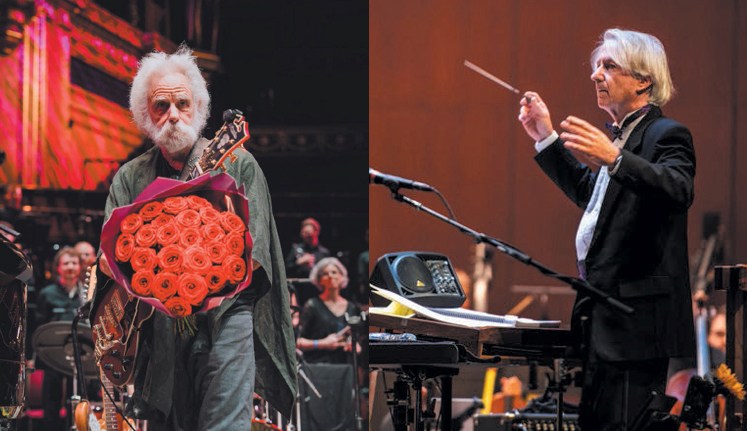
The final Wolf Bros show took place at the Royal Albert Hall with the Royal Philharmonic Concert Orchestra. Bob had been working towards that performance for many years. Can you describe how it all came together?
He had a real strong vision of what these symphony shows were going to be like, and he had it eight or nine years ago. When he described it to me, I had doubts. My fear was that the classical music fans weren’t going to accept it, and that Grateful Dead fans weren’t going to want to hear the songs done that way, so it was going to fall in a no man’s land.
The first show we did was at the Kennedy Center. It’s a pretty big way to try something out. You’ve got to be fearless for that to be the first thing you book.
Before the first performance we were standing backstage and everyone was pretty nervous. We didn’t know what to expect. Then the orchestra started the overture and we could hear yelling coming from the audience. We were like, “Is that some protestors disrupting the show? What’s going on?” When we took a look out, we could see that the Kennedy Center was filled with Deadheads and they were all up dancing as they were hearing the hints of the songs they loved in the overture. They were hooting and hollering for the thing while the ushers were going out of their minds.
That’s when I realized, “Oh, he knew all along how this was going to go.” I gave up questioning his instincts a long time ago because he was always right on. He had a real strong vision about things. He didn’t always know exactly how to achieve those ends but he was fearless about trying it out in front of people.
When we started Wolf Bros, I didn’t know what the fuck I was doing and it was kind of a mess, but he had patience. He said, “We’re going to go out, we’ll play for a couple years, and it’ll start to become what it is.” That’s a rare thing, someone being that comfortable to understand that it takes a while to develop something great and to have the patience to quietly steer it towards where it needs to go.
By the time we got to Royal Albert Hall, we had worked on some of the bugs. The biggest hurdle is that when you have an orchestral score, you can’t decide on the spot, “Well, this feels so good—these eight bars between the first chorus and the second verse—let’s just stay on this for a minute.” You have to come down in the right place, even if it’s not what you’d necessarily like to do in that moment.
However, Bob continued to work on ways to bring improvisation and spontaneity into the proceedings. One of the first things we discovered, for example, was that you could actually talk to the conductor during a song. I didn’t know that could happen. I thought that was some kind of sacred thing, but if you’ve got the right conductor, you could say, “Stay here. Stay on these chords for a while.” So we did that a number of times where he would call an audible and the conductor would have a way to convey that to the orchestra.
By Royal Albert Hall, even though we’d had a couple of mess-ups, we pretty much had it figured out. Of course, the audience was always patient. It’s like anything in that world of music. If you’re feeling something and you jump off the cliff trying to achieve it and you don’t quite get it, the audience is with you because they appreciate the fact that you’re trying to do something new and fresh for them.
Also, the orchestra at Royal Albert Hall was magnificent. With all due respect to all the other orchestras we played with, I never heard anything like that in my life. Charts are hard to play, and these guys were way on top of it. So the combination of the sound of the room, the skill level of the orchestra and the enthusiasm of the audience was something else.
The most memorable thing was that as we were taking our bows, he turned to me and said, “Man, I love this. I could die in this place.” I never thought that was going to be the last time we’d play together, but it was.
Bob was rarely effusive after a show. He would be thinking about what he could do better and what the band could do better. Well I never saw him like he was at Royal Albert Hall. I think he had fulfilled this quest to chase down the symphonic version he had in his head.
He felt that it was a way of making the music carry on. We talked about that a lot. He specifically talked to us about continuing to play these orchestra shows when he could no longer play. I think he felt it was a way to keep that music going. A lot of people talk about the 300-year thing. I don’t think it was specifically that it can’t be 299. He was just looking at classical composers whose work outlived them by centuries and he wanted the same thing for the Grateful Dead music.
Royal Albert Hall, 6/21/25 (photo: Chloe Weir)
After Jerry passed, Bob slowly began adding the Garcia Hunter repertoire to his RatDog shows. I assume that was because he felt an affirmative duty to keep those songs in the public purview.
I think that’s absolutely true. I can also tell you from my own experience, these songs have something special going on in them. Over the years of playing with Bobby, I felt that the songs had become like friends. If we didn’t play them for a while, I’d start to miss the songs. You don’t always feel that, but I think there’s something special in the writing, and not just Jerry and Hunter, but also the songs that Bobby wrote with Barlow and other people.
The first thing is they kind of roll off your fingers. Even the ones that seem really complex, like “Saint of Circumstance.” When he told me to learn that, I actually was kind of pissed—“Why do you have to have this extra beat in there? I don’t understand the point of going to 7/4 for one bar.”
“Weather Report” has got a lot of complex stuff, “Lost Sailor” has got a lot of complex stuff. “Estimated Prophet” was one that took me a minute or maybe a hundred minutes. [Laughs.] It took a while to wrap my head around playing a reggae song in 7.
But once you internalize what was going on, everything made sense and everything was there. Nothing stopped the songs. It all enhanced the songs. They’re beautifully written, and the stories and the characters behind them are of mythological proportions.
I think he probably didn’t want to stop playing the songs. Imagine not ever being able to play “Standing on the Moon” or “Stella Blue” again. So I think that’s one driving force. You just want to play them.
Wolf Bros began as a three-piece and eventually featured 10 musicians and the occasional orchestra. What prompted that evolution?
It all started out when Bobby had this dream in which Rob Wasserman came to him. Rob Wasserman is the guy who introduced us in the ’90s, and in this dream Wasserman came to Bobby and said, “The reason I introduced you was he’s supposed to take my place in your band when I’m gone.” He even dreamt the name Wolf Bros. Then he called me up the next morning, told me about the dream and asked, “So do you want to start something with me and Jay?” I was like, “Fuck yeah!”
I’d gone with [John] Mayer the first time he went to jam with them for what became Dead & Company, so I knew there were at least 150 songs to draw from. As a result, I said to Bobby, “Don’t ask me to learn the 150 songs. Just give me six songs to learn.” That’s what he did, and I locked myself in a room at the Bowery Hotel with a string bass for 10 days where I did nothing but play these six songs until they were etched into my soul. Then I flew to San Francisco with the bass I had using to practice. I came in, and Bobby didn’t call any of the six songs. [Laughs.]
We just started jamming on an A minor chord and we played for about 20-25 minutes. It immediately was clear that Jay and I felt the time in the same place. We could lock together and get a groove going. That doesn’t always happen. In fact, it doesn’t happen most of the time. So there was something special there, and I also found that Bobby and I could feed off each other a little bit.
At the beginning, I wasn’t sure what we were doing. Wasserman was a virtuoso. He was like a lead guitar player. I had no idea what he was doing. He had a very unique approach to the bass, as did Phil. So those were the two people I had to listen to, and I couldn’t figure out what they were doing or how I was going to play like them.
I didn’t want to do a karaoke version of their parts because, first of all, there are no parts. Phil played it differently every single night. There was no set part for anything, and I was kind of haunted by that. We got a couple shows in, and I was playing a lot of stuff before Bobby finally said, “You don’t have to play all that, and you don’t have to try to imitate. If you want to know the correct way to play these songs, it’s to be yourself. Don’t play it like Phil played it.”
So that gave me some confidence. Then the three of us played together for nearly two years before we got the balance right. The idea was to give Bob room to inhabit the characters. What that means is don’t fill up all the space so that he can phrase differently every night and tell the story in a fresh way. A lot of it was about accompanying him without boxing in his storytelling as a singer or as a guitarist. He wanted room to stretch, but he wanted a musical conversation going on. So it became more refined as we went along and we locked it in.
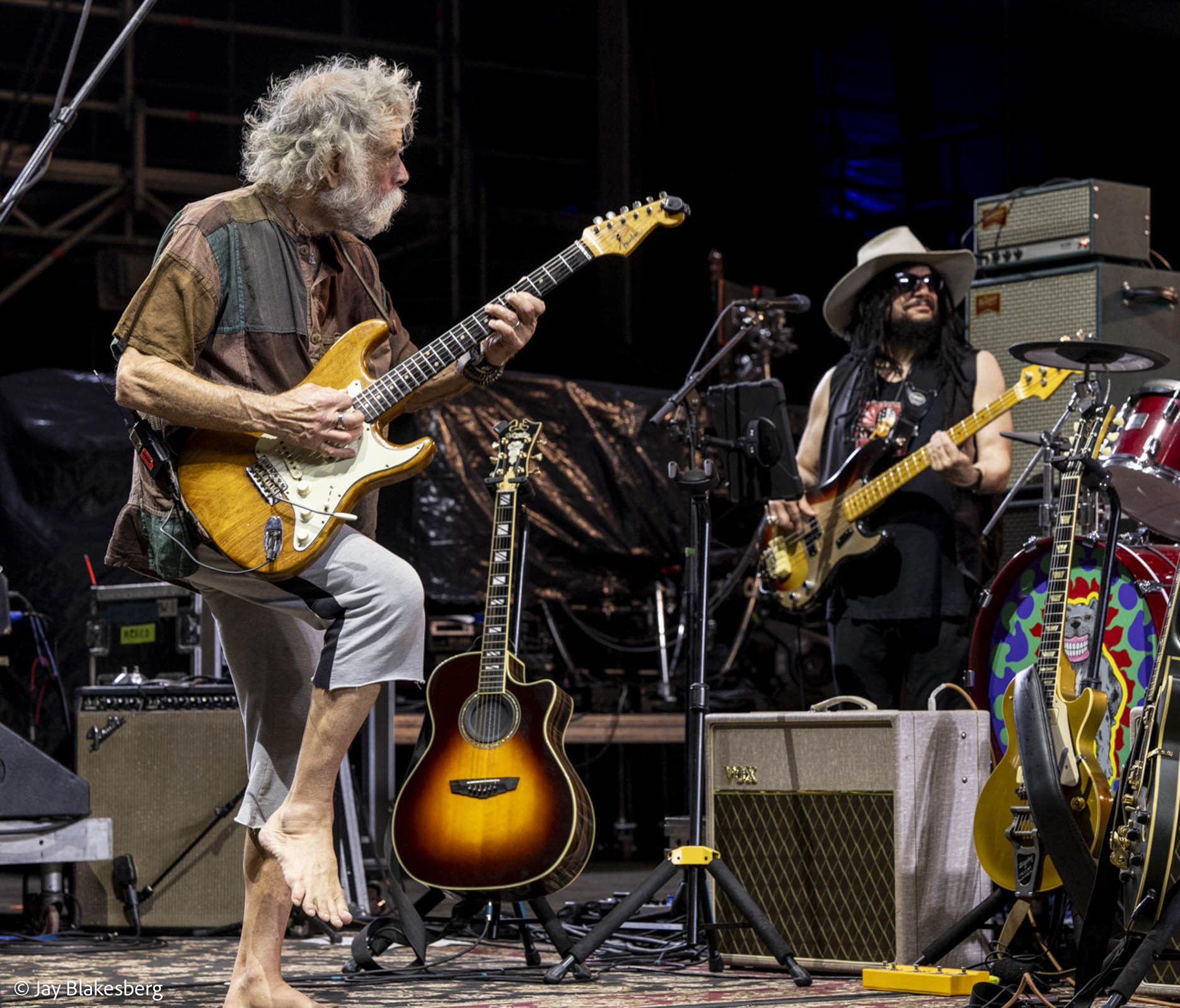
To me, when Wolf Bros started, it became an intimate night with Bob Weir. You got to hear his guitar playing without it being surrounded by lead guitar because what he plays is so interesting. It’s so unique and unpredictable and vivid and highly expressive. I can’t say enough about Bob’s guitar playing. I don’t know anybody who approached the instrument like him. What he chose to play was always a surprise and a delight to react to.
Then, during COVID, every other weekend I would drive up to TRI and hang out. We jammed and different people came to play with us, like Greg Leisz and Jeff. We were looking for new avenues and it seemed like we could expand the palate of colors a little bit and keep that intimacy going.
When the symphony entered into it, Bobby wanted an element of improvisation to carry over into the orchestras. He was looking for ways to do that, but one of the things he thought of was getting four or five people who could sit with the orchestra but also stand up on these songs and improvise.
We tried it one time with an orchestra to test the charts and Bobby said, “If any of you are hearing something, just play it. If you want to veer off the charts, that’s fine. You hear something extra to play, play it.” At that point, when I turned and looked at the orchestra, I never saw so much fear in my life because it was the exact opposite of everything that they knew to do.
So The Wolfpack was brought in to be ringers in the orchestra who’d stand up and stretch out at a given time. But the orchestras don’t want that. They wouldn’t allow them to sit within the middle of the viola section and solo, even though the members of The Wolfpack were all trained orchestral musicians and could have done it. They did play along but they had to sit in a different place. We just enjoyed it so much that we started playing shows like that.
Jeff Chimenti, Jay Lane, Bob Weir and Don Was at the Kennedy Center on 10/9/22 (photo: Jay Blakesberg)
Going back to the Grateful Dead days, I feel like it took a while for people to catch up with Bob’s guitar playing.
I think so too. I liken it to a conversation, you’re just using notes instead of words. Who do you want to go to dinner with? Some guy who talks in a monotone voice and has nothing original to say or someone whose conversation is so fascinating that you don’t want him to stop speaking during the meal. Bob was a brilliant conversationalist on the guitar and part of it had to do with the way he could put contrasting moods together.
Bobby could play sophisticated voicings that he’d picked up from McCoy Tyner. He could maneuver around like Segovia, or he could be really raw, like Jimmy Reed or John Lee Hooker, all within the course of a minute. So he’d constantly surprise you.
Playing a show with him and bouncing off his guitar was the equivalent of going to dinner with the most fascinating conversationalist—someone who would hold your rapt attention because he was so interesting. That’s what he was like on the guitar. No one played like him. There were no clichés. He was unmistakable all the time.
You mentioned preparing those six songs for the initial Wolf Bros rehearsal, which Bob didn’t play. Tom Hamilton recently described a similar experience before his first appearance with Bobby. What do you think accounts for that? Was it a prank, a test or something entirely different?
I think he was deliberate in that he knew that once you started thinking about what you were going to play, it was all over. You might as well go home when people start thinking. So if you rehearse something but don’t play it that night, the rehearsal of it allows you to understand the basic relationships between everybody on stage and sets a framework for how the thing can go.
Then if you call new songs that people haven’t played, they stay fresh and have to rely on instinct. No one’s reading a chart or playing what they played before. I guess that was the biggest rule: Play anything except what you played last night, because no one else is going to be where they were last night. If you try to repeat that you’re going to be out of step with everybody.
Jay would never play the same beat twice on the song, so there was no point for the bass player to have a part in mind. That’s why if you’d see the band vamping—you’d see that it in Grateful Dead, Dead & Company and Wolf Bros—we’d be starting a song and holding on one chord until we fell into the groove of the night. Then once we got to that point, we could play the song. So even though there was structure to the songs and there were right chords and wrong chords and the songs were kind of laid out the same from night to night, how you inhabited them was completely different every time.
So I think that’s what it was. If you rehearse something, then you had something to fall back on. Sometimes we’d soundcheck on a song that we weren’t going to play that night, and it kept what we were going to play that night fresh.
Back to the orchestra, what did Bob have in mind to advance the improvisational aspects of those performances?
He was working on ways to ease the orchestra into something improvisational. One of the things he wanted to do was have it be like those choose your own adventure books where you’d get to a page and then you could decide how you wanted the plot to continue.
Bob was working on setting up iPads with colors. So there’d be a red way, a green way and a yellow way through the song that you could call on the spot. You could turn to the conductor and say, “All right, red.” Then everybody’s iPads would change and that would be a new way through the song. It was a way to call an audible during a show and not throw the orchestra off too much.
So that was a start and we’d also started working with a couple of conductors who understood what Bobby was trying to do and who were open-minded. I think ultimately he would have gotten to a place where he could give the conductor a signal and it would mean something. I think he’d have found a way.
Final question: As you sit here now thinking of Bobby, what image occurs to you?
My favorite times in the Wolf Bros outside of the shows were at the beginning, when it was just the three of us. After the show, we’d get on his bus for a while. Jay and I shared a bus. Bob had his own bus, but we’d get on his bus, and we’d ride for a couple hours and just listen to music. I was the DJ. We’d use my iTunes, but everybody could call a song to play. We would just listen to stuff, like all the different versions of “Shake, Rattle and Roll” and admire original approaches and great feels, looking for people who were sincere and original in what they were doing.
I can picture him sitting there in the same stuff he wore on stage, the kind of yoga pants and the serape. He was the same guy always, whether he was playing or doing that. He was so enthusiastic about music and he loved listening to records. That’s what it all came down to. We were just guys who loved music and those were the best times, sitting up at three in the morning, driving across America blasting songs.