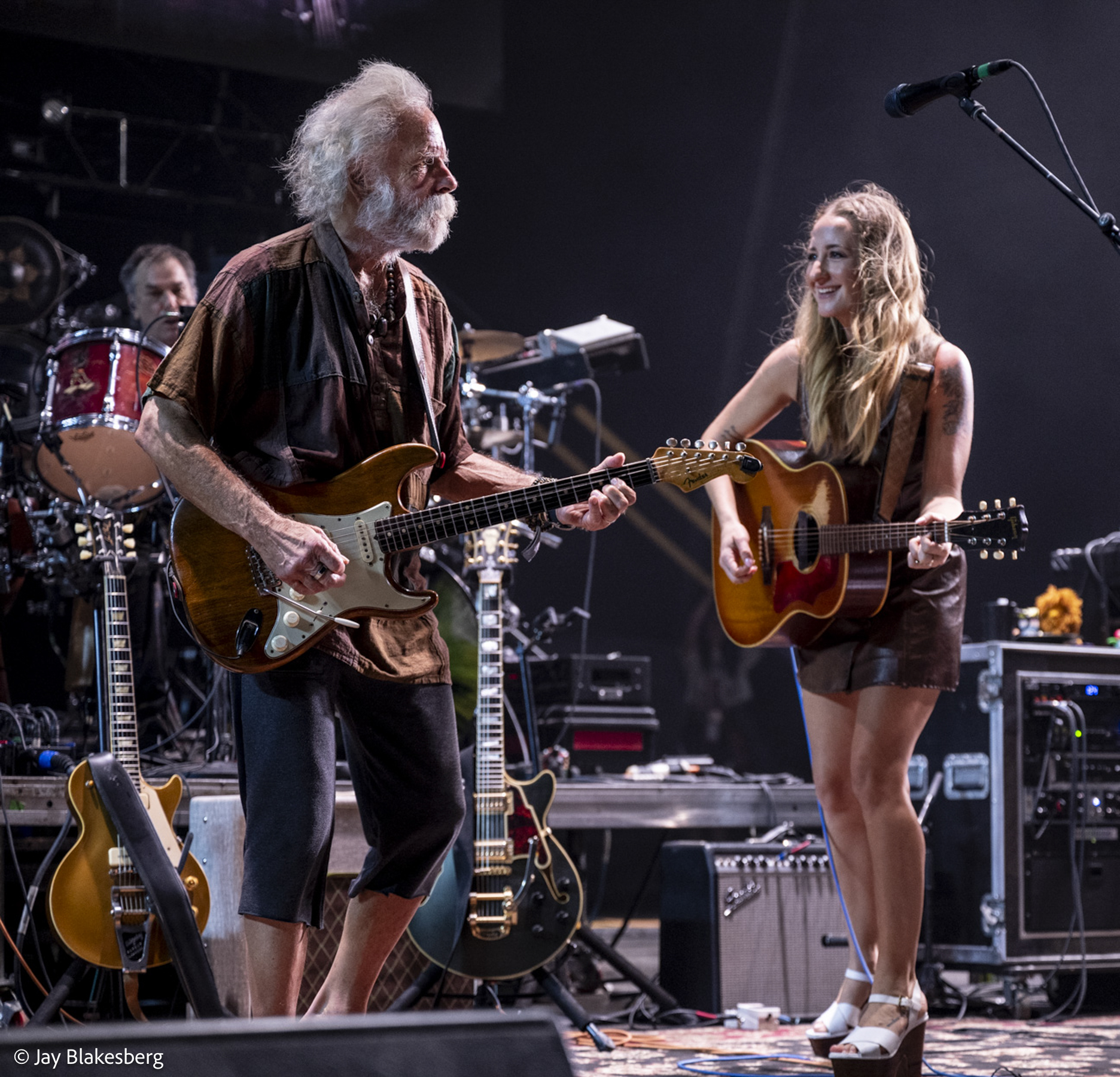
[This article appears in our special 132-page Bob Weir edition, which presents rare photography, archival interviews and new conversations that pay tribute to an endearing, enduring artist. We previously shared our Sturgill Simpson and Susan Tedeschi features from the publication.]
On the day of Bob Weir’s passing Margo Price offered an eloquent ode to the man and musician who contained multitudes. After learning the news, Price wrote, “Getting to know Bob Weir over the past decade was a gift. Bob was a sage—a profoundly wise musical guru who taught me so much about songs, art, melody, meditation and being in the moment. He was unlike most rock stars in that he was unpretentious, deep and rooted in knowing who he was. Bobby vibrated with magic. He was both ancient and young—he always had a twinkle in his eye. Like a barefoot philosopher or the Lorax, he was mystical. He spoke for the trees.”


He also vouched for Price.
In November 2018, Weir invited her to perform with Wolf Bros at the Ryman Auditorium.
“That first time I sang with him at the Ryman, he had so much faith in me to let me come in and join him,” she says fondly. “He really championed me as an up-and coming songwriter, which was unreal.”
Weir continued to offer his approbation, bringing Price to the stage on assorted occasions, including two additional years at the Ryman, as well as a Dwight Yoakam tribute, a 90th birthday salute to Willie Nelson and Cancun’s Dead Ahead 2024.
“I have a lot of good memories from the Mexico trip that we all had together, and singing ‘Attics of My Life’ with him and Don and Sturgill,” Price adds. “It wasn’t perfect, but it was beautiful to sing those songs and to be with him. I was just thinking how lucky I was to get to spend time with him and make music with him and really get an insight into how he created. He never got stagnant because he was continually moving.”
One trait that I think you share with Bob is that he occupied his own space in the world and remained true to it even as he embraced new ideas and objectives.
Bob was so magical and whimsical. He was truly in love with the craft and never seemed to stop growing within the music and within himself.
He was also present. We’re living in a time when it’s really hard for people to give you their full attention. Everybody is kind of lost in their phones. I mean he did have a phone, and we would communicate through texting and calls and stuff. But he would lead me through some of those meditations with his band and it was really unpretentious. He was still doing some psychedelic journeys in those days as well.
There was definitely a rock-star quality to him, but he was just very much there for the music. He was always trying new songs and different approaches and never doing the same thing twice. You could have a rehearsal and practice something and later it would take on a different shape and a different life of its own, but it was all very much with intention.
I’ve heard a couple stories from artists who described working up songs with him and then the onstage performances veered away a bit from those arrangements.
We’d have rehearsals and soundchecks and he would be like, “Well, if the soundcheck’s too good, then the show’s not going to be good.” He had some quirks about that.
Other times, he’d say, “OK, I’m going to take the first verse, you take the second verse,” and when we’d get out there, he’d point at me on the opposite verse. I’d be like, “OK, I’ve got to get my shit together.”
I think one of the first times I ever played with him, we were doing “Hard Rain” by Dylan. I was so impressed. He did not have a teleprompter out there and most people his age, and most people who were younger than him, if they were going to do material that wasn’t theirs, would definitely have a teleprompter. But he impressively remembered all of “Hard Rain.” It was different than it was in the soundcheck, but it turned out even better.
Somewhat similarly, after Jerry Garcia passed, Bobby eventually began to take on that catalog and honored the songs while vesting them with his own identity as well.
I only knew him post Garcia’s passing, but he was so determined and so willing to just take everything that he learned in the Dead and keep experimenting.
I remember we were performing together at this Dwight Yoakum tribute, and we were playing “Fast As You,” which is such a cool song. He was going to take a verse, we were going to sing choruses together, I was singing a harmony, and then I was going to take a verse. I was like, “I really can’t sing it in this key.” So I asked him to change it, and he was like, “We could change it for sure but why not just make up your own melody? What really matters is the story you’re telling.” Then he explained that’s what Aretha Franklin used to do when she was thrown into singing these more male keys. When he told me that, it opened this whole door in my head because previously I’d been singing along to records and just singing a harmony.
It was so insightful and it gave me this new confidence if I would be thrown into a situation where I was singing on a key that was not comfortable for me, like if I was singing “Paradise” with John Prine. I would just make it my own and sing where it was comfortable for me because what’s really important in that situation is telling the story. Bobby taught me that and it has definitely stuck with me.
In 2022, you interviewed him for your Runaway Horses podcast. You already knew him pretty well by them. What did you discover in that context?
It was insane interviewing Bobby. I had spoken to him so many times in green rooms and I was always trying to pick his brain about one thing or another. But it was very nerve-racking because this was being recorded and there were all these people listening in.
The kind of funny story is that I had been on a microdosing journey over the past seven years, on and off, trying to help with my depression and some stuff. So that morning I took what I thought was a microdose, but it was a new kind of strain or something from my guy. So I was almost tripping a little bit. I hadn’t eaten very much food and then when I was talking to Bob Weir on a Zoom call, I was very emotional during the whole conversation.
I learned so much during that conversation and I loved talking to him about psychedelics. He’d never done any kind of guided journey and he’d always say, “Oh, I like to cowboy it a little bit.” I like that style and I had gifted him mushrooms several times, and taken mushrooms with him on his bus. It’s just insane to be able to say, “I tripped with Bob Weir!”
He let me ride on his bus where it was pretty much just him, his wife and his daughters. Just being in his orbit for the last almost decade was so special. I love his family and I’ve had some incredible, deep conversations with all of them. I just feel really grateful that I got to know them.
I was able to hear stories from him of those early days and it was so surreal to be able to talk about different musical genres. I can remember asking him if he identified with country music and genres in general.
He was so insightful. He felt that genres were useful insofar as the further he could push something while staying within those limits, the more success he felt he’d achieved.
He was always saying, “One of these days, I’m going to make a country record and I’m going to push it to the limits because I grew up listening to country music.”
He was working on an album and had a recording setup in the back of his bus. It was quite impressive. The first time I saw it, I was like, “Whoa, you got a full rig back here.” It was insane.
So he was working on this album and from the way he described it to me, it seemed like a whole concept album. It just sounded like there was a crazy circus with a lot of different characters. I wonder if that album’s going to come out. As a fan, I really hope I get to hear it.
You mentioned psychedelics. I think back to when he was 17 and ingesting a fair amount with his bandmates. How do you think that reverberated over the decades to follow?
I think people don’t understand how powerful psychedelics can be. Even when you’re on stage and you’re not taking any psychedelics together, when you’re on stage with people for that long, you get a telepathy. I know this because I was with some members in my band for 13 years. You get this communication with your eyes, with just subtle motions. It’s such a special thing.
But with the Grateful Dead, they were pioneers in experimenting with some of that stuff. Lately with my band, we’ve been taking some mushrooms before we get on stage. I think it’s a way more potent medicine than just boozing and Bob also told me about taking ayahuasca, peyote and other things.
I mean, he went deep. I remember walking around and he was barefoot moving through the desert. He really was this whimsical kind of guru that you just were like, “How can he even be real because he’s so just effortlessly grounded?”
I believe that to his mind, through all of that, he was having experiences that would serve the music.
He was just more tapped in than other people. I had this incredible experience with him and Ramblin’ Jack Elliott. Bob was bound and determined that he was going to write a song on stage with Ramblin’ Jack, Peter Rowan and me. He kept saying that to Ramblin’ Jack all day long, who was like, “No, you’re not. I’m not writing a song today. I haven’t written a song in a long time and I’m certainly not writing one on stage.” Bob was like, “Oh, we’ll see. We’ll see about that.” And Ramblin’ Jack kept telling him, “No, we won’t.”
Then, sure enough, when we got up there, everybody sang the planned songs, we did some covers and just jammed. We’d all sort of run the gamut, and then suddenly, Bob somehow coerced Ramblin’ Jack into this talking blues. He completely wrote a song in front of the whole audience.
It was unreal how he pried that out of him. Nobody else could have achieved that. Bob not only made him want to do it, but then he couldn’t get him to shut up once he started. [Laughs.]
It had been absolutely surreal sitting and having dinner with both of them and watching how much Bobby idolized Ramblin’ Jack, who was like 20 years older than him. It was cool to see Bobby look at somebody the way that we were all looking at Bobby. Of course I also love Ramblin’ Jack, who’s an absolute legend.
Can you talk about what you picked up from Bobby as a guitarist over the years?
When we would play things together, he would do this double-bassline thing by doubling the guitar and really stacking things and making it thick.
I had been playing a good amount of electric at the time and he was like, “I don’t think you should be playing that Tele. You should be playing a hollow body, something that’s a little bit more similar to an acoustic.” Then it was insane because he made me this custom D’Angelico guitar, gifted it to me and was like, “I hope you get some good songs out of this.”
I looked up to him so much as a rhythm player, but he did come into his own as a lead player. It also inspired me to see somebody who was kind of the backbone of everything. I’m a rhythm guitar player too. I play a lot of cowboy chords, I don’t do a lot of lead. I don’t do a lot of fancy stuff, but being in that pocket and being kind of the glue between the percussion and all the auxiliary instruments, he was always holding it down in there. Everything he was playing was just so thoughtful and such a masterclass in how to play guitar.
How would you characterize his songwriting?
Picking his brain on genre was so interesting because there was nothing that was really off limits for him. He would draw on country, blues, pieces of folk music and obviously psychedelia, along with everything that he had been brought up on, like Little Richard and the early rhythm-and-blues stuff that he loved so much. It was all just a melting pot for him.
I think if the Dead was out there today, people would probably say, “Oh, they’re an Americana band.” Otherwise, how do you classify it?
Bob’s songwriting was the same way. He was such a great storyteller and had such a thoughtful, melodic basement that it made lyrics come alive. Bob had such a great lyrical relationship with John Perry Barlow with all those songs like “Cassidy.” It was magic and you can’t have a great song without one or the other.
Those songs and those lyrics are haunting. For me, they go beyond genre and beyond getting locked into one thing. It’s incredible storytelling and it should be mandatory listening for anyone who wants to make music.