Jazz Fest is also defined by its culinary sensations.
This article is part of our 50 Years of Jazz Fest celebration and appears in the special Collector’s Edition April/May 2019 issue of Relix. Subscribe here using code NOLA50 and get 20% off.
Louisiana native Cindy Hart visits the New Orleans Jazz & Heritage Festival for a deep dive into the music, theart and the swirling party. But what really gets her excitedto go back, year after year, is the food.
“Sometimes I don’t know if I’m buying a ticket for the music orfor the food,” says Hart, who was raised eating gumbo on BayouLafourche, not far from the city.
“The difference with this festival is you have chefs and peoplewho really know how to cook. It’s the Louisiana way,” she adds.“They want to make you happy with their food, just like the peopleon stage hopefully want to make you happy with their music.”
Jazz Fest is a rite of spring in New Orleans, attracting huge names from the music world as well as a variety of Louisiana talent to its stages. It also draws deeply from the region’s robust food culture, imbuing Jazz Fest with a dual identity as a place to feast. The hearty gumbo and meaty jambalaya, the po-boys built on crusty French bread, and the way crawfish, shrimp, catfish and oysters turn up in crazy abundance for classic dishes are signature parts of the Jazz Fest experience. “I’ve never been to another festival where the food had such a strong connection to the city,” says Robert Johnston, a New Orleans fan who rarely misses a day at Jazz Fest. “It’s totally fundamental to it—Jazz Fest food is inseparable from the festival.”
Indeed, the food is a major part of the “heritage” in the New Orleans Jazz & Heritage Festival name. Repeat visitors have their favorite dishes, which they pursue as rituals of the event. When it’s time to eat, they’re not just filling up between sets. They’re reconvening with touchstones of the experience, whether they carefully haul a collection of dishes back to their spot by a stage or just dig in with abandon right there by the food stands.
Through the years, and over generations, there has been a remarkable continuity to the food at Jazz Fest, which has helped traditions grow.
It’s common at other annual festivals to see a flux of new vendorsand changeable dishes each year. That’s not the case at Jazz Fest.
Many food vendors have been part of the event for decades. Fresh dishes occasionally appear, but the vast majority of the menu at Jazz Fest has remained tried and true through the years. More than 60 independent vendors, who are closely managed by Jazz Fest staff, are responsible for the event’s eateries. The culinary team constantly assesses the quality and consistency of their offerings and they select new vendors and dishes with a curatorial eye. It all reflects the importance of the food aspect to the overall festival experience.
“Sometimes it feels like a food festival that also has music,” Jazz Fest staple Jonathan Walker says with a laugh.
Walker is a vendor whose family sells the cochon de lait po-boy, a sandwich that has earned a cult following at Jazz Fest. It’s oneof more than a dozen po-boys served around the grounds, but thisdish is different from the po-boy shop classics of fried shrimp orgravy-soaked roast beef also served here.
Cochon de lait (“pig in milk”)refers to the suckling pig thatis the mainstay of a traditionalCajun hog roast. The Walkers,who do business at the festivalas Love at First Bite, evolved therecipe to deliver smoky, tender,crisp-edged pork, and enough ofit to field thousands of po-boyseach Jazz Fest day. It’s all packedinto airy, crusty pistolettes andfinished with creamy, crunchycoleslaw.
It may sound simple, but the combination has proven to be a compulsive hit, blending rural Louisiana flavor with a festival-friendly po-boy format.
“People tell us as soon as they get in here that they don’t run tothe stage to drop their chair anymore. They run to our stand to gettheir first po-boy,” says Walker.
The name Crawfish Monica is also a Jazz Fest headliners every year. Order one and you get a bowl of curly rotini pasta gleaming with a spicy cream sauce and studded with crawfish tails. Named for the creator’s wife, Monica Davidson, it has inspired countless interpretations at New Orleans restaurants, which serve their own variations throughout the off season. But each year at Jazz Fest, crowds still line up for their annual audience with the original.
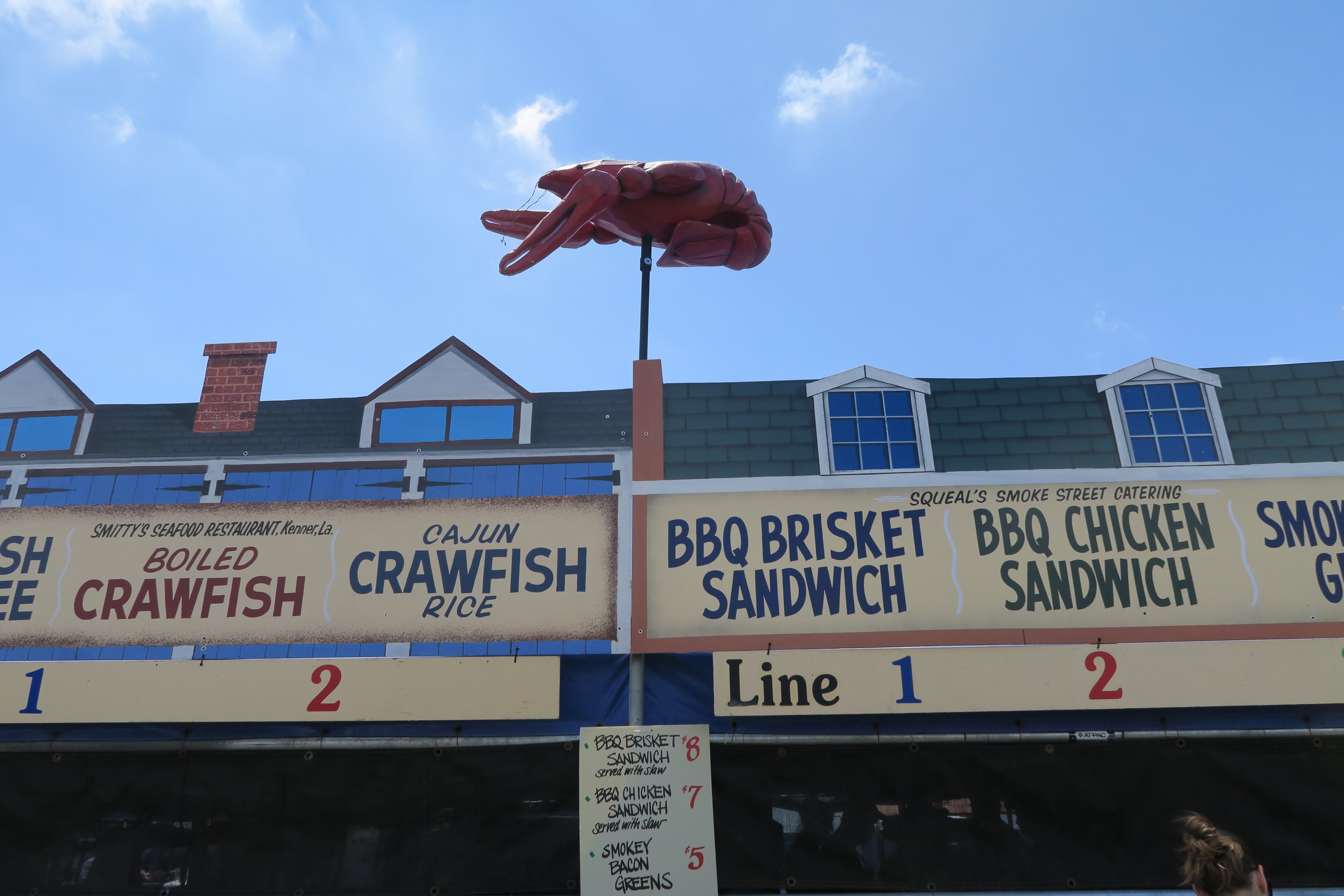
Crawfish is staple at many of the booths around the festival grounds, and it’s only one of the ingredients that keeps the food intrinsically tied to Louisiana, the wellspring for most of America’s crawfish harvest. Around NOLA, you’ll find baskets of boiled crawfish to peel and eat. (Pro tip: suck the heads for the maximum blast of flavorful juice.) Crawfish is cooked down like stew for étouffée and stuffed into savory little crawfish pies the size of your palm and perfect for snacking on the move. It goes into crawfish bread, which is like a Cajun calzone stuffed with cheese and peppery spice. And crawfish inspires what might be the most head-turning combo plate at Jazz Fest. Local catering company Patton’s assembles a one-plate banquet of savory crawfish beignets (puffy fried dollops of spiced batter) and crawfish sacks (neatly tied fried purses filled with crawfish), along with oyster patties (the little towers of puff pastry with creamy oyster sauce).
This food would be equally at home onthe white tablecloth of a French Quarterbistro. The same holds true for any numberof elaborate seafood dishes at Jazz Fest,like the pecan catfish meunière with a sideof seafood mirliton casserole from localrestaurant Gallagher’s Grill.
Other dishes could have come from achurch picnic, like the classic fried chickenand jambalaya combo from CateringUnlimited or the barbecue ribs with meatywhite beans and coleslaw from Down HomeCreole Cookin’, a Baton Rouge outfit thattravels for the fest each year.
Still, when it comes to festival foods,it’s hard to beat the po-boy. The soft shellcrab po-boy from the Galley restaurantis a Louisiana specialty that has becomeinseparable from the Jazz Fest experiencefor many. It’s a big bite of Gulf Coastseafood bounty, a whole crab and all ofits sweet meat under a fried crust on thatdistinctively crunchy local French bread.Another is the Creole hot sausage po-boy, ablend of pork and beef and spice from theVaucresson family, who have been part ofJazz Fest from year one.
Like the Vaucressons, many of the foodvendors around Jazz Fest are part of familybusinesses that run restaurants or cateringoperations the rest of the year. The Baquetfamily is another prominent example. In thebusiness since the 1940s, the Baquets havegrown into one of the longest-running blackrestaurant families in New Orleans, andtoday operate Li’l Dizzy’s Café in Tremé, anessential neighborhood hub. For Jazz Fest,they go all out, serving a tour de force ofCreole flavor.
“This food is very important to us,because it comes from our family recipes,”says Wayne Baquet, proprietor of Li’lDizzy’s. “It’s the Creole food of NewOrleans. It’s who we are.”
That tradition takes theform of crawfish bisque, anold-fashioned stew finishedwith the shells of crawfishheads stuffed with breadycrawfish dressing; seared fishunder a buttery crabmeatsauce; and the Baquet family’sCreole gumbo. This is “kitchensink”-style gumbo, made withseveral types of sausage, sweetshrimp and hunks of crab, stillin the shell but with its essenceseeped into the roux.
Around Louisiana, no two gumbos are exactly the same, which is why Jazz Fest offers three different versions for a regional showcase of the essential dish. There’s also a deep, dark Cajun-style gumbo from Prejean’s, a Lafayette-based restaurant, made with quail, duck and andouille sausage. The third comes from “Fireman Mike” Gowland, who was a New Orleans firefighter when he started cooking at Jazz Fest. His gumbo has shrimp, okra and andouille, and aligns more with Louisiana’s bayou cooking tradition.
In addition to the local restaurants and family operations, some of the stands benefit local nonprofits. For instance, local community radio station WWOZ, a fount of Louisiana roots music, is in charge of one of the festival’s signature treats, the mango freeze. It’s a sorbet, served by the scoop from a number of stands, with a bright, tropical color, a mellow fruit sweetness and an unparalleled potential to cool you off on a hot day under the Louisiana sun.
Each year, the United Houma Nation, an indigenous community based in Louisiana’s bayou country, serves up traditional dishes like fry bread, a puffy-crisp disk of dough topped with sugar (or made into the group’s Indian taco with seasoned beef, cheese and salsa). The United Houma Nation is also known for its macque choux, which resembles a succotash with corn and smoky sausage or shrimp and is a light and rejuvenating dish.
When it’s time for something sweet,Jazz Fest vendors offer a taste of the streetfood traditions of New Orleans. Pralinesand mini sweet potato pies—staple snacksof the city’s street parade culture—are alsowell-represented at the Fairgrounds.
Sugar-dusted beignets and café au lait from the famous French Quarter institution Café du Monde sometimes stand in for Jazz Fest breakfast. The sugar and caffeine could also be a well-earned midday coffee break from the fest. There is a lot of eating to do here. Eventually, everyone needs a boost.
A Few New Orleans Regulars Reflect on Their Favorite Festival Flavors:
DAVE MALONE, THE RADIATORS
I always get the crawfish tamales and the smoked quail and pheasant gumbo—and the jama jama. There’s also a Vietnamese stall near the Gospel Tent that kicks butt.
TARRIONA “TANK” BALL, TANK & THE BANGAS
Every year, I go to the same two places without fail. My Aunt Tina used to work at the crawfish bread spot for years, and I’d always go there. I don’t even like crawfish bread, but my family was there. Next is the jambalaya and fried chicken spot. I still go there right after I perform! My family is there too, and they always have a hot plate for me.
SAM WILLIAMS, BIG SAM’S FUNKY NATION
Crawfish Monica, crawfish beignets, crawfish bread and meat pies are my favorites. You can never go wrong with those. Also, anything by Ms. Linda.
BIG FREEDIA
Get the white chocolate bread pudding at Ms. Linda Green’s Ya-Ka-Mein booth. There are usually a couple of people who make it, but it’s to die for!
WALTER “WOLFMAN” WASHINGTON
I request that good jambalaya. I like the one with sausage. I never learned how to make it on my own, but I wish I had.
AARON NEVILLE
The crawfish étouffée is my favorite. I wish I could get it every day.
This article originally appears in the April/May 2019 issue of Relix. For more features, interviews, album reviews and more, subscribe here.