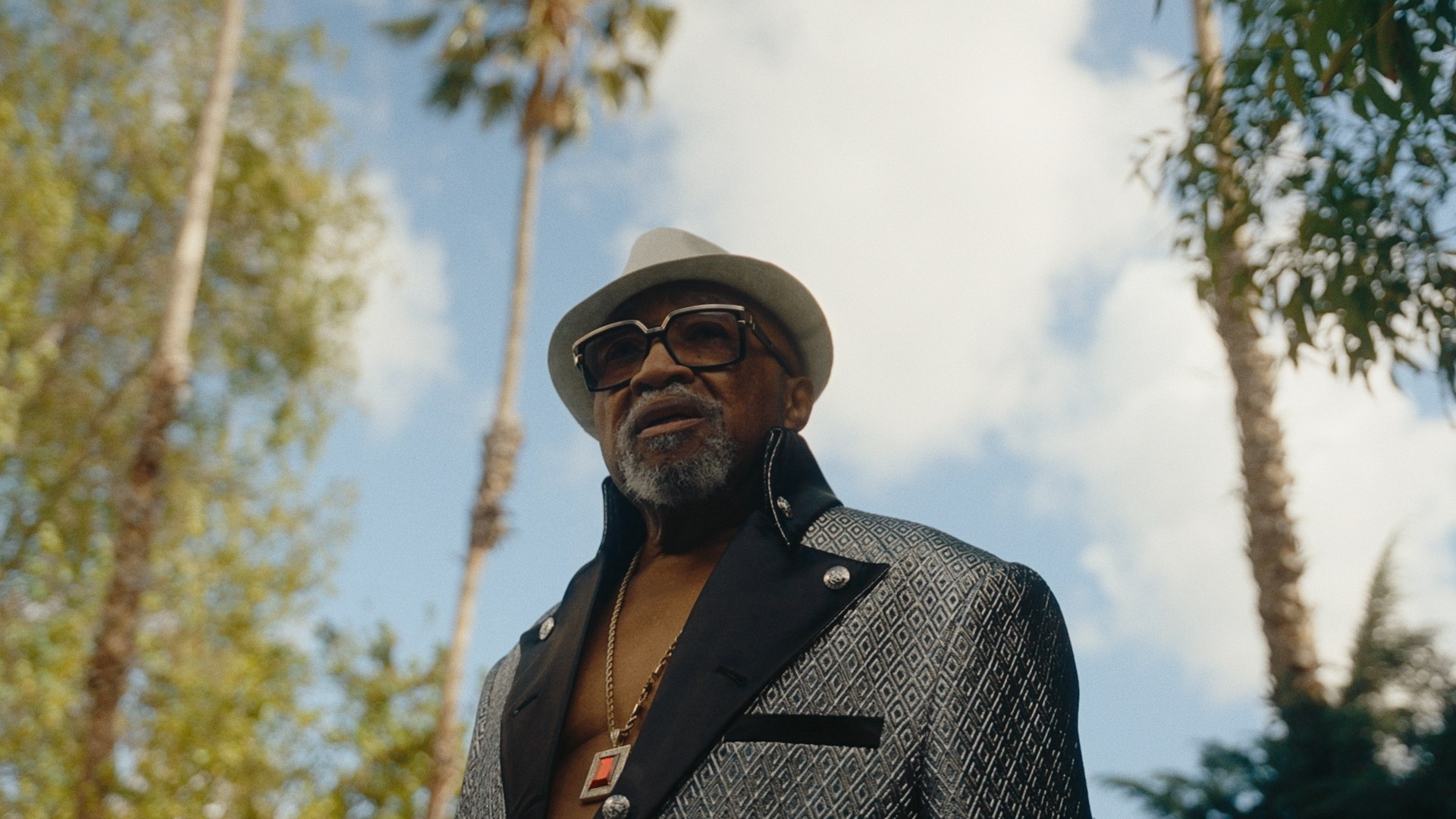
“If you strip all my tracks down, you can hear how everything’s connected,” musical iconoclast Swamp Dogg says of his original material that spans 27 albums. On any given record, the singular artist leaps across genres in a single bound.
“The way I think about things, it’s all the same,” he explains. “Although the chord structures might vary, rhythm & blues and soul are country and bluegrass. Or depending how you look at it, country and bluegrass are rhythm & blues and soul. They’re just dressed differently. One might be in a brown suit, then the next is in a black suit, followed by a white suit and so forth.”


Swamp Dogg and his suits of many colors have often confounded music execs and radio programmers, going all the way back to his aptly titled debut LP, 1970’s Total Destruction to Your Mind. However, he has retained a core collective of enthusiasts who are committed to the artist’s voice irrespective of the changing inflections.
What’s more, Swamp Dogg continues to expand on a fanbase drawn to his mode of expression. Margo Price has stated, “I wouldn’t be the artist I am today without hearing his songs.” She hails Swamp Dogg’s ability to “interpret styles like R&B, soul, bluegrass, folk, black grass, psychedelic pop, country, funk, and country soul.”
This is all second nature to the 84-year old musician who grew up as Jerry Williams Jr. in Portsmouth, Va. The songs he performed at his initial public appearances as a nine year old did not necessarily conform to the expectations that one might have of a Black pre-teen in the early 1950s. However, they did hew to the overarching belief he maintains to this day, that music is music.
“I think I was nine years old when I won my first talent show,” he recalls. “I sang ‘Hadacol Blues’ which was a country hit for Bill Nettles. I also really liked Red Foley and I sang some of his stuff. Hank Williams Sr. was another one of my favorites. If you read his lyrics, they’re like poetry.”
Swamp Dogg also emphasizes that he grew up in a particularly welcoming and expansive musical environment. “My mother was a drummer and piano player who always had a band,” he says. “Her group played a lot of hotels and small venues throughout the country and even over in Cuba. You have all types of people going into hotel bars from around the world who might want to hear a particular song or a particular kind of music. So they played blues, rhythm & blues, pop and they were also pretty well versed in classical pieces. My stepfather was a multi-instrumentalist in her band and they rehearsed at the house, so I heard all of this.”
The precocious artist released his first single "HTD Blues (Hardsick Troublesome Downout Blues)" at age 12 as Little Jerry Williams, and the game was afoot. With the support and assistance of his family he even played some local gigs.
Looking back on his early years, Swamp Dogg reflects, “I took away quite a few things from growing up as I did. Watching my mother, my stepfather and everyone who played with them do what they do, it seemed glamorous. That drew me in and I haven’t been disappointed with my decision to pursue it. Something else tied into that, is I listened to all types of music, which is what I’m still doing depending on my mood. That’s also the way my albums have been.”
This kaleidoscopic approach is manifested on his latest studio effort, Swamp Dogg Contemplates the Afterlife. The title is not meant to suggest that his demise is eminent, although he does acknowledge that many of his confidantes have passed on to the next plane (including his wife Yvonne in 2003 and his longtime roommate Guitar Shorty in 2022). However, while the record is not designed as Swamp Dogg’s swan song, it does evoke various aspects of his career.
For instance, one of the many highlights is his animated interpretation of the John Prine composition, “Please Don’t Bury Me.” Back in 1972 Swamp Dogg recorded the plaintive Prine tune “Sam Stone,” which had appeared a year earlier on Prine’s eponymous debut. Swamp Dogg had heard the song prior to its official release via his gig as an A&R exec and staff producer at Atlantic Records.
“I was their first in-house black producer after pressure was put on them because they didn't have anyone dark on staff,” he discloses. “So they gave me a list of artists and if I didn’t want to work with them, the label planned on dropping them. That list included the Commodores, Patty LaBelle and The Drifters. That’s how John and [manager] Al Bunetta came into my office. They played me ‘Sam Stone,’ and I hadn't heard a song that great in a long time. So I didn’t put a line through John’s name. By the time his album came out, I was off releasing my third album as Swamp Dogg, so I recorded my own version. People really loved it and for many years now, ‘Sam Stone’ has been one of the songs I’ll use to end my concerts. It makes people cry.”
After losing touch for a stretch, Swamp Dogg remembers that Prine reached out to him: “He said, ‘Man, I'd like to do a Swamp Dogg album.’ So we picked out a couple songs together.”
Their reconnection led to Prine’s participation on Swamp Dogg’s 2020 country-infused record Sorry You Couldn’t Make It. This ended up being the final Prine recording released during the artist’s lifetime.
Swamp Dogg continues to hold his friend in such high regard that he indicates, “I am determined to never again do an album that doesn't contain a John Prine song. ‘Please Don’t Bury Me’ is another all-time great, which stands up with all of the songs I've heard, whether it's Berry Gordy, Smokey Robinson or Gershwin. I’ve started ending my shows with that one as well.”
On the subject of songwriting, Swamp Dogg Contemplates the Afterlife also facilitated a reunion with former collaborator Gary U.S. Bonds. The album’s co-producer, S-Curve label founder Steve Greenberg, who has known Swamp Dogg for three decades, made the suggestion. Swamp Dogg and Bonds had once partnered on such hits as "To the Other Woman (I'm the Other Woman)" by Doris Duke, and "She Didn't Know (She Kept on Talking)" by Dee Dee Warwick. The two hadn’t spoken for 50 years but they finally broke the ice and Bonds contributed vocals to “Waka Waka Waka.”
Beyond the R&B hits for Duke and Warwick, Swamp Dogg has had songwriting credits across the charts. Gene Pitney’s version of “She’s a Heartbreaker” was a top 20 pop hit. Johnny Paycheck’s recording of “She’s All I’ve Got” was a #2 country track. Indeed, this has been a steady aspect of Swamp Dogg’s career, in which he estimates he has written over 1,500 compositions.
Sam Hollander, who has contributed to numerous hit songs while working with artists such as Ringo Starr, Panic! At The Disco, Fitz and the Tantrums, One Direction and Tom Morello, collaborated with Swamp Dogg on a few tunes for Swamp Dogg Contemplates the Afterlife. Hollander raves, “As a songwriter, he’s absolutely fearless. Funny, provocative, heartbreaking, absurd, ridiculously soulful… sometimes all within the same tune. There’s a beautiful lack of self-censorship to what he does, and I learned so much from him.”
Hollander then characterizes their collaborative process on the album’s closing track, “Final Approach”: I came in with a chorus vibe that I was super excited about, and he grabbed the baton and sprinted with it, taking it places I never would’ve anticipated. He completely elevated it. That’s what I love about his musical brain. Decades of experience, yet zero predictably about where he’s headed next.”
One aspect of Swamp Dogg’s career that his fellow artists regularly reference has been a commitment to his artistic vision. Bon Iver’s Justin Vernon, who played guitar throughout Sorry You Couldn't Make It and later contributed to 2024’s Blackgrass: From West Virginia to 125th, identifies Swamp Dogg as “one of the most prolific, artistically free, disruptive, soulful, sensitive, and smooth musicians and singers the world has ever known.”
Margo Price has shared a similar sentiment via her enthusiasm for the song “God Bless America (for What)” This song appears on Swamp Dogg’s second album Rat On! which was released on Elektra in 1971, the label that signed him following his notable debut.
After changing his name to Swamp Dogg in effort to create an alter-ego to circumvent the expectations associated Jerry Williams, he self-produced Total Destruction to Your Mind for the independent Canyon label in 1970. "Mama's Baby, Daddy's Maybe" another co-write with Bonds, climbed to #33 on the R&B charts.
Total Destruction also includes “I Was Born Blue,” a quintessential Swamp Dogg song that might feel whimsical at first blush but also carries a deeper message, with the lyrics: “Why wasn't I born with orange skin and green hair/ like the rest of the people in the world?/ I was born blue, I was born blue/ Another job that I can't get/ Another house that I can't rent/ Another place that I can't go.”
The signature selection on Rat On! is “God Bless America (for What),” which decries both racism and the Vietnam War. Swamp Dogg indicates, “There was a lot of turmoil resulting from that song and Elektra dropped me because of it. The song asked a lot of questions. [It opens, ‘Oh lord, is this the land of the free?/ And can someone please explain this word called equality?’] I feel like I got slammed in the mouth for asking questions.”
Price maintains, “What I love about this song and this album is that this track really represents the creative journey of someone who is absolutely unafraid to take risks and get the message out that he wanted to put into the world. But in 1971, ‘God Bless America (for What)’ was not a message that many people, especially white people, were ready to receive. That affected his career, but it didn't stop Swamp Dogg from making the music that he wanted to make. I can absolutely relate to this as someone who made a political album. I put out All American Made, and it pissed a few people off, but it was what I needed to say at the time. And having somebody like Swamp Dogg to look up to and create the blueprint to follow your art, follow your heart, that was really inspiring to see.”
Swamp Dogg continues to express himself in this manner on his new album. “A Million Tears Ago” offers an anti-war perspective. “Daddy’s Little Girl” explores gun violence. A number of other songs muse eloquently on the passage of time. He readily speaks without hesitation to the topics that are on his mind and of the moment.
Returning to Swamp Dogg’s second album, the cover features the artist astride a white rat. He notes with some amusement, “It’s regularly voted one of the worst album covers ever made. Of course, whenever that happens we sell a few more records.”
Then he adds, “People still ask me about the rat and I tell them that the purpose of it was to show that the Black man was finally on top of the white man. But if you look closely, that rat is smiling because it’s saying, ‘You may be up there today but it’s only a temporary situation.’”
Swamp Dogg has been answering questions about Rat On! as of late due to the documentary Swamp Dogg Gets His Pool Painted which premiered at SXSW in 2024 and was acquired by Magnolia Pictures. The throughline of the film, which provides a spirited account of the artist’s life and career, involves a design that is being added to the bottom of his swimming pool, which it turns out (spoiler alert) is the cover to Rat On!
There is a playfulness to Swamp Dogg’s artistic endeavors that shouldn’t detract from the earnestness of his intentions.
Over the years, he has supplemented his own recording career with a steady diet of producer gigs. Swamp Dogg worked with ZZ Hill, Ruth Brown and Irma Thomas, among many others, writing much of the material himself. The Brand New Z.Z. Hill includes his composition “It Ain’t No Use,” which became a Jerry Garcia staple in the 1970s. Garcia’s version appears on his Live at Keystone album with Merl Saunders, John Kahn and Bill Vitt. SwampDoggacknowledges, “I was blown awaywhen I found out about that.”
All in all, Garcia’s interest in the tune is not surprising when one considers the Grateful Dead guitarist’s predilection for a swath of music that in today’s parlance is defined as Americana. This term is also a fitting descriptor for Swapp Dogg’s output and he recently made multiple memorable appearances at AmericanaFest.
As Hollander observes, “Swamp Dogg is one of those uber rare artists who’s managed to spend decades operating entirely in his own musical galaxy. Soul, country, blues, R&B… He’s spent his entire career blurring genre lines, which to me at least, is the very essence of Americana. Swamp Dogg isn’t just an Americana artist. He’s part of the actual fabric of American roots music. He’s never seemed particularly interested in fitting into a genre, which ironically makes him one of its most authentic voices out there. And the fact that he’s still pushing boundaries rather than scouring the past is what makes him such a national treasure.”
Yet while he’s a treasure, Swamp Dogg is no museum piece. He remains an active, engaged artist. In addition to his own dynamic album, he produced the latest release from Eli “Paperboy” Reed, Getting There, also contributing a song and vocals.
Not only does Swamp Dogg refuse to rest on his laurels, at times it seems like he barely rests at all. If occasionally he sits poolside, it’s not to gaze at his visage but to contemplate his future ventures.
“I'm still determined to do albums with all the types of music that I like,” he asserts. ”I heard a lot of gospel music growing up and I’ve always enjoyed Dixieland. I’ve also been talking about a duets project. There’s so much more for me to do.”