This article appears in our special 132-page Bob Weir edition, which presents rare photography, archival interviews and new conversations that pay tribute to an endearing, enduring artist.]
When Stanford University music theory professor Giancarlo Aquilanti first heard Bob Weir’s pitch to collaborate on arrangements of Grateful Dead songs, he nearly passed on the opportunity.


The idea was to create orchestrations that the Marin Symphony would then perform with Weir and some of his RatDog bandmates. Aquilanti recalls, “My initial reaction was to say, ‘No, I’m a classical composer.’ At the time, I didn’t know much about rock-and-roll, and I didn’t know much about the Grateful Dead. But then I thought, ‘Why not? Let’s see where this takes me. We’ve got to be open to other things.’”
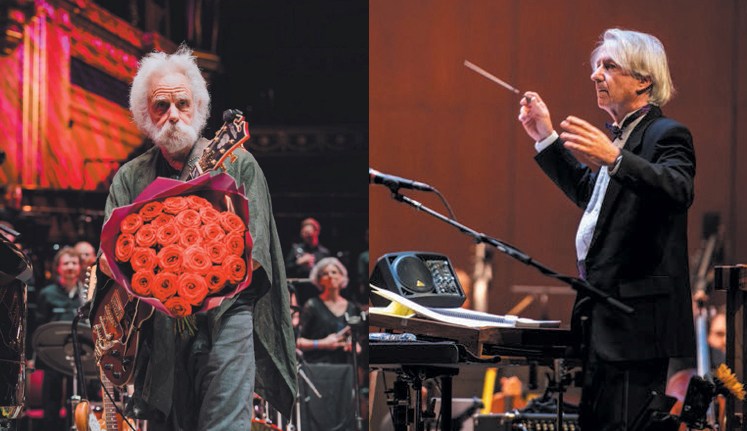
So he teamed with Weir on a series of scores that debuted during a Symphony fundraiser at the Marin Veterans Memorial Auditorium on May 7, 2011. The two remained in touch over the years to follow, building on their initial efforts. The project finally took substantive form over four nights with the National Symphony Orchestra and Wolf Bros at the Kennedy Center in October 2022. Additional opportunities ensued with the Cincinnati Pops Orchestra, the Chicago Philharmonic and Louisiana Philharmonic Orchestra before Weir finally realized a longtime dream of appearing at Royal Albert Hall with the Royal Philharmonic Concert Orchestra.
“For that original concert in Marin, I only orchestrated five or six songs,” Aquilanti details, “but Bob was very excited about it. I was very excited as well, and that’s when we both realized this was something we should continue to explore. It was also when I realized that I had made the right decision.”
How would you characterize your initial conversations with Bob and the challenges you collectively faced?
First of all, I made it clear to Bob that if I got involved in this, it couldn’t be the usual pop concert with some rock-and-roll band that is going to show off in front of the orchestra with the orchestra in the background accompanying them. I said, “The orchestra needs to be at the same level of the band. It has to be one of the main actors. We need to make it so that there are going to be moments where the orchestra is shining and the band is in the background.”
I remember telling Bob, “This is going to be like a baroque concerto where there are two components. It’s a dialogue between the soloist and what in Italian we call the tutti, which is everyone else. It’s not like one is more important than the other, though. There is the tutti, which is the orchestra, and then there is the soloist, which is the band, and it’s a dialogue between these two components.
He was very excited about that, and he was always very open. He was very knowledgeable about classical music, but at the same time, he was very respectful of what I would tell him and how I would envision the process.
There were two challenges, one of which dissipated immediately. First off, we were starting with songs written for a group of four instruments. What was I going to do with the second bassoon or four French horns or 15 violins? How was I going to distribute all this music to an ensemble that could have 60, 70 or 80 players? What I eventually learned—and it took me a while to discover this—is that the music of the Grateful Dead translated very well into this orchestration project.
The other challenge was figuring out how to get the orchestra to improvise. That was very important for Bob, and we couldn’t figure it out at first. Eventually, we found some way to involve the orchestra in the improvisations.
This was a time-consuming endeavor as you weren’t just a machine translating the songs and spitting out the results, but rather you infused your own perspective. Can you describe how that manifested itself?
You used the right words because one of the things that I said to Bob was: “I don’t want to be a machine that is just translating. I’m sure that can be done by a lot of people. I want to collaborate and have my own voice in this. So if you say, ‘Let’s add another verse,’ then I will respect that, but as far as the orchestration goes, like which instruments I’m going to use, that is going to come from me.’”
I think Bob liked this idea that I had different visions of these songs. I was basically an outsider and he thought I would have a vision of these songs that would be different, without the usual clichés.
After that first concert in Marin, I had this idea of writing an overture, meaning it was a piece dedicated entirely to the orchestra. The band was not even on stage. I took the idea of the Italian opera, which opens with an overture. There are no singers on stage, but you hear a fragment of the aria. The orchestra is playing and it gives a hint of what’s going to happen during the opera. The idea was to set the tone, to say, “This is something different. This is not the typical rock-and-roll concert. The orchestra is important.”
We decided this was the way that every concert was going to open. At the Kennedy Center, where we had four evenings, every one opened with the overture. We weren’t quite sure whether the audience would accept the orchestra starting out by themselves, but they did, and that was part of the confirmation that this project worked.
So there were some interludes where the band was not playing and I took the elements of the Grateful Dead, but I transformed that through my own way of seeing it. For example, in “The Other One” the theme became an orchestral fugue.
I was surprised how knowledgeable Bob was about classical music, and I was very respectful of his advice. So we never had a single glitch where we were arguing. Sometimes I might say, “I don’t think this is possible.” Then he would say, “OK, no problem. Let’s see where we can go here.”
You also mentioned improvisation. How did you approach that?
At first, I was very skeptical of this idea that the orchestra was capable of improvising. I have to confess that I said, “Bob, this is not possible. Those are classical musicians. They just play what they see on paper. If we force them to do something they don’t like to do, it’s going to play against us.” He insisted, though, so we tried a series of experiments and eventually I saw that it was actually possible. While we were experimenting, we did some workshops with the students at Stanford University, who were excited about the idea of improvising.
There is this idea that a symphony orchestra is stuck and conservative—like a monster that moves very slowly. What I eventually realized is that it is actually possible to make them move. I should have figured this out earlier, but the idea is that in an orchestra of 80 classical musicians, there has to be someone who also comes from a different background, like a jazz band.
So when we would go to an orchestra, I would ask the conductor, “Who could be interested in improvising?” Then, once those people were pointed out, I would talk to them. In the score, during the parts where the band was improvising, I wrote a jazz chart for them with the rhythm and the chords to improvise over. Sometimes I would put some notes here and there to give them a suggestion or a starting point.
We would tell them that they could do that if they were interested, but we could not force them to do it. We left it to the players and the conductor, who would encourage the players that he knew were more prone to improvisations.
The truth is that you don’t need the entire orchestra to improvise because that would be total chaos. You really need like five or six people to jam with the band. In any orchestra, we always found those people who were willing to do it.
It’s very different when Bob is playing with his band, and he would improvise and everyone could look at each other. In an orchestra, the string bass might be 15 yards away with no idea what’s happening in the front. So that musician would have to look at the conductor for the signal when it’s time to move on to the next section, and that information needs to be communicated a few seconds earlier. You can’t do it right at that moment. So what we did was determine in advance how long each improvisation would be. We might decide that it would be for 16 measures and then everyone would have to stop and move on.
We had a few issues here and there, but it was pretty successful. Toward the end, we were getting to the point where we were going to experiment with a new technique where we would say, “OK, let’s not decide in advance how long the improvisation is going to be because one evening you might decide that you feel like you want to improvise longer and another evening you might decide that the improvisation in that particular moment shouldn’t be as long.” So we were thinking about that.
Was there a song that would be particularly challenging for the orchestras?
Well, some songs were more challenging than others. “Terrapin Station,” for example, was like half an hour long. You have to go to a Mahler symphony to hear something like that where a movement could be 30 minutes long and the musicians don’t have a single moment of rest to catch their breath. In classical music, the whole movement of a Beethoven symphony might be 10 or 12 minutes, but “Terrapin Station” was literally 30 minutes of nonstop music. That’s very challenging.
How long did it take you to work on “Terrapin” and the other scores?
Fast songs take longer because there is more music to write. So 10 minutes of fast music might translate into 50 pages of score, but 10 minutes of slow music might only be 25 pages.
To give you an overall sense, I wrote roughly 1,500 pages of orchestral scores. This translates into about 6–7,000 pages for the orchestral parts. So to orchestrate a song that was about 10 minutes, it would take me a couple of months. With “Terrapin Station,” I remember working on that forever. [Laughs.]
What was your starting point for those? Would you begin with the studio tracks?
No, the process was that first I listened to all kinds of recordings. Bob would suggest listening to this version and that version—“Listen to this version from the ’60s, and this is the way we did it in the ’90s.” So I would take the time to really understand the songs musically. Then I would ask Bob to tell me something about the song. Sometimes the text is clear, but sometimes there’s something that I don’t know.
Then I used my expertise as a music professor, where I would look at a Mozart symphony and ask, “What is this piece about? What’s happening under the hood? What are the harmonic progressions? What are these melodies and how do they fit with the harmony?”
All in all, as you look back on working with Bob for over 15 years on this project, what did you take away from the experience?
I literally put my classical career aside and dedicated the past five or six years entirely to this. It’s not like I was forgotten in my world, but people would ask, “Can you do this?” And I’d say, “No, I’m busy with something else.” They call you once, they call you twice, then they call someone else. So I was taking a chance, but I’m glad I did it.
I’m also glad I did it with Bob, who was a kind man and very respectful. When he would rehearse with the band, he was the boss, no question, but he was the boss in a kind way. Before these orchestra concerts, we would rehearse these songs at his studio and I might say, “Guys, here you need to play softer,” and Bob would be totally quiet. He would say to everyone, “Listen to what Giancarlo has to say to us.” He would do the same in the orchestra with the conductor. If the conductor said something, he would never question it. Suddenly, despite being the leader that he was, he would follow like everyone else.
There’s something else I’d like to point out. If we go back to what I said earlier about figuring out how to write these scores for all these players, sometimes I’d think, “What is the second bassoon going to do here? What about the four French horns? We’ve got three trumpets, three trombones and 18 violins. What am I going to do with that?” So I would listen to this recording and I would literally copy a line from Jerry Garcia’s improvisations or what Bob was playing. Then I would take that line and bury it on the second bassoon or the fourth French horn.
It was like taking the soul of the Grateful Dead and placing that inside the orchestra forever. So their soul is embedded in the second bassoon in a way that when you hear the orchestra playing it, you will never recognize it, but it is there.
I’m from Italy, where we have art all over the place. So just imagine you go to visit one of these great churches and there is a statue that is sitting on a corner where the only thing you can see is the front. But if you could see the back, you would notice that even though no one will ever see the back, the artist has worked just as hard to make it as beautiful as the front.
So even though no one will ever hear the second bassoon, it’s there. The moment you take that away, you’ll probably sense that something is missing. But even if you don’t, it absolutely has to be there.
To me, this all goes beyond today and tomorrow or a single concert. Bob always would say, “This is going to be remembered 300 years from now.” I hope this is a small contribution to that idea he had.