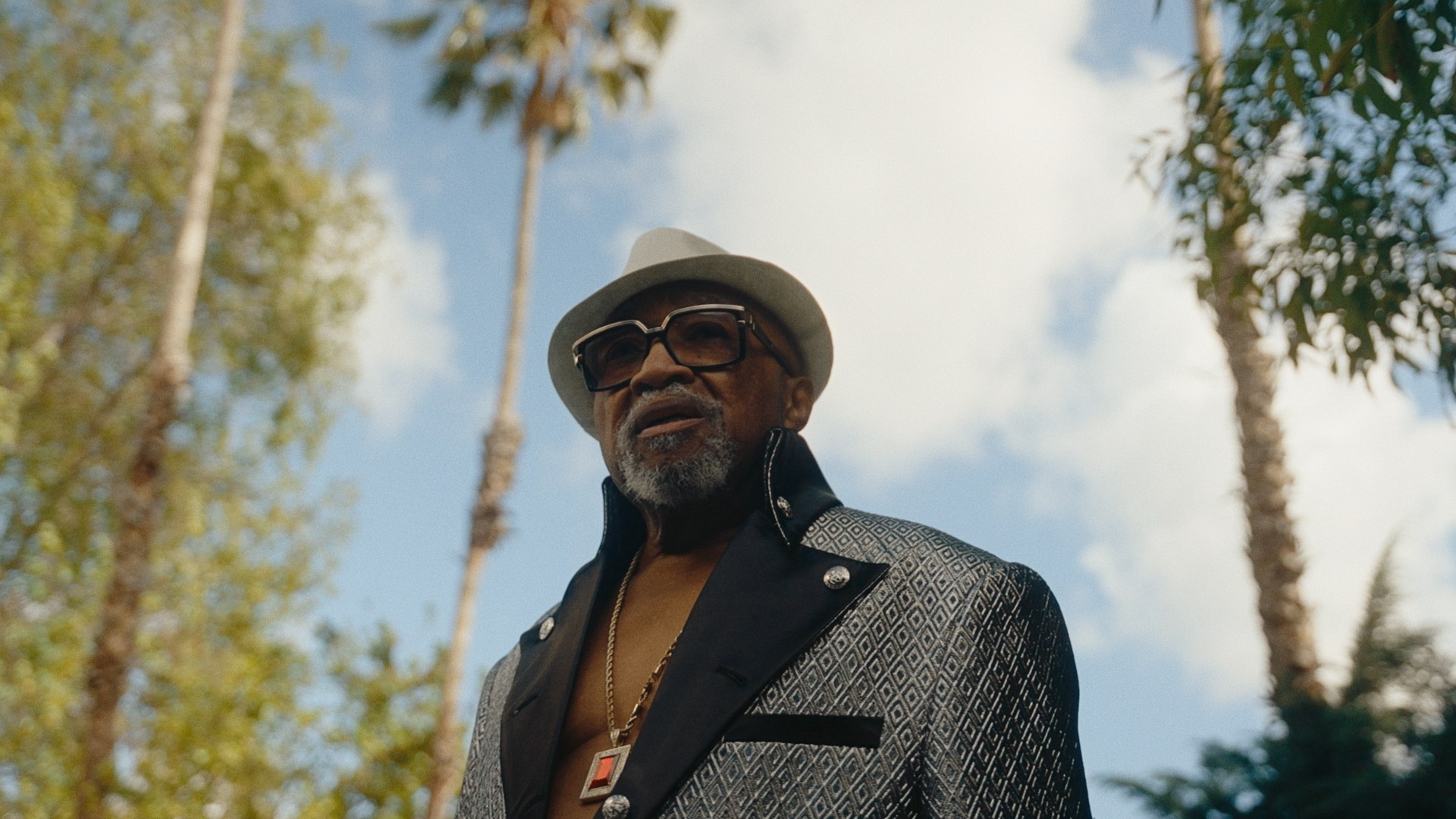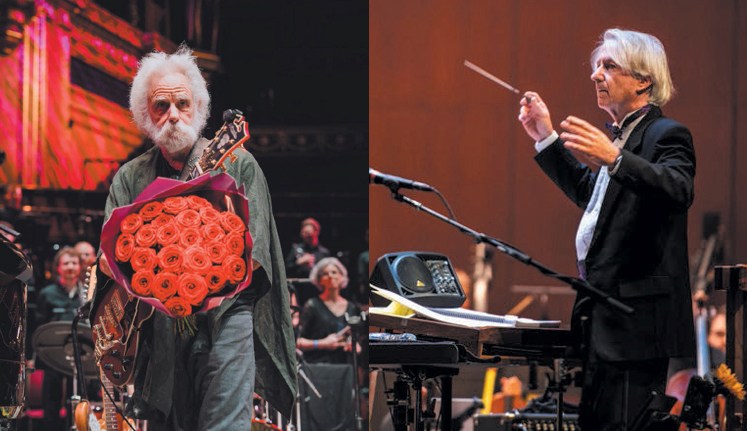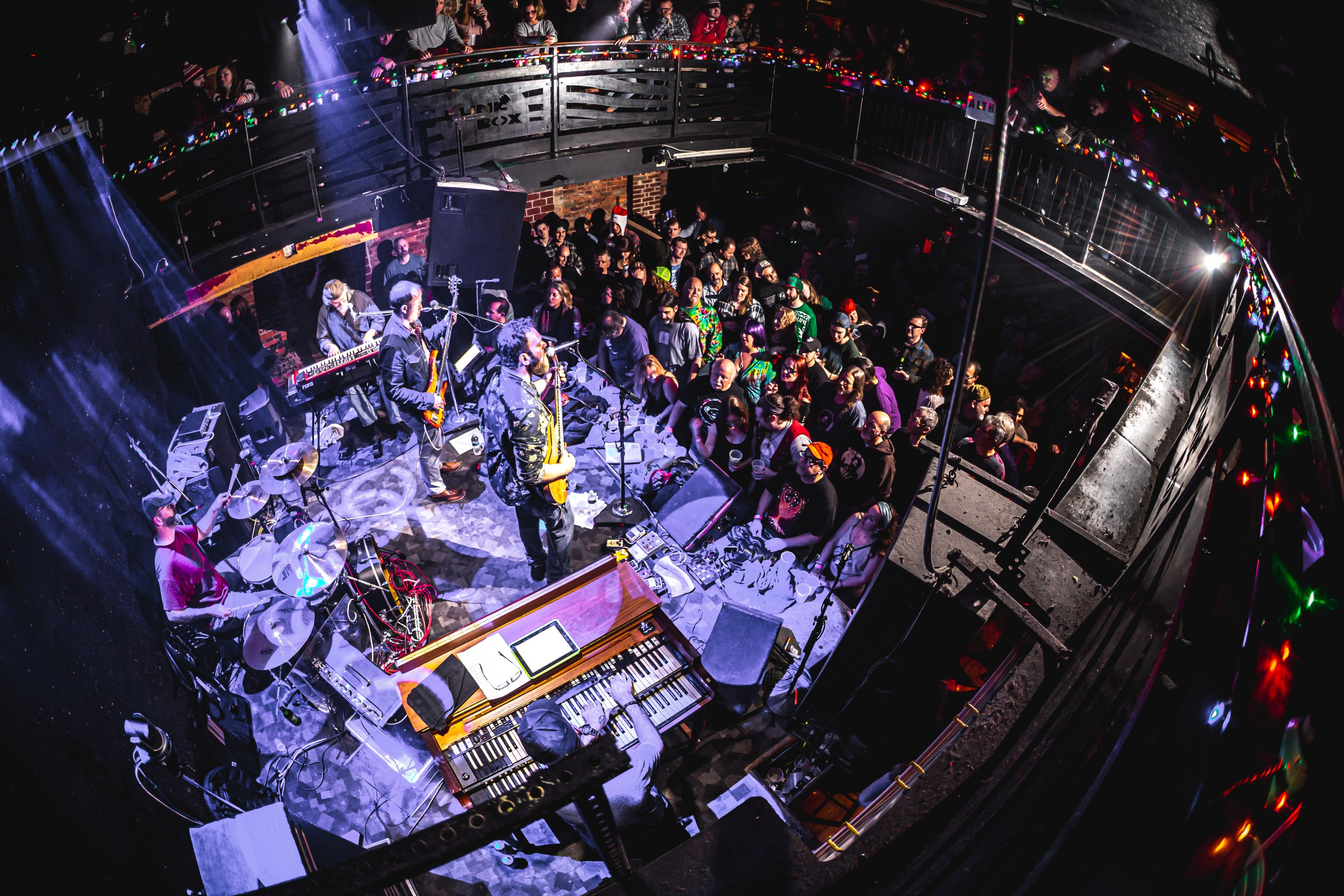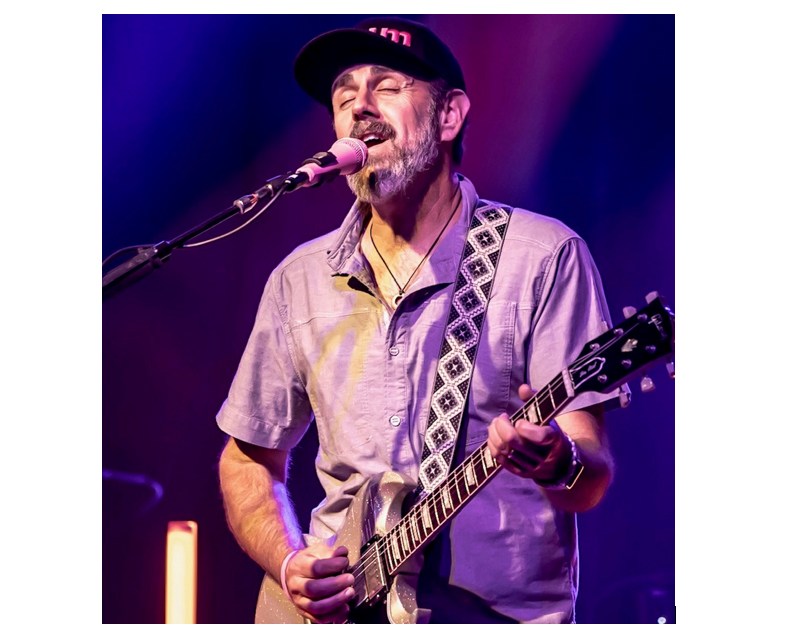
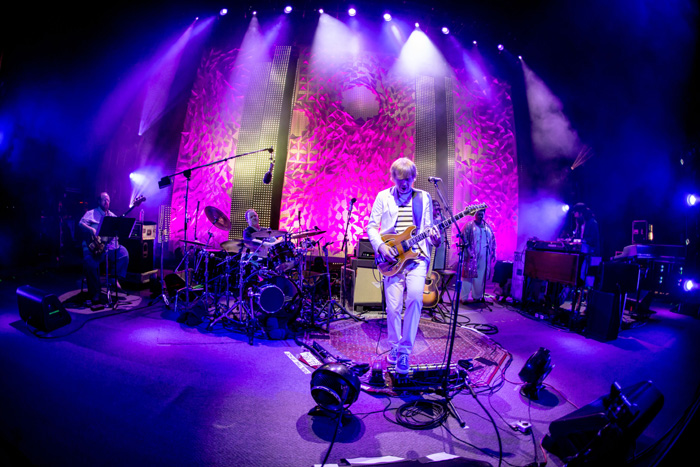
Ghosts of the Forest onstage at Greek Theatre in Los Angeles (photo credit: Steve Rose)
Here is the second installment of a four-part series that explores how Trey Anastasio's Ghosts of the Forest project came to fruition. Part one is available here.
***
At first, Ghosts of the Forest was only envisioned to be modestly ambitious. Anastasio would record a nine song album at his Barn studio in Vermont in the spring of 2018, just a few months after Chris's death. He would be joined by Phish drummer Jon Fishman and Trey Anastasio Band bassist Tony Markellis, with TAB keyboard player Ray Paczkowski adding keyboard parts not long thereafter. There would be a staged component, and the shows would perhaps blend the new material with more familiar numbers from the songbook. However, the project began to evolve.
Trey Anastasio: Pretty early on, “Beneath the Sea of Stars” was the song that pointed me in the direction of doing a whole live show as a narrative journey. That was when there were only nine songs. It was the last song on the record, and I was thinking of lost family members and friends, Chris, my grandparents, my sister. The Barn is in the woods and full of my grandparents furniture from my childhood, so I think of them a lot.
That song is set up like a long night in the woods,you hear the hooting of the owls, and we go into the woods together with thespirits. Then it gets darkest before the dawn, in that trippy section, and thenin the middle there’s a sunrise moment: “morning birds arc in magnetic paradeand the dawn is slowly breaking.”
The morning brings a little clarity and hope andspirituality with the “blue all around” part, but at the end, reality hitsagain and we kind of smash back through the glass right back into the confusionfrom the beginning of the album. This feels accurate to me when it comes togrief, at least in my experience. A brief glimpse of the big picture, followedimmediately by, “Who cares about your stupid concept? I’m just sad. I can’t getover this shit, it’s breaking my heart, and I’m really depressed. Stop tellingme they’re in a better place.” So that was a conscious choice to make the albumloop back around in a cycle.
I think that song was sort of the trigger point forcreating a whole show.
I wanted this to be different than Phish. It should beone set, not two. Pretty early on, it was conceived as a journey, an emotional journey.
AbigailHolmes: They were really wonderfulconversations, exploring this wonderful new music, the great musicians whowould be playing it, and the best ways to frame that experience on stage. Wemet on and off over time, which was cool. That let us talk about ideas for theshow, and then gave some time to think about things and work on them. And comeback and look at them and talk about the next step. Some things really stayedconstant throughout, and others we’d come back to and maybe say, “yeah, that’scool, but not right for this show.” There was enough time to let things developand then let things go.
AlthoughAnastasio had ventured into musical theater with Hands on a Hardbody (2012),the truer lineage of Ghosts of the Forest’s staging might be found in the challengeof introducing new music to audience members with expectations of hearing theirfavorite songs.
Phish made alow-key art-form of rolling out their new material in creative ways. In 1992,they accompanied their latest batch of songs with a musical secret language, inpart to measure how quickly fans spread the tapes. In 1995, there was a wholealbum’s worth delivered at a Voters For Choice benefit a month in advance oftheir summer tour with enough time for the recordings to spread before the bandhit the road. In 1997, a set of all-new songs (played twice) at the backyardBradstock gave way to a tour where the band shelved many classics. Since 2011,Phish’s Halloween performances have become a way to launch new material intotheir repertoire, vacillating with Phish’s typical slipperiness between sillyand serious, including 2013’s Wingsuit (which would become the 2014 albumFuego), 2014’s Thrilling, Chilling Sounds of the Haunted House, and 2018’s írokk, performed in the guise of Kasvot Växt.
TreyAnastasio: I learned from Wingsuit. We put people in the difficultsituation of trying to grapple with something they couldn’t viscerally latchonto, and I don't think it went all that well. As soon as it was over, I waslike “whoops, we should have started with ‘Fuego,’” which is what the albumended up starting with. “Wingsuit” is a song we were really excited about, andI still am, I just don’t think it should have started the whole thing off.
Then, the next time we did it, it was Chilling, Thrilling Sounds, and Ithought we should start with eleven absolutely visceral dance grooves beforethe band even got together. The idea being that we’re gonna do this again, butthat there was a skill set that was carried forward, so we didn’t make thatsame mistake again. Instead, we’re going to come out with a bang. We’re goingto give people something that they can have fun with, and allow them to come onthe journey with us. And then the roof is going to blow off and it’s going tobe fucking fun.
Then the next timewas Kasvot Växt, where we’re going to do it with more elaborate songwriting,where we really try to say something, and it’s gonna be a party, and the firstsong is gonna go bang, the stage is going to be white and you can’t take youreyes off it, and it’s a really heavy dance groove. Everybody’s invited to theparty. By the end of the first song, I wanted to honor the audience by invitingthem on the journey with us and not giving them something that’s difficult towrap their brains around -- because that’s our responsibility.
This time [with Ghosts of the Forest] what was reallyscary was going a giant step even way further into the personal, honest, andthe emotional. It was a risk to walk on stage to a sold out house and know thatall I have to do is turn around say “’Sand,’ one, two, three...” and the wholefuckin’ place goes nuts -- and not do it. And [then] start singing these songslike, “I’m sad that you died,” and “I feel uncomfortable in my own skin” and“I’m about to run” and all this shit, and not have any idea how people aregonna react.
AbigailHolmes: I’ve been at many Phishshows. I worked with Chris Kuroda on the production design of the recent layoutwith the moving trusses; and on the show prior with the video surfaces. Onething about the Phish audience is their loyalty, and their level of engagement.It is amazing to be able to make completely new music with a new band and havethe audience ready to come and experience it. That is incredible, because itallows risk taking and experimentation. And I think that the audience knowsit’s reciprocated. Trey thinks deeply about how the audience is going torespond. We talked a lot about theaudience -- their expectations, what was going to be different about this show,having moments they would relate to, and also taking them to some new places,and how to find the best balance of those things.
TreyAnastasio: It’s kind of built to befinite. I’m going to try this experiment, I’m going in full, I’m diving incompletely. I’m going to let the chips fall where they may, despite doubts. Iknew everybody was gonna fuckin’ rock out to Kasvot Växt, because it was builtthat way. Whereas that wasn’t true on this one. This was part of theconversations with Abbey, about how the production is going to unroll one songat a time. There are no flashing lights. Every piece of production is going tobe built on 100% emotion. I’m going to start off with this really slow, sadpiano thing. We’re not going to rush it. It felt really revelatory.
AbigailHolmes: There is a strong sense ofplace in many of the songs, being out in nature where Chris lived, the idea ofGhosts of the Forest. I had the feeling from listening to the songs that thiswas partly a real place, but also a mystical place. In my thinking, ideally thevisual design would help the audience enter into a sort of journey with themusicians, enter into a world where this music would be played and shared, andstep out of the everyday for the time of the show.
Trey Anastasio: That was definitely the stated goal -- that there wasa sequence of events. It was laid out almost with some of the rules of theater,the main rule being that I know what the whole narrative is, and that Abbeyfollowed the same direction. Even though all the visuals were abstract, shelistened to all the lyrics and the music and knew why she making every choicethat she made; they were all conscious choices to further the emotion ormeaning of the song. Anytime it started to get too literal, she would take itout. She didn’t want a literal definition. There was intent, that was thekeyword. There was intent behind every visual based on the meaning of the songto her, and there was intent in every sequence to further the story. That’swhere it was different than a Phish show. A Phish show is visceral in thepurest sense of the word, the real definition, which means in the muscles ofthe heart.
Abigail Holmes: We would definitely have an idea for the meanings thatthe visual design choices were representing -- but they were absolutelyintended to be abstract enough that the audience could interpret and relate tothem individually, not to be so literal that they defined things toocompletely. It was important to leave space for people to experience it intheir own ways. For visuals, I mostly think this was done in a subtle way--ashift in color, or brightness, a change in the video--always meant to enhancewhat the music was saying.
Trey Anastasio: It’s not a theater piece, but there are skills I picked up along theway to make things carry more emotional weight. You learn little tricks alongthe way, like the 11 o’clock number, which is a term from the golden age ofBroadway, a theatrical tool, the big break-on-through number. In Gypsy, it would be “Rose’s Turn,” whereGypsy Rose leaves, and her Mom has a full-on breakdown and realizes her plight.The character often changes. They call it the 11 o’clock number, because showsin the golden age of Broadway used to end at 11:30. “A Life Beyond the Dream” felt like thatsong.
Thereare all these tricks that people have learned from hundreds of years of doinglive theater, live performances. Every time I do one of these things, I figureout something new. Doing Hands on aHardbody taught me so much that I use habitually now -- for instance, howto run a rehearsal, how to get more out of a finite rehearsal.
So,with Ghosts of the Forest, I really needed to do this thing that we did withKasvot Växt, and have some nice moments in the night where people can grab ontoa visceral drumbeat for relief. Otherwise it’s too much. With Kasvot Växt, Iused these mouth drumbeats that I put on my phone, and I brought them all inand Fish laid them all into grooves, which is where the songs started. So Iwrote 26 more Kasvot-style drumbeats, and asked Fish--since he was going to bein New York--if he would mind going into the studio with me on January 1st andrecording them all.
Jon Fishman: Phish played New Year’s Eve in New York City and onNew Year’s Day--the morning after we just did this four-night run at MadisonSquare Garden, so I’m in great drumming shape--I went into the studio with Trey. We went to a studio a few blocks from thehotel, and he’s got 25 or 26 mouth drumbeats on his phone. There’s a drum kitset up, and Bryce Goggin had it mic'd up, and I played them. Some of the beatswere a little weird, because drum machines and people singing into a phonedon’t care where things are on an actual drum set. But all of it was prettysimple because you can only do so much with your mouth at once. What’s greatabout it--and I feel like I should do this--is that you see things that youwouldn’t play necessarily right out of the gate, so that makes your limbs movein combinations that you wouldn’t have done otherwise necessarily.
Therewere 15 or so that made it to potentially being songs, from which 10 orsomething eventually made it to the stage. He sent me the tape of thesedeveloped songs, now with some lyrics, guitar, and drums that he and Bryce hadspliced together. Some of it, they would take one drumbeat and marry it toanother one, and build the song with a bridge and verses and stuff.
Ray Paczkowski: It was uncanny. Trey was telling me that he would go,like [sings mouth beat] and Fish wentthrough it and what he ended up with was the verbatim of what Trey was singing. Trey played it for me. Itwasn’t, “I’m gonna take this idea and make a rhythm out of it,” it was, “thisis the rhythm and I’m going to make the drums sound like [sings mouth beat].”
“Wider” song progression samples
Trey Anastasio: I knew how it was going to end and knew how it was going to start. I knew from day one that was going to end with that “blue all around” [from “Beneath the Sea of Stars”] wrapping back around. I knew the islands where it was going to go in the middle, that “Beneath the Sea of the Stars (Parts 1 & 2)” would be three-quarters of the way through. So then it was, “How are we going to get into 'Beneath the Sea of Stars'?" And that was “Green Truth.” That was one of the drumbeats.
***
Next time: Staging Ghosts