Here is the third installment of a four-part series that explores how Trey Anastasio’s Ghosts of the Forest project came to fruition. In case you missed the initial pieces, you can look back at part one and part two.
***
Jennifer Hartswick [vocals]: I loved this music. I came in after the recording process, so I came in with really fresh ears to a project that was basically complete. The first time I heard any of the music was when I heard the record, and I was driving, just weeping. I had to pull over, not necessarily from the sadness, but the intensity of the music. I feel like it was written with a different purpose than anything Trey had written before, and played with a different intent.
Ray Paczkowski: It was really a one-of-a-kind thing. The music thatcame out of all of this has that emotional quality to it. But the songs werejust unique, too. The first track on the album [“Ghosts of the Forest”], I’venever heard Trey do something like that, just the perfect melding of an oddtime-signature.
Trey Anastasio: KasvotVäxt, Ghosts of the Forest, and [the staged New Year’s version of] “Mercury”all happened in a nine-month period. That’s 30 new songs and two essentiallynew songs with near-full production in less than a year. Part of why it worksis because I learned how to prepare and run rehearsals. You do enormous amountsof prep work before you get there and you know exactly what you want toaccomplish with the limited time. You bring appropriate charts and you sketchit, which leaves space in rehearsals for the most important part, which is being open and free with the band andproduction team. By preparing, you don’t leave these massively talentedmusicians standing around getting bored while you try to make up your mind.Everyone is present in the room and together we fly. I mean, look at what Abbeydid. That’s a pro. She did it all before she did it, then at rehearsals she waswide open.
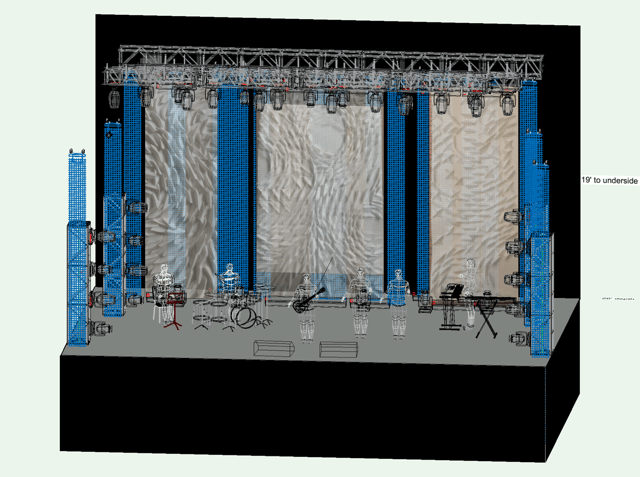
Abigail Holmes: The backdrop was one of the first elements in thedesign. I had been making some paper art, just for myself. As we talked aboutthe project, I had the idea that those pieces could be the basis for abackdrop. Since the original paper pieces are handmade, there is a very organicquality to them. The pieces are placed slightly differently, shaped slightly differently.The dimensional pieces of the drapes were applied by hand, they feel verydifferent from something which is made by machine. That seemed true to thenature and forest references, the raw quality of the emotional content of someof the songs, and the nature of the band and how they played.
Trey Anastasio: The backdrop was a roll-uppable piece of fabric thatshe sculpted, while listening to the music, based on her interpretations of themusic. It was very integrated. She designed the backdrop that almost lookedlike metal. She crafted it on a piece of paper, which is now framed and hangingright in front of me as we speak in my home. She built it like it’s asculpture, with little folded pieces of paper, then had somebody fabricate itout of fabric in such a way that it looks like the original.
Abbey laid out exactlywhere the band was set up. It looked so good. She would send me stuff and Iwould make suggestions. For instance, Tony likes to be not on the hi-hat sideof the drums. He’s told me that over the years. And Fish told me that he likesto turn his head to the left when he plays, and that way he can look at myright arm, so if I start to speed up or slow down he can go with me.
She decided that shewanted Jennifer and Celisse in between the fabric pieces, standing in a row. Ihad told Abbey that I wanted the vocalists to be able to disappear from theaudience’s view, when the four of us start jamming. But I didn't want anybodyto see them walking off stage, I wanted them to vanish. That’s why they weren’ton the other side of Ray. Abbey also told us that if our clothes werecamel-colored or white, we would disappear into the background more easily, soI found a camel-colored jacket and a white jacket and Jen and Celisse alsodressed in that color scheme.
Abigail Holmes: The patterns of the drape and the thin vertical panels of the LED werepartially conceived as non-literal woods, the shapes on the drape nodding tothe filtered light [as seen] through leaves in the woods. They were designed toallow a sense of depth, so the visuals could sort of float or recede inportions of the show. Maybe that could feel like a disconnect from an everydayreality, and create space around the music, let it be expansive.
About a month prior toproduction rehearsals, I spent several days with a programmer workshopping thevisual ideas in a 3D rendering set-up. Trey spent time with us, and we testedthe live camera effects used for the song “About to Run”, and other videoimagery. That was a good opportunity to talk more about the shape of the show,and narrow the direction for some things, so we could make the best use ofproduction rehearsals.
Jennifer Hartswick: When you’re working with somebody else, I won’t say working for somebody else, but when you’reresponsible for carrying out their vision, I will very often rely on what it isthat person wants: What are you looking for? What do you hear? And [on Ghostsof the Forest] it was met every time with, “What would Jennifer Hartswick do?”“Should we come in the second time?” Trey would just smile and say, “What wouldJennifer Hartswick do?” And so it becomes really personal, too. Like, “Well,I’d do this, if I were me.”
Celisse Henderson [vocals]: It’s infectious. It’s impossible to be around thatenergy and not feel incredibly grateful. You can’t have much of an ego aboutanything when you’re opposite someone who’s in charge of everything, and is thebest at everything, and also is so eager to learn, at every moment.
Jennifer Hartswick: For what was only a very short tour, there was anenormous amount of work and thought and care that went into it. Because ideallythat’s how you want to birth something, but also if you’re paying homage toyour best friend who passed away, you want to do it exactly right.
Celisse Henderson: Sometimes you lose a little perspective about what thething is and how it reads in the house, because you’re on the stage. The soundset-up is so incredible, they’re multitrack recording everything. Trey wenthome and listened through, and at the beginning of one of the rehearsals on oneof the days, we went and sat and watched and listened. The initial idea was toask them to cue up certain places, to look at this, and try this, but we wereall so stunned and how everything sounded and looked with Abbey running throughher cues. Trey would call up a certain number, and they’d use that as arehearsal for the lights. So we got to sit out and experience what it was andwhat it looked like and what it sounded like, and it was pretty incredible. Itmade all the things we were doing make a lot more conceptual sense. When you’restanding on stage, and there are lights everywhere around you, with a beautifulbackdrop, the gravity can be hard to read because you’re inside it. But beingout there and seeing how magnificent it looked, more than anything, it wasinvigorating!
Trey Anastasio: We had a dress rehearsal where I actually took theband out into the room and made them watch and listen to the way they wereplaying while watching the production, which was hugely successful. It wasactually the turning point. On “Beneath a Sea of Stars,” I think there was alittle bit of fear happening, that people felt like they had to play too muchbecause it was so gentle. And then I had everybody come out and sit in a semicircleand watch what Abbey was doing with the production while the tape of the bandplayed. And the next time they went up on stage, they got it. It gave peoplethe confidence to be spacious and slow and patient.
Jennifer Hartswick: We had the luxury of having several sets ofrehearsals. We would all meet up in New York for four days, start feeling outwhat felt right. We multi-tracked every rehearsal, and by the end of the dayour entire multi-tracked rehearsal was in a folder, and we could go back and listento it and say “I liked this,” “let’s do this,” or whatever. It’s extreme. No one else I’ve ever workedwith does anything like this. It’s blowing Celisse’s mind. She’s like, “Is thisnormal?” And, yeah, it is.
Jon Fishman: That last round of rehearsals in the dress rehearsal space, with Abbey’s production in there as well, is where we really dialed it in, two days before the first show. April 2nd was our last rehearsal in New York. And that was basically the day the order of the songs and everything came together. The first time we played the show that everyone saw on April 4th was on April 2nd. It all kind of came together right up at the finish line. It was a comfortable process.
***
Next time: Touring Ghosts