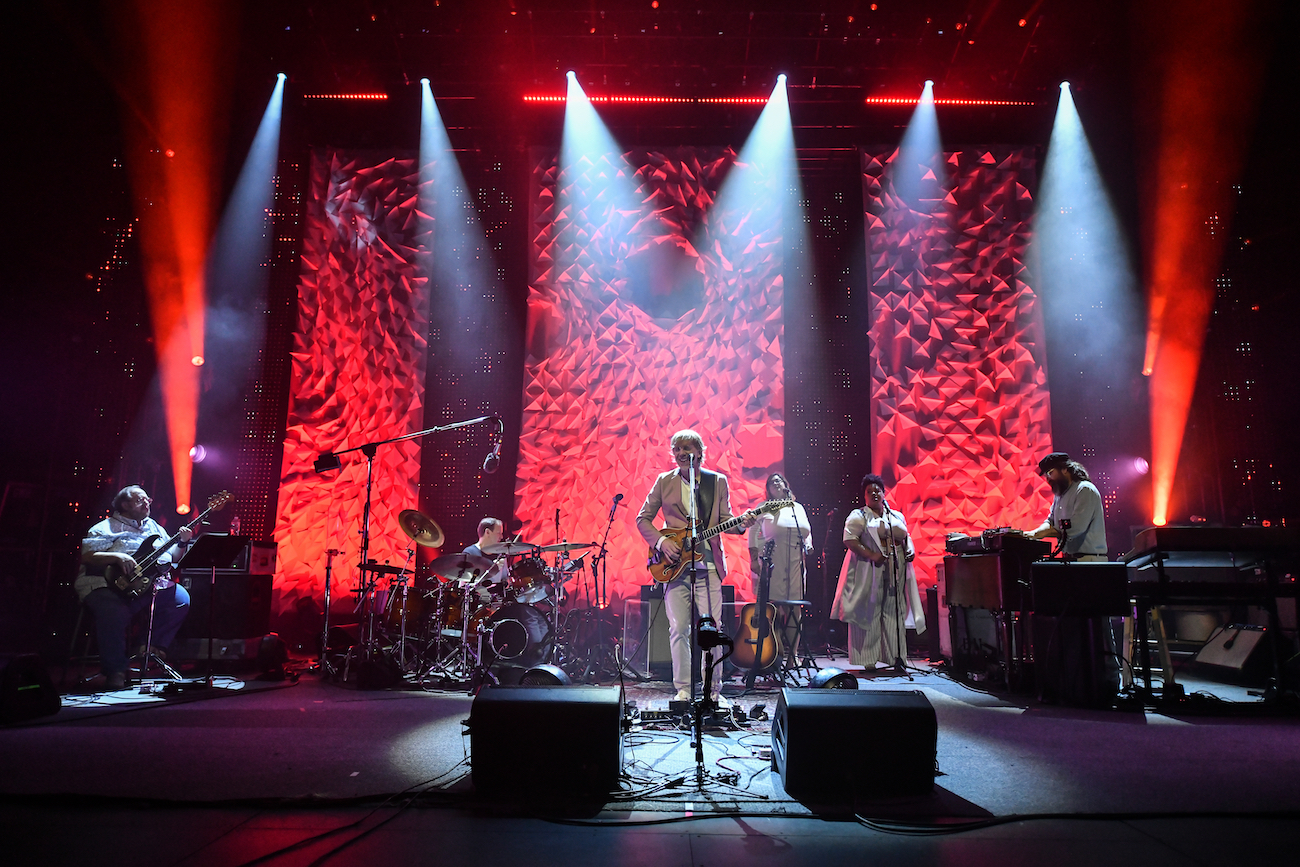
Trey Anastasio: It’s my favorite thing to do. It’s so scary. I walked out on stage in Maine, on the first night of the tour, and it was so different.
Over a35-year career, Trey Anastasio has performed in a rock quartet and withsymphony orchestras, with cosmic free jazz big bands and Broadway pitmusicians, with collaborators he’s had for decades and players he’s only justmet. However, Ghosts of the Forest constitutes something new for him. And notjust new in the sense that of an original album and limited edition band, but anew kind of new altogether.
Ghosts of theForest--the album and ten live performances with an additional dozen songs--remainsits own body of work, self-contained and unlike anything else in TreyAnastasio’s career: a crafted stage show with two hours of unheard music,deeply personal lyrics, and platforms for improvisation.
In part, theproject was a tribute to Trey Anastasio’s close friend Chris Cottrell, whosuccumbed to adrenal cancer in January 2018. Not long before, Anastasio hadlost his sister. And, just after Cottrell’s passing, Trey Anastasio Band keyboardistand old friend Ray Paczkowski fell ill with a brain tumor. It was a tumultuousand emotional time. Anastasio enlisted close musical friends Jon Fishman andTony Markellis, and eventually Paczkowski himself.
But despiteits introspective roots, spectral name, and the radical notion (for Anastasio,anyway) of performing a fixed song-list each night, Ghosts of the Forest washardly a grim monument. In tribute to Cottrell, who loved the adventurous sideof his friend’s bands more than anything else, Ghosts of the Forest became acontainer for the present moment -- and each ensuing present moment thatexisted as the project unfolded.
There was an album, too, released on the eve of the tour. But, as with much of Anastasio’s music, it was most alive during performance, a tangible and illuminated thread. Lift the bell jar and see.
TreyAnastasio: I’m kind of alwayswriting, so I think something was being born, and I didn’t quite know where itwas going. And then this thing started happening with Chris. But the projectwas actually started before that became the event of the day. I try to keep a“no resistance” relationship with music, just open and in the present momentall the time. So, then, things that happen in the present start to affect thedirection of where things are going. And my experience--sitting with Chris inhis last moments, drifting in and out of sleep--is what informed it and shapedit into what it was. It grew in an organic and natural way, because of thetiming of all this.
After this whole thing was over, I started thinkingthat it had just happened so fast, this outburst of music, writing andarranging and playing. I found myself asking, “what was I lamenting here?"Everybody’s friend dies. It was a profound loss, but It still felt like therewas more beneath the surface. It really haunted me.
I’ve been trying to put two and two together after thefact. I think a lot of it is about the loss of that naive feeling, all thatstuff you feel when you’re a kid. And when that goes away you have to get a newmojo. And maybe that’s what it was about -- more than the loss of an individualperson, that this was the person that tied me to my childhood outside my work world.He was a tether to “Let’s go ride a fuckin’ raft down a river in Utah and campout for six days in a tent,” which we did, and look back and realize you’rereally not supposed to put a tent right next to a river because the river risessometimes and people die. But we did that. It was stupid, but it never evencrossed our minds. Eventually, you get too old to live that way anymore. It’sright around the age that I am now. So maybe this is more lamenting the loss ofthat than an individual.
RayPaczkowski: When I was in thehospital, Trey would come over all the time, and we were talking about Chrisand what happened to him. I’d known Chris for many years. It was kind ofsurreal to be in a hospital room, and I wasn’t sure what was going to happen,but I was pretty sure it’s going to be fine, because that’s what I was told.Trey was definitely a little crazed about it all, that I might be headed offinto the other world. I think when Trey freaks out, [his personality] just getseven more Type A.
Don’t mistakethe ghosts for the forest.
Where Phishhave become infamous for never repeating a setlist, playing more than 230different songs during their 13-show Baker’s Dozen run at Madison SquareGarden, Ghosts of the Forest negated the notion of setlist score-keeping almostentirely. During their 10-show tour in April 2019, the band performed a fixedsequence of music. As Anastasio points out, the project wasn’t a theater piece.But it wasn’t quite a rock concert either. While the music was rehearsed andtight, and even scripted to some degree, there was flexibility and room forimprovisation.
Anastasio andPhish have escalated their game over the years, from one-night-only big pictureset pieces to slower long-term evolutions. But Ghosts of the Forest standsalone as a single focused moment, a standalone two-and-a-half-hour night ofmusic consisting of 21 songs, a four-piece band, two additional singers, andstaging by Abigail Holmes, meant to be performed and experienced live. It alsorepresents perhaps his biggest step as a lyricist. Often a collaborator,Anastasio’s truly solo compositions likewise thread through his career, hislyric writing growing more nuanced and personal over the course of decades.Ghosts of the Forest represents the largest and most cohesive batch of lyricsentirely by him, and unquestionably the most personal.
TreyAnastasio: Chris was an elk hunter,but he wouldn’t get an elk most years, he just loved being high up in the RockyMountains. He told me that there was this Native American term, “ghosts of theforest,” to describe elk, because they would vanish into the woods when you aretracking them. They’re very hard to hunt. He’d told me how he’d be following atrail, and it would suddenly just end, as if the herd had all leapt sideways.You never knew when the trail would end.
Finally, one year he got an elk. He was all alone whenhe shot the elk, and he told me about this eye contact moment. It gave mechills. He dressed the elk in the proper way, which he was very proud of, andcarried the elk meat all the way down the Rocky Mountains alone, hundreds ofpounds of it. I would come over, and he would serve it to us. It lasted for along time. There was an elk rug on his floor when you walked in his house.
It was the only elk he ever got, but I remember therewas a change. There was a sense of pride, a spiritual shift. I could tell whenwe talked that it was a very big deal to him. It made me reassess my point ofview about hunting, because there was nobody who loved nature more than Chris.When he died--and I was sitting with him, playing guitar, as he drifted intothe spirit world--I thought back about that.
Helping tobuild on the narrative was Abigail Holmes. A concert design veteran with amulti-decade genre-spanning resume, one early credit that attracted Anastasiowas her work with Talking Heads during their pivotal Stop Making Sense tours. Serving aslighting director for the genius re-imagining of a live rock performance--ashow that a teenage Anastasio caught several times--Holmes worked with DavidByrne again recently on his spectacular fusion of color guard and live music, ContemporaryColor. She’s partnered with Janet Jackson, The Cure, and Roger Waters, helpingthe Pink Floyd songwriter stage The Wall in Berlin. She’s collaborated withlongtime Phish lighting director Chris Kuroda to design the band’s last twolight rigs, including the bold LED screens that surrounded the band in 2016, aswell as the new movable rig that debuted in 2017. Anastasio enlisted her as acollaborator before the Ghosts even had a discernible shape.
TreyAnastasio: Abbey [Holmes, productiondesigner] and I started to meet early on. We had coffee before I even finishedwriting the songs. She was kind of talking to me as it was being written, andwe would talk about theatrical concepts. We talked about why you need to be, asan artist, completely concrete in the narrative and the intent behind everyline, in every musical choice -- even though it’s not important that theaudience exactly knows my concept. But if I put nonsense in there, their radarwill go off.
From a musical perspective, having Fish and Tonyseemed like a place to start. They’re my close friends, which was importantbased on the subject matter. And it was important that it was neither Phish norTAB as a starting place, and we started off just the three of us.
Jon Fishman:There was also a very clear elementof Trey saying things like “I’ve always wanted you and Tony to play together. Ikind of play with a certain abandon. And Tony plays with a certaingrounded-ness. He can definitely stretch out and I can definitely tighten up,but he's very grounded. You never have any fuckin’ doubt where the one is whenyou're playing with Tony, or where the groove is, or the feel. And that makesit easy for me to get a little bit wild-eyed and play to the edge of my skillset.
TonyMarkellis: I've been fortunate enoughto play with a lot of great drummers over the years, but Jon is a wholedifferent animal. His playing is such a balance of delicate detail withexplosive, raw animal energy -- a rare combination of freedom and precision.I'd go so far as to call his drumming melodic.
TreyAnastasio: Tony likes charts, so I’dmake a chart for Tony. With Fish, I sent him [demos of] all the songs and hejust went home and practiced. He’s a practice addict. He showed up knowingeverything. For “Drift While You’re Sleeping,” he came up with this beautifuldrum part that’s all sculpted.
Jon Fishman: I love every single one of these songs. As asongwriter, I think Trey really upped his game with this particular material. Notthat the material suddenly became serious in the sense that there's no humor toit. But, you know, Trey’s sister passed away. His best friend passed away.There was a scare with Ray. There's a lot of death around us. Things get real.I think there was a focus on the realness of life as he experienced it up tothis point, and trying to say things in a straightforward manner, and not sugar-coating.The focus was on the realness of the life experience and the beauty of theworld, and the beauty of music.
TreyAnastasio: After Chris died, and I’dfinished making the album, I went on a cavern tour in Utah, next to a Navajoreservation. I had a Navajo guide who started talking to me about elk. He saidthat when a boy turns into a man in his culture, they go hunt for an elk with abow, and when they shoot the elk they become a man. They believe in thispassage of the elk’s spirit to the natural world.
And, when the guide told me that, my head wasexploding. I’d just finished the album, and the very beginning of thealbum--the very first lyrics of the opening song--was my attempt to write fromthe point of view of the elk, as Chris and the elk make eye contact in thewoods: “And you’re the one to take me down, so take me down.” The Ghosts ofthe Forest idea is that Chris has now died and gone to that spirit world; theyare together, one spirit, and that’s what the album cover eventually became,the spirits commingling in the woods.
***
Part Two: Growing Ghosts