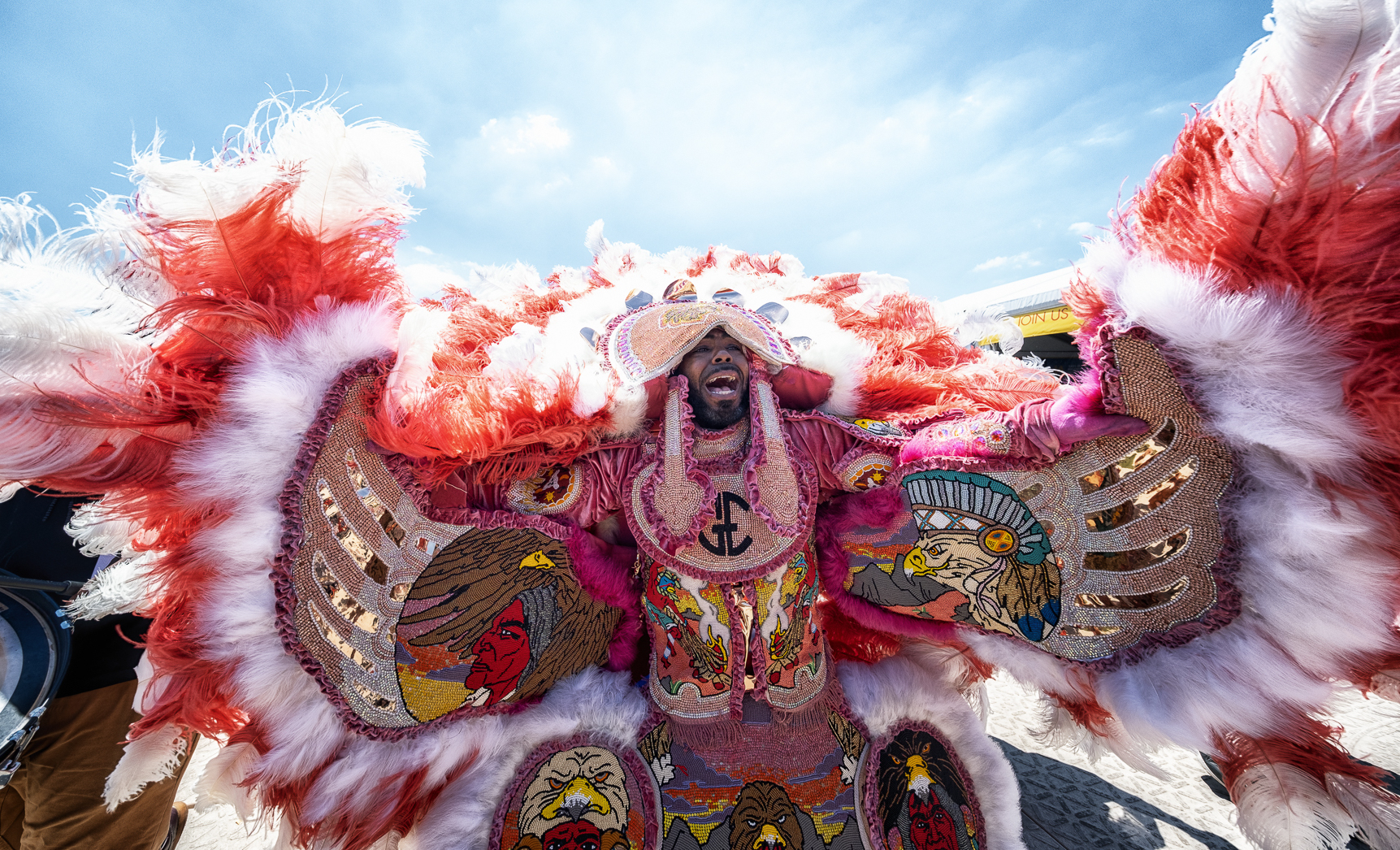
Big Chief Joseph Boudreaux, Jr. at the Young Eagles Mardi Gras Indians parade, Jazz Fest 2019 (photo by Marc Millman)
The Big Queen of the Guardians of the Flame shares her perspective on the Mardi Gras Indians tradition.
This article is part of our 50 Years of Jazz Fest celebration and appears in the special Collector’s Edition April/May 2019 issue of Relix. Subscribe here using code NOLA50 and get 20% off.
My earliest memories are dreamlike explosions of colors and aurora borealis flashes that are not only visual, but also visceral. Later, as a young girl, I remember standing before my daddy, the late Big Chief Donald Harrison, Sr., stretching my head back to take in all of his prettiness. He seemed so tall, like a majestic mythical warrior with his Swarovski-crystal-encrusted feathered crown. His movement was innately choreographed to the percussion-backed, call-and-response chants of “Two-Way-Pocky-Way,” “Shallow Water” and “Golden Crown.” It was all so natural, I didn’t realize this phenomenon known as “Masking Indian” was simultaneously unique, ancient and contemporary.
The precise origin of the tradition is not known with 100-percentcertainty. My dad said it is an homage to the mutual struggle ofpeople from African and Native American descent to experiencefreedom in America. He further elaborated: an homage to thestruggle for freedom of movement, spiritual practices, culinaryways and language expressions. In general, to have opportunitiesto be full-fledged citizens with economic opportunities and to liveself-actualized lives.
I am the third of five generations in my family to participatein this Mardi Gras/Carnival-related creative art expression thatincludes: original ceremonial dress art, community theater, ritualdance and procession, call-and-response narrative chants andpolyrhythmic percussive rhythms. The earliest participants inthis unique tradition practiced in African-American communitiesthroughout New Orleans and referred to themselves as “Indians;”later the name “Mardi Gras Indians” was imposed on them and,recently, many have embraced the term “Black Masking Indians.”Personally, I have adopted the term “Maroons.” A maroon hashistorically been described as the enslaved people of Africandescent who self-emancipated themselves from enslavers andjoined or established independent, hidden settlements. Maroonsutilized the area’s topography to evade capture.
The Code Noir and Jim Crow laws restricted people of Africandescent from fully participating in the celebratory masking traditions ofMardi Gras day. Yet, through Masking Indian traditions, participantsengage in acts of civil disobedience through the appropriation ofpublic thoroughfares for ritual processions that bring beauty, prideand comradery to African-American communities, all while beingcloaked in secrecy, resistance and resilience.
Historically, each member in the group (also called “gangs”) hasa distinct role. The first person usually encountered is the “spy boy.”His job is to spy on, or look out for, other groups, in order to set uppossible ritual meetings. He relays a covert message through othergroup members to his own big chief—who is usually in the lastposition in the group—to inform him a rival gang is approaching.The chief, in turn, relays his response back, indicating whether ornot the group should proceed with a meeting.
The next person usually encountered is the “flag boy.” A flag boytypically carries a decorated stick or a flag that serves to identifythe group by name, and relays information to and from the chief.
The “wild man” role does not have a fixed location in relation tothe chief. Rather, he can move about within the group’s formation.Think of this person as security for the group. His attire is usuallycharacterized by animal horns on his large decorated stick and/orheaddress. As the name implies, a wild man can act in what mayappear to be an aggressive manner. However, it is roleplaying, sothe intent is to keep spectators at bay with stern looks and gutturalutterances, rather than physical contact.
The role of children is largely determined by their age andmaturity. Younger children often mask alongside adults in largelyceremonial positions. For instance, a spy boy may have a youthmask next to him as a “little spy boy.” Some children show enhancedaptitude and are able to fully carry out the function of the position.
Women, who primarily mask as “queens,” usually do so alongsidea male group member. The role of women varies greatly fromgroup to group. In some groups, all women mask with the chiefs,in others, they may mask with a spy boy or flag boy.
A group can have one or more chiefs. The big chief is the leaderand is usually the last person in the group in its processions, unlessthe gang has a “trail chief.” In that case, the trail chief walks behindthe big chief. The big chief traditionally has the most elaborate suitand the largest stick staff. He is the public face of the group andmakes all major decisions.
Participation is personal for me; it is a spiritual calling. Although, I have been an ancillary member of the tradition since birth, I didn’t actually dress out until 1992. The first year I participated as Second Queen, after my dad refused to allow me to be his queen. The following year, he elevated me to be his Queen, the Big Queen. Upon the announcement, I excitedly inquired what my new role would be as the Big Queen. He matter-of-factly stated, “You are a mere embellishment. If a chief is pretty, he is prettier with a queen.” That declaration stirred within me the quest to be self-actualized as a woman in this African-American, male-led tradition. I knew it would not be to dress or assume any chiefly traits, but to carve out a unique identity of strength as a Queen. I have done that through my work as a narrative artist, via creation of my original art, ceremonial attire (referred to as a suit) and cultural activism. The quality of being pretty and being told you are pretty within this tradition is highly regarded; for many, it is the pinnacle of success. My father was different; he reiterated to members of our group, the Guardians of the Flame, that you cannot be motivated solely by the desire to be pretty. Pretty is important, but you must say something, make social commentary, note historical events—i.e., put something on people’s minds. He stressed that art should be provocative and interactive, encouraging dialogue and reflection.
My suiting (masking) and suit-design style honors my WestAfrican ancestry. As an African born in America without a clearpathway back to my ancestral homeland, the narrative attire andoriginal visual-art expressions serve to reconnect me—one beadand one stitch at a time. Beading is a laborious obsession. Theprocess and the content of my creations guide my life. For me, it isa way of stripping down to the essence of my being. It is bringingforth my personal narrative in the purest sense, without regard forimposed standards of any kind. I get to set my standard; I get totell my story on my own terms. It is the ultimate way for me toexperience freedom, in a frame of mind that I can only describeas euphoric. My standards are not dependent on Western ethics.After all, my hair is kinky, my knees knocked, my teeth gappedand my brown skin covers my very ample 220-plus pounds ofvoluminousness.
My inspiration and techniques come from many individuals and experiences. First and foremost, my parents grounded me and all of my siblings in an appreciation of the fact that our history did not begin in the bowels of ships, that it predates the Trans-Atlantic trade in human beings.
My dad was an avid reader and student of philosophy, art, music, world religions, sociology and history. As he neared the end of his life, he embraced expressing himself through surreal imagery, based on his love of the work of Salvador Dalí. His work took on a dark cast in revealing the ills of society. It is his fearless truth-telling that serves as inspiration for me and drives me to tell my own truth through clear, rather than rose-colored, lenses.
I read a Frida Kahlo biography when I was undergoing chemotherapy. It was a paradigm shift from how I had seen the world up to that time; I embraced telling my story that year, a story of “kicking cancer’s butt.” The suit, titled “Rise Up!,” depicts me as a rising phoenix, symbolizing my rise and metamorphosis. As a beadwork artist, I incorporate beads of different sizes, textures and materials to create the narrative images for the ceremonial attire I create and debut annually on Carnival Day in New Orleans. Personal research has broadened my awareness of narrative beadwork traditions of the Yoruba people and others from West Africa. With deliberate intent, I began to embrace the characteristics and colors of the Orishas/ Loas (deities) in my suits in 2007. Since then, each year features a color associated with one of them and beaded images that overtly or covertly allude to their attributes and symbols. In 2018, I incorporated the warrior Oya—she represents transformation, thunder, lightning, winds, hurricanes, the marketplace, graveyards and tornados. That suit also depicted images that commemorated the contributions of African-Americans during The City of New Orleans Tricentennial and illuminated the contributions of Africans. This year, my suit is inspired by Obatala, the Orisha of exceptional children, justice and mercy. My suits are original art creations that incorporate West African imagery, themes, materials and techniques to ground it in ancestral origins of sacred significance.
The aspect I love most about being Queen Reesie of theGuardians of the Flame is the feeling of freedom I experiencewhen I walk out the door on Carnival morning. Although suitingis referred to as masking, for me, it is the opposite. It is presentingmy naked self. My suits depict events that are uniquely my story. Forinstance, in 2016, my suit was a tribute to my great-great grandfather,Madison Briscoe. At the age of 12, Madison was enslaved, stolen fromVirginia and brought here to Louisiana. I cannot mask as Madison’sgranddaughter; I am his granddaughter. In the act of suiting, I amrevealing that truth, my essence, naked. Nakedness can be a stateof vulnerability but, for me, it is when I feel strongest. It is themanifestation of the true me, without the need to justify or makeaccommodations to fit in or bow down to any standards, but ratherto uphold my own. It is the embodiment of my dad’s rebellious andfearless spirit. It is my strong place. It is living my best life.
As the Big Queen of the Guardians of the Flame, I have had diverseexperiences locally, nationally and internationally. Among my mosttreasured moments are those I shared onstage with my father andthe annual performance of the Young Guardians of the Flame at theNew Orleans Jazz & Heritage Festival. My dad, a visionary, includednot only traditional percussive instrumentation, but also Africanpercussive instruments, a tradition maintainedthrough the Young Guardians performance inthe Kids Tent every year at the festival.
Of personal merit and note for me is thatin 2013, I served as a consultant for the MardiGras Indian Pavilion. That work providedopportunities to document important storiesof participants in the tradition who providedvital historical links through personal accountsthat are now stored at the New Orleans Jazz& Heritage Archives. Interviewees recordedinclude: Big Chief Joseph “Monk” Boudreaux(Golden Eagles), Tribal Queen Littdell “QueenBee” Banister (Creole Wild West), the late FlagBoy Isaac “Ike” Edward, Jr. (co-founder of theWhite Eagles), Big Chief Thomas Sparks, Sr.(Yellow Jackets) and Theodore “Bo” Dollis(Wild Magnolias).
My life has been intertwined with the New Orleans Jazz & Heritage Festival through performances; panel discussion, facilitation and participation; and quality-of-life enhance- ment through attendance. I have attended iconic performances by my son Big Chief Brian Nelson, with the New Orleans Hip- Hop Coalition, my brother Donald Harrison, Jr., my nephew Christian Scott aTunde Adjuah, Dianne Reeves and John Boutte, as well as the late Hugh Masekela, Etta James, James Brown, Ray Charles and B.B. King, to name a few. However, the most important way my life has been impacted by Jazz Fest is through the Jazz & Heritage Foundation Community Grant Program. I have been the recipient of over 10 grants to document, present and preserve the history of the Masking Indian tradition. Funding has supported publications, panels with tradition participants, exhibitions, research, and educational programming for youth and the general public. It is through this work that I found my place of strength—beyond that of a mere embellishment—as a supporter and documentarian who happens to be pretty, pretty Queen Reesie of the Guardians of the Flame.
Cherice Harrison-Nelson is the co-founder and curator of the Mardi Gras Indian Hall of Fame (MGIHOF). The MGIHOF has published six books and coordinated numerous exhibitions focused on West African inspired cultural expressions from New Orleans. Currently, she is the Education Consultant for the Donald Harrison, Sr. Museum (guardiansinstitute.org) located in the Upper Ninth Ward of New Orleans.
This article originally appears in the April/May 2019 issue of Relix. For more features, interviews, album reviews and more, subscribe here.