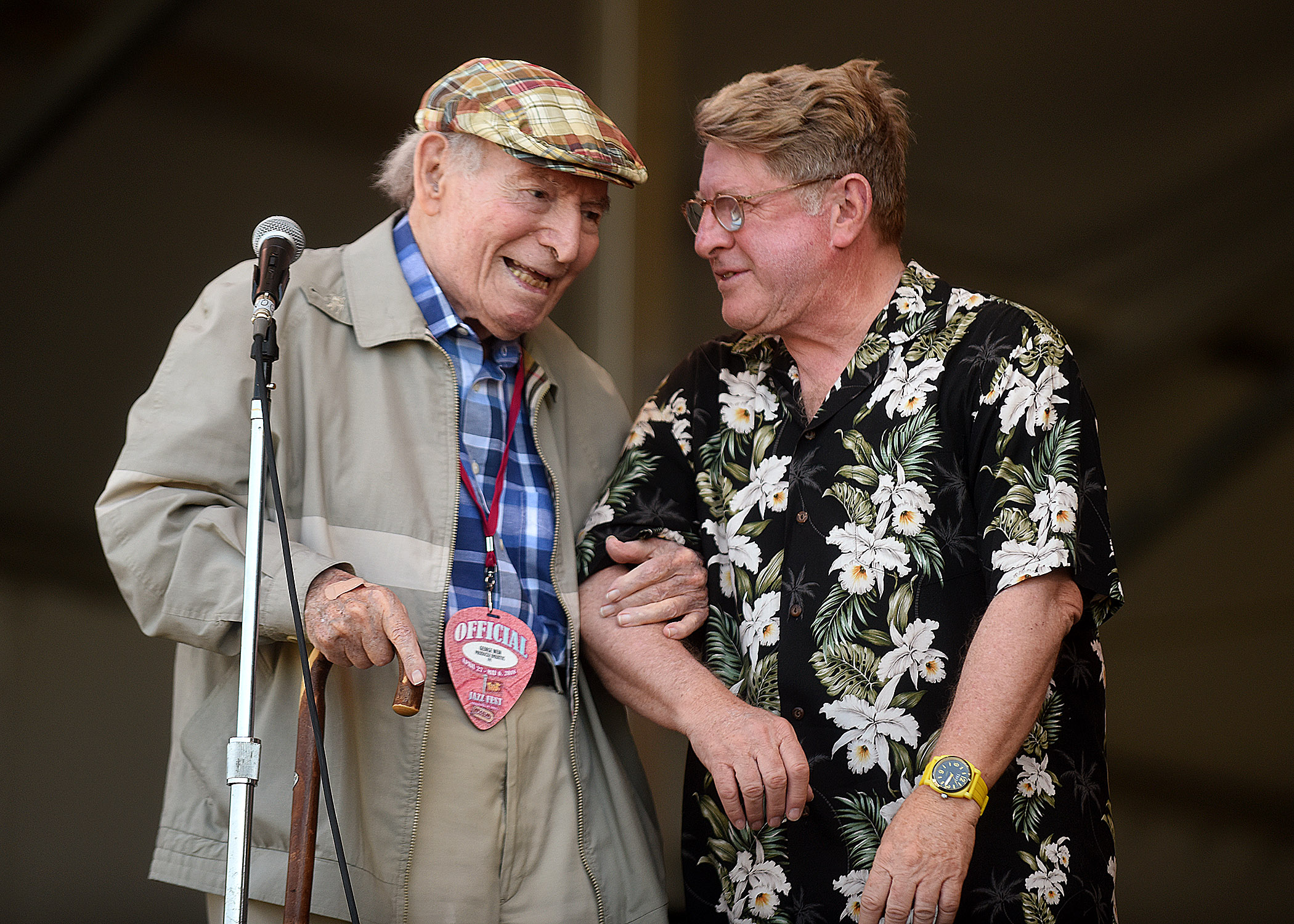
George Wein and Quint Davis at Jazz Fest 2018 (photo by Dino Perrucci)
New Orleans Jazz & Heritage Festival producer Quint Davis shares his perspective on the 50th year of the fest.
This article is part of our 50 Years of Jazz Fest celebration and appears in the special Collector’s Edition April/May 2019 issue of Relix. Subscribe here using code NOLA50 and get 20% off.
"This whole '50' thing—I can't really get my head around it, actually,” reveals New Orleans Jazz & Heritage Festival producer Quint Davis. “If I go back and look at pictures and stuff, I still can’t figure it out. But after 50 years, to still be not only thriving, but also relevant with our traditional music structure is an amazing thing.” Davis, who grew up in the city, embraced its culture from an early age, finding his way into local clubs while still a teenager. He was a Tulane University student in 1970 when founding producer George Wein tapped him to help secure local acts for the initial Jazz Fest. Only a few hundred people attended the inaugural event at Congo Square, a far cry from the 450,000 who were on hand in 2018 at the Fair Grounds Race Course (where the festival moved in 1972). However, as
Davis notes, “We have the exact same palette that we had the first years in Congo Square. We have a jazz tent, we have a gospel tent, we have a blues tent, we have The Meters on a funk stage, we have jazz funerals going on. It’s immensely bigger, but it’s the same palette.”
As you began programming the 50th year of the festival, did you have a particular goal or principle in mind?
The thing to remember is that each stage has one national guest per day. Everything is from around here, by which I mean New Orleans and Southwest Louisiana. We have about a thousand gospel singers, 40 Mardi Gras Indian tribes, and 40 Social Aid and Pleasure clubs—both onstage and participating in parades. There are 30 brass bands—traditional, in-the-street New Orleans brass bands. A lot of them are young and they can funk it up. For a kid inthe inner city to reach for a trombone to play jazz, is astounding.In most cities, they’re just going to be handed a ball—a baseball, afootball—but not a clarinet. But here, they are given instruments.
We also have New Orleans acts who are now national acts, likeThe Revivalists and Trombone Shorty, who will headline theirstages. The Revivalists are closing the Gentilly stage on Friday,and Shorty closes the whole festival every year. So that’s a greatevolution.
We’re also doing a lot of tributes because we’re very tied to ourancestors. We have a tribute to Allen [Toussaint] and a tribute toFats [Domino]. We have the “Piano Professors” tribute. The firstSunday in the jazz tent is the Ellis Marsalis Family Tribute—atribute to Ellis, the top of the clan so to speak—with WyntonMarsalis, Branford Marsalis, Delfeayo Marsalis, Jason Marsalisand Ellis himself. So Wynton is playing with everybody in thefamily, which I think has only happened a couple of times.
In thinking about the national guests, we have people who havebeen here for many years and have been woven into the fabric ofthe festival. That’s how you get Santana, Van Morrison, BonnieRaitt, Dave Matthews Band, Jimmy Buffett, Al Green, Boz Scaggs,John Fogerty, Herbie Hancock, Buddy Guy and others.
Now, having said that, you have to look both ways. I like topoint out that heritage is not only looking in the rearview mirror;heritage has to be looking out the front windshield.
Jimmy Buffett and John Fogerty are two of the artists often seen walking around the festival, sampling the food and taking in the music.
Absolutely. For many years we had two festivals—we had the Fair Grounds that went until 7 p.m., and then we had The President, an art deco, side-wheeled, paddleboat steamer. The whole inside was one big ballroom with a balcony all the way around. We did James Brown, Ernie K-Doe; wedid Sun Ra out in the middleof the river going in a circlechanting, “Space is the place.”One night, there was a reallylong line for the 8 p.m. show, andI see John Fogerty in the line.And John Fogerty, to me, was,like, Elvis. So I go up to him andI say, “Why don’t you come onin here?” And he said, “No, no,it’s OK.” So I told him, “Please,come out of this line and let ushost you a little.”
Another year, I met PaulSimon on the balcony on ThePresident. He had come tosee The Neville Brothers, buthe didn’t contact us. He wasmarried to Carrie [Fisher] at thetime, and there they were on thebalcony. Then one night on the Blues Cruise, ZZ Top came on withtheir beards tucked into their shirts. And, Buffett will put on hiscap and head off to go eat.
This year’s roster also includes a few notable first-timers.
Katy Perry is in that rare firmament with the top two or three women in the world. She has, from what I’ve seen on the last two tours, what might be the most highly produced arena production in the world. She’s like an Olympic athlete with what she does in this show.
[Ed. note: The Rolling Stones are no longer playing this year's Jazz & Heritage Festival. Instead, Widespread Panic will be taking over the headlining slot on Thursday, May 2.]
The Rolling Stones are probably the biggest band in the worldand they have the biggest stadium production in the world.
We don’t have a roof; we don’t have lights. We’re a daylight-only festival, but both of them really want to do it. Katy’s coming down here and she’s going to rip the place apart. It says something fantastic about them because not everybody will do that. We know from asking artists we won’t mention, who won’t play without their production.
When The Rolling Stones announcedtheir tour, it was all stadiums. At first,we didn’t list ourselves but, a few weekslater it came out that they’re also goingto play this field in New Orleans withreal good oyster sandwiches.
The Stones are a blues-based bandat heart, so they totally get everythingthat’s here. In “Down Home Girl,” Micksings, “I’m gonna watch you do thesecond line with an umbrella in yourhand.” I actually did that once with himand Charlie Watts. It was the Prince ofWales Social Aid & Pleasure Club. Wefound the parade, and we were just kindof walking along the side. So now, “DownHome Girl” has come to life.
Well, Mick bolts out in the middle of the street, in the second line behind the band, and because he’s the real deal, I’m sure he’s done this in Haiti and in Brazil. I’m wondering if all these people here in the heart of the city know who it is—he gets out there in the middle and is dancing—I mean he’s Mick Jagger, he’s getting down. Then, they start a street chant, “Go Mick, Go Mick, Go Mick...” He was in the middle of the whole second line and they’re turning to him chanting. Then we had to get him out of there. [Laughs.]
For folks who are interested in some of the more unheralded acts, do you have any suggestions?
To make it a quick, easy answer, look at the schedule of the Cultural Exchange Pavilion. All the other venues are pretty much genre-specific, but the cultural exchange tent has something different every hour, and it all says something about this festival. Just looking at day one, Thursday, April 25, we have Pride of Zulu from South Africa, the Django Festival Allstars and The One Mind Brass Band, who are going to parade into the middle of the tent with their big second line and just rock the middle of the tent. And then Diassing Kunda, from Senegal, is closing.
One of the things that I thought has gone missing a bit was real, traditional African music, which we used to have a lot of. And not just King Sunny Adé, who was one of our pillars of African music. We have to go back andreally make that a part of the festival.
I’ve told our music people, “We can’t have a festival where youjust call an agent and book the band. We have to have a festivalthat digs down deep and finds the culture.” We have people that, inorder to get them a visa, they have to havea passport, and in order to get a passport,we have to get them a birth certificate. So,staying as deep as we can be is a big partof the weave.
Diassing Kunda’s story is interesting.We have an online application for localbands, and the deadline is October 1. Oneday, way after the deadline, I get somethingfrom the music department that said, “Wejust got this application. It’s from a groupin Senegal,” which was Diassing Kunda.They had filled out the local registrationonline form and said, “We would like toplay your jazz festival.” They provideda link in which they were performingat some little, local festival. They wereon this little stage and they have thesetwo drummers sitting down playing twodrums each, and they’re incredible. Theyhave this big guy standing in front witha whistle and he’s the lead drummer.He’s got a stick in his hand and he’djust be doing a little bit here and there,then he’d take off and just explode thewhole thing. Then standing next to him,Diassing is playing a kora that he’s put ona microphone. He dances around playingthe kora and then he steps up to a micand starts singing.
So I said, “Get them.” Nobody believedme. A week or so later they come backand said, “You know that group thatapplied—were you serious about that?”They explained what they would need todo in order to make it happen. And I said,“Yeah, bring them here.” So we did.
And as you say, that’s just one day on one stage.
Yes, there are still all these treasures on all these stages mixed in. Jupiter & Okwess from Republic of the Congo, we had them for the first time last year. They’re a phenomenal band. They almost reminded me of Parliament Funkadelic in a way. Jupiter is like 6’6 and has these traditional drums in the middle of the stage and kind of growls. Then there’s two or three guitar players, and a bass player who sings, and then the drummer, who has no shirt, and is wearing a Mexican wrestling head cover. It’s surreal and they’re playing their asses off. So we had them back and they’re in between Big Freedia and the Hot 8 [Brass Band]. And that’s Jazz Fest.
This article originally appears in the April/May issue of Relix. For more features, interviews, album reviews and more, subscribe here.