This article originally appears as the cover story of the June 2019 issue of Relix. Subscribe before July 1 here with code SUNFLOWER to get $5 off.
Six years after dropping their previous LP, Vampire Weekend dig into their “jam-adjacent” aspirations and new band realities on a cosmic fourth album inspired by East Coast nostalgia, hip-hop production and the good ol’ Grateful Dead.
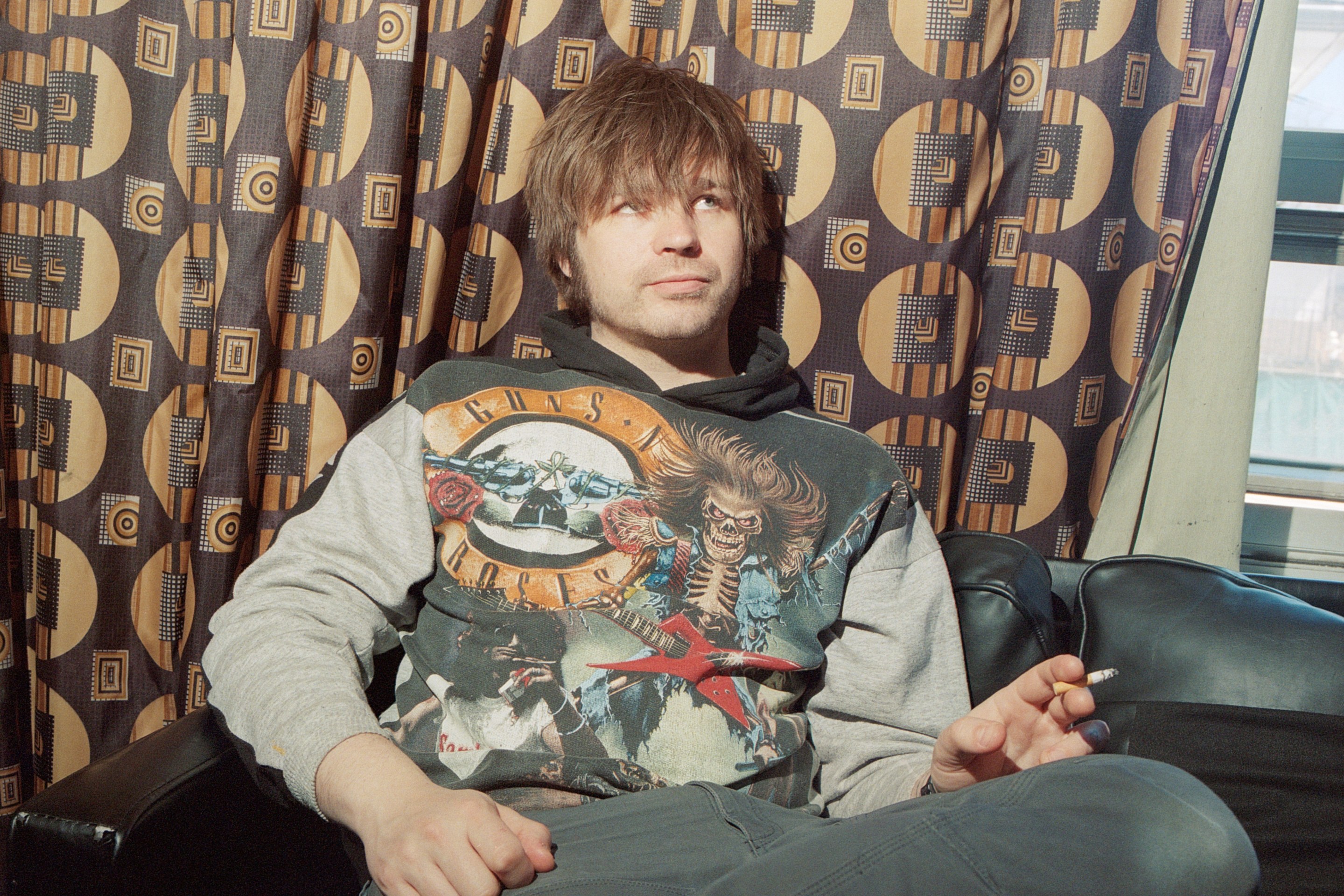
It's a sunny day in Hollywood, Calif., but Vampire Weekend's Ezra Koenig is glad to be indoors, at his management's office, sitting comfortably on a couch where The White Stripes, The Shins and Cold War Kids have all sat and ponderedtheir careers. The room is sparse but somehow laced with muted excitement, like a waiting room for those about to rock.Koenig still has to wait another three weeks before Vampire Weekend’s Father of the Bride, his group’s fourth LP and firstin six years, hits shelves, and it’s impossible not to feel like he’s living inside the metaphor—the album is the bride. Andhe’s about to give her away. It’s a big moment.
All ceremony aside, the hope is that Father of the Bride will join David Bowie’s Hunky Dory, Queen’s A Night at the Opera,The Who’s Tommy and Bruce Springsteen’s Darkness on the Edge of Town as bids for longevity; those albums all elevatedtheir respective makers from johnny-come-latelies to legacy artists. Not coincidentally, they’re also all fourth albums.
“One burst of good ideas can get you through three albums,” says Koenig, nodding, keenly aware of where theconversation is going. Koenig is bright, measured and lives a self-examined life that prizes intent and awareness.
So he knows: There’s no shortage of bands who have made three successful albums only to fold into the arms ofoblivion. Others have suffered fourth album losses, devaluing their previous hits into little more than throwbacks. Indeed,the express lane leading from heat-seeker to blast from the past is well traveled and takes only a few short years to traverse.
That cruel destination scared the shit out of Koenig. As a student of music who always does his homework, including the extra credit, he couldn’t help but see the precipice where Vampire Weekend stood at the end of the cycle for their third album, 2013’s Modern Vampires of the City, and feel the wind blow up from below.
“Over the course of three albums, we went on a journey from youth to the end of youth,” he says. Koenig had to put a lot of time and effort into making sure that each of those three albums was unique, that each of them broke new ground. Their self-titled breakout was quirky and—despite some critics who ostentatiously grappled with the disparate elements—it made most indie bloggers very, very happy to have something new to talk about. The music was fresh, it was different and it catapulted Vampire Weekend from nowhere to everywhere, and fast.
Their second album, 2010’s Contra, wasn’t a departure, but did add depth, foraging from a wider swath of the musical landscape for anagreeable patchwork of synth-pop, ska, worldbeat, electronic, hip-hop, punk-pop and indie-rock. The band’s audience continued to growin numbers and, by their third release, they were getting recognition from their peers and elders as well. They had become established. Itwas an arc that, essentially, mirrored Koenig’s 20s.
“It’s not a shocker to me that some people took the third album, Modern Vampires, more seriously,” Koenig admits. “Because you stuck around, you grew, you hopefully maintained some quality—you getthese pats on the back that nobody is going to give you when you’renew.”
He stops to take a sip of coffee and reflect. “That all felt goodand it’s gratifying. But then there is that funny feeling that happensthe moment you’ve finally achieved what you’ve been dreaming of:The next day, you’re like, ‘Well, what do we do now?’”
The answer, for Koenig, was nothing. As Vampire Weekend’screative captain, he had no destination in mind while the shipbobbed across open water. He let go of the wheel, but wouldn’t letanyone else take it either. Without any land in sight, it didn’t matter.They had time to drift and, with no fuel in the tank, it was the bestpossible thing for their long-term survival. A few years passed.
Koenig knew that if he wanted to—or if he wasn’t careful—hecould write a fourth album that sounded a lot like the first three.But why bother? The fast track to irrelevance is redundancy.
So, after Modern Vampires won a Grammy for Best Alternative Music Album, with the obligatory whirlwind tour that followed, Koenig took some time off. He stayed somewhat active, creating an animated series for Netflix (Neo Yokio) and working on his podcast (Time Crisis). He had a baby. But the Vampire, which he named after an abandoned film idea he had back in college, was always there.
“It took some thinking to say, ‘Yeah, so, whatdo we do now?’” says Koenig. “The stakes werelower in the sense that we probably could’vereleased a totally boring album and we’d still sellsome tickets.”
It’s true—at a certain point, even if you release a bad album, as long as you still play the hits (say, “Oxford Comma,” “Ya Hey,” “The Kids Don’t Stand a Chance,” “Hannah Hunt,” “Step”—there are plenty of them) fans will come to the dog-and-pony show, take Instagram clips of their favorite songs and recall the time in college when Contra first came out and it was playing at that party the night of...
“Actually, maybe that’s when the stakes are higher,” says Koenig, looking down at the coffee table while gears visibly move inside his head. As he grew older and progressed through his 30s, he needed to figure out a way to progress the band as well, or else risk creative death—not just commercially, but personally.
“I’m not talking about the critics or the fans, but if you canmake a fourth album just for yourself, that gives you some of thosefeelings you had in your early 20s when you wrote a new songthat wasn’t quite like anything you’d ever done before...” he says,pausing to think. “Then you can see a path forward.”
That path has a destination called community. The VampireWeekend fans who live there are lifers. They get to experience aband that has grown with them since graduation, that has beenwith them as they struggled to get jobs, families, a home, and thenhas stuck with them well into their 30s as they’ve gone on vacationsand put down roots and started to have kids of their own. “That’swhen you realize there’s something deeper than infinite growth,”Koenig says. For those who have gone the distance with them, theband’s history becomes a shared history—and Vampire Weekendbecomes an experience.
Koenig makes an observation about his personal life as ametaphor: “I don’t need to be surrounded by strangers or casualacquaintances all the time anymore,” he says. “I would rather havea core group of friends and just be around the people that I’m closewith. I’ve got less FOMO than I ever had in my life.”
With an important album release around the corner, and all the unimaginable pressure that must bring to any artist, Koenig appears remarkably at ease—relaxed, prepared, confident. Heseems familiar with the couch in his team’s office that he’s sprawledout on, comfortably, while his managers are presumably at theirdesks, behind closed doors. But there is an elephant in the roomand that’s the absence of founding member Rostam Batmanglij.
In 2016, Batmanglij quit the band. His departure shouldprobably be a big deal because he helped define VampireWeekend’s inimitable sound. And yet, Koenig and his twobandmates—drummer Chris Tomson and bassist Chris Baio—allseem nonchalant (or, at least, respectfully tight-lipped) about thechange.
Koenig insists that there’s not much to it and doesn’t haveanything more to add about the departure, other than he alwaysknew the day would come—Batmanglij had additional aspirationsfrom the beginning and never looked at Vampire Weekend as hisown life’s work. He adds that Batmanglij’s creative identity wasnever tied to a specific instrument; in fact, he and his longtimefriend were never even married to the concept of VampireWeekend being a band.
Significantly, Batmanglij still contributed to Father of the Bride. Perhaps he’ll continue to contribute to future albums. “The split was amicable,” as they say. Perhaps the band’s casualness isn’t stoicism so much as it is adjustment—after all, for them, the change happened several years ago. They’ve had time to acclimate. More important, initial concerns were squashed by the time they started rehearsing the new material.
“I don’t need to be surrounded by
– EZRA KOENIG
strangers or casual acquaintances all the time, anymore. I would rather have a core group of friends and just be around the people that I’m close with. I’ve got less FOMO than I ever had in my life.”
“As tectonic plates shift, there’s some settlingto be done,” admits Tomson, hesitantly. “VampireWeekend, as an entity, was going to have to figureout change and figure out growth and figure outa lot of things—regardless of Rostam leaving orstaying.”
Tomson’s enthusiasm, when reflecting backon the process of forging ahead, is undeniable.“I’m not pumped because of something that hasceased to be,” he clarifies. “I’m pumped for a newchapter to start.”
Still, any initial unease from fans on the outside is understandable: Vampire Weekend has always been Koenig’s Frankenstein; his songs, his vision. But Batmanglij was usually the one next to him, in the producer’s chair.
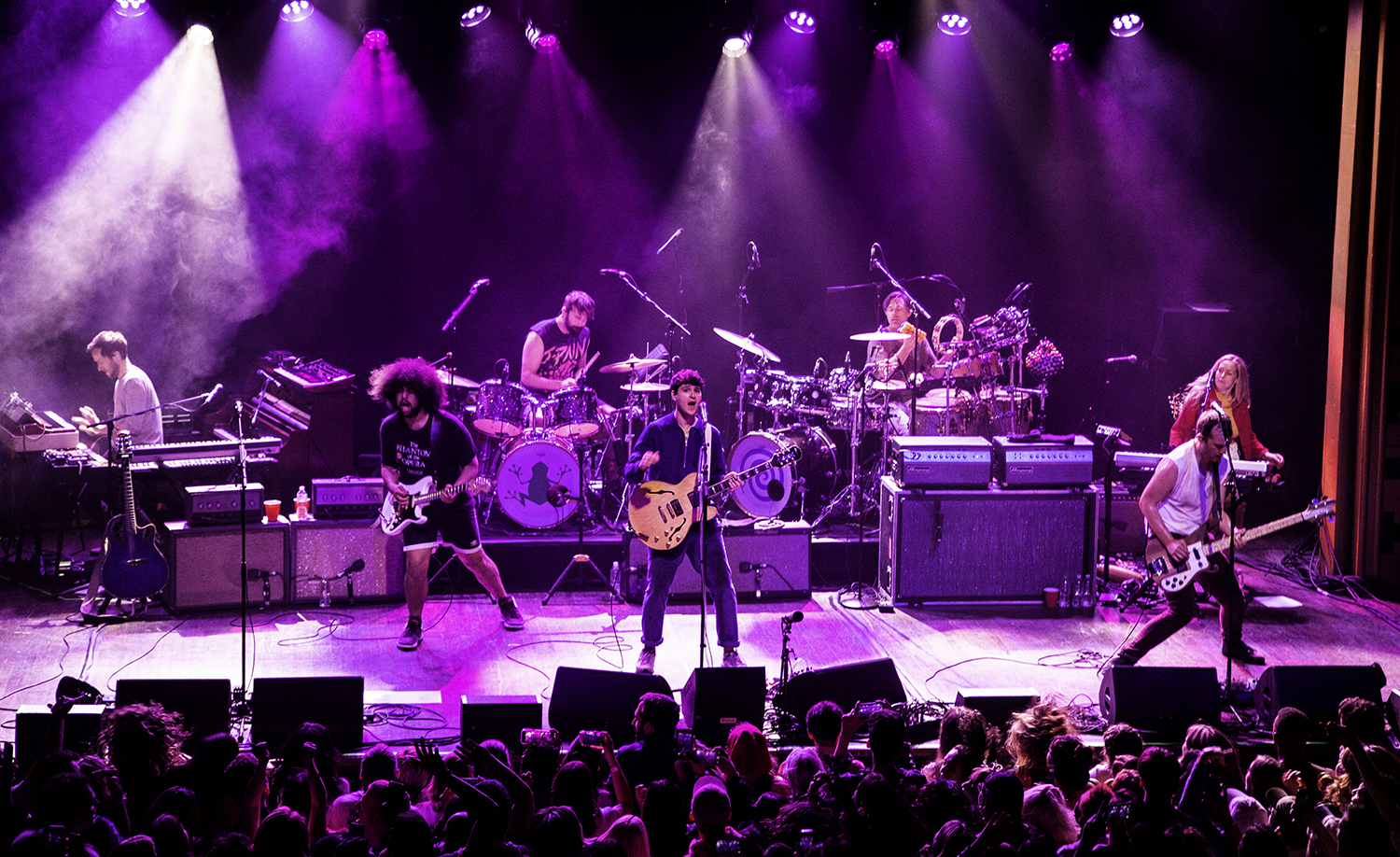
With Batmanglij gone, they were no longer a quartet. Sothey expanded into a septet instead, bringing in guitarist BrianRobert Jones, multi-instrumentalist Greta Morgan, drummer/percussionist Garrett Ray and keyboardist Will Canzoneri.
Jones, who had previously played bass with Gwen Stefani,represents a new generation of fans who grew up on VampireWeekend’s music. “I listened to Vampire Weekend when I was inhigh school and, now, I’m playing in the band,” he says with a grin.
“There was something totally unappealing about finding aperson to just do the parts he played, as he played them and allthat,” Tomson says, supporting Koenig’s instinct. Adding fourmusicians instead of one allows the band to play things live nowthat they never could’ve before, by sheer virtue of all the extralimbs.
“The idea of rolling out there with four people feels so anemicnow,” says Koenig. “It doesn’t make sense to me.”
Vampire Weekend 2.0: Ezra Koenig, Chris Baio, Will Canzoneri, Brian Robert Jones, Greta Morgan, Garrett Ray, Chris Tomson (clockwise from center top) (photo by Jeff Kravitz)
In the studio, Koenig has always favored having a collaborator for checks and balances so, in Batmanglij’s absence, he reached out to other producers, including Mark Ronson, BloodPop and longtime associate Ariel Rechtshaid—all of whom come with impressive track records. The Internet’s Steve Lacy guests on a song, and vocalist Danielle Haim appears on a number of them. Hans Zimmer even has a writing credit.
Koenig notes that, even though he and the Chrises will always have their shared heritage, it did not feel representative of theirtrue creative process to simply have a picture of the three of themin the album’s liner notes. He admits that some of his productionpartners are “kind of ” in Vampire Weekend, but including a pictureof everyone involved in the process would look like a “middleschool” photo so they went with a picture of Haim for the Father ofthe Bride vinyl gatefold.
“When I listen back to this album, I think there’s elements ofall three of the albums, plus something new,” says Koenig. And tobe sure, Father of the Bride is an evolutionary album for VampireWeekend—the bridge between their youth and middle-age.
Without really even intending to, Koenig relocated to LosAngeles in a move that happened slowly over a couple of years—amove he still talks about ambivalently. His romantic partner,actress Rashida Jones, lives in LA. The two of them had a childtogether last summer. And his core bandmates, Tomson and Baio,also moved to the area, each for their own reasons. So, even thoughhe considered himself a lifelong New Yorker and had his ownapartment, Koenig found himself living in LA.
“So much of this album is about analyzing my own nostalgia foran East Coast ‘90s feeling,” says Koenig, who finds it ironic thatearly reviews have decided that Father of the Bride has a Californiasoul to it. “I picture myself being exiled in California, thinkingabout being back in Vermont in 1997.”
Indeed, Father of the Bride is chock-full of nostalgia and homesickness, dressed up in various disguises. There’s the pensive “Big Blue” (“I was so overcome with emotion/ When I was hurt and in need of affection/ When I was tired and I couldn’t go home”), the patronizing “This Life” (“Baby, I know pain is as natural as the rain/ I just thought it didn’t rain in California”) and “Sunflower,” which betrays Koenig’s preference for the overcast Northeast weather over the perpetual Southern Californian sun (“No power can compel you/ Out into the daylight/ Let that evil wait”).
“As tectonic plates shift, there’s some settling to be done. Vampire Weekend, as an entity, was going to have to figure out change and figure out growth and figure out a lot of things—regardless of Rostam leaving or staying.”
– CHRIS TOMSON
But the East Coast that Koenig pines for might not exist anymore. It’s not just about geography; it’s a longing for a time as much as a place. As an example, he brings up the Wetlands, the New York City nightclub that, in the 1990s, every Deadhead in the country knew about and every jamband fan within a certain radius called their second home. “The venue represented a specific type of East Coast person who generally didn’t just like the Grateful Dead, didn’t just like Phish, didn’t just like Dave Matthews,” says Koenig. “They probably would like at least one of those bands, but they were also interested in hip-hop and interested in music from the ‘60s and ‘70s. It almost represented an approach to music, an attitude toward music, and an interplay between musicianship and composition. There’s a million ways you could describe it, but there was something about it—it was a pristine moment.”
Koenig fondly recalls seeing the Greyboy Allstars, who he covered in his high-school band, at Wetlands, shortly before the venue shuttered in September 2001. “By the time Vampire Weekend were playing shows,” he says, “it was already a faded memory of New York.” His nostalgia for that halcyon era is reflected by the fact that he recently watched a documentary on the nightclub’s history, Wetlands Preserved. [The 2006 film on Relix publisher Peter Shapiro’s former club was directed by Relix editor Dean Budnick.] Koenig explains that he doesn’t really get a chance to discuss this with journalists, and he seems eager to talk about it.
“The East Coast is kind of my ancestral homeland,” he says.
Any optimism in the lyrics on Father of the Bride is found in those moments fraught with sentimentality for both youth and home. Anything dealing with today or tomorrow is shaded with anxiety and detachment—or, perhaps, a guilty kind of acceptance. In the album track “How Long,” the narrator asks, “How long till we sink to the bottom of the sea?” without sounding too worried or concerned. It’s a resigned acknowledgment thattime passes and things change.
“As I get older, I realize the art form is not thesong. It’s not the album. It truly is the career,”Koenig muses, spit-balling as he goes. “It’s thediscography. You could go back and debate whatKanye West album might be your favorite, butit doesn’t matter. You can have different entrypoints, but Kanye produces a body of work thatchanges and grows and, yet, feels connected. Tome, that’s the highest thing to aspire to. What’sexciting is that can you keep adding chaptersto the book—you’re reading the same book,nobody’s confused, but you are progressingthrough a narrative.”
It's an equally sunny day in Glendale, on the backside of the iconic Hollywood sign, Griffith Park and Tinseltown just beyond. Here, on the wrong side of the hill, all seven members of the current, touring version of Vampire Weekend are gathered in an industrial park, surrounded by warehouses, factories, a couple auto part stores and not much else. Welcome to Vampire Weekend’s rehearsal space. The band is taking a 30-minute break from running through the new material, pausing only to eat lunch. Rehearsal ends at 3 p.m., but it’s still going to be a long day—after rehearsal, the guys have to stick around for the joyless task of filming a videofor the song “This Life.”
A photographer sets up for someband portraits and, upon meetingKoenig, confesses that he’s a hugeDeadhead and that the new single,“Sunflower,” reminds him of the Dead’s“China Cat Sunflower.”
“Oh, really?” asks Koenig, onlyslightly surprised. “Some people havesaid it sounds more like Phish.” Theystart talking about Jerry Garcia’s“China Cat” riff and the song’s chordprogression, and Koenig posits thatechoes of both elements seem to popup everywhere, even in places wherethey’re not. He offers that anothersingle from this album, “HarmonyHall,” has also received that samecomparison.
But then there’s this: When Vampire Weekend went on BBC Radio 1 recently to promote “Sunflower,” they performed a cover of Post Malone and Swae Lee’s hit of the same name instead. During the intro, Koenig referenced a guitar lick from “China Cat Sunflower” and then teased Vampire’s own "Sunflower” (and “Harmony Hall”) during the instrumental breaks. Furthermore, on the new album, Koenig used an envelope filter effect that gets him undeniably close to Garcia territory, despite the foreign cover song. It was a clever prank and a deliciously layered musical pun.
All of this is surprising, considering that Vampire Weekend wasonce part of a wave of indie-rock coming out of Brooklyn 10-15years ago that rejected guitar solos and that instinctively revoltedagainst any notion of “guitar rock,” let alone “jams.”
On the day of the band’s rehearsal, Rolling Stone published an article proclaiming that the guitar solo is officially dead. “That kinda makes it cool again though, right?” saysKoenig with a knowing grin.
Inside the rehearsal space, Koenig takes outhis phone to snap a shot of Nikki Sixx’s autograph,written in Sharpie on a cymbal on display on awall in the hallway. There’s also kombucha in thevending machine. It’s that kind of studio.
The band is set up facing each other in a thin but long rectangular room, with a lighting truss hanging from the ceiling and soundproof walls. With seven people in the touring configuration, the band now has two drummers which, in itself, begs additional questions about a new or renewed Grateful Dead influence.
“Like any kid growing up on the East Coast—and like any kid who likes rock music—I was familiar with the Grateful Dead,” Koenig explains. “I liked them and I had my little phase as a tween wearing Grateful Dead shirts and being interested in it.”
But, also indicative of the time and place of his upbringing, by the time he got accepted to Columbia University, his primarytastes had shifted more toward hip-hop. He studied pop music andthe emerging trend of hip-hop crossing over into the mainstream.He also appreciated punk-rock, among other genres. Rather thanbeing a genre-whore, Koenig just likes a lot of bands, regardless ofwhatever categories critics place them in. “When you’re a musicnerd,” he says, counting himself in, “youcould take the whole rest of your life todig through everything that’s made animpression on you.”
In interviews—both in this one andmany others—Koenig repeatedly refersto himself as a “studio guy.” Meaning, inpart, that he always viewed live shows asa presentation of the album, interspersedwith some greatest hits to keep everyonehappy. When done right, he loveselaborate, polished stage productionsfull of pomp and spectacle. He points toJaden Smith’s recent set at Coachella,which featured a Tesla flying down fromthe rafters, as an example. But now, hisinterests are expanding.
One of several catalysts for this shift appears to be his friend, Jake Longstreth, his co-host on Time Crisis, a painter by trade and a member of Grateful Dead cover band Richard Pictures (originally called “Dick Pics,” a pun on the officially sanctioned “Dick’s Picks” archival Dead series). The two have now discussed the Grateful Dead on their podcast multiple times and Koenig has even enjoyed catching Richard Pictures live, when his schedule allows for it. (Both Jake and his brother, Dirty Projectors’ visionary David Longstreth, contributed to Vampire Weekend’s recent studio sessions.)
“When I first saw them, it was almost at the exact moment when indie music was starting to feel overly professional and sterile,” he says. “But then I saw my friend perform the music of the Dead at a tiny little art space. Beyond the music itself, it was also the vibe of seeing people perform guitar music with joy. I realized that was lacking. So, in this funny way, that experience, more than the specific music of the Dead, definitely felt influential.” “It’s undeniable that Ezra has been way more interested in the Dead and that universe (including the Jerry Garcia Band) than he was in 2008,” says Tomson, noting that the unexpected development has been gratifying for him to watch. “The ethos of jam, more than any specific signifiers, is now part of the vocabulary in a way that I find really cool and, in a weird way, a return to my own roots.”
To prepare for this tour, the band spent 14 months rehearsing. While Tomson was motivated to take drum lessons for the firsttime in his life, Koenig started picking up his guitar at home andpracticing it more, something he never used to do. His instrumentfor composing new songs has always been a laptop. He definedhimself as an artist and a musician, but not as a guitarist. That’s nolonger the case.
“I wasn’t interested in live music when I was a kid,” he admits. “So, on a very basic level, I was always way more interested in the Dead’s studio recordings.” He cites “Uncle John’s Band” as a song that he was obsessed with and, later, around the time Vampire Weekend formed, the uniqueness of “Crazy Fingers” really grabbed his attention. And, when listening to Father of the Bride, it isn’t surprising that he studied “Crazy Fingers.” Vampire Weekend might not sound like the Grateful Dead, but—for the first time—there’s some kind of compositional branch that connects them.
Koenig’s “Studio Dead” influence isn’t a new thing. Before theirvery first album was released, he took notice of the Dead’s owninfluences. “At that point, I was interested in looking at electricguitar in slightly different ways, so I looked at a number of ‘rock’musicians who had little moments that seemed indebted to theAfrican guitar tradition, whether it was [The Smith’s] Johnny Marror the Grateful Dead. There was something about it where I waslike, ‘Woah! This was way before Paul Simon made Graceland.’”
Similarly, as a music scholar (he’s been known to go to a librarywith grad students to study lyrics), he can name-check a numberof “jambands,” including Twiddle (whom he recently caught liveat the Troubadour after dedicating a good portion of a podcastto a deep-dive into their song “Jamflowman”), the Disco Biscuits(whom he refers to as “Bisco”) and Widespread Panic (whom hecalls by their nickname Widespread “Mother Fucking” Panic). Butit’s the mention of Bone Diggers, a Bay Area band that takes PaulSimon tunes and jams them out JRAD style, that makes his eyeswiden. “That kind of stuff really interests me,” he says.
Koenig’s bandmates also bring their own backgrounds to thegroup—it’s easy to spot the Phish fan in any crowd and, here, it’sTomson. For today’s band rehearsal, he’s wearing a bootleg Phishshirt that repurposes the NASCAR logo to read “Curveball.” Hebought it from some guy on Twitter.
For years, he’s rocked Phish shirts onstage, including some high-profile late-night television appearances, but it’s not just an ironic fashion choice: Tomson gushes that he made it to Madison Square Garden to catch one of the “Baker’s Dozen” shows in the summer of 2017 (“Lemon” night) and while he proudly recounts jamming with Phish bassist Mike Gordon—on some Grateful Dead tunes, no less—he remains a genuine front-of-house fan. “Whenever I do get to shows,” he says, “I really fucking love it.”
Meanwhile, Baio comes more from the electronic/DJ scene buthas paid attention to the expanding overlap between producedelectronica and live improvisational music over the past decade;he cites Four Tet’s appearance at Camp Bisco as an example of thecrossover.
“I think a lot about the direction of the live show in terms ofhow I think about it when I DJ,” says Baio. “The idea of combiningsongs and transitions and things like that.”
Though Jones is new to the jamband scene, Koenig has spent some time turning him on to the Dead while Tomson has pointed him the right direction on the Phish front. “There’s so much history of guitar wanking,” says Tomson. “I really like that Brian’s sick on the guitar, but he’s true to the original spirit of Vampire Weekend.” Koenig notes that Vampire Weekend’s entire songbook is still less than the 100 tunes that Trey Anastasio had to learn for just five Fare Thee Well shows. But, with more than 60 originals in their canon, and more than a dozen carefully curated covers in their pocket, it’s getting there. Which means that the band finally has a song cache big enough to have some fun with.
In a career first, Baio says, “I don’t think we’re ever going to play the same set twice.” They’ve even worked out alternative versionsof particular songs to whip out on any given night.
That’s a stark difference from their 200-show tour behindContra during which, according to Baio, they “may have changedthe setlist two or three times” over the course of a year and a half.
Koenig reveals that he’s been going onto the website setlist.fmto track changes in various artists’ setlists across entire tours (andcareers). Not surprisingly, he’s been focusing his research on bandstouring behind their fourth album. “More than ever, I have becomevery interested in who switches up their setlists,” he says. “Whenthey do it, how they do it.”
Vampire Weekend has been described—in fact, is self-described—as “jam-adjacent.” But Koenig points out that he’d also put Bruce Springsteen and Pearl Jam in that corner. It’s an attitude, an approach and, perhaps most important, a live show for the sake of a live show, as opposed to looking at it as part of the promotional outreach of a particular album. “There is a joy in approaching the show a little bit differently every night,” he says, as his eureka moment. “It goes far beyond the definition of ‘jam.’”
“Like any kid growing up on the East Coast—and like any kid who likes rock music—I was familiar with the Grateful Dead.”
– EZRA KOENIG
It’s this specific epiphany that seems to be pushing VampireWeekend in a certain direction more than, say, Koenig watchingvideos (which he has saved on his iPhone) of Dead cover bandsat the Skull & Roses festival in Ventura, or having a podcastco-host that can intelligently discuss the nuanced differencesbetween the Dead’s performances of “Eyes of the World” in 1977versus 1990.
“We have the option now to really switch up the setlists andchange up the arrangements because we are starting to feel like wehave a true songbook,” he says. “Not only do we have that as an option,but it increasingly feels like the only option—for mental health.”
Koenig reflects that while touring the albums did not comewithout reward, he frankly just wasn’t having any fun doing it.“People would ask me: ‘How’s tour going?’ and I realized thatthe only metric I had to describe if the tour was going well washow enthusiastic the audience was and how many tickets wesold,” he says.
Musically, it was the same thing every night, day in and out. Aslong as something didn’t go horribly wrong, it was just another dayat work. Muscle memory does all the heavy lifting for you; you’renot making music, you’re reciting it.
But then Koenig discovered what the jambands have alwaysknown: You don’t switch it up for the fans’ benefit; you switch itup for your own. And that makes all the difference. “So, now I’mstarting to find a joy in performing that is similar to the joy I wouldfind in the studio, where you’re trying new things and surprisingyourself,” he says. “It’s perfect timing—we’ve got the songs to mixit up a bit and we’re also older and need something different.”
Back at his management’s office, Koenig glances around asif he’s about to tell a secret, then says, “If I am going to have alife in music, specifically the type of music we do—which is notmainstream pop music—it’s understood that you have to go andshow people the music. If I really want to continue that, I haveto find a way that I’m OK with this being a permanent part of thetexture in my life. So that does become an existential question and,thankfully, I think we’re starting to find the answers.”
On the eve of a world tour that doesn’t have an end in sight, Vampire Weekend just might be discovering their best selves.
This article originally appears as the cover story in the June 2019 issue of Relix. For more features, interviews, album reviews and more, subscribe here.