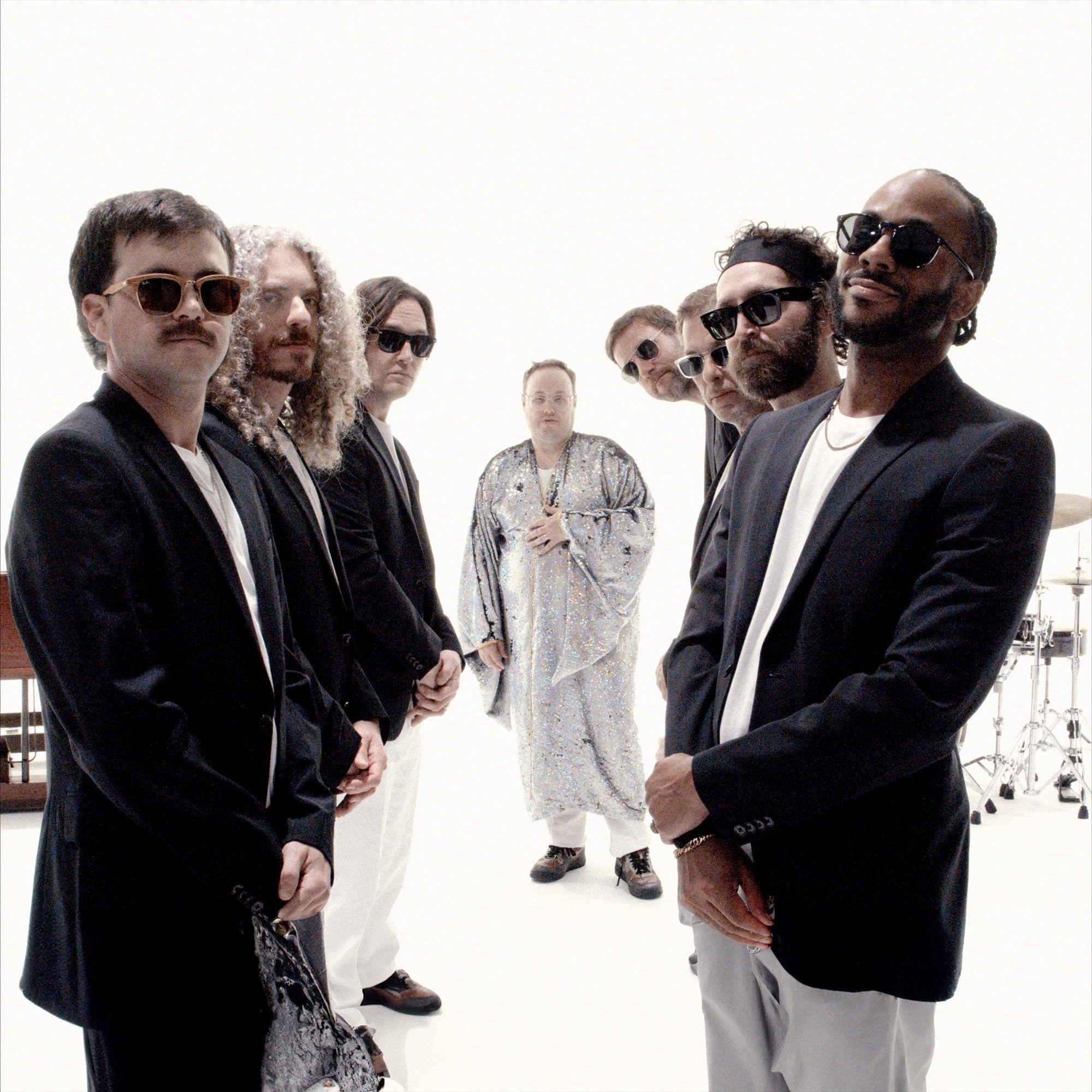
photo: Matthew Daniel Siskin
“Do we make a 10-song album, or do we make a 14-song album,” says Paul Janeway on a recent September afternoon. I have genuine love for all four songs,” says Paul Janeway on a recent September afternoon.

He’s talking about the impetus for St. Paul & the Broken Bones’ new EP Proxy, a short and sweet follow-up to the band’s self-titled album that came out last year. Songs were born out of a writing and recording trip to London, where Janeway and the band worked with producer Eg White (Adele, Florence + the Machine), as well as having roots at famed Alabama studio Muscle Shoals.
He hopes fans don’t think of this as just a small collection of throwaway tunes; in fact it's just the opposite. For example, “Mess I Made” is a sister song to “Change a Life” from last year’s album, and “Loving Wrong” takes inspiration from Radiohead in its outro, as he details below. It’s all to say, there’s a solid punch here, where their classic Motown vibe is still intact, along with that Broken Bones energy that’s defined their albums over the years.
Here Janeway walks through protecting the instrument, how far the band has come from its garage-rock start, his Daptone Records devotion and the piece of advice he can’t let go of when he’s on the road.
How would you describe the band’s evolution?
We've come full circle in a way…playing in a room, writing songs in a room, capturing that as the band. It’s significantly better than when we first started. We didn't know our ass from a hole in the ground when we first started. We were just like “sell 1,000 records and we'll break even.” Little did we know, it'll do much better than that.
When we first started, it was a garage rock band that had soul influence. And now it's a fully functioning, R&B soul band that has rock elements to it. That's truly because the band is better. We've gone through this weird, interesting musical journey where we've experimented, and we're comfortable with who we are.
For a little while, we had no governor. We could just release whatever we wanted, and at the start it's like having birthday cake every day. Then you’re just at this point where you're like, “Okay, but what are we trying to accomplish here? Be these artists that make this obscure kind of music, or what?” We really got in love with the idea of songcraft and understanding songcraft . . . and I don't want to say we didn't have an appreciation for it, but maybe now we have a stronger appreciation for it than we did early on.
How do you take care of your vocals these days?
I have terrible allergies, so I have to get myself allergy shots all the time, which is so much fun [Laughs]. I don't drink or smoke, never have, and drink a lot of water. I try to do my best about that. I try to do warm-ups. I should be better about it. I get scoped probably twice a year, and the specialist is always like, “You use your vocal cords a lot. You have very healthy vocal cords.” I was like, “You have no idea. I use them quite a bit.” It's constantly making sure that there's no polyps developing, because you always get terrified of that. I stay on top of that.
The band obviously has major soul influences. Did you all listen to newer soul with that classic sound, like everyone on Daptone Records?
We took a field trip to go see Lee Fields. Jesse, who's the bass player, didn’t know him as much, and so I’ll never forget, Lee Fields was playing in Atlanta, and I was like, “This is what I'm talking about.” He was blown away. You had Sharon Jones and Charles Bradley and Lee Fields . . . this is what I grew up with. This is the kind of music that fits my voice. I'm not gonna make the country record, it just doesn't quite fit the voice.
How does improv play a part in your live set?
We have designated moments. Obviously, we're not a jamband. There's moments in the show that lend themselves to that, and I let the guys do what they want to do. We have songs that people want to hear. But you also want to create those improvised moments and let the band breathe. We have this thing in the show where I count the beats, and then there's the magic number, and if I hit that magic number, everyone knows I'm ready. We're going out of this.
In Europe and the U.K., they are just as into that. I could be singing the craziest note on the planet, and they're just as into the saxophone improv thing, or drums, or the keys, or whatever it might be. I hesitate to use the word appreciation, but they probably do appreciate it a little bit more than U.S. audiences. And it also depends on the audience in the U.S.—you play the more jam-centric kind of festival, you could get that, which I always love, because it's fun to see the guys get some love.
Can you walk through the songs on your new EP Proxy?
When you put the word EP on something, it taints it. People are like, “Oh, throwaway songs.” I'm like, “No, no, no.” This is the age we live in . . . what we decided was, let's make a 10-song album and let's take these four, and put them on a little four-song EP and do a special record release with it. It gets its time to have the spotlight. I was really into that idea because that is unfortunately just the world we live in. You have to just feed the beast. I'm not trying to be cold about it, but it was a strategic decision.
“Proxy,” we're gonna push that as the single of the EP. “Mess I Made,” I love that song. That's really a sister song to “Change a Life,” which is on the LP. I always preferred “Mess I Made” because I thought it was a better song. If you put those songs together, those are definitely related in a big way . . . the way they operate, kind of dark, but I always loved it. It kind of started out with that Motown Martha Reeves and then it goes to halftime in the chorus, and it gives it that dramatic big thing. But those two songs, because I wrote with Eg White, who produced the record in London, I was just feeling alone. I mean, London's never sunny, and you come up with this narrative.
“Pretty With a Chance of Rain,” I really like this concept. It was initially written in Muscle Shoals, but the lyrics that ended up happening, I didn't really like. I thought it was just a little too basic. I was like, “Okay, let me make this song more internal instead of talking about some lady or some weird shit like that.”
“Loving Wrong” is one we've been doing live and it has been destroying. It’s your basic six-eight love ballad that we do really well. But then the outro is kind of a Radiohead chord sequence to get out of it.
What nuances do fans miss about your studio recordings?
There's a couple songs on the last LP that are very emotional for me, and I can tell that they're emotional for me. I can tell that on the take I was crying a little bit; you could hear it in my voice. Those real human moments, I do think you're seeing more of that now. We get obsessed about masters and mixes, but I think that realness is the little tremble in the voice. You're literally making it human. I'm grateful that we can do that.
I was actually talking to a pop producer not long ago, and he said what he's starting to notice more now is that exact thing. The whole goal used to be to make it sound perfect, make it to where anybody could sing it and take all the life out of it. We have AI now, right? Well, that's going to make everything perfect, tuned, and lifeless. So, what's going to happen? There's going to be a counter to that, and there already is to some degree.
What’s the best piece of advice another musician’s ever given you?
Elton John told me don't sell your publishing. I’ll be honest . . . when we first started, royalties and all stuff, we could care less. Now that you're a little older, you're like, “Oh, okay. That starts adding up a little bit.”
And I've been married now for 12 years, and someone told me, treat your wife, your partner's day, as it's just as important as your day. So if you go meet someone, have these crazy shows, whatever, just make sure you treat their day with the same gravity as your day.