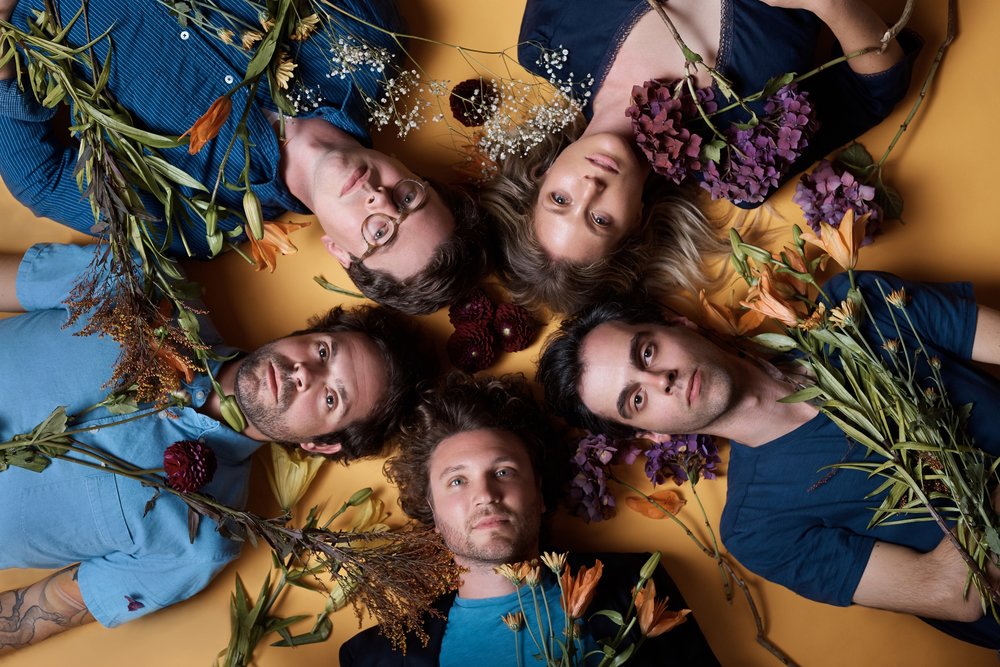
"With every record, it’s hard to tell the storywithout first tellingthe story of the end of thelast one,” explains Wes Miles,frontman for Ra Ra Riot, as heremembers the fatigue he feltnear the close of the touringcycle for the indie-pop group’s2016 LP, Need Your Light. “Bythe end of the year, I had justburned out on the slog, and wewere all like, ‘OK, we need tochill and re-acclimate to homelife and our families.’ And oneof the most important things isthat we didn’t make a timelinefor exactly when we’d getback together.”Although the time offcould have caused Ra Ra Riotto fall into an extended hiatus,the lack of schedule actuallyended up fueling their nextstudio effort, Superbloom,which dropped in earlyAugust. Sooner than they’dall thought, the wheels startedturning—albeit slowly—andthe musicians began exploringa new, inspired recordingprocess.
“Just having that freedom, and insisting that we weren’t going to rush, meant there was no urgency in us staying together over the holidays or at the beginning of the year,” Miles says. “It allowed us to do whatever we wanted.”
“It felt much less laboredand much less a deliberateattempt to create somethingspecific,” adds violinistRebecca Zeller. “It’s almostas if we tricked ourselves intomaking a record; things fellinto place pretty easily.”
Consequently, the tracks that make up Superbloom, Ra Ra Riot’s fifth full-length album, came together piecemeal, springing from various collaborative writing sessions and recording stints in studios all over the country. The process really kicked off when Miles and guitarist/ keyboardist Milo Bonacci took a trip to Los Angeles, where the band’s new publishing company had set them up for a series of co-writing sessions, just to test the collaborative waters.
While working with outside songwriters and producers wasn’t a completely foreign concept for the group—Miles’ longtime friend Rostam Batmanglij, formerly of Vampire Weekend, has worked with Ra Ra Riot in some capacity on many of their albums, most notably on “Water” and the title track from Need Your Light—they embraced a fully open-door policy for Superbloom. One writing/producing team with whom Miles connected immediately was the duo of Kieron Menzies and Dean Reid, whose credits appear on nearly half of the new album’s tracks. The band also had fruitful writing sessions with Alex Goose and Nick Van Hofwegen during that initial LA trip, and Batmanglij helped the group finish two songs from their Need Your Light sessions, “Flowers” and “Bad to Worse.”
“You have to have a certain openness to do that,” Miles says of allowing outsiders to make their mark on Ra Ra Riot’s music. “In the past, we might have felt too careful about who we worked with or how much input we took, or too precious about which songs we shared. But we had so much [material], and we are very comfortable with who we are as a band and how weeach contribute.”
Their work with Menziesand Reid, especially, helped themembers of the group—whichalso includes bassist MathieuSantos and drummer KennyBernard—expand their notionof what Ra Ra Riot could be,musically. The songwriting duonudged the band into somemore pop-leaning tendencies,which, in turn, gave themembers the freedom toexperiment in other directions,epitomized in their trip back toNew Jersey, where they set upa DIY recording space in Miles’parents’ house and recordedtwo of Superbloom’s genreoutliers: the tongue-in-cheekcloser, “A Check for Daniel,”and the pounding “EndlessPain/Endless Joy,” probablythe heaviest trackthat the members ofRa Ra Riot have everproduced.
“That felt like we were a garage band again, getting together at our parents’ house, throwing up a dirty little studio and recording lo-fi songs,” says Santos, who wrote both tunes. “Every part of the process was fun, and we all felt refreshed and energized. Part of what our band has always been about is balancing our more poppy sensibilities with our more idiosyncratic stuff. We’ve always tried to combine those elements in a way that made sense to us. On this record, instead of being stuck asking, ‘How do we combine these things in a clever way?,’ we focused on the strengths—making the poppy songs poppier and the weird songs weirder, funnier and more interesting. That felt powerful.”
“There are times when you go home for Thanksgiving as an adult and assume that same role or behavior from when you were a child—sometimes, getting back together with the band can have the same result,” muses Zeller. “We’ve been together for so long and grown so much as individuals and as a unit but, sometimes, you just fall right back into old—and sometimes not healthy—behavior patterns. Having other people and songwriters in the room has this amazing effect of making people more open-minded. It’s sometimes easy to get hung up on what writing and recording should be like; breaking that mold is very freeing and really takes the pressure off.”
This article originally appears in the October/November 2019 issue of Relix. For more features, interviews, album reviews and more, subscribe below.