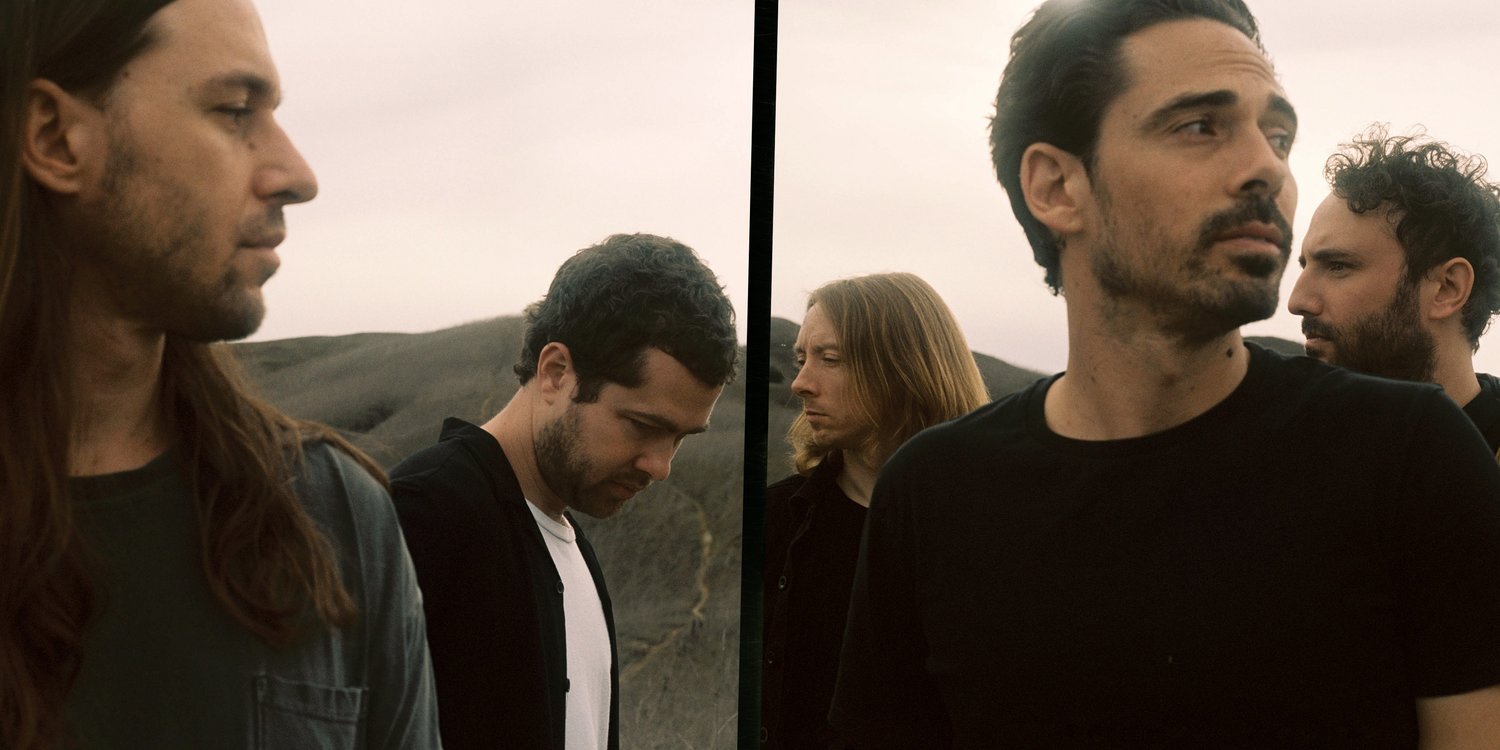
Local Natives push aside their recent pop-rock approach, turning in an emotional, true-band album with the help of producer Shawn Everett.
“There are no problems in thestudio—there are only a millionsolutions,” says Local Natives’ TaylorRice. The singer-songwriter is recountingcrucial words of wisdom from producer/engineer Shawn Everett, the acclaimedsonic guru who shepherded theindie-rock band through the left-fieldexperiments that spawned their fourthLP, Violet Street.
The album, with its lush arrangements and signature three-part vocal harmonies, isn’t exactly a departure: The seductive, Fleetwood Mac-like grooves of “Café Amarillo” and heart-crushing, string-heavy balladry of “Vogue” could have fit snugly on 2013’s Hummingbird. But intimate listens reveal sparks of madness: the bizarre radio sample and ghostly vocal loops that haunt “Tap Dancer,” the creaky percussion tracks and abrupt burst of noise in “Shy” and how the drums on “Megaton Mile” gradually decelerate to form the main groove of the atmospheric “Someday Now.”
After the polished, precise pop-rock approach of 2016’s SunlitYouth, Local Natives were eager to get their hands dirty. AndEverett, who approaches the recording process like a child eyeinga pile of Play-Doh, was their perfect guide into the unknown.“As musicians, sometimes you get into this logic puzzle, and youfeel like you need to put everything together in this beautiful andwonderful way,” Rice says. “But our energy throughout [VioletStreet] was staying connected to the idea that music is this magicalthing that emerges more or less spontaneously. There are really norules at all—and there’s a million ways a song can come togetherand finish.”
And on their fourth record, they utilized almost all of them.
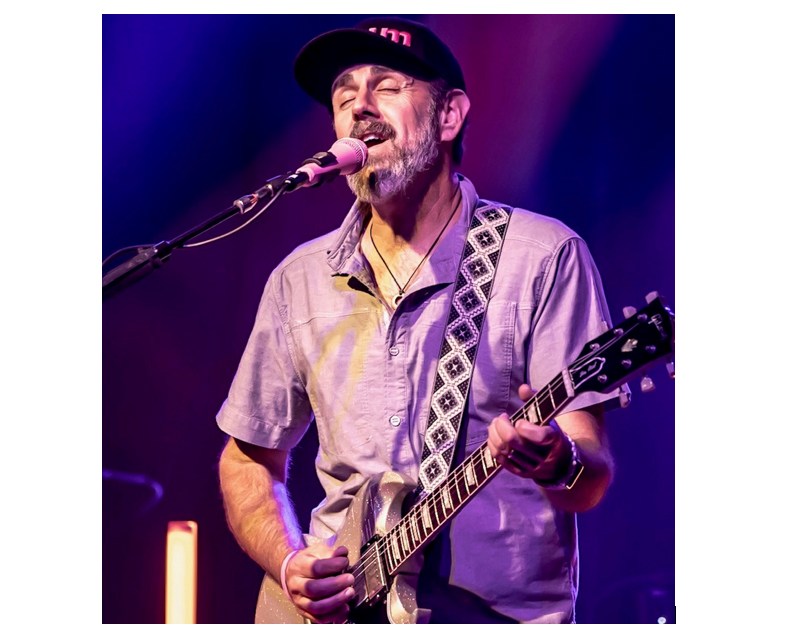
Local Natives planted the first seeds of Violet Street, shortly after their tour supporting Sunlit Youth. Exhausted from the road and ready to unwind at home, the quintet—Rice, fellow singer-songwriters Kelcey Ayer and Ryan Hahn, bassist Nik Ewing and drummer Matt Frazier—received an offer to play a wedding in Mexico.
“It was a really intriguing offer, but it was like, ‘No, we have tofocus. We’re really excited to be home and writing,’” Rice says.“Then they were like, ‘What if we give you a free month at ourcompound for a writing session?’ It was such a crazy offer, andwe were like, ‘OK, that would make it make sense.’ We played thewedding and came back later and were there for a month. We werein this hut on the beach on the West Coast of Mexico. We were setup in the jungle on the edge of the ocean.”
They formulated most of their new songs in that month-longretreat, accumulating a collective pile of iPhone recordings.“That’s where we started the writing and got the vibe going for therecord,” Rice says. “The biggest difference from before is that wedidn’t do any generic pre-production. We can be methodical goinginto the studio—[The National’s] Aaron Dessner was the first tohelp us crack out of it a bit [when he produced] Hummingbird. Yet,we took it to its most extreme for this album. Our pre-productionis like a file of 150 voice memos. That’s when we went into Shawn’sstudio.”
That’s also where the madness began. Everett briefly workedwith Local Natives as an engineer on Sunlit Youth, leading the bandto experiment by recording outside and on the studio roof. And inDecember, during a test run to lay down some initial ideas at his LAwarehouse-studio, he proved just how weird he was willing to getin search of an original idea.
“We had these voice memos from Mexico, and we went in andwere like, ‘Here’s ‘Megaton Mile,’ which is this song about theapocalypse, but it has this upbeat vibe like Talking Heads meetsThe Clash,” Rice says. Picking up on that thread, Everett decidedto channel the Talking Heads’ approach on their 1980 track “Oncein a Lifetime,” recording eight-bar loops that the band would then“perform” by pushing up the faders in real-time. Rice admits theywere a bit skeptical. (“I don’t know, man—is this crazy? Is thisactually going to work?”) But the warped ideas kept producingquality results.
High on the thrill of the tape-loop madness, the band decided totrick out “Megaton Mile” even further by recording the percussiveclank of glass Coke bottles, each filled up to achieve the appropriatepitch. “Then Shawn was like, ‘We should just use these drums forthe next song [the much slower ‘Someday Now’],’” Ayer says. “Andwe were like, ‘What are you talking about?’” The producer thencalculated how the percussion should be pitched to account forthe difference in BPM and key between the two songs, splitting thedifference between a music theory test and science project. “That’sjust the fucking Shawn Everett ride,” Ayer admits.
At this point, after being blown away by the results of theirtinkering, Local Natives knew they’d found the perfect studioshaman to join them down Violet Street. “We all huddled togetheras a band and went, ‘OK, we have to lock him in as an engineer/mixer/producer,’” Rice says. “He was game and wanted to do thewhole record.”
From there, every day in the studio was built on that sense ofchildlike exploration. Everett’s bag of tricks included using therandomness of Brian Eno’s “Oblique Strategies” (cards labeledwith cryptic suggestions aimed to guide musicians in a newdirection), messing around with tape machines and samplers, andperforming songs in dozens of styles to see which fit best. (Thetwitchy, anthemic “Gulf Shores” also existed in a more meditative,piano-heavy version, along with what Ayer calls a “jungle-y, insane,Animal Collective-y version.”)
Rice likes to playfully brag that he was the first band memberonboard for that wild ride, with Ayer straggling behind. “I was thefirst in the band to jump on the Shawn rollercoaster,” he says. “Ilike razzing Kelcey about it now because he was the one dragginghis feet, like, ‘I don’t know—we should just record it in a normalway. It might save three or four days.’”
“He’s right,” Ayer admits, fake-threatening his bandmate witha fight. “Shawn is so brilliant, but he has all these tangential ideas,moving on and wanting to fuck with stuff. There were a bunch oftimes early on where I was like, ‘This is awesome,’ but he wantedto go further. I’d be like, ‘I don’t want to fuck with this thing wejust did that’s so rad.’ I’d just want to work on a song in a normalway, and he never wanted to do that. [Laughs.] Earlier on, we werepitching the songs, and he’s like, ‘We should record everyone’sinstruments into the sampler, and everyone will play differentsamplers into the tape machine.’ I’m like, ‘Ugh, let us just play it!’But whenever I’d get frustrated, everyone would be like, ‘No, no,let’s just try it.’ It ended up taking me a little longer but, after likefour or five instances of doing that—and the end product beingundeniably amazing—I was like, ‘Whatever you want to do, I’ll doit. My life is in your hands.’”
Everett’s exploratory approach befitted a band desperate torecord as a unit, to veer away from the fractured process thatbirthed Sunlit Youth.
“There’s an interesting cause and effect constantly happening,” Ayer says. “After Hummingbird, everyone was ready to feel really happy and fun again, so we wanted to lean poppier and a bit brighter. There were a lot of people in different rooms, producing songs and bringing them to the band. It felt like a bunch of producers in the room—which can lead to some amazing production stuff and things that you could never do with just five guys. That has itsbenefits. But we did that, and we were ready to be more of a bandagain. There was some sort of pendulum swing back [with VioletStreet]. We weren’t trying to be too cerebral about anything. Firstand foremost, we just wanted to play together again.”
“There was a pendulum swing,” Rice confirms. “And we did have all these conversations before, even when starting to write the record, of, ‘Guys, let’s return to something that’s all five of us in a room performing off of each other, all the musicians in one space.’ That’s a big opposite of Sunlit Youth, where we wanted to be completely free of that. The other part of it was just pure luck that we were working with an absolute mastermind, genius producer.”
Both Rice and Ayer estimate that over 90 percent of their far-out experiments wound up on the album, but one notable exception is “Munich I,” a sprawling, eight-minute instrumental jam that was too unwieldy to crack the LP’s compact tracklist. In order to facilitate new ideas for the song, Everett pulled up the Radiooooo app, which generates random music after users select a country, decade and mood.
“We set up live in the room, playing off each other,” Rice says.“Shawn decided to do five countries and decades. We’d listen to thesong for like 30 seconds to get the vibe then play for five minutes.We had the sweetest jam ever—we couldn’t even believe it was us.It’s this incredibly ambitious project we were so in love with, butwe just couldn’t make it work. It’s still alive somewhere in the backof our minds.” (Adding to the insanity, Everett edited the track’sstructural changes to the beginning of Nicolas Winding Refn’s 2011neo-noir film, Drive.)
Everett’s obsession became problematic—but not for the band. “He’s a workaholic doing 14-hour days every day,” Rice says. “We forced him to go on vacation during the record. I booked his flight and accommodations in Greece. A lot of producers are like, ‘Here’s my huge bag of tricks,’ but Shawn always wants to try something he’s never done—possibly something nobody’s ever done.” Crucially, Local Natives weren’t just screwing around without a plan. They were armed with the hookiest, most poignant songs in their catalog—including “When Am I Gonna Lose You,” a number Rice wrote for his future wife in the early stages of their relationship, juxtaposing his blossoming joy with a sense of inescapable dread.
“It’s probably the one I was most lost in the deep, epic journey of,” Rice says. “I think I drove the other bandmates a little nuts, but Shawn went with me. We explored 40 versions of the song before we hit the finalone. Originally it was a slow, sad, very weepyacoustic song. A dark LA Fleetwood Mac vibewas one of the guideposts we had aesthetically.I thought it would be this slow ballad, and itturned into a driving groover on day one.
“Lyrically, it [came from the idea of ] having this incredible thing in your life that feels too good to be true,” he adds. “It’s a pretty sad name and idea for a love song, but it’s the idea that fate is going to intervene or I’m gonna mess it up. The whole thing takes place in Big Sur, and I heard the final mix of it driving up the 1 on [the PacificCoast Highway] to Big Sur with my wife, whom I married inAugust of 2018. We heard it together for the first time, and that’swhere the story in the song had begun. That was a really surreal,insane moment.”
Violet Street is the polar opposite of Sunlit Youth’s gleaming,stadium-friendly tunes—it’s grimier, darker and, like the recordingprocess itself, full of fascinating detours. As Ayer reflects, it’s closerto the type of music they’ve always envisioned making.
“We want to make emotional, heavy music that deals with deeper things,” he says. “I think Sunlit Youth got away from that a little bit and leaned way more heavily on the pop-rock side. This is more back to normal for us, in how Ryan, Taylor and I interact as songwriters. We’ve course-corrected to a more correct version of the band.”