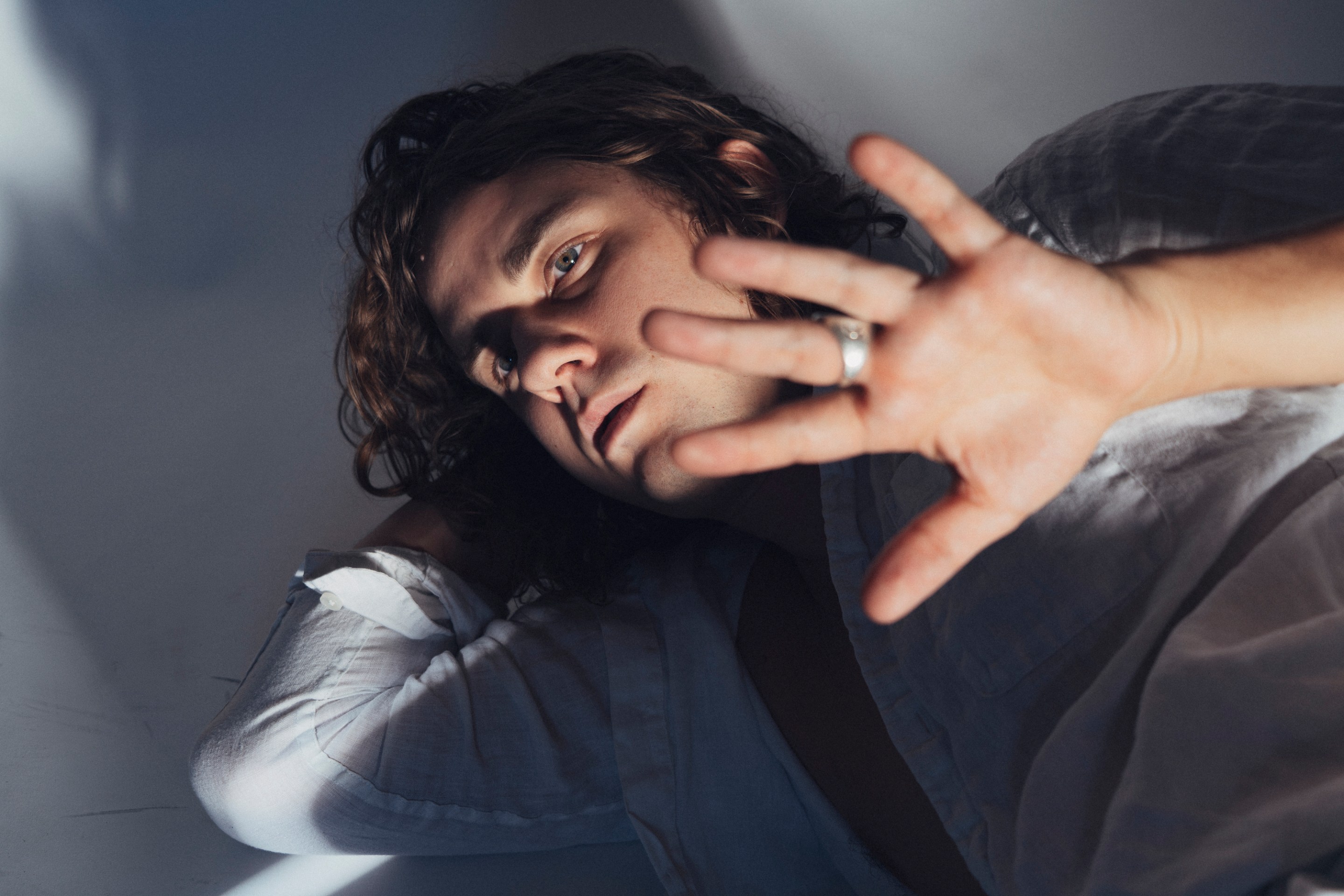
Having fully embraced the “old-soul” reputation he earned when he was the baby in the Woods family, Kevin Morby looks inward on a deeply spiritual and meditative new LP.
Kevin Morby is a bit sweaty and slightly out of breath. It's an odd sight on this cool spring night. But he just biked 60 blocks, darting a weaving through rush-hour traffic as the sun started to set over New York City. And now he's ready to be at peace.
"I've gotten really into Transcendental Meditation," Morby says, standing outside Inscape, a wellness and meditation center in the Flatiron section of Manhattan. He's tall and built like a power forward, but possesses a laid-back, sun-soaked aura.
This meditation spot is clean and chic, a bit like an Apple store but with numerous CBD products lining the shelves. It’s selling a lifestyle built on the idea that you can be a better person, with more clarity, more focus, more perspective, through mindfulness classes like “Total Calm - Deep Relaxation,” “Tree of Life - Inner Journey” and “Reset - Mental Fitness.” On tap for Morby this night is “Spaces in Sound - Deep Sound,” which that boasts you’ll reach a deep state of mind with the guidance of instruments.
“I’m so glad to be doing this,” Morby says, taking a sip ofcucumber water. After a few moments, he’s ushered into ahexagonal room that feels like a sacred space. Little pallets line thefloor, with pillows and blankets on each one. The room is awash ina purple-ish glow, emanating from the low ceilings; Morby finds aspot close to the door and promptly lies down. The space is filledwith twenty and thirty-somethings, presumably just off work.
And it’s quiet. Morby has already seemingly gone into a relaxedstate, or he’s at least prepping for it. “What I really believe is thatthe higher power comes within,” Morby would say hours later. “It’sprobably chaos that brought us all here, but there’s magic in theuniverse too, just like there’s evil in the universe and disease in theuniverse. It’s all existing and it’s noticing that magic—taking timeto talk to yourself. I’m trying to take care of myself. The world isan open vessel.”
That ethos is the essence of Morby’s fifth solo album, Oh MyGod, a phenomenal musical leap forward in a solo career that hastaken off in the past six years, starting with his 2013 debut, HarlemRiver. The new album is a meditation on religion, weather, highercallings, football metaphors, love, death and, perhaps, the afterlifetoo. At its core, Oh My God finds Morby wanting his listeners to findsomething to hold on to. As he puts it: “finding your own salvationin a world that has no salvation.”
The meditation guide enters the room and, in a hushed voice, delivers instructions on what to expect: “You may fall asleep. Let the sounds guide you. Let go.” With a ringing of a chime, the session starts and Morby just lies there, still. More chimes envelop the room, making it nearly impossible to have competing thoughts that weren’t focused on the music.
Raised in Kansas City, Mo., Morby didn't grow up in a religious household, but religion was all around him. His father worked for General Motors before pivoting to a career in house flipping, while his mother worked for various insurance companies. Morby started playing guitar when he was 10 but was always conscious of the Midwest’s religious roots. “It was a very God-fearing atmosphere,” he says. “There were billboards everywhere and churches would have marquees with banners on them. There were a lot of situations where my friends’ parents would ask what church we belonged to and I’d say ‘Methodist,’ and they’d ask what church we went to and I’d say, ‘Well, we don’t really go to church.’ And they’d call my mom up and ask us to go to church—very passive-aggressive Midwest.”
So one day, he went. “My mom didn’t go, but my dad and I went,”Morby recalls. “And my friend’s father was crying throughout theservice. There were tears in his eyes and he was very moved. Ilooked at my dad and he was asleep. I remember this mentality:‘We work all week; we don’t want to have to go to this chore—servethe Lord or something.’” I remember at the end of the service, mydad was like, ‘I’m not going to come back here. You should if youwant to.’”
At 17, Morby dropped out of high school, got his GED and, a year later, moved to New York City, despite the fact that he didn’t have a job or even any contacts there. During his first weekend in his new home, he went to a show where the Dirty Projectors were doing Bob Dylan songs and he was smitten with everything: the city, the music it contained and the creativity it seemed to spawn. For years, as he was making the right musical connections, he got by doing jobs like babysitting, bike delivery and working as a barista. “I really paid my dues,” he says of those early days. “It was the best. Fucking unbelievable. I was 18 [and] that DIY culture of the time—it was unreal. Then, after a couple years, I fell into playing with the right people—and I slowly let myself be vulnerable and put myself out there.”
After meeting the members of Woods while he was workingin the service industry, Morby joined the psychedelic folk-rockband as their bassist in 2008 and quickly got an early educationon what life on the road is like. Morby played with Woods up until2013, engraining himself in a close-knit musical community thatincluded the members of Real Estate and Vivian Girls. In 2009,in the wake of his close friend Jamie Ewing’s death from a heroinoverdose, he also formed The Babies with the late musician’s Bossybandmate, Vivian Girls’ Cassie Ramone. Though they only releasedtwo albums, he credits the group as the first true vehicle for hisoriginal songwriting. The project’s sobering origins were a sign ofthe inward, personal approach his solo career would take.
Morby left New York City for Los Angeles in 2013, just as hissolo career was about to start in earnest. “New York was bubblingover,” he says. “Everything I loved about it was going away. LA feltlike a small town.”
The move proved to be serendipitous. In 2016, right after Trump was elected and the world seemed to be in a state of upheaval,Morby penned a song called “Beautiful Strangers,” a number thatwas inspired by current events like the Pulse nightclub shooting,the Bataclan terror attack in Paris and the suspicious death ofFreddie Gray.
“There was a lot of tension at the time,” he says. “I was goingthrough a bad break up and the world was just insane. I had thisbreakthrough in my career with my [2016] record Singing Saw, butit wasn’t changing the fact that I was unhappy. I got back from tourand was living in LA and, literally, it was on fire. I was living in astrange sublet, and I started to feel like I was living in hell. Therewas ash in the air [from the wildfires]. It started to feel like theworld was elevated.”
“Beautiful Strangers” drips with Dylan-esque folk—Morbysurrounded by some guitar, soft rhythms and gospel-tingedbackground singers. It’s six minutes long and explores everythingfrom death to gun violence to the police (or, as he calls them, “thecoppahs”). But around the four-minute mark, Morby starts to lookupward, in a chantlike style, singing, “Oh, my Lord, come carry mehome. Oh, my god, oh my Lord, oh my God, oh my Lord.” It’s thatline that was the impetus for Oh My God.
“Came out of nowhere,” he says. “And it’s this mantra. I’venoticed people really relate to that. When I sing it live, they chantthat. Whenever I opened up the news—whether it was funnyor tragic—‘Oh, my god’ was the only thing I could apply to myemotions. Once I had the concept and wrote a few songs with thatembedded in it, I just ran with the spiritual aspect—both sonicallyand within the subject matter.”
There’s always been an old-soul vibe buried within Morby’smusic, even when he was considered the “baby” among his DIYBrooklyn peers—he mines from the ‘60s and ‘70s folk and psychscenes often, coming off like Leonard Cohen at times with his vocalphrasings. Oh My God doesn’t deviate from that formula too much,but it also veers into some new territory: A choir shows up oftenon “Beautiful Strangers” and songs like “Piss River” and “SevenDevils” are more complex narratives. “OMG Rock n Roll” could bea lost Velvet Underground jam, while the opener, “Oh My God,” isdriven by piano and an ultra-smooth sax.
But the running thread throughout Oh My God is the phrase,“Oh, my God.” It shows up in numerous songs, almost taking on alife of its own. It’s a phrase that people use casually, and haveforever at this point—and Morby uses it as a device to not onlyframe his album, but also his worldview. “It’s an incredible tool totell a story,” he says. “And it’s a breadcrumb trail back to religion.”
The album, too, was written as close to God—or at least heaven—as Morby’s ever been: He says he composed a vast majority of the music above the clouds, while on airplanes. And the way the album is tracked mirrors a plane trip, from takeoff to landing.
“I wanted it to exist nowhere,” he says. “Above the clouds, abovethe weather. Everywhere and nowhere at the same time. Sonically,I wanted to represent that.”
“We really wanted to make a strong statement, and make acohesive album that would stand out from his past work,” saysmusician and producer Sam Cohen, who sat behind the boards forOh My God and Singing Saw.
They laid the initial groundwork for Oh My God at Cohen’s Brooklyn studio over a week in January 2017, starting with the songs “Savannah,” “Nothing Sacred/All Things Wild,” “No Halo” and the title track. From there, Morby went out on the road to support City Music (which hadn’t even come out yet) and toured for almost a year before returning to Cohen’s studio with a fresh batch of music to work on.
"What seemed most exciting were the songs that felt like they could have a levitational quality, where we could strip awayacoustic guitars and band instruments and do something moremodern,” Cohen says of what would become the very first Oh MyGod session. “Modern in the art sense—minimal, abstract, trying tocommunicate a pure luminous feeling, as opposed to creating themood by using musical references.”
“Flying became this escape through everything I’m talkingabout: Trying to get away from the internet, trying to get away fromthe news,” Morby says. “They say humans are afraid of two things:heights and loud noises. So you’re in this elevated state whenyou’re up there. And I do a really good job at making decisionswhen I’m up there. I’m always finishing songs. I’m always listeningto demos and I’m like, ‘Here’s the last lyric I’m going to do.’ It’s door die up there.”
Back at Inscape, the sound meditation becomes much louder about 30 minutes in. It’s enveloping the entire room in a very droney way and Morby continues to lie there, motionless, taking it all in. Later, he says that he felt like he was in a state between consciousness and sleep, and the sounds were only enhancing that. But situations like this, he says, are as close as he can ever come to a religious experience. Connecting with yourself, with your senses, with music, is really the only thing that makes sense to him spiritually.
As the session comes to a close, he drifts back into full consciousness and quietly shuffles out of the room alongside the rest of the class. Morby’s still flying under the radar in many ways; he can attend something like this, remain unrecognized and tune outthe world that has weighed on him so heavily in recent years.
Oh My God was released a few weeks later, and most criticsgreeted it with kind reviews. And, Morby has a lot of excitementon the horizon: He’s been touring marquee clubs and theaters withan expanded backing band that includes Dap-Kings/Robert Waltersaxophonist Cochemea “Cheme” Gastelum, Tedeschi Trucks Bandsinger Alecia Chakour and Cohen. In late September, he’ll reunitewith the late-‘00s Woods lineup for a special performance in upstateNew York as part of the Woodsist Festival. The homecoming showwill also function as something of a comeback for Woods, who havebeen quiet for much of the past year while singer/guitarist JeremyEarl started a family and multi-instrumentalist Jarvis Tavenierehunkered down on a variety of studio projects in LA. (The Woodsprincipals also worked with Silver Jews’ David Berman on his firstnew music in 11 years and, along with the current Woods lineup,backed him on the road this summer.)
But just as important, Morby is proud his new LP resonateswith fans in ways he hadn’t seen with his previous records. “It feelslike it’s on a larger scale,” he says while on a break from rehearsingfor the Oh My God tour. “When a record comes out, critically,there are going to be people who are obsessed with it or who aredisappointed with it. For me, it’s always gauging a general fanresponse. That felt really strong. I’ve had people already writingand telling me how much it means to them. That feels the best.
“The earth is so manmade at this point,” he adds. “Everything is so affected by humans and everything is how humans perceive it—these stories we try to tell ourselves. It’s a record about trying to find hope within the chaos.”
This article originally appears in the July/August 2019 issue of Relix. For more features, interviews, album reviews and more, subscribe here.