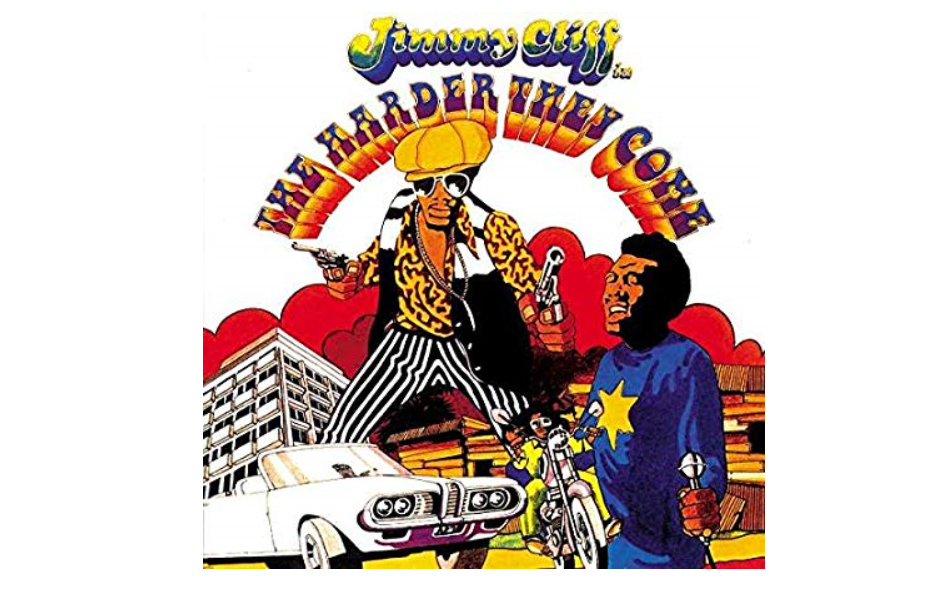
Jimmy Cliff is regarded without dispute as a true pioneer of Jamaican music—whether ska, soul, roots, or reggae—as well as one of the most revered songwriters of his time. In 1972, Cliff added to his legacy with his cinematic debut, starring in The Harder They Come—the tale of Ivan Martin, a poor Jamaican country boy seeking a better life in the city. A new Collector’s Edition (Shout! Factory) features a 4K scan transferred directly from the 16mm negative of the landmark film as the centerpiece of a three-disc set, now available for the first time on Blu-ray. Additionally included are director Perry Henzell’s long-awaited, reggae-infused, follow-up, No Place Like Home, and a slew of vintage interviews and featurettes, including segments of Cliff’s recording sessions.
While offering his recollections on the film, Cliff also commented on a recent New York Times article reporting a Universal Music warehouse fire that destroyed master recordings and backups of many noteworthy artists; Cliff has been mentioned as one of the artists whose work was lost. “I heard about the fire. I haven’t heard anything before or after (the article) so I assume none of my music was in it. Otherwise, they would have informed me,” says Cliff. As for The Harder They Come, Cliff discusses many of the now-classic film’s themes and lasting impact, its powerful soundtrack, and the one scene in this story of a musician-turned-criminal that scared him the most.
One of the themes ofthe film is escapism. Your character,Ivan, comes from the country to the city in search of a different life. He reads Playboy and comic books, goes to themovie theater to see shoot-‘em-up Westerns, fixes up a bicycle for rides to theshore, and offers his music to producers and deejays. Everything he does seems motivated by adesire to temporarily or permanently escape his lot in life, either literallyor psychologically. Was that apredominant feeling among Jamaicans at the time, to want to escape?
For us at that time in Jamaica one of the ways to escape wasthrough music. The other one wassports. But, music is the one that youcan make some money; to make a living. There wasn’t much money in sports unless you got really big. At that time, the sport was cricket, but you had to be really good to make anymoney from it. For football, or socceras you call it in America, you would need to get called to England to makeit. So, really, to escape, it was music.
Eventuallycircumstances lead Ivan to crime. Do yousee the film as a cautionary tale?
I don’t know if it was cautionary. If it was cautionary, it was (the depictionof) the producer who offered me little or nothing (for my music). The producer did the most atrociousthings. Why didn’t he get criminalizedfor doing that? In the categories (ofpeople) in Jamaica, it was lower, middle, and upper class. Maybe that’s (true) all over of the world, Iguess. When you are born into the lowerclass, if it’s not music, well, you have to sell some ganja. Those were, like, the only two money-makingthings.
Would you say thefilm is also a commentary of the oppression of people in Jamaica througheconomic and social systems?
In the United States, you’ve got (systems). In the UK. In France, where I used to live. All over the world. If you notice,the movie was kind of made in documentary form. Perry (Henzell) was just depicting what he saw going on in Jamaica.
Did you offer anyinput into the script, based on your personal and professional experiences?
I did. My questionall along to Perry when making the film was, Why does my character have todie? Why doesn’t the record producerdie? He kept saying, ‘Crime doesn’tpay.’ So all through the movie we had alittle conflict about that. Perry was anintelligent man. He would tell us thescene we’d be shooting tomorrow, but when we’d get there he’d say, ‘You knowwhat, Jimmy, forget about what I wrote. How would you do this?’ I’d justgo back to some of my experiences living in the ghetto. I understood the behavior- how a bad manwould live- because I knew it very well. I put myself in the place of the bad men I knew.
You were filming onlocation in the ghetto at a time of political and social unrest in Jamaica. Did you ever worry for your safety or wereyou more concerned with depicting the ghetto accurately so that people couldsee how rough it really was?
The latter of what you say. For one thing, they’d never seen a Jamaican movie being made in theghetto, in that area. And I was JimmyCliff. I was making a movie, and theythought, ‘He’s one of us. It’salright.’ The only part of the moviewhen I was scared was when I was swimming to catch the ship at the end; theship that was supposed to be going to Cuba. Sharks followed those ships because they would throw old meat off ofthem. If you look, you can see in myeyes, or my motions, I was scared. I’m agood swimmer, so I did it, but in one take. I’m not doing it twice. One and Iwas done.
Were you everconcerned with what the perception of Jamaica would be after the film came out?
That’s another question I had: What about those who come toJamaica for sea and sun? That’s how weget to putting in the scene with the big hotel, and I drove the car on the golfcourse. We needed to show that otherside of Jamaica that was in Kingston.
I think about a movielike Hustle and Flow, and how itseems like a direct descendant of TheHarder They Come.
In America, or in England, we see that same kind ofcharacter- I don’t want to call out names- but (we see it) in rappers; like yousaid, in Hustle and Flow. Another movie (example) is Scarface. It’s the same character (as Ivan). Our film had an impact not only for music,but in Hollywood.
Did you have anysense of the impact it might have when you made it?
Not at all did I have that sense. At the time I didn’t even want to do themovie. I was a big star in Europe. I could make a lot of money. I had hits through the charts: “WonderfulWorld Beautiful People;” “Wild World;” “Vietnam.” Perry said to me- and this is the line thatgot me to do the film,- ‘I think you’re a better actor than singer.’ I’ve always thought that of myself, eventoday. First thing in school that Iwanted to do was act. I lit up whenplays came around for me to do; to recite a poem; to become someone other thanmyself; anything. I recognize that Ihave a good voice, but I always loved acting.
How did you preparefor the film? Did you take any lessonsor just rely on your experiences as a youth?
Just my love for acting. Okay, showtime! It’s natural forme. No lessons; just doing what I alwayswanted to do. (From making this film) Iknow Hollywood. I know producers. You have to play the game.
The soundtrack isjust as notable as the film- in some ways, maybe more- for introducing reggaemusic to an international audience. Howmuch of the music did you write specifically for the movie?
I wrote only one song for the movie, which is the titlesong. The other song I wrote during themovie, which was “Sitting in Limbo.” I’ll give you a little history. We were filming with the working title of Hard Road to Travel. That’sanother song of mine. My character,Ivan, was (essentially) saying the harder they come, the harder they fall. A light went off in my head. I got an idea, and that same night I wrotethe song. I played it to Perry the nextday and he said, ‘Wow! That’s it.’ He wanted it raw like that.
That scene when youare recording the title song looks and sounds like it was a live performance inthe studio. Was it?
Absolutely. He got itraw. Like the rest of the film. He said, ‘I don’t want actors. I want real people.’
There is a greatscene during a church service led by an older pastor in which the choir issinging and there is an electric guitar playing. It’s almost like a rock-and-roll gospel. Was this typical of a church service inJamaica?
Good question. Theolder pastor was a real pastor. So thatwas a real scene with him in his church; that’s what he does normally. The other pastor wasn’t a real pastor. He was a dentist. Perry liked him because of the tone of hisvoice.
In one of the bonussegments, Perry Henzell talks about a possible sequel, saying that Ivansurvives the gun battle. What do youthink of that idea?
For me, he survived; always in my mind. The idea of doing a part-two was myidea. I never wanted to see thatcharacter die, like most who watched (didn’t). You see him get shot down, but you never see him buried. So, we don’t know what happened. I know a friend of mine in Jamaica who tookfive or six bullets, went to the hospital, broke out, went into the country,got out a hot knife, and pulled every bullet out of him. So, I thought Pedro (Ivan’s friend) could havepicked him up and gone to a bush doctor, a medicine man, and medicine him up.
What should audiencestoday take away from the film?
We spoke about classes earlier. The movie wasn’t only about class. It was also a subtle comment about race. My record producer (in the film) was Chinese,and the other producer was what we call a brown-skinned Jamaican. Jamaica categorizes that way, almost likeapartheid: If you’re black, stay back; If you’re brown, stick around; If youare white, you’re alright. There’s a lotof talk in America today about racism. The dirty head of racism has risen up from the crypt. I want to comment on that. When you get to the finish line, we all haveto leave our physical body behind. Noone wins the race in racism.