Jim James has never recorded at Electric Lady, yet he can’t help but feel the ghost of Jimi Hendrix when he steps into the guitarist’s famed Greenwich Village studio. “It’s so beautiful—what fails and what succeeds during the course of a recording session or a writing session,” the My Morning Jacket singer says, while surveying the signed LPs that adorn the space’s walls, each of which seems to ooze a different piece of rock-and-roll history. “It’s so beautiful how the music tells you where it wants to go.”
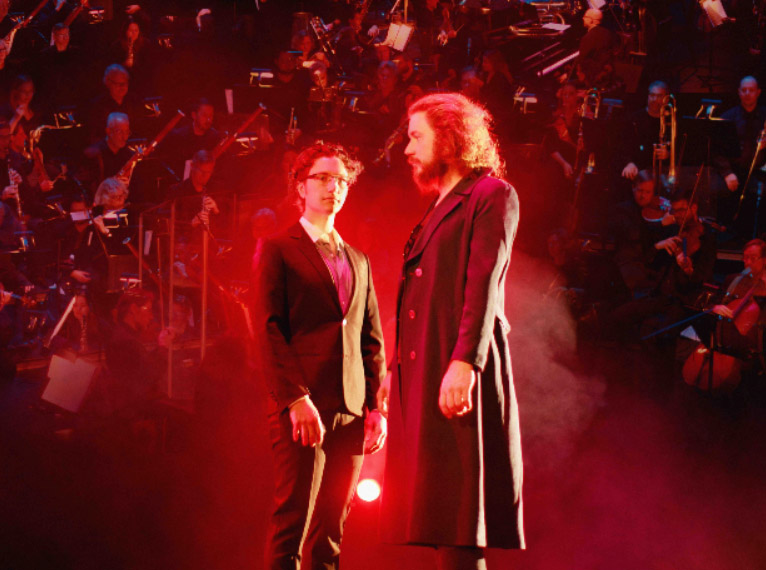
It’s a late October afternoon andJames is camped out in New York for some press around The Order of Nature,his third solo album in under two years and first collaborative work with TeddyAbrams and the Louisville Orchestra. A day earlier, James, Abrams and some ofthe symphony’s first chairs presented one of the LP’s tracks on The TonightShow with Jimmy Fallon and, the night before that, they performed theentire suite of music at LPR, an intimate New York venue that hugs the space between spiritualsanctuary and a social club. James has had a busy few hours and, after wrappingup a podcast taping and some fun in a lobby photo booth, he decides to standthroughout this late-afternoon chat.
Though he’s currently based inLos Angeles, James lived in New York for a while and is bummed to hear that oneof his old haunts, the decades-old City Bakery, recently closed. The cyclicalnature of change is something that he’s experienced in all areas of hislife—for better or worse.
“The Louisville Orchestra was prettymuch dead, creatively—nobody talked about it, nobody was interested in—and Teddycame and just blew the doors off,” the Kentucky-bred James says, standing inone of Electric Lady’s upstairs studios, dressed in the type of overcoat he hasperformed in onstage and chewing a piece of gum. “He just reimagined andreinvented it, bringing in all these different genres, all these different performers.He took it to the streets, actually playing out in the street and playing musicfor immigrants who would come in. It was amazing and inspiring to me—a real invigoratingthing for the community.”
Abrams, who is the midst of hissixth season in Louisville, points out that the symphony actually had a wonderfulinternational reputation for commissioning new work from the ‘50s into the‘80s, during a period where James’ own great aunt happened to be a performer, buthad long fallen on hard times when he arrived. “There was a strike and abankruptcy—and I was tasked with rebuilding things,” he says a few days laterwhen back home. “I really wanted to draw on the orchestra’s history of creatingnew music. So we used the orchestra as a platform for forging new relationshipsand rethinking where an orchestra can play.”
James and Abrams first met inlate-2014, early in the conductor’s tenure, and quickly hit it off socially.During the summer of 2015, James asked Abrams and members of the LouisvilleSymphony to join My Morning Jacket onstage during their hometown show at the ForecastleFestival, which opened the door for a more expansive and original collaborativework.
Adrams says that the performance piece that eventually blossomed into The Order of Nature went through a few different iterations, but they honed in on a new suite of music that included fresh takes on some familiar James originals and covers associated with Nina Simone and Leonard Bernstein.
“The narrative had this subtext about nature, how people relate to each other and how people need to be more cognizant of their impact on the planet,” Adrams admits. “Nina Simone was one of the great genre-bending musicians—she really wanted to be a classical pianist but, as an African-American woman at the time, that was hard to do. So she is very representative of the album.”
“We hit it off personally andbecame friends,” James adds. “Over the years, we talked about wanting to dosomething together. We want to talk about difficult things but in a way that,hopefully, anybody can engage in.”
In April 2018, James—a few weeksinto My Morning Jacket’s year-plus hiatus—debuted his new symphonic suite duringa pair of performances with the orchestra. The second night of that stand wasrecorded and released, without overdubs, as The Order of Nature thispast October. Despite writing much of the new material on guitar, James electedto perform the suite live without an instrument, allowing him to avoid, asAbrams points out, the trope of simply using an orchestra to embellish a rock bandat the front of a stage.
“One of the things we decidedearly on was that it would be one entire suite instead of stopping and doingone song and then doing another,” Adams says. “Of course, Jim writes the Jacketmaterial too, but I do think there is a different voice that comes out with hissolo material, and one thing I wasn’t expecting is the bigger subtext of thealbum that came to light. Jim is never preachy about it, but he has apreacher-like quality—he doesn’t tell you how to think but he tells you tothink.”
They’ve already revisited thepiece at a few different places around the country and plan to present TheOrder of Nature in other marketsin 2020, with the help of some other revered symphonies.
“As a kid growing up inLouisville—like a lot of people who are in more outsider circles—the orchestrais there and you have this respect for it because you know it’s powerful, but you’renot really into it because they’re not really speaking to us,” James says. “Someof it is timeless and amazing and eternal, but they’re playing all this musicthat’s trapped in the past.”
The Order ofNature isa symphonic suite that incorporates new material, some previously recorded soloworks and even two covers. Is there a particular thread that connects all thismaterial?
I wanted to have this message ofpeace, love and equality—just trying to get a conversation started with people aboutfairness and love and true justice. I’m always trying to promote amessage—trying to get people out of this mode of fighting all the time. Teddyand I both want to speak to everybody; we don’t want to just preach to thechoir and play for people that agree with us. We wanted to talk about these toughtopics, but we wanted to talk about them peacefully. So, for the new songs Iwrote, I did imagine the symphony, but I let Teddy be free with what he did. It’snot like I imagined all of the little things that he would do.
We wanted to have an arc. I knewI wanted “Walking in the Snow” to be first track because that feels like thelead-in, the introduction. It’s setting the tone for a lot of the record’s themes—abouthate not being a part of the order. Hate is this extra thing we humans put in,that’s actually going against nature—both environmentally, in terms of ourdisregard of the planet, and in terms of our disregard of each other and ourhatred toward each other. With “Set it to Song,” I placed it at a particularplace. I wanted there to be a moment of light—of joy—because there’s so muchheavy subject matter going on and so much heavy discussion going on. I wantedit to be a little moment of relief before the ending, so there was a lot ofthought put into where things went.
Even before the2016 Presidential Election, your solo work has tackled that theme of peace,love and equality.How did you select which songs from your back catalog to rework for theorchestra?
At first, it wasn’t going to be arecord, it was just going to be a performance, so I also said, “Let’s do acouple of my songs that already exist and that people are, hopefully, excitedabout—like ‘Here in Spirit’—so people might know them, and then a couple ofcovers and make it a suite.” Oftentimes, if you play too many new works for
, even if they like them, after a while, they’re like, “OK, whenare you gonna play one I know?”
After we had done all of thatwork, and I listened to his arrangements, I was like, “We gotta record this,just in case.” And we recorded it and just loved it, and decided we wanted toput it out.
During TheOrder of Nature support shows, you’ve performed the record in its entirety,but when touring as a solo act or with My Morning Jacket, you have a hugecatalog to choose from. How do you balance the new material you are excitedabout and the proven showstoppers when writing your setlists?
One advantage of social media isthat you can be clear with what the show is—that’s where it can be helpful. Youcan say, “Tonight is a show of only new songs” or “This is the album from startto finish.” If fans come expecting the greatest hits with their hands in theair, and you are just standing there playing something new, that’s when peopleget frustrated. They may or may not be great songs, but you just have to beclear of what your intention is. Like, “This is a night where we’re testing outnew songs or where we are playing an album, so come expecting that” or, “Thisis a career-spanning retrospective where you’ll hear everything.” We’ve all hadthat concert experience, where you go see Neil Young, Bob Dylan or whomever andyou want to hear all of these songs, and they only play these new songs thatyou don’t know. Though, man, I’m always down with whatever Dylan’s doing.
You touched onone of the benefits of social media, which is a direct line of communicationwith your fans. Yet, you’ve had mixed feelings about social media over theyears and even deleted your various accounts at different times. Do you thinkthat the benefits of social media have started to outweigh the dangers?
I don’t. I think its bad news. Ithas its good sides, it has its up sides—it’s a great promotional tool and it’sgreat for spreading awareness about events that are going on and things thatare happening. But I just feel like it’s a terrible drug that we’ve takenadvantage of. You can liken it to a million things: You can liken it totobacco. You can think of the Native American’s respectful usage of tobacco,and then, here, we fucking cram two packs of cigarettes down our throats every day.It’s the same thing.
If it was something we usedcarefully and respectfully, it could be a really great tool, but instead we’readdicted to it like it is crystal meth. It’s so hard to get off of it. I can’ttell you how many times I’ve deleted Instagram and Twitter, and then get backon two weeks later and I’m hooked again. It’s really crazy and, when thehistory of humanity is written, whenever that is, they’ll look back on thisperiod as a really big mistake.
I agree. One daypeople will look at early 21st-century pictures, where everyone ison their cellphones, and cringe in the same they do now when they see a picturefrom the ‘50s or ‘60s where everyone is smoking cigarettes inside.
I did that yesterday. We were at Fallonrehearsing and, at a late-night taping, there are periods where you’re juststanding there waiting. I looked around the room and, literally, everybody wason their phone. It was this surreal moment so I took a picture.
We’ve all been that person. I’vebeen that person, too. Sometimes it’s nice, like when you’re at the airport andyou can just disappear into your phone and make the time go by. But they say itkills creativity and I believe that. I keep trying to go back to a flip phoneor something, but there’s always this reason of why I can’t. Even if I nevergot on social media again, I do love having all my music with me. I do reallyneed the maps because I find myself in a different town every day on tour and thinkto myself, “Where’s the coffee shop? Where’s this or that?” It’s such a tough thing.
Most of newmaterial on The Order of Nature was written around the time you weregearing up to release your solo album Uniform Distortion, which feltlike a return to your early, garage-rock days. Despite their obvious sonicdifferences, do the two albums share the same message?
For me, with half the songs Iwrite, I am always thinking, “How can I spread information about equality andabout speaking out, and staying informed.” And the other half are always aboutwhatever I’m dealing with personally, at the moment, that I’m trying to figureout—whether that’s falling in love or falling out of love. There have just beenso many cycles that have come and gone, it’s almost hard to remember. I try notto think too much about things
Most of [the new songs on TheOrder of Nature] were written right after Uniform Distortion orright in there, though Uniform Distortion hada couple songs that were older than some others [like “Throwback” and “No Usein Waiting,” both of which have been in James’ setlists since 2017, and MMJeven played “The First Time” once]. The songs from this record are probablythree years old or so.
Between UniformDistortion and The Order of Nature, you also released The UniformClarity, which featured stripped-down versions of the songs on Uniform Distortion.
It was cool because it wasreversed. The Uniform Clarity isn’t a [collection of] demos, they’rejust acoustic versions of those songs. I did Uniform Distortion firstand I wasn’t even going to do Uniform Clarity for a while. We approachedit as somebody living in the early 1900s would make a record, where you justcame in the room and played your guitar or horn, and it went onto the cylinderor the wire and that was it. There was no mixing—or anything. That’s also howwe did Uniform Distortion. Like, “Let’s not over analyze this—it goes C,D, G. Let’s do it.” With Uniform Clarity, I just stood in a room forthree days and played every song I know how to play—I played tons of Jacketsongs, tons of covers. We laughed because I felt like I was putting on thisconcert for one person. It was fun—we have a ton of stuff from that session wecan release.
It seems like,at this point in your career, you are interested in what message your songs canreveal when you mix up their arrangements.
Everything just rotates around. Ilove music so much, and I love it all. As a listener, it’s classic flooding andabsence. I love hip-hop so I’ll flood myself with hip-hop, and then I’m sick ofhip-hop. Then I’m like, “Aww, the Stones sound so good again,” and then I’llflood myself with rock-and-roll again, and then I’m like, “I’m sick of it, Ineed some quiet stuff.” It just keeps going around—it’s not even dictated byme. You’ll hear a song in the supermarket and be like, “Fuck, I haven’t thoughtabout Simon & Garfunkel in years” and off down that wormhole you go. Or yousee a great film and you Shazam a song in the film, and you’re like, “Holyshit.” That’s why I feel like it’s so cool that most of the things I listen to,I don’t really even consciously decide to listen to.
You stillregularly perform songs you wrote over 20 years ago, and My Morning Jacketrecently ran through the band’s debut album The Tennessee Fire in itsentirety. When you listen back to your lyrics on those albums, do you stillrecognize the narrator?
It’s crazy. I feel like I’m somany different people right now, on a day-to-day basis. When we do those oldsongs, sometimes I’m just like, “Who the fuck is this person and what was hetrying to say?” Other times, I really enjoy it and I do feel connected to it.For me, it’s almost a day-by-day or hour-by-hour thing. It’s weird.
My MorningJacket regrouped for their first shows in almost a year and a half—your longestbreak—this past summer. How did it feel to get the band back together?
They were my favorite Jacketshows ever. They were transcendent for me. They were the first Jacket shows,maybe ever, that I played without sunglasses or without hiding behind some kindof cape or my hair. I felt like a new person; I felt like a free person.
I’ve often felt caged andtrapped, but I felt so free. And a lot of that is because we’ve made a lot ofpeace as friends in the band. We’ve had some good talks and said some difficultthings to each other, and we just dealt with the truth, and that’s translatedinto a really special thing.