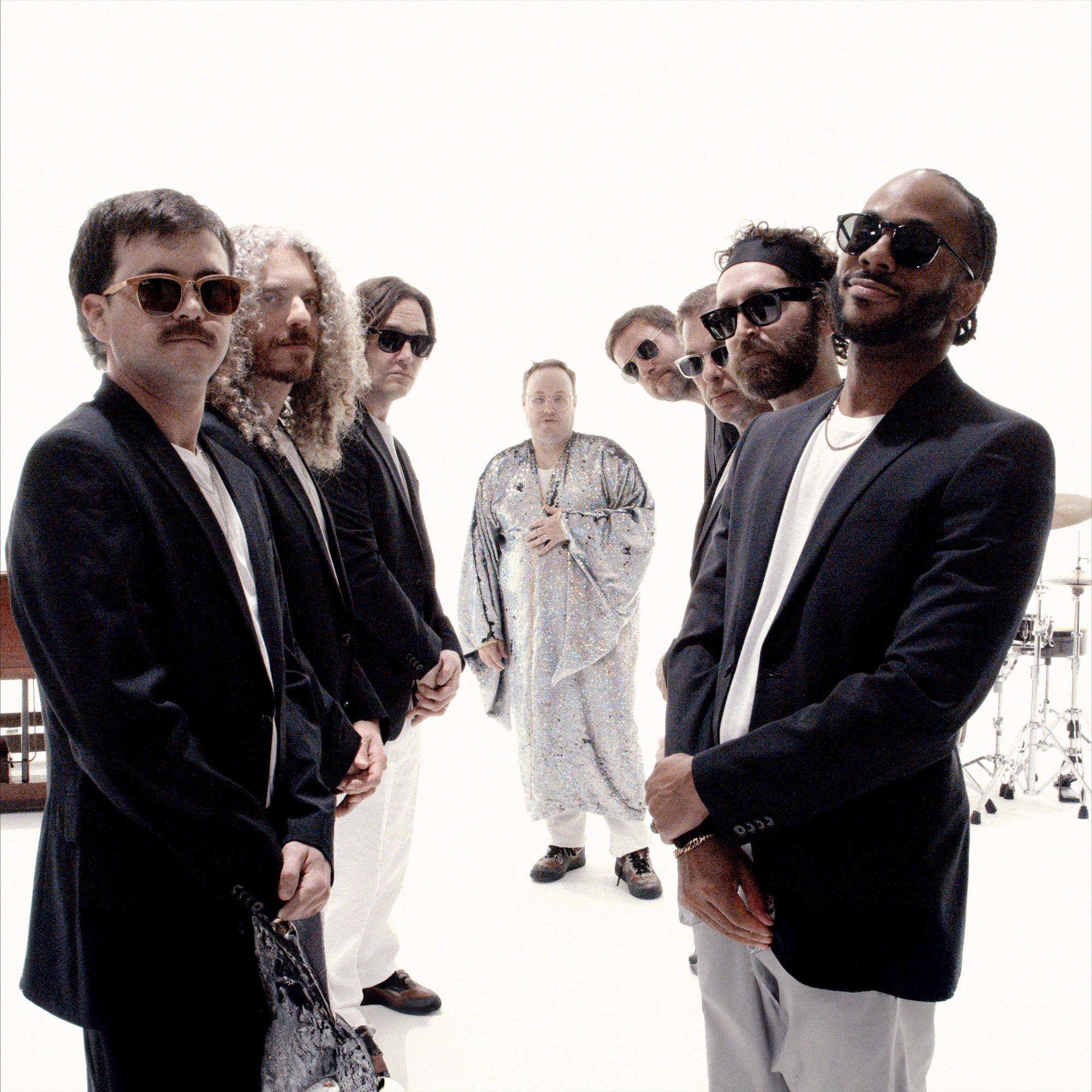
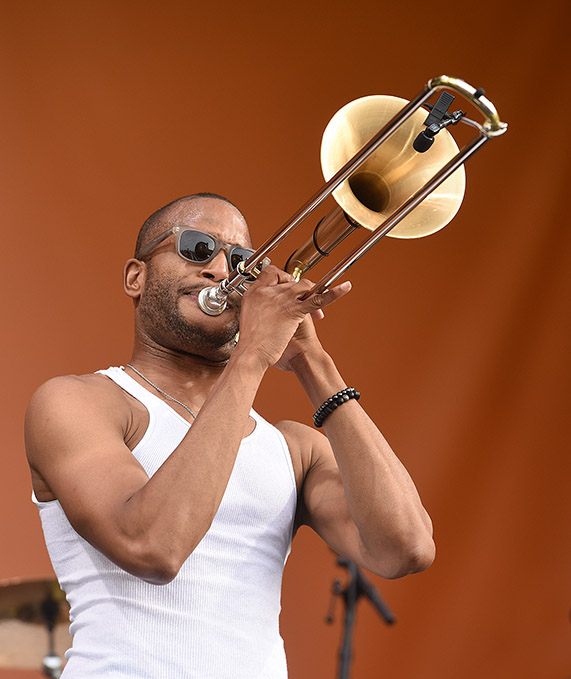
Troy Andrews was only four when he first appeared at the New Orleans Jazz & Heritage Festival. Now 33, the lifelong CrescentCity resident known asTrombone Shorty will onceagain close out this year’s JazzFest along with members ofthe Neville family.
Perhaps due to his precocity, Andrews has long taken an interest in the youth of his home city, providing instruments and instruction through the Trombone Shorty Foundation. He also has written two acclaimed children’s books, Trombone Shorty (winner of a Caldecott Honor and a Coretta Scott King Award) and The 5 O’Clock Band (nominated for an NAACP Image Award), which looks back on his own youth.
“I’ve received a lot of great feedback but the funniest thing for me is when these kids come to a show to meet me, and I disappoint them because they think I’m still a kid. I’ll tell them, ‘I’m Trombone Shorty,’ and they won’t believe me,” he says. “I have to explain, ‘I’m a grown man. I’m a bit older now.’”
The musician is currentlyworking on a new studio albumwhich, he explains, “soundsextremely funky.” Then headds, “As I’m putting the songstogether, I’m also starting tohear some featured solos andsingers. So I think, on this one,I might invite a couple of myfriends to join us.”
There’s a well-known photo of Bo Diddley watching you perform when you were only four years old. Do you have any memories of moment?
I remember marching in the second-line parade. I remember my mom walking me through the crowd to get a snowball after I played with my brother's band. I guess that was my payment or my treat for walking in the hot sun and playing. My lips were so small that I used to play with a trumpet mouthpiece on a trombone, so it made a very weird sound, and I was able to get this loud note.
I do remember people picking me up, almost crowd-surfing me to Bo Diddley. I didn’t know who he was, of course, but I remember that.
You grew up in New Orleans, and one of your earliest bands also featured Jon Batiste and some musicians who still appear with you in Orleans Avenue. Is there a particular moment that jumps out at you from that era?
Jonathan Batiste, Christian Scott, Sullivan Fortner and most of my band all started playing together before we got to high school. We were probably 8-9 years old. We still, to this day, call and check up on each other.
Jonathan and I would actually miss class sometimes just so we could rehearse together in the practice room, because we were figuring out some things. He would teach me, and I would teach him, and it was just a wonderful thing. Then, we would go to class and “hip” the other students to what we’d been dealing with, and that would open up a whole other conversation. It was just a really special time, and it still feels special whenever we get a chance to play with one another.
Speaking of education, how did your foundation come about?
I started it to give away instruments to the schools because, sometimes, I would go there and the instruments would be pretty banged up. Then I started the Academy, where we teach music every Monday night. Not only do these kids learn music, but they also learn the music business. I just want to give them the tools because, growing up in New Orleans, I noticed that while we know how to makemusic, sometimes themusic business part ofit is a bit foreign. Thathurt a lot of artists.
We have to make sure that music stays in the public schools because a lot of my friends would’ve definitely dropped out of school if they didn’t have the band. I was just driving down the street and there were kids marching with their snare drums, practicing—just out of the blue. It always warms my heart. It happens every other day; I’ll get off a flight and be driving home tired and, as I get closer to the city, there are kids at the bus stop playing their trumpets, mellophones and baritones. Music is king in this city. It’s a beautiful thing.
You’ve appeared with artists from many different genres over the years. Is there a particular collaboration that even you were surprised about?
I never saw any restrictions because I played the trombone. I always wanted to be like Lenny Kravitz and Prince. So while I’m not sure if anything surprises me, I did open for Zac Brown Band for about two months. I could always imagine us playing with people in the country arena but, with the first note I hit, I was like, “Oh, wow. That really just happened.” I also have been able to play with Dierks Bentley. It’s been great.
I jammed with StevieWonder, and we did a littletrade-off. One time, duringJazz Fest, we played at thePlayhouse club—where heplayed harmonica and I wasplaying the trumpet or thetrombone—and we wereplaying off each other a littlebit. That was incredible.
I’ll never forget being ableto play at the Essence Festivalin front of all those people andhaving Prince bring me out as aspecial guest in my hometown.That’ll forever be a memorablemoment for me.
You’re closing out Jazz Fest again this year. What does that mean to you?
It means a lot. I used to playwith The Neville Brotherswhen they were closing it out.Omari Neville, Cyril’s son, andI would jam with The NevilleBrothers starting when I was12-13 years old. We wantedto join The Neville Brothersband so we could feel whatit’s like to close out Jazz Festand, years later, the dreamcame true for me. It’s still veryshocking and I’m just honoredthat Quint [Davis] had thatmuch confidence in me. Andto have some of them performwith me this year is just mind-blowing.
Closing out the festival, like The Neville Brothers did, lets me know that all of our hard work is being recognized. We can bring all the people who have seen us in Japan and Australia and have them mix in with our local crowd. It’s just a championship for me and my band. It’s what we look forward to every year.
This article originally appears in the April/May 2019 issue of Relix. For more features, interviews, album reviews and more, subscribe here.