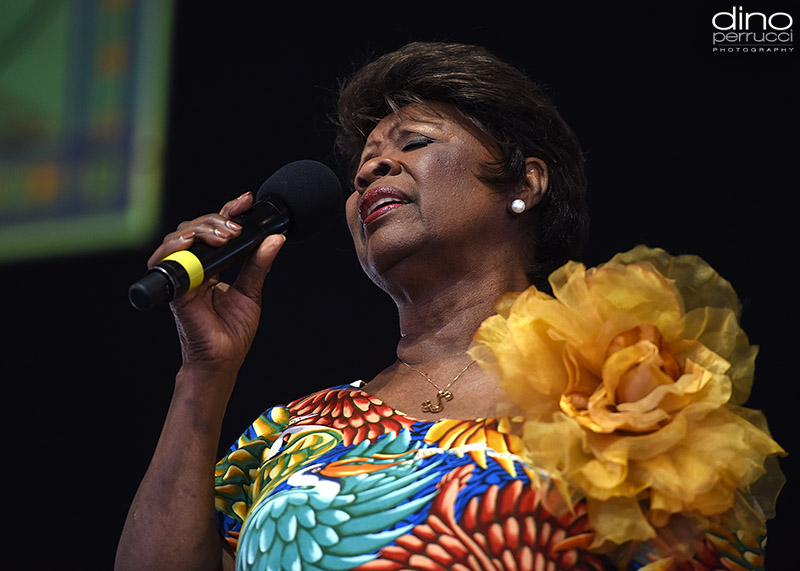
"The Soul Queen of New Orleans” looks back on her Jazz Fest legacy.
"I have not missed performing at a JazzFest since my firstone in 1974.” At that time,Irma Thomas, a New Orleansnative, was living in California,where she moved afterHurricane Camille destroyedmany of the clubs that sheregularly performed at alongthe Mississippi coast in 1969.Eventually, Thomas made herway home and continued topursue her singing career whilealso operating a nightclub, TheLion’s Den, with her husbandEmile Jackson.
Thomas balanced those two worlds for many years, until she and Jackson shut down the club following Hurricane Katrina. While it was certainly a challenging time for Thomas, she also experienced a career renaissance that continues to this day. Her 2006 album, the aptly titled After the Rain, received the Grammy for Best Contemporary Blues Album, 15 years after her initial nomination in this same category for Live! Simply the Best.
Thomas first achieved national notoriety in 1960, when the 18 year old’s 1959 single “Don’t Mess with My Man” reached the No. 22 spot on the Billboard R&B chart. Over the following years, she maintained acclaim not only for her efforts as a recording artist on songs such as “Breakaway,” “Anyone Who Knows What Love Is (Will Understand)” and “Wish Someone Would Care,” but also as a dynamic live performer, who is just as well-known for her willingness to take audience requests.
And, in 1989, MayorSidney Barthelemy evenofficially designated IrmaThomas as “The Soul Queenof New Orleans.”
The band Galactic recently purchased Tipitina’s. As a fellow artist and club owner, what were some of the challenges you faced balancing those roles?
It was not easy. Initially, it was my husband’s club more than it was mine. He and a buddy of his got together and opened up the bar. One side of the building was connected to a place where a young lady—also by the name of Irma—had a bail-bond office. After she moved out, which left that room vacant, we talked to the landlord and asked him to open it up and make it a part of the bar.
I used it as a rehearsal place. Then somebody got wind of us rehearsing back there, and the rest is history. We began charging people to come in. During Jazz Fest, I started cooking red beans and rice, and invited folks to come and have a bite to eat while I performed for them.
We were blessed to havegood workers—people whowe could trust to take careof business while we wereon the road—but it was verychallenging.
Thinking back on that period, is there a particular performance—by you or someone else—at The Lion’s Den that jumps out at you?
Ed Bradley showed up to have a good time with us during Jazz Fest one time. So, my husband gave him run of the bar.
Over the years, we had several people show up—Marcia Ball used to come all the time whenever she had a moment. Boz Scaggs would pop in on us every now and then. Of course, quite a few local folks would drop in on us and sit in with me.
The thing I really missabout having a place like thatwas that it kept my chops upand it kept the band’s chopsup. We were able to sing a lotof stuff that we normally didn’tget the chance to sing onstage.It also had that intimacy,where the audience felt closeto us, and we felt close to theaudience.
Relative to your repertoire, while you are well known for accepting requests, you won’t perform gospel music in a club setting. Can you talk about that decision?
I’ve been truly, truly blessed. Itry to bring joy to folks becauseI want joy back, and myaudiences have done just that.
I give them the opportunity to make requests and I try to respond because my duty as an entertainer is to give the audience what they want. I’ve been doing that since way back in the game when I got criticized for doing it. Somebody said that I was letting the audience tell me what they wanted me to sing because I didn’t have enough material to put on a decent show. I ignored that because my feeling is that, when you come out and spend your money to see me perform, you want to hear yourfavorite song.
However, I was raised that you do not mix your gospel music with your rhythm and blues music, mainly because people are in there drinking and having alcoholic situations, and you don’t want to confuse the two. I feel that’s a valid reason because gospel music is not entertainment—gospel music is prayer music. A lot of people confuse it and use it as an entertainment, too, when it’s really a place where you get your spiritual uplifting. But, over the years, it has been misconstrued and is perceived as entertainment.
When I’m singing a gospel song, it’s got more meaning than, “Let me shake my tail feather” and all that good stuff. As I said, I don’t mix the two, but there are folks in the business who would end their show with a gospel song or begin their show with a gospel song. I don’t do either. I don’t sing “When The Saints Go Marching In” at my show. And if they are doing it at another show as a finale, I’ll stand there but I won’t sing.
The Rolling Stones recorded “Time Is on My Side” after hearing you perform it. Have you ever spoken to them about their version?
The last time that I spoke to them was before they ever recorded it. I was doing a show in Manchester or another city in England, and both Mick Jagger and Keith Richards came to my show and they told me that they loved “Time Is on My Side.” I came offstage just after I finished singing it and they told me: “We want to do that song.”
I had no clue as to who they were. They didn’t say, “We’re The Rolling Stones; we’re going to do your song.” They just said they liked the song, they liked my show and they wanted to do it. That’s the one and only time that I said anything to Mick Jagger. Keith has been working in and around the United States, and he’s spoken to me a couple of times, but he didn’t have any comments about the song.
My version came out before theirs but, at some point, I stopped doing it because, whenever I would sing it, the folks who had not done their homework would say, “Oh, she’s doing a Rolling Stones song!” Well, no, I wasn’t. I got tired of explaining it, so I stopped doing that song for years and years. And then, Bonnie Raitt came to New Orleans for a New Year’s Eve party down in the French Quarter that they have by the Jax Brewery. She called me and asked if I would sing it with her because time has been on our side. I said, “That makes sense,” so I sang it with her, and I gradually put it back into my repertoire.
Did Otis Redding similarly hear you perform “Ruler of My Heart” [one of many songs written for Thomas by her lifelong friend Allen Toussaint] before he released it as “Pain in My Heart”?
Yeah, I opened for OtisRedding when he wastouring in this area and heheard “Ruler of my Heart.”When I finished my set,he said, “I like that song,I’m gonna do that one.”
Of course, he changed thelyrics and tried to get awaywith it, but it didn’t work.I wasn’t angry with him.Back then, we all weretrying to do whatever wehad to do to make a living.I wasn’t angry with TheRolling Stones either; theydidn’t do anything wrongto me. I just got tired ofhearing that I was doingtheir song. And I still sayMick Jagger can’t sing, buthe’s laughing all the way tothe bank.
When you think of Jazz Fest, what is the first thing that comes to mind?
Well, when I had the energy to do it, I would come on days when I wasn’t working and just enjoy the artwork and some of the booths that were out there. Of course, I had to get my Crawfish Monica, get in line for the strawberry lemonade and just enjoy the festival as a fan. But as you get older, you make promises with your mind that say, “Yes, you can,” but your body says, “Oh, no, you can’t!”
So, I don’t get to enjoyas much as I want to.Although, when I’m outthere, I have friends thatwork for Jazz Fest whowill give me a little ride ontheir buggy so I don’t haveto do a lot of walking. But Istill try to enjoy the festivalas a fan because it’s sucha wonderful thing to seepeople from all over theworld, basically, come tosee the local artists.
The big names that come are used to expose not just the New Orleans artists, but also the homegrown Louisiana artists. I enjoy the fact that they really help the local heritage. Out of that comes a lot of tours that those artists might otherwise have not gotten. Some folks who like the big names will come and camp out in front of the stage but, in the meantime, they’ll see the local artists and they wind up liking what they see. Then they will buy their records and start getting bookings for them in their home town areas.
That’s what happened to me. My career escalated when I started playing Jazz Fest back in its early stages. I got gigs from places I’d never played before, and I assume that that’s happened to other regional artists who got exposed at Jazz Fest. It’s been wonderful.
This article originally appears in the April/May 2019 issue of Relix. For more features, interviews, album reviews and more, subscribe here.