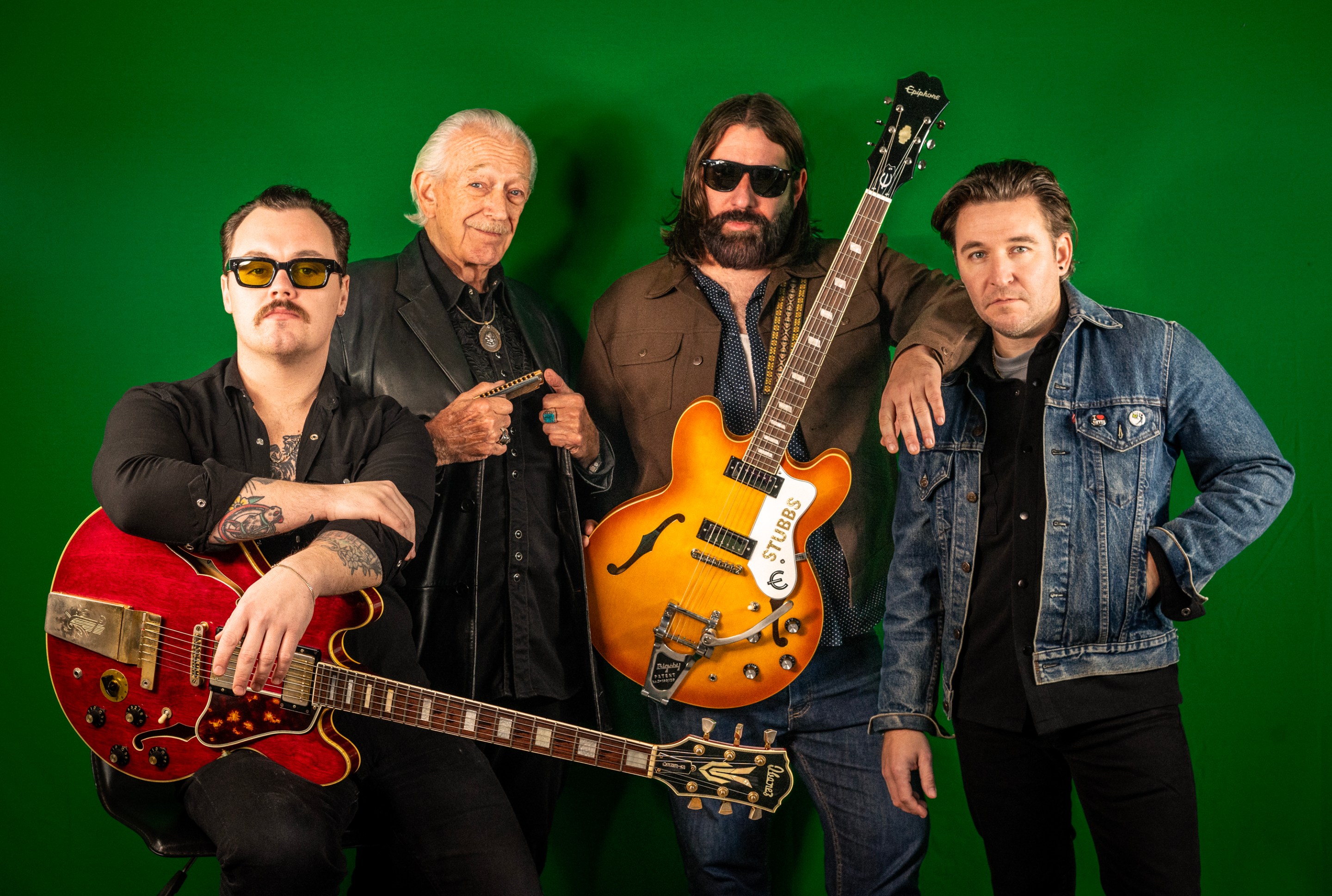
“I just love the energy of it,” storied harmonica ace Charlie Musselwhite says of performing with the acclaimed, ascending blues trio GA-20. The four musicians entered the studio last year to create a record that honors their collective enthusiasm for the genre, nearly 60 years after Musselwhite’s opening salvo via his debut album Stand Back!
The title of their collaborative effort, Blues Now, also serves as a mission statement. The 10 tracks enthusiastically and unabashedly draw on the history of the art form via material from Elmore James, Otis Spann and Willie Dixon, as well as a couple of Musselwhite’s signature songs, which he first recorded on Stand Back! (his own “Strange Land” and a cover of “Cristo Redentor”)

In many respect this pairing feels inevitable. GA-20 guitarist Matthews Stubbs, who produced the record, began touring in Musselwhite’s band nearly 20 years ago. However, in 2018, when Musselwhite took to the road with Ben Harper in support of their record, No Mercy in This Land, Stubbs opted to form his own group, while waiting on Musselwhite to return. That trio, GA-20, which also features guitarist/vocalist Cody Nilsen and drummer Josh Kiggans, has released multiple albums that have topped various blues charts, while garnering laurels from numerous organizations devoted to the genre.
Blues Now was released by New West Records in late July and the four musicians have continued to explore their chemistry in the live setting. Their upcoming dates include an appearance this Saturday at the Telluride Blues & Brews Festival, followed by a couple New England gigs: on September 24 in Portsmouth, NH (Jimmy's Jazz & Blues Club) and on September 26 in Fall River, MA (Narrows Center For The Arts).
There’s likely more in the offing as well, as Musselwhite affirms, “It feels real good to play with them and they have a lot of excitement, reverence and respect for the music. It's just a great blend.”
Your new album is titled Blues Now. Looking back to the outset of your careers, can you talk about what led you to explore the blues then?
Charlie Musselwhite: I always loved blues and I felt like I had to play it. But at the beginning, I never gave it any thought about whether this was something I was going to do to make a living. I guess you could say it was like a hobby. I was just drawn to it. I had to play.
It was not until I got to Chicago and ran into some situations where people heard me play, that I got the idea that maybe this is something I could do for an income instead of working in a factory.
It feels really good to play blues for people and turn them onto it. I think a lot of people when they hear the term blues have different ideas of what that is, but when they're properly exposed to it, they're hooked. I like to think I've passed it on to a lot of people and turned them on to blues who otherwise never would heard it.
It didn't start out that way. I just walked through the doors as they opened. I certainly had a lot of ups and downs, but I never thought that it was time to get out or it was going to all go away. I always had a lot of faith in blues.
Matthew Stubbs: I got into music through my father. He's a guitar player and I grew up with his band rehearsing in the house and doing gigs on the weekends. He started bringing me to see concerts at a pretty young age.
I remember he brought me to see Joe Cocker at the Hampton Beach Casino in New Hampshire, close to where I grew up.
I knew Joe Cocker back then from the theme song to The Wonder Years. I was really excited to see him, and he had a guitar player with him who played a dark red Strat. I remember watching that show and thinking, "I need a Strat. I need to start playing guitar." So my parents ended up getting me one, and that's when it started.
As for blues, I liked Joe Cocker and I liked Lenny Kravitz, then my father introduced me to Jimi Hendrix. Then when I started listening to Jimi Hendrix, I began digging into the people he was listening to, like Albert King and Buddy Guy. Within a year, I was pretty deep into ’50s and ’60s American blues music.
As soon as I got into that, I had blinders on. I was probably 14 and that was it for me. My parents wanted me to go to college, so my goal was just to get good enough to get into Berklee College of Music. I thought that was the ticket to becoming a professional and making a living at it. I got into Berklee but dropped out within the first year. If I went now, I might like it, but I didn't at the time.
So I just hustled gigs from then on. I was already gigging a lot before I went into college. I worked a couple jobs very briefly in my late teens, early 20s, but somehow I've always figured out how to just play music. That's all I've ever wanted to do.
Is there an album that comes to mind when you think back to your formative years listening and learning about the genre?
MS: At that time, it was CDs. When I was really getting into these artists from the ’50s and ’60s, I had some guitar mentors who would hip me to stuff. A lot of it was either CDs that someone burned for me or compilations. Back then that's kind of how I would discover different artists. The Chicago blues label Cobra had a compilation with all the early Otis Rush stuff on there. Otis Rush was the one who really spoke to me on there but I was also hooked on the different artists from the compilation. As soon as I heard Johnny “Guitar” Watson and Guitar Slim, I was obsessed with both of those artists and their whole careers, even when Johnny “Guitar” Watson transitioned into doing rap and stuff.
Another favorite album that I’ve always gone back to from the first time I heard it was an Otis Rush record called Mourning in the Morning. It was produced by Mike Bloomfield and recorded down in Muscle Shoals. That's a little bit later than the Cobar stuff but it's one of my all-time favorite blues records.
CM: Just about any of those Chess “Best of” albums are great, like Best of Muddy Waters and Best of Little Walter. Those are just priceless. Every tune on them is great and they're accessible. But there's a lot of stuff I like. “Cristo Redentor” was on an album called A New Perspective by Donald Byrd. That's a jazz album and a little off the beat from blues, but it's got a melancholy feel to it.
You perform Earl Hooker’s “Universal Rock” on Blues Now. He’s someone whose music would likely connect with Relix readers, although they would not necessarily think of it all as the blues per se.
MS: There's an Earl Hooker record called There’s A Fungus Among Us. It's mostly instrumentals and it's the ’60s, so it's not just slow blues. There are some slow blues on there, but I could see why someone who might not be deep into the blues would hear that and not think it's blues.
I think the PR story of blues music now is that when people think of blues, they go right to more modern guitar shredding blues. When I think of blues, however, I do think of Earl Hooker. To me, Earl Hooker, Buddy Guy, that's the definition of blues.
Charlie has great stories about Earl Hooker, but like a lot of those players, Earl could also play country music. He was diverse. The line was blurred back then. A lot of those players could play country, they could play blues, and they could play rock-and-roll.
Charlie, what comes to mind when you think of Earl Hooker?
CM: Matt just mentioned Buddy and Earl. One night I went to see Earl. He was playing great like he usually did, but this night he was really in the zone. Every 12 bars was better than the last 12 bars. I was like, "How can it get better?" But it did.
Buddy must have been off that night because I remember him standing in front of the bandstand, jumping up and down. Earl was just blowing Buddy Guy's mind, and Buddy was standing there screaming. He couldn't believe it.
Then, if you looked at Earl, he was just sitting there with a poker face, no expression at all, playing 12 bars after another. It was unbelievably wonderful. Just perfect.
Charlie, you mentioned The Best of Muddy Waters. After you moved up to Chicago at what point did you first meet him?
CM: It was really great. He was so accessible. His home club was called Pepper's Lounge and he lived right around the corner. If he wasn't on the road, he was at Pepper's Lounge. So I saw him a lot and going to that club, I don't remember exactly how it all unfolded, but I used to request tunes.
I never showed him my harmonica or asked if I could I sit in. I never told anybody I played. Coming from Memphis, I knew how to drink, so I just wanted to hang out and listen to the blues, talk to people and socialize.
Eventually, I'd sit at Muddy's table. He'd invite me over. He became a good friend and it just was very natural. Pepper’s Lounge didn't have a green room where the band all hid out until it was time to play. They were all in the club, in the crowd with the people.
What was your first opportunity to perform with a major Chicago blues artist?
CM: Well back to Muddy, like I said, I wouldn't tell anybody I played, but I had gotten to know this waitress and I'd played for her at her apartment. So back at Pepper's Lounge, she's told Muddy, "You ought hear Charlie play harmonica." Muddy was like, "Charlie plays harmonica?" He just thought I was a fan. So he insisted I sit in.
I can remember standing on the stage next to Muddy. He was singing, I was playing harmonica and I was thinking, "How the heck did I get here?" That really turned the corner for me because people saw me sitting in with Muddy and they started offering me gigs.
For the record, who was Muddy’s steady harmonica player at the time?
CM: That was James Cotton.
It must have been quite a moment being up there in James Cotton's spot doing your thing.
CM: Well, it wasn't unusual that someone sat in. A lot of sitting in went on because they played till four in the morning. So Muddy was happy to have friends of his sit in. What was unusual is how young I was because it was strictly adult music. There was nobody else my age in the club and nobody white.
Matt, can you talk about how you become a member of Charlie’s band?
MS: I was living in California in like 2007 or 2008. I had moved there from the East Coast to get gigs with blues artists or R&B artists, and I was doing lots of touring as a sideman.
I was doing some tours with John Nemeth, who was a singer/harmonica player. He didn't really have a set band. He used different musicians on his tours. Well I got in with him and was doing some touring. On one of the tours, he had this drummer June Core. June and I hit it off, but June's main gig was with Charlie. He's played drums with Charlie for a long time.
Then, I guess, the guitar player in Charlie's band gave his notice, so they needed to find somebody, and June recommended me to Charlie.
Prior to that, Charlie and I had only met once or twice in passing at festivals and stuff like that, saying hello, but we had never played together and barely knew each other.
June had told me I might be getting a call, and when Charlie called me I was very excited. I was probably 23 years old, so it was a pretty big call for me. He called me up and offered me the gig just like that, with no audition. He told me about his upcoming tour and asked if I could do it. I quickly said “Yes,” and we've been playing music together now for 18 or 19 years.
Charlie, you certainly had faith bringing him into the fold without any form of a tryout. What prompted your decision?
CM: Well, I had heard him before we really got to know each other. I also liked his attitude. I thought he had something and was going somewhere. I remember when I hired him, somebody asked me about why I’d picked him. I said that not only did I like what he was doing then but I thought he was going to keep getting better and better. I was right. [Laughs.]
Matt, can you remember the first time you saw Charlie perform?
MS: The first couple times we met each other, it was at festivals. There was a guy named Mark Hummel who also plays harmonica, and he does these harmonica revue shows. They have three or four harp players come up and play a little bit, then they jam at the end. So there were a couple of those.
The first time I was working with this artist named Janiva Magness, and Charlie was in that harp revue thing. Then I think fast-forward a year after that, he came through Boston with that same setup. I think they call it the blowout, the harmonica blowout. I went and saw him at a jazz club in Boston, Scullers. Kim Wilson, from the Thunderbirds was also there.
Those were the first two times we met and I saw him play in person. Obviously, I'd heard his records. My father had his records when I was growing up.
Matt, was there a specific catalyst that set this recording project in motion?
MS: For a few years now, I really wanted to produce a record with Charlie. I've done all the GA-20 records. GA-20 started back in 2018. Charlie did a record with Ben Harper and went out with Ben Harper's band to promote it for a year.
So that left me in Boston, which is when we started GA-20 in order to have something to do and pay the bills. Then we started putting out records and we had some success. So eventually I thought it was a good idea to go full circle and make a record with Charlie and us. Charlie and his wife loved the idea.
As I understand it, the starting point for Blues Now, at least conceptually, was Stand Back! Can you talk about the relationship between the two albums?
MS: That's my favorite Charlie record. I love the playing and the production on it. That record probably is the closest thing to past GA-20 records, where it's pretty raw and stripped down. It was recorded live with everyone in the room. Charlie will tell you they did that in under three hours, the whole record.
That was Charlie's first record. So for me, it was kind of the inspiration for how I wanted to approach this record. Of course, it ended up being its own thing. I don't think it really sounds like Stand Back! or anything, but that was the approach.
There are a couple songs on Blues Now that were on Stand Back! and then we picked other tunes. Charlie came in with some songs, and myself and the band came in with songs. For me in the producer role, I really wanted to pick songs that Charlie had a connection to, whether he knew the artists who wrote them, he had played with those artists or he wrote them himself, like “Strange Land.”
So there were some that we liked and there were some that Charlie liked and brought to the table. They all fit nicely.
Charlie, what are your memories of recording that initial record in three hours?
CM: Well, Sam Charters was the producer. He had already recorded me as part of his series called Chicago/The Blues/Today!
Then he called me up one day and wanted to know if I'd like to make an album. I said, "Yeah, I'll make an album." He arranged the time in the studio, and I told the guys when to be there. When we showed up, Sam said, "You’ve got three hours to knock it out." We just did one tune after another. These days, it takes three hours just to set up the drums.
By contrast you recorded Blues Now in six days?
MS: We booked six days. We ended up recording for five, and then the sixth day we just hung out, got photos and stuff. To be honest, that's a long time for GA-20 or myself to make a blues record. Typically, we do it in a couple days. We wanted to have a relaxed atmosphere. We booked the time at my friend's studio in Cambridge, called Rare Signals. He's the engineer there, Brian [Charles].
We wanted to go in and be relaxed. We would get there about an hour before Charlie to make sure the drums and everything sounded good. Then he'd come in and we would work with Charlie for four or five hours. After that, he'd split and go to the hotel with his wife. Meanwhile, we'd listen back and do a couple little things to make sure we got what we needed.
Then, most nights, we would go meet for dinner. So it was very relaxed compared to how I'm used to making records, where you're trying to get seven songs in a day if it's a blues record. But right away, it felt great.
Once we were done that first day, I knew we were going to be fine. We ended up recording 18 songs in five days and 10 of them made the record. There are a couple bonus tracks that we might end up releasing.
Charlie, has your approach to cutting vocals in the studio changed at all over the years?
CM: Gosh, that's a hard question to answer. I just do the best I can and hope it comes out okay. I never had any voice lessons and I didn't sing in church or anything. I just open up, let it come out and hope it's good.
Is the same true of harmonica?
A lot of the harmonica players you hear, you can listen to them and can tell they've memorized everything they're playing. Every 12 bars is another memorized solo. I try to play without memorizing anything. I try to just play spontaneously and straight from the heart. Plus, the more you know about the instrument, the more you can get around on it. So I've discovered a lot of stuff over the years.
Was there a track that really surprised you or stood out for the way it came together in the studio?
MS: Yeah, are a few tunes on the record that I'm really proud of for different reasons. From a producer standpoint, I like the way that “The Blues Never Die” came out sonically. I'm really proud of the way we recorded it, the way the band played, the way Charlie sang, and how it turned out.
To me, it has a lot of room sound. If you close your eyes, it feels very 3D-sounding, but not necessarily modern. It’s more like the '60s when they started making those records where they wanted it to sound hi-fi. They chased a certain type of drum sound in the studio and Josh Kiggans did a great job with it. To get that sound it's almost like a jazz record. The drummer has to really play quiet and mix themselves when they're playing, because cymbals can get carried away.
The way we recorded this, the guitar amps were right there, which means you’ve got the microphones from the guitars and drums, all bleeding into one another. So it's truly an ensemble performance, and I like the way we captured it sonically.
From a performance standpoint, the duet, “Big Stars Falling” with Cody and Charlie singing is one of my favorite songs on the record. We didn't know how that was going to turn out. Josh and Cody never played with Charlie until we made this record. They don't have the history that Charlie and I did. When we rehearsed that song Cody just approached it the way that he did and their voices are so different. But I think it's really special the way that duet turned out.
CM: I've been a fan of that tune for a long time. I thought it was a really cool song and I just threw it out there to see how it would sound. It worked out really good. I was also quite happy with it.
When people think of the blues they typically focus on individual performers and often overlook the origins of the songs. Can each of you talk about an unheralded songwriter?
MS: For me, it’s Willie Dixon. It almost seems like he was writing like 10 songs a day back then. I think there were two or three songs that we recorded from different artists where when we were figuring out the publishing, we’d go back and discover, “Oh, Willie Dixon wrote this one.” He's kind of the guy for Chicago blues when you look at how many songs he wrote and how many times people have covered them.
CM: St. Louis Jimmy is an obscure name. I used to see him around Chicago a lot. He wrote “Going Down Slow” and a bunch of other tunes. But “Going Down Slow” is a classic Chicago Blues, and hardly anybody knows St. Louis Jimmy [Oden]. He was quite a guy.
Charlie, it’s one thing to play music, but writing a song is often another leap altogether for an artist. Can you recall what first prompted you to express yourself that way, whether it was with “Strange Land” or some other tune?
CM: Well, speaking of “Strange Land,” I made that song up when I first got to Chicago. I was walking around looking for work in factories and any kind of job I could find. I was walking the streets, I didn't know anybody and I just felt like a stranger. I started making up that song, singing it to myself in my mind—"I'm just a stranger in a strange land.” I didn't know there was a book with that title. I wasn't thinking about it as something I was going to record or perform for people. I just made it up for myself to get on down the road.
Although you didn't write it, you’ve been playing “Cristo Redentor” for decades now. Do you find that you approach it differently these days than when you started out?
CM: I still love the music in the same way. I just want to present it to people in a way that they'll like it too. I’m playing from the heart. It's not contrived. It's not memorized. It's all just natural. I don't know how else to put it. It's just right off the top from the heart.
“Cristo” is an interesting song because it always seems like the first time, every time. It never seems the same. It never gets boring and it just has a life of its own. When I play it, I feel like it takes me where it wants to go.
Matt, while you've been performing the Blues Now material with Charlie on the road, is there a song that you've really enjoyed revisiting in the live setting?
MS: I think the opening track, “Crazy Love” might be my favorite one to play live. That one and “I Can't Hold Out.” We've been doing both of those at shows this year with Charlie. I love “I Can't Hold Out” and I'm always surprised at how much the audience connects with that. It opens with a little guitar break and when it kicks in, people really seem to connect to it, which is great. To me, it's a great Chicago shuffle. A lot of songs have that beat, so maybe that's why it sounds familiar and people like it, I don't know. But that one and “Crazy Love” the Buddy Guy tune, which is in your face.
Although you’d played with Charlie for years, Cody and Josh had not. What advice, if any, did you offer them prior to the initial recording sessions?
MS: Use your ears, be an ensemble player and support. For me as a guitar player, harmonica blues is a different vocabulary compared to Freddie King or Albert King where the guitar is the singular voice and the band is supporting that. There's a whole vocabulary from Chicago blues of how you back up a harp player and have the conversation between harmonica and guitar.
I did have a discussion with Cody when he came in. We don't have a bass player for most of the stuff, so you have to know how to approach what they call tops and bottoms—the low end and the top end. You’ve got to know how to weave back and forth. So really in the end, just knowing the vocabulary and then using your ears.
Did the fact that GA-20 doesn’t have a bass player impact the way you arranged these songs with Charlie?
MS: With GA-20, we've been doing it now for six or seven years, and that's kind of our sound. For this record, Blues Now, we brought in a bass player for a few songs, Marty Ballou, and he did a great job. If the song calls for it when we record, we'll do that. But live, we've kind of figured out how to do it with just the four of us. When we have bass players sitting in live, often it's fine, but it doesn't sound like GA-20 to me. It ends up sounding a little bit more like everybody else, I guess.
Charlie, do you have a preference one way or another?
CM: Back in Chicago, I did a lot of gigs for a long time with no bass player. It was often just two guitar players, like Johnny Young and JB Hutto. The three us would take the Greyhound, along with a drummer and go to places where we’d play. There was no bass. So it feels good to me, I don't miss it at all.
Charlie, you’ve been doing this for a while now. As you look out into the crowd these days how has your audience changed, if at all?
CM: I’ve noticed in the last few years there are more younger guys who want to play real blues. They don't just want to be a guitar shredder, which I compare to somebody with a big vocabulary and nothing to say. There's younger people listening to blues.
I think when people are properly exposed to good blues, they love it right away. A lot of times they don't know what it is until they hear it. I think people are hungry for it because there's so much stuff out there these days that's plastic and contrived.