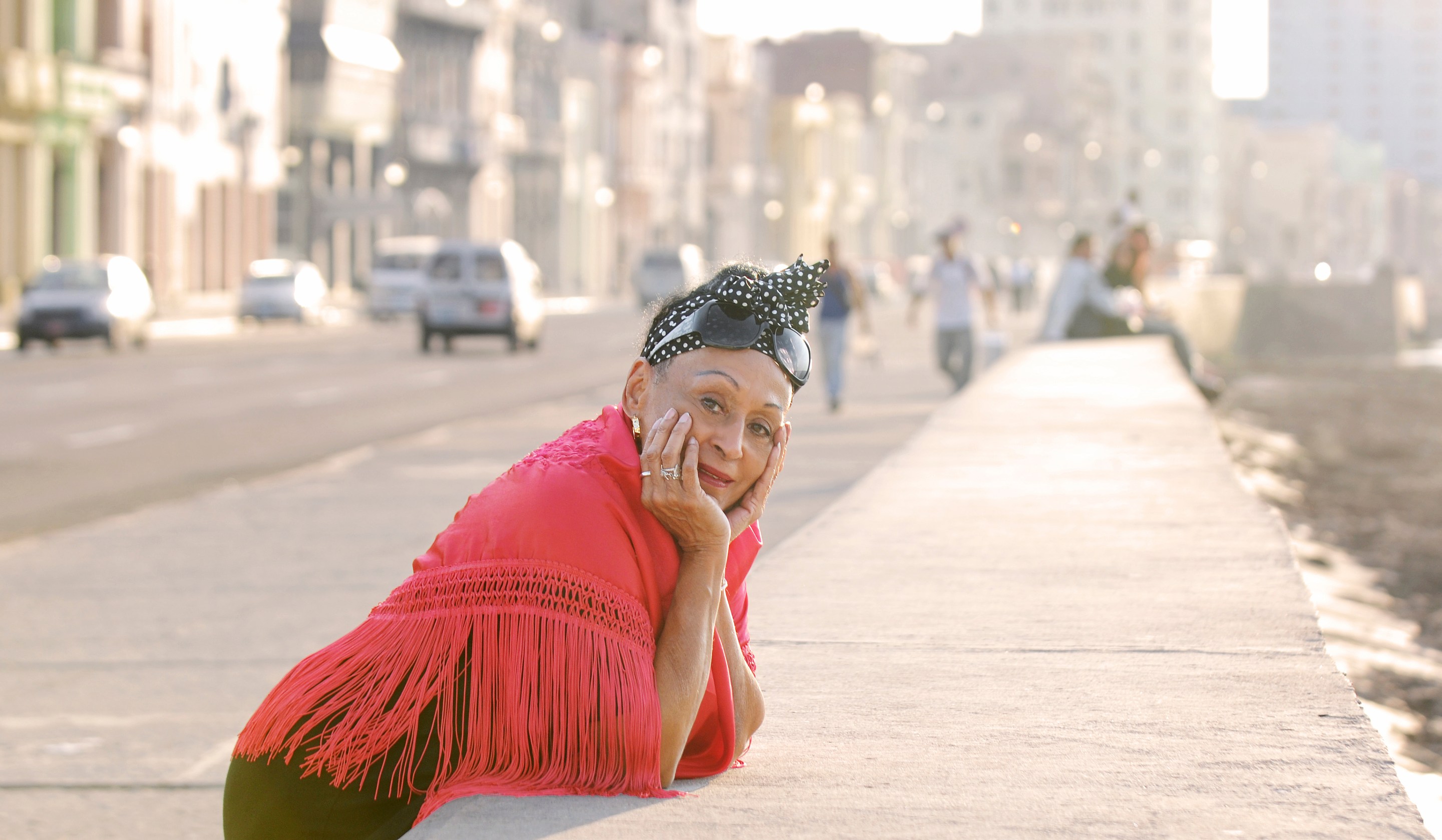
With her current tour, the Buena Vista Social Club guiding light may be offering one “last kiss,” but this 88-year-old singer is still years away from her final bow.
Someone forgot to tell Omara Portuondo that she is on her farewell tour. While the Cuban singer’s spring run of U.S. dates was billed as “Last Kiss” and promoted as her final go-round, she seems uninterested with the prospect of a life off the road.
But when the 88-year-old Portuondo is asked, hours prior to taking the stage at New York’s Sony Hall in late April, why she’s chosen to retire now, a look of frustration comes over her face. It seems that she’s been answering this question a lot since she arrived in the States for this tour. Through Roberto Fonseca, her translator and pianist, she explains that this may in fact not be the end. “Maybe this is just the last
time doing this type of music,” Fonseca says. “She still has a lot of energy.”
Indeed, she does. Portuondo recently released a new album, simply titled Omara Siempre—translating to “Omara Always”—that is as strong as any she’s released in a career that has passed the seven-decade mark. On this tour, she is performing songs from the album, as well as from her extensive catalog. She’s using a smaller ensemble than normal this time but, besides that, her intent is the same as it’s ever been.
“The special plan is to make people enjoy, to make them happy,” Fonseca says, paraphrasing for Portuondo. “It’s about the whole window of sound that we have in Cuba. She wants the people to feel and she wants to express all this feeling. It’s all for the people. That’s why it’s very special. She would still like to do everything.”
Most American music fans were unfamiliar with Portuondo until the release of the eponymous, Ry Cooder-instigated Buena Vista Social Club album in 1997 and the mega-successful, Wim Wenders-directed documentary film that followed two years later. The Grammy-winning album—which has sold six million copies to date—and Oscar-nominated film re-explored the music of pre-revolutionary Cuba and showcased some of the aging stars of that era, creating a massive buzz that brought countless new fans to traditional Cuban music. The participants suddenly found themselves in demand—most released solo albums, there was a BVSC reunion later on, and their concerts in the U.S. and elsewhere routinely sold out. Portuondo, the only female member of the core troupe, is one of few who survives today, let alone still performs.
But she bristles when some historians and journalistsmistakenly claim that hercareer truly began with BuenaVista Social Club. Agreeingto participate in the projectturned out to be a good thing,she says, because “I wasalready working in Cuba a lotand now I was able to reachmore people.” But she wasalready a huge star at home;that is why she was asked totake part in the project. Shelaughs, and adds, “Now peopleknow that Cuban music ismore than [the oft-coveredstandard] ‘Guantanamera.’”
In fact, not only had Portuondo been a star in her homeland for decades by the time Cooder and Wenders came around, she’d also already performed in the United States—all the way back in the 1950s. Even then, she played for audiences that didn’t always speak her language but loved what they heard. “People understand because she’s singing with her soul and the soul is easy to communicate,” says Fonseca. A highlight of Portuondo’s early visit was singing with Nat King Cole, one of her favorite artists. That, she says, with perhapsa little something lost in thetranslation, “was really cool.”
Equally cool was when, half a century later, Portuondo found herself in America again, this time singing at the White House for President Obama. The experience, she says, was unfathomable when she was growing up in Cuba. “When she was little, there was a lot of racism,” Fonseca relays. “Black people weren’t allowed to do a lot of things. She never thought about being able to do something like that.”
Beside the increased level of fame outside of Cuba, Portuondo admits that not much else has changed for her; she still sings in the same style that she always has, and sings many of the same songs that have been in her repertoire for decades. She has not felt the need to adjust to changing trends; rather, she has watched as other singers have emulated her. “More people sing the Omara way. She’s the one and only Omara,” says Fonseca. “There’s not two or three or four; there’s just one Omara.”
The song Portuondo contributed to the original Buena Vista Social Club album, “Veinte años,” was, in fact, one that she knew from her childhood. “I heard it from my father and mymother. That wasthe first song thatthey taught me,”she says.
“People becomecrazy when shesings that song,”adds Fonseca.
On the “LastKiss” tour, theadoration Portuondoreceived from heraudiences waspalpable, as was herlove for her fans.Even at her age, she’s nevertaken it for granted that she’sattained worldwide renown.
“The way she sings is incredible. It’s amazing. It’s unique,” Fonseca says. “We [the band members] are trying to be on the same level that she’s on because she has a beautiful and huge voice. She’s the most beautiful representation of Cuban culture. That’s why she calls her album Omara Always. We want the people to smile, we want the people to cry and we want the people to dance. She gets her inspiration from Cuba and she says our culture is recognized by the whole world. She’s the top singer of Cuba.”
So what will Omara Portuondo do now, if the “Last Kiss” tour is not where her career ends? “She will continue,” says Fonseca, without any doubt in his voice. “She says that she will not stop. She can’t stop. She still wants to bring our culture to more places.”
This article originally appears in the September 2019 issue of Relix. For more features, interviews, album reviews and more, subscribe here.