For most, the mention of Haight Street in San Francisco conjures ideas of freedom, love and unity rooted in a subculture devoted to pushing boundaries and experimentation. This sentiment permeates multiple forms of art, both visual and sonic, and continues to inspire in multiple settings.
The Haight Street Art Center has set out to preserve and present ephemera that celebrates the local and international allure of the neighborhood’s former inhabitants, and the city’s allegiance to the arts. Opened in 2017, the non-profit exhibition space and printmaking studio centers on posters, offering the public an opportunity to fully engage with the process and product—historical and contemporary.

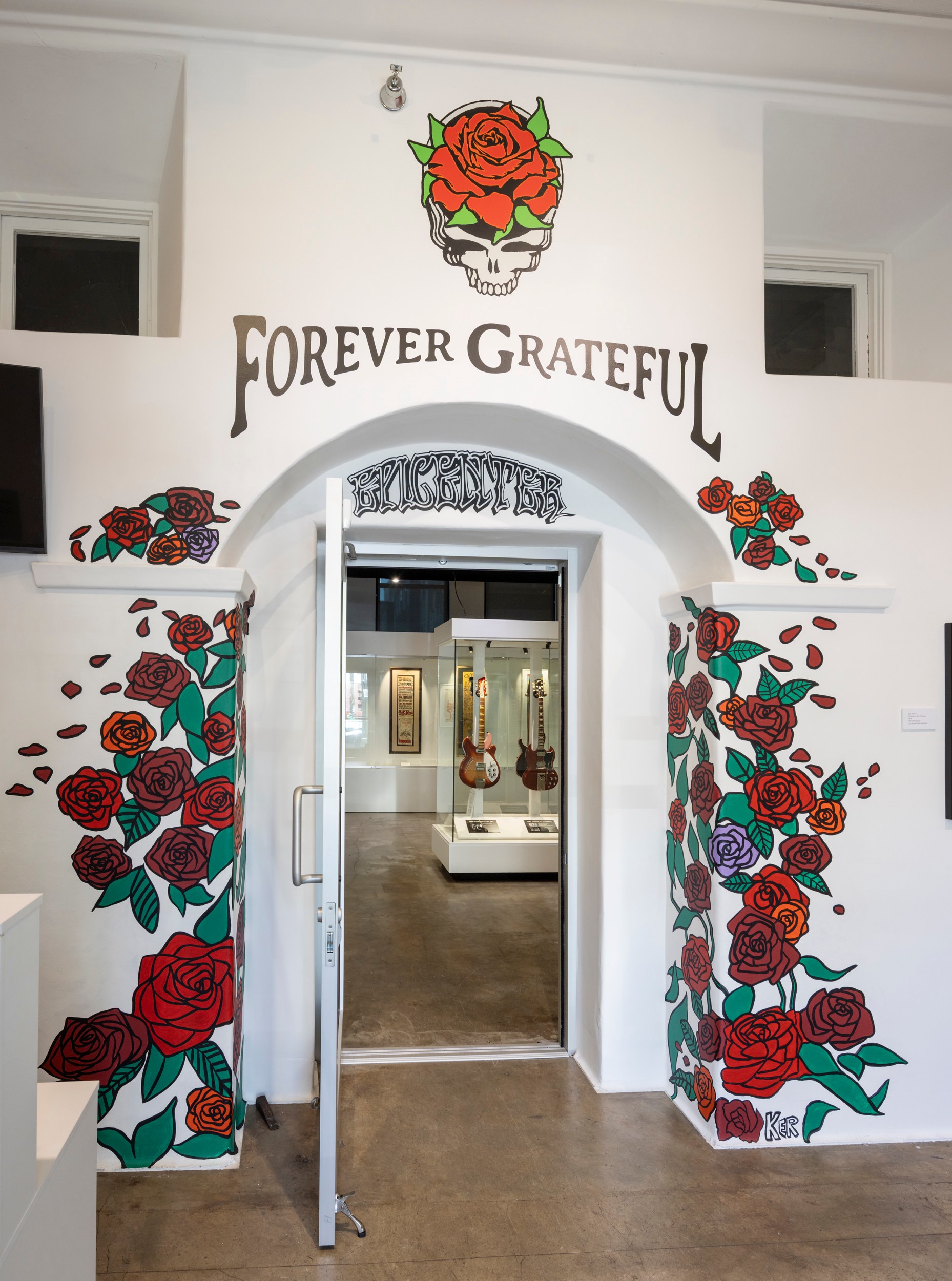
The Center’s latest undertaking, Forever Grateful, is a presentation of historic keepsakes divided and displayed across two distinct spaces. The initial exposition began on July 3 [and runs through Sept. 20, 2026 where it is free and open to the public], paying tribute to the Grateful Dead's heritage through posters, handbills, historic instruments, and memorabilia, allowing folks to ponder the band’s aesthetics.
An auxiliary gallery, located within the Country Fair Building at Golden Gate Park [running from Sept. 5 through October 25, this is a ticketed event], pivots to interactive territory, harnessing its subheading to the sights and sounds of the Grateful Dead, with the Merry Pranksters’ 1939 International Harvester school bus, “Furthur,” and Jerry Garcia’s BMW serving as its centerpieces.
**
Helming the operation is the Center’s Executive Director, Kelly Harris, who envisioned and enacted a multi-floor homage to the poster artists that shaped the Dead’s long-running and beloved iconography: skeletons, skulls, roses, et al.; surrealist in style and transfers that might well assume the form of melting letters that make up the words which denote a transfer of information beyond just a psychedelic display of date, time and location.
Upon entering HSAC, attendees are invited to examine the process of rock poster-making and the movement’s burgeoning use of line and shape to evoke an altered state of consciousness that mirrors the music's own trance-like effect. Within the space’s recessed wall display cases are black and white originals from the Big Five: Rick Griffin, Stanley Mouse, Alton Kelley, Victor Moscoso and Wes Wilson.
Rather than jump into a colorful semblance of concert ephemera, Forever Grateful introduces the outset of 1960s poster-making: the cut-and-paste assemblage information, mocked up to draw interest and push ticket sales, listed atop and beneath perception-shifting modules of a greater allegory.
More often than not, these posters draw attention to the Dead’s early co-bills, concerts also featuring fellow Bay Area luminaries like the New Riders of the Purple Sage, Jefferson Airplane, Big Brother and the Holding Company, Quicksilver Messenger Service, in addition to a multitude of other greats that dominated the psychedelic music scene.
Displayed in a vitrine within the poster-lined walls of the Center’s Great Room are instruments on loan from Grateful Guitars. With historic ties to the likes of the recently departed and beloved Bobby Weir, as well as his Dead and Company bandmate John Mayer, the collection of eight axes catches the eye and draws interest, before the deep red of the next room maintains the organic momentum through the exhibit.
By migrating through an open passage into room two, the viewer meets the band: headshots of each member, complemented by a wealth of contributors on keys as well as ’70s-era leading lady Donna Jean Godchaux, and principal lyricists Robert Hunter and John Perry Barlow.
Around the corner of the informational partition, music emanates from Anthony Coscia’s 1:4-scale reconstruction of the Dead’s famed Wall of Sound, positioned amid an inviting, living-room-like setup, begging viewers to sit and listen as long as they’d like. A complementary sign displays the date and location of the cranked-up concert, granting an auditory layer while one can peruse album art and other framed collectibles.
Highlights include nods to the band’s 1978 Giza shows via photographs and Mouse’s “Grateful Dead, Egypt” mock-gold-foiled lithograph, in addition to the original ceramic-tile signage from the band’s first concert location, Magoo’s Pizza, as well as nods to the band’s famed Europe ‘72 tour via Kelley/Mouse’s esteemed Ice Cream Kid and Rainbow Foot illustrations.
Elsewhere on the first floor, the viewer comes in contact with an optical celebration of concert promoter Bill Graham: a long red wall adorned with concert posters that reflect the band’s legacy at the Fillmore West. The colorful punch of approximately 45 performances that earned their own ads provides a visual transition from the initial display of black-and-white renderings. It suggests that the art grew like the band’s own sound.
Before ascending the stairs to the HSAC’s final culmination of visual artifacts, a specialty-equipped vending machine dispenses goods made by Mouse: T-shirts, hats, and bandanas adorned with cherished iconography, as well as original art, suited for any excitable spender.
In addition to another bounty of posters that line the walls and beckon the band, Michael Everett’s hidden skull sunflower poster for Fall Tour 1995 is on display, nodding to the tour that never happened as a result of the profound loss of Garcia on August 9, 1995.
Further memorabilia include a trickle of handbills, tickets, articles, magazines, contracts, and more that construct a broader understanding of the ensemble’s storied three-decade ride; a stand-out among them is blue and white promotional material for “Truckin’” which knits Garcia, Weir, Phil Lesh, Bill Kreutzmann, Pigpen, and the Godchauxs as a cohesive outfit, despite minimal overlap following the track’s 1970 release. [Keith Godchaux played his first gig with the Dead in December 1971 and overlapped with McKernan until the latter’s final show in June 1972.]
Also included is a short stack of Garcia’s stylized line drawings and watercolor paintings, “Dracula’s Heart” and “August West” [Yes, that’s a “Wharf Rat” reference] among them, in addition to “the first” Grateful Dead T-shirt, circa 1966, and a Bill Walton-owned Lithuania basketball jersey, complete with skull-dotted “I”s.
Needless to say, there’s no lack of ephemera. For an afternoon spent tracing the lineage of the Grateful Dead [the band’s famed 710 Ashbury Street residence is a mere 1.3 miles from the Haight Street Art Center’s 215 Haight Street location], it’s an ideal layer while excavating the band’s origin story and enduring charge.
***
Forever Grateful’s Haight Street Art Center exhibition will overlap with the Golden Gate Park gathering between September 5 and 20, with the latter experience running through October 25 and representing the first public appearance of Ken Kesey’s famed Furthur bus.
Earlier this month, the Merry Pranksters’ mystical shuttle, immortalized in Tom Wolfe’s counterculture classic, The Electric Kool-Aid Acid Test, made its way down I-5, leaving its home on the Kesey family’s Oregon farm for the first time since 1969.
Prior to relocation, Harris flew to the greater Eugene area, where she met with Zane Kesey and his wife, Stephanie, who heads The Furthur Down the Road Foundation, devoted to restoring and preserving the bus and its legacy for future generations. [Furthur was loaded onto a flatbed truck for the 500+-mile journey south.]
Harris notes the energy emanating from the steel body of the colorful coach’s potency, a vibrating entity with a storied past. Like the posters and the band itself, Haight Street Art Center offers its guests two unique experiences, each infused with phantasmagoric radiation that permeates the senses.
***
It trembled and exploded, left a bus stop in its place
The bus came by and I got on, that's when it all began
There was Cowboy Neal at the wheel of the bus to never ever land
– Bobby Weir, “The Other One”
“Forever Grateful” at Haight Street Art Center [215 Haight Street, San Francisco, Calif.] is free and open to the public Thursday through Sunday, 12-6 p.m, till September 20.
The Exhibition of Sights and Sounds will open at Golden Gate Park’s Country Fair Building on September 5 through October 20. Tickets are available now.
The Haight Street Art Center “continues to be a space to celebrate poster art, bridge communities, and drive cultural change through exhibitions and education.”
To learn more and donate, visit haightstreetart.org.