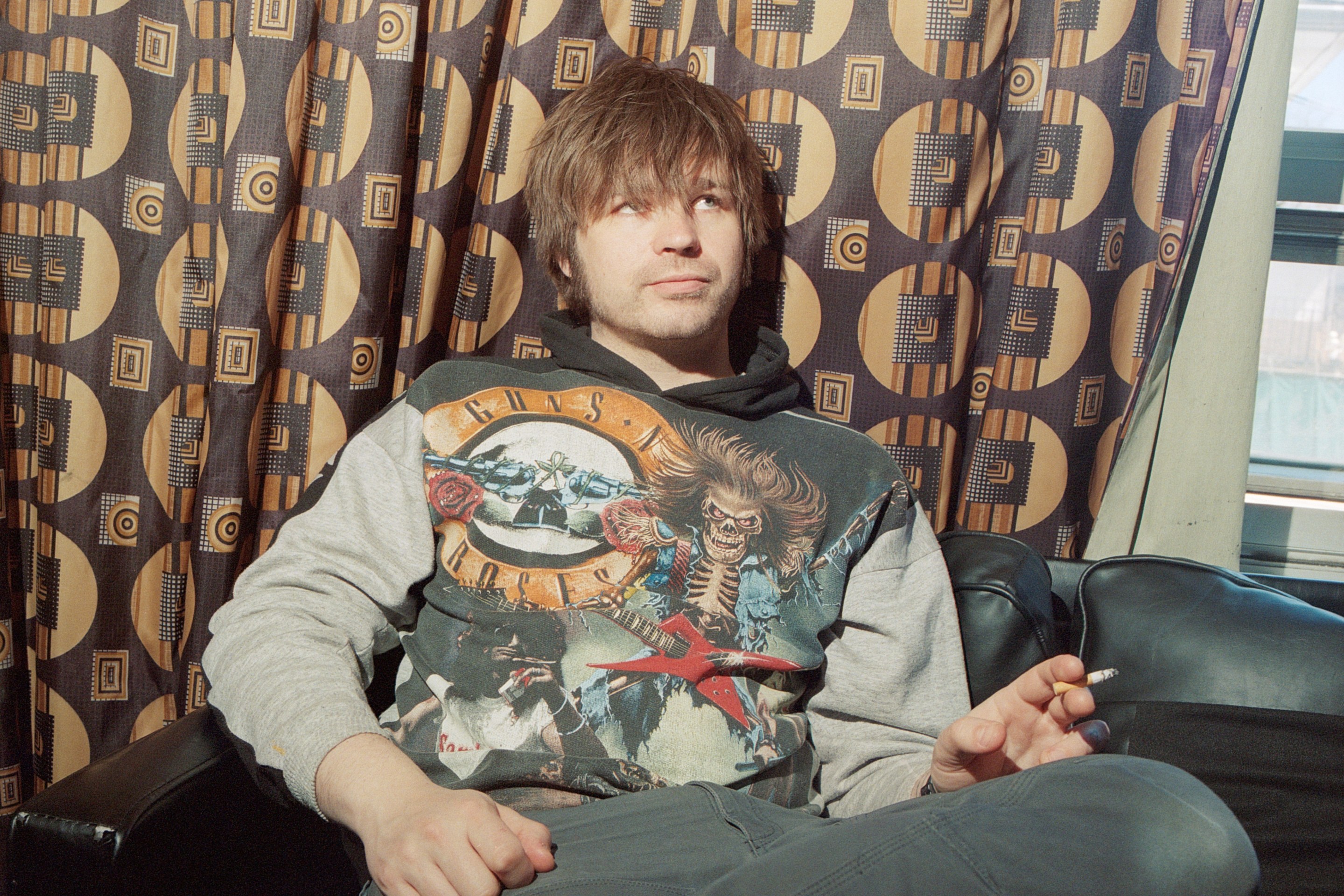
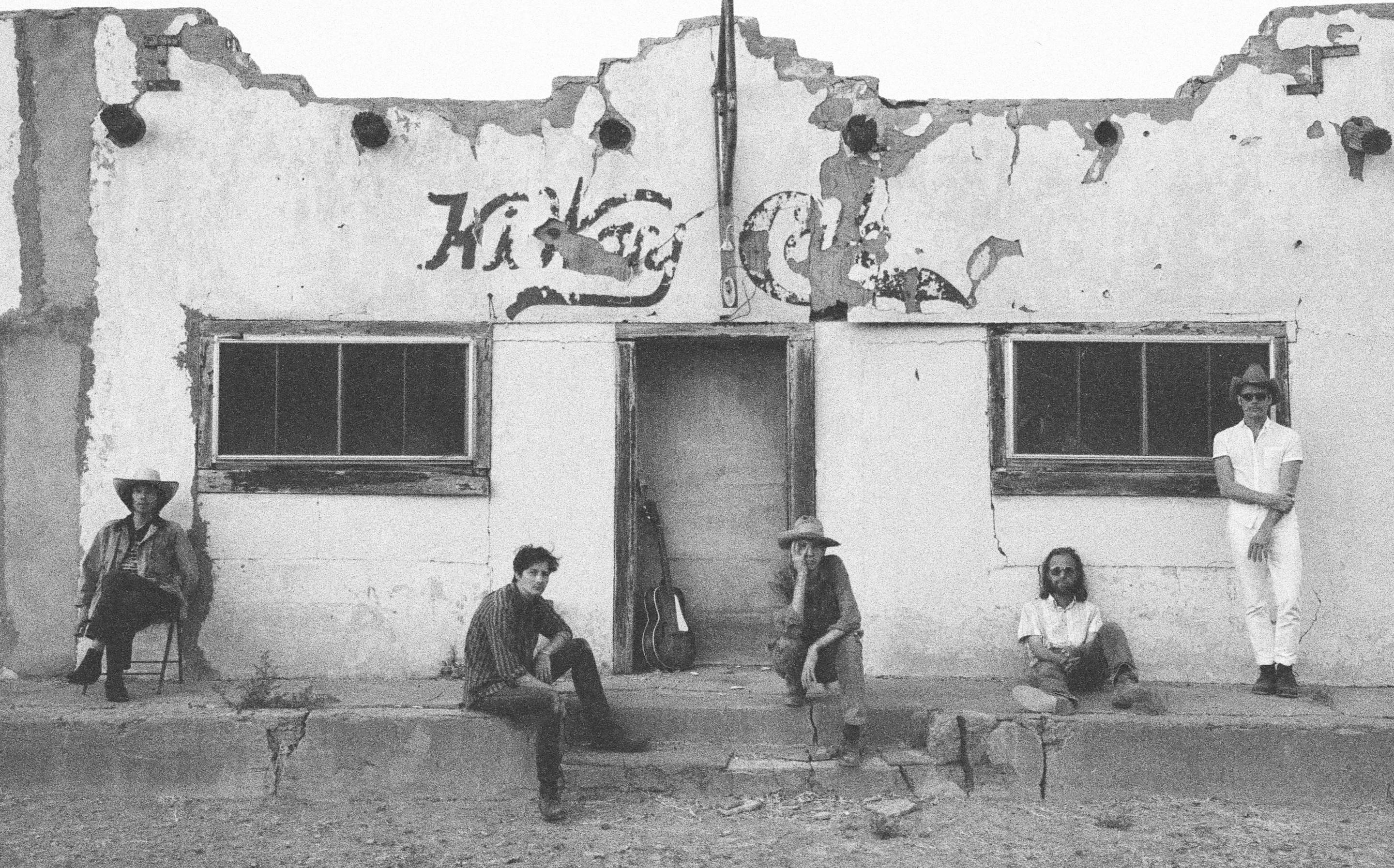
Deerhunter’s Bradford Cox rejects distorted visions of the past—and future.
Bradford Cox feels more privileged than most for one good reason. “If I have one privilege, one elitism that I have over anyone else, it’s that I have no interest in schedules or time—I do what I want to do when I feel like it,” the Deerhunter frontman says on a cold December afternoon, while camped out in New York’s Ace Hotel.
Cox’s decision to live without a schedule reinforces his firm belief that neither the past, nor the future, are of any concern. It’s also why Deerhunter’s eighth studio album, Why Hasn’t Everything Already Disappeared?, is a daring compositional feat firmly rooted in the now. The album clips along to a groove of synthesized sci-fi strings and stream-of-consciousness poetry while managing to explore some heady ideas about time throughout a tight, 37-minute collection of songs that are catchier than they should be. It’s a cinematic mirror reflecting a bleak wasteland, a document of a decaying world that stands outside of time.
Cox calls the single “Element” an “elegy for ecology (a landscapedone in toxic watercolors)” but refuses to get sentimental duringthe song, instead singing: “The wind was stained/ Orange cloudslaid out for a toxic view/ Of endless time.” He describes albumhighlight “Futurism” as a postcard from “the slipstream,” aphenomenon he can best explain by referencing the end of the lastseason of Twin Peaks, when the audience realizes that time is notlinear while continuing to grasp at that nonexistent timeline.
Cox reflects on his past with a reluctant disdain for lookingback. As a kid, he embraced nostalgia through the discoveryand celebration of old music. Now, he seldom ever listens to oldDeerhunter albums, save for when he’s preparing to tour.
“Now that I have my own life, I’m old enough to have my ownnostalgia,” says Cox. “When you’re young, you have a borrowednostalgia, a shared nostalgia. I think you have to keep yourselfmainly in the present because there’s too much overwhelminginformation in the past and it tends to want to ambush you. A lotof it exaggerates its own meaning and it can be deceitful. Thingsthat you’ve experienced will have you think that they formed you,when reality is a random collage of the past, present and future.”
However, he recalls one formative childhood experience that remains undistorted. In 1993, when he was only nine years old, Cox—cracked out on the energy drink and chocolate-covered espresso beans that he got at a nearby Jittery Joe’s coffee shop—darted into Athens, Ga.’s Low Yo Yo Stuff Records for the first time while his mother sat in a salon getting her hair done.
“I spilt a Jolt Cola all over The Fall section—all the CDs in theirbins—a little card catalog thing, and my mom had to buy them allbecause I ruined them,” Cox remembers. “She said, ‘I spent allthis money on this,’ so we took the CDs, I cleaned them off andlistened to them because I didn’t have any. So those were my CDs.I accidentally inherited 12 Fall CDs.”
Those albums served as an inspiration for Cox’s earliestsongwriting. Popping into Athens’ Atomic Music Hall in 1994, Coxmet the influential noise band Harvey Milk and asked them if hecould play a show. When the band asked Cox what type of music hewas into, he namedropped The Fall. The play worked, and HarveyMilk backed Cox during his first gig when he was only 10 years old.
In fact, stumbling upon The Fall’s entire catalog not onlyhelped Cox land his first gig, but it also served as the start ofhis self-taught artistic education. “Since I was a child, if I foundsomething shiny, I gravitated toward it,” he says. “Art books aretypically shiny to some degree, and I like what I like. I cannotwork without aesthetic stimulation. I was always doing exactlywhat I am doing now.”
True to his word, a trio of newly acquired art books sits on his table at The Ace, reflecting where Cox’s head is these days—there’s a 50-year retrospective of American painter Cy Twombly, another book documenting the work that Asger Jorn (a Danish avant-garde painter/writer and founding member of The Situationist International movement) produced during his time in Munich and another book collecting structures designed by the modernist architect Le Corbusier.
You don’t need an art history lesson to draw a tether between thework of these past masters and the ideas on Why Hasn’t EverythingAlready Disappeared? Cox’s lyrics and liner notes explain hisapproach to these songs through a language of odd pigments andcompositional techniques.
“All of my records are films,” he says. “And, a lot of times, whenI think of visual art, there is a cinematic quality to it. Willem deKooning, Cy Twombly and Asger Jorn—I view their work as cinematic.Not necessarily literally, but I view movement in them. Rhythm.”
Like Jorn, Cox’s output challenges the expectations of an artistworking in popular mediums, taking advantage of the fact thatpopular pieces are often falsely assumed to be more substantivebased solely on their cultural prominence.
That’s another reason why genre labels are problematic whendescribing Deerhunter. Cox firmly rejects the notion that theyare an “indie-rock” band. He thinks that “Futurism” sounds likeABBA, and also shoots down any claims that the band has a punkessence—“punk is just white privilege,” he says. He also denies thatDeerhunter is a pop band, at least in the traditional sense. “I mean,I’m not Ariana Grande. I hate subversiveness, but I can’t disagree.I am a contrarian—just a bitter bitch.”
However, Cox still considers himself an entertainer duringDeerhunter’s promotional cycle and tours. “But only in the contextof any commercial product that’s being marketed,” he says. “WhenI’m home alone, I’m not entertaining anyone, and that’s how Iwrite these songs.”
Cox walks a fine line through this lens, simultaneously puttingon a spectacle for his listeners, while still challenging them witheach new work. It’s an artful balance that demands perfection.
Why Hasn’t Everything Already Disappeared? was alreadymastered when Cox recalled it back from mass production,tinkering and remixing the songs until he thought everythingwas absolutely perfect. The move involved some deliberatelyconfrontational choices—he’s particularly proud of the “ugly”sound that Deerhunter drummer Moses Archuleta makesusing a children’s drum kit, pitched down, on opener “Death inMidsummer,” along with the distorted demo vocals of album closer“Nocturne” that made it into the final mix.
Feeding his desire to produce something that cuts through today’s digital barrage of infinitely vapid streaming content, Cox has enmeshed his unique perspectives on time with the visions of his bandmates, resulting in a synthesized otherworldliness that all the members are proud of. “We were just like kids in a sandbox,” says Cox. “They loved it. We all just took turns pushing thingsfarther and farther out.”
Cox emphasizes that maintaining such a strong body work,even after it’s marketed as a product, requires a steadfast lack ofconcern for what’s next. While he’s considering resurrecting hisformer solo project, Atlas Sound, he’s also certain that he’s exactlywhere he needs to be.
“I’ll get back to Atlas Sound in a year or so, once things havesettled down,” says Cox. “Rightnow, I need to be with my friendsand brothers in Deerhunter. I’vebeen so concerned with keepingDeerhunter on track because thereare children now. There are schooltuitions. My dog is very spoiledand requires a lot of attention.”
In the album’s press release,Cox writes of a trend that positswhy our collective attention spansare decreasing while the rate ofmedia we absorb continues toincrease: Why make this album inan era when attention spans havebeen reduced to next to nothing,and the tactile grains of makingmusic have been further reduced toalgorithms and projected playlistplacement? Why wake up in themorning? Why hasn’t everythingalready disappeared?
“I definitely feel like my roleis diminished,” Cox says, “but Ifeel a sense of stress and graspingfor relevance in a lot of my peers.I don’t feel so enticed to do so. Iown my house, so I’m not going tobe homeless. I grew up poor, and Idon’t ever want to be poor again,but I’m basically operating in alifestyle in which I’m not havingto worry about financial things inthe near future.
“When I see the attention spanfor my work shrinking, are peoplelosing interest? A lot of my friendsin this business, musicians, feellike they’ve passed their peak; Idon’t feel that way, I feel like I’mmaking my best stuff.”
Deerhunter’s new record alsoflirts with a bunch of radical arttheories that try to explain howcreativity has been weaponizedinto a product by time—the track“Futurism” alludes to the Futuristmovement.
“In the context of the song,I thought of futurism as a veryconcrete thing,” Cox says. “Thesehorrible, horrendous buildingsdesigned for living in. Just bleak.Bleak! I wanted to write ‘Futurism’in Cyrillic. I have no idea what itmeans.”
Cox also has no idea what his own future holds. He doesn’t know what he’s doing later this evening, let alone what he’s doing next week or where he’ll be for Christmas. What’s far more important, he maintains, is staying fully present and being in the now.
“Not every day is the last day of your life or the first day of your life,” says Cox. “I like the middle—not the beginning or the end, but the middle—of life, of everything. The present’s not always the middle, because when you’re dead, the present’s the past, and when you’re young, the present’s the future.”
This article originally appears in the March 2019 issue of Relix. For more features, interviews, album reviews and more, subscribe here.