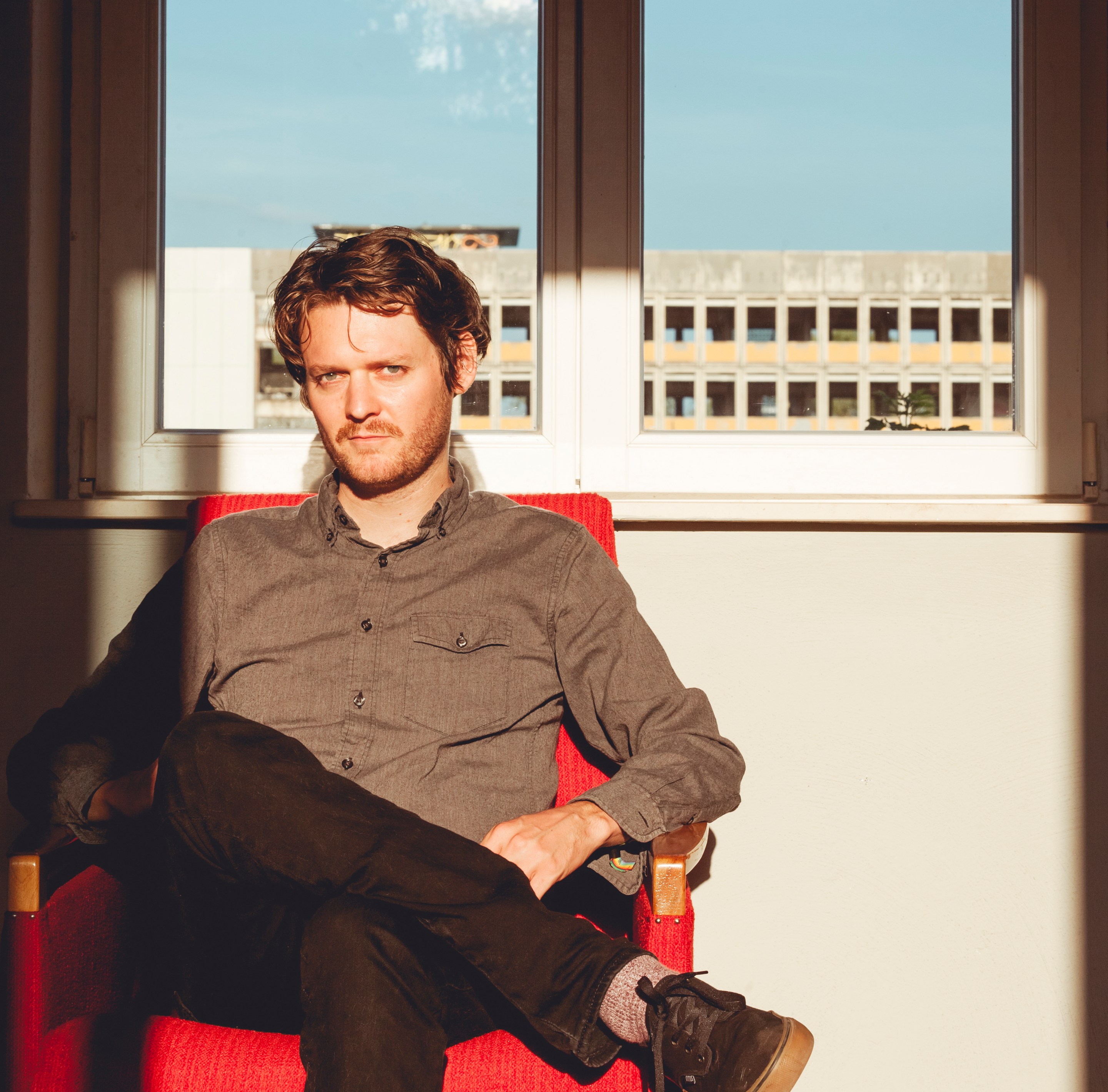
For his latest Beirut offering, Zach Condon celebrates his own sound on a truly global record that is worlds away from his Santa Fe bedroom recordings.
Beirut's music has always been somewhat of a contradiction. Anyone listening to the band’s unexpectedly lush debut album, 2006’s Gulag Orkestar, could be forgiven for imagining that the record was created by a world-weary troupe of Eastern European musicians, rather than a teenager in his bedroom in Santa Fe, N.M. After all, it’s sonic signatures included a swirl of rich, crackling horns, Balkan-informed beats, and impossibly thick vocal harmonies anchored by a lilting and theatrical lead baritone.
Zach Condon, the mind behind Beirut—as well as the voice, thetrumpet, the ukulele, the piano and so on—never meant to portrayhimself as a traveling troubadour. But a unique debut effort likeGulag Orkestar hits hard and, though Condon has gradually strayedaway from those heavy Eastern European influences in the span offour subsequent albums—including Beirut’s latest, Gallipoli—thesinger-songwriter admits that, accurate or not, his reputation as asort of musical Marco Polo has stuck with him.
“There is an image projected of me as this guy who goes to somecountry and then runs back home to lay down what he heard whiletraveling,” Condon explains while at home in Berlin, where he’slived for the past two years. “To me, it couldn’t feel further fromthe truth. I get more influence from records and movies in the firstplace. I just go, ‘Oh, wow, listen to that fucking accordion—thatsounds amazing! Why didn’t I think of using the accordion more inmy songs?’ I’ve allowed it over the years, and sometimes I regret itbecause it pigeonholes me. In my mind, I’m just writing pop music,but I am trying to be expansive about what I’m listening to andwhat kinds of instruments I’m using.”
Despite Condon taking a couple of what he refers to as “typicalteenage backpacking trips” in Europe, the worldly sound of thatfirst Beirut record can be traced back to a source much closer tohome. Condon worked in a local arthouse movie theater for his firstjob, serving popcorn and, on his off hours, watching the foreignmovies that the cinema projected. Now, Condon, an admittedformer teenage Francophile, cites French films like Pickpocket andLes Quatre Cents Coups (The 400 Blows), along with the work ofJean-Luc Godard like Week-end and Breathless, as early favorites.
“It’s hard to say what came first—the music or the movie,”Condon reflects, noting that, while he’s considered a foray intofilmmaking or at least soundtracking, the idea of working with alarge amount of people—or having to write music specifically for ascene or ambience—“sounds like absolute torture.”
The Balkan musical influence was also derived from the moviescores he grew to love at his local cinema, akin to those featuredin the works of Bosnian filmmaker Emir Kusturica, whichimmediately struck Condon and began to soak into the music hewas writing. “I was just so fascinated; it was one of those thingsthat I had to try, especially as a brass player,” he says. “Like, whynot? And then it came out so grainy and weird and kind of fuckedup, but I loved it.”
Even more lasting, perhaps, was the influence of Condon’s olderbrother, who opened his ears to a variety of genres of increasingobscurity—starting with simply guiding him away from some ofthe questionable musical fads of his youth.
“I came home with a Green Day CD as an 11 or 12 year old, andhe just chucks it out the window and goes, ‘No, at least start withRadiohead!’” Condon recalls with a laugh. “And then he wouldpush me all the way into super ambient German electronica; [mybrother] had this crazy thing about that. I don’t know where he wasgetting this stuff—like, he was trying to get me to read Kierkegaardat the age of 13! But he opened my eyes a lot. And then the theaterwas playing these Kusturica films, and I heard the brass bands andwas just blown away. I knew my aesthetics did not fit in with whatI was around. I hated punk-rock. I hated emo. I hated hardcorewith a passion. I couldn’t find my place, but I knew that I lovedmusic so much. Then I heard that and just went, ‘Oh, man, fuck allthis rock bullshit—what the hell is that?’”
Early on, Condon’s family saw that he was destined for the lifeof a creative. After he dropped out of high school, he says that hisfather exasperatedly joked that he was “one of those Condons,”a group that presumably included his cousin Brody, a visualartist 12 years his senior who was an artist-in-residence at theRijksakademie in Amsterdam when Condon first met him at age 19.
Brody, who helped Condon with the cover art for Gallipoli,along with the video for album single “Corfu,” also played intoCondon’s decision to officially move to Berlin after the musicianhad been spending time flying back and forth between there andNew York City during the early portion of the creative processfor the new record. The company Brody kept in Europe struckCondon as a welcome respite from the relatively tense vibe he wasexperiencing back in NYC.
“It just clicked,” Condon says. “It was a quality of life thing, firstof all. There seems to be this constant striving in New York thatpushes you to think about money and measure your success. WhatI found in Berlin was people who were working on art and reallydidn’t give a shit about status. I know this kind of sounds clichéand worn out, but it was a breath of fresh air to me. I would go tosomeone’s studio and this guy would say, ‘I’m a tape-loop guy.’ Hedidn’t give a fuck. These people were truly interested in their artand possessed to work, and I like to be around that.”
Once Condon was fully committed to living in Berlin, he says there was “no question” that he wouldn’t be returning to New York City to finish writing and recording Gallipoli, though some of the tracking began in a Manhattan studio. (He also admits that he hates flying, another knock against the prevailing image of him as a constant cultural traveler.) At the recommendation of his bass player, Paul Collins, Condon joined with him and another longtime collaborator, drummer Nick Petree, plus producer Gabe Wax, at a recording studio in Puglia, an area located on the southeastern “heel” of Italy. The new LP and its title track are named for a small town in the region, where Condon and his bandmates had what might be described as a typical—even clichéd—Beirut experience, which Condon decided to lean into while writing the artist’s statement that he shared when announcing Gallipoli to the world.
In it, he writes, “We stumbled into a medieval-fortressed islandtown of Gallipoli one night and followed a brass-band processionfronted by priests carrying a statue of the town’s saint through thewinding narrow streets behind what seemed like the entire town,before returning late to Sudestudio. The next day, I wrote the songI ended up calling ‘Gallipoli’ entirely in one sitting, pausing onlyto eat.”
And, although Condon’s statement goes on to refer to “Gallipoli” as the song that helped “return [him] to the old joys of music as avisceral experience,” providing “the guiding logic behind much ofthe album,” he somewhat plays down the experience now.
“I always had a silly fascination with city names, which iscontrary to a lot of things,” Condon says. “In the past, it was akicking-off point to write a story because it tickled the imaginationjust enough to get going—because I hate lyrics. It feels like a chore.This time around, I was actually being a little tongue-in-cheek. Ihad this feeling of wanting to be unapologetic about my sound andmy image in some ways: ‘Fuck it. I write songs and I stick city nameson them, often as placeholders before I have lyrics or anything.’
“You can tell that I am a little conflicted,” he continues, referring to the ongoing battle of artistic self-identity versus public perception. “To me, [‘Gallipoli’] was almost in the vein of ‘Postcards From Italy’ [the ukulele-fueled standout single from Gulag Orkestar], which is a song that I wrote when I was 18 years old living in Santa Fe with no fucking clue what I was doing. [Now,] there are layers of self-awareness that drive me fucking nuts, and sometimes I wish I could just roll with it. [In Gallipoli,] we found this brass band playing and I knew it was one of those little moments that I live for. It was like a movie playing in my head—I was transfixed—and I remember thinking, ‘God, I love the name of this city.’ And, too, ‘Look at us—we are right in the middle of our own cliché! How beautiful is that? We’re like pigs in shit; we love this stuff.’ But it’s not like I went home and said, ‘I gotta write something about that!’ The next day was just another day in the studio using the same organs I had been using back in New York.”
Petree, who has collaborated with Condon and Collins in Beirut for 13 years, has seen his bandleader evolve over the group’s five albums in both musicianship and approach to songwriting. He’s also noticed an increased appreciation for their own live performances, which Petree says Condon was never too fond of when compared to their studio work. Condon admits that he is loathe to relinquish any creative control, though Petree notes that he does take his bandmates’ suggestions, at least when it comes to their own instrumental parts. Above all, though, the Beirut drummer admires Condon’s desire to search for new influenceswhile exploring old themes and still striving to create his ownunique style.
“Zach is always looking for new shapes and sounds that will inspire his writing, whether it’s a certain genre of music he’s using as a jumping-off point for his creativity or whether he is just exploring new instruments to write on,” Petree says. “In the beginning, the ukulele and the trumpet were the major sources of inspiration for him, but from [2011’s] The Rip Tide on, he has delved more into the piano, and I think that’s one of the reasons we’ve started to sound more like Western pop music recently. But he will always love the sounds of accordions and other old-world instruments, which will always be a part of the identity of this band. On this new record, Zach is playing more with synthesizers, and it’s fun to incorporate those new sounds with the old—something that he has always done since the very first album.”
And while Condon describes the title track of The Rip Tide as one of his favorite compositions from throughout his career, he also reveals that he experienced some frustrating writer’s block during that album and 2015’s No No No, partly stemming from an admittedly misplaced desire to push back against perceived notions of what he calls the “one-trick-pony style” of his earlier work. On the new album, however, Condon finds solace in returning to what launched his career in the first place: focusing on the songs and not dwelling on outside commentary.
“With Gallipoli, I wanted to celebrate my own sound, personally,” he concludes. “It’s not like I used to obsessively read reviews or anything like that, but they were there and I was aware of them. So I just crawled into a cave and wrote an album for myself. I like to think that it is genreless, and unplaceable in that way. Because of that, it feels pure, like it’s unique to me. In a lot of ways, it’s a combination of everything that came before; I hear a piece of every single record on there. I mean, it has its faults, like every record I have done, which I think people usually tend to accept as the package. For me, it’s really a freedom from self-consciousness. It was pretty liberating.”
This article originally appears in the June 2019 issue of Relix. For more features, interview, album reviews and more, subscribe here.