Ship Happenings: Dave Harrington on Jam Cruise 22
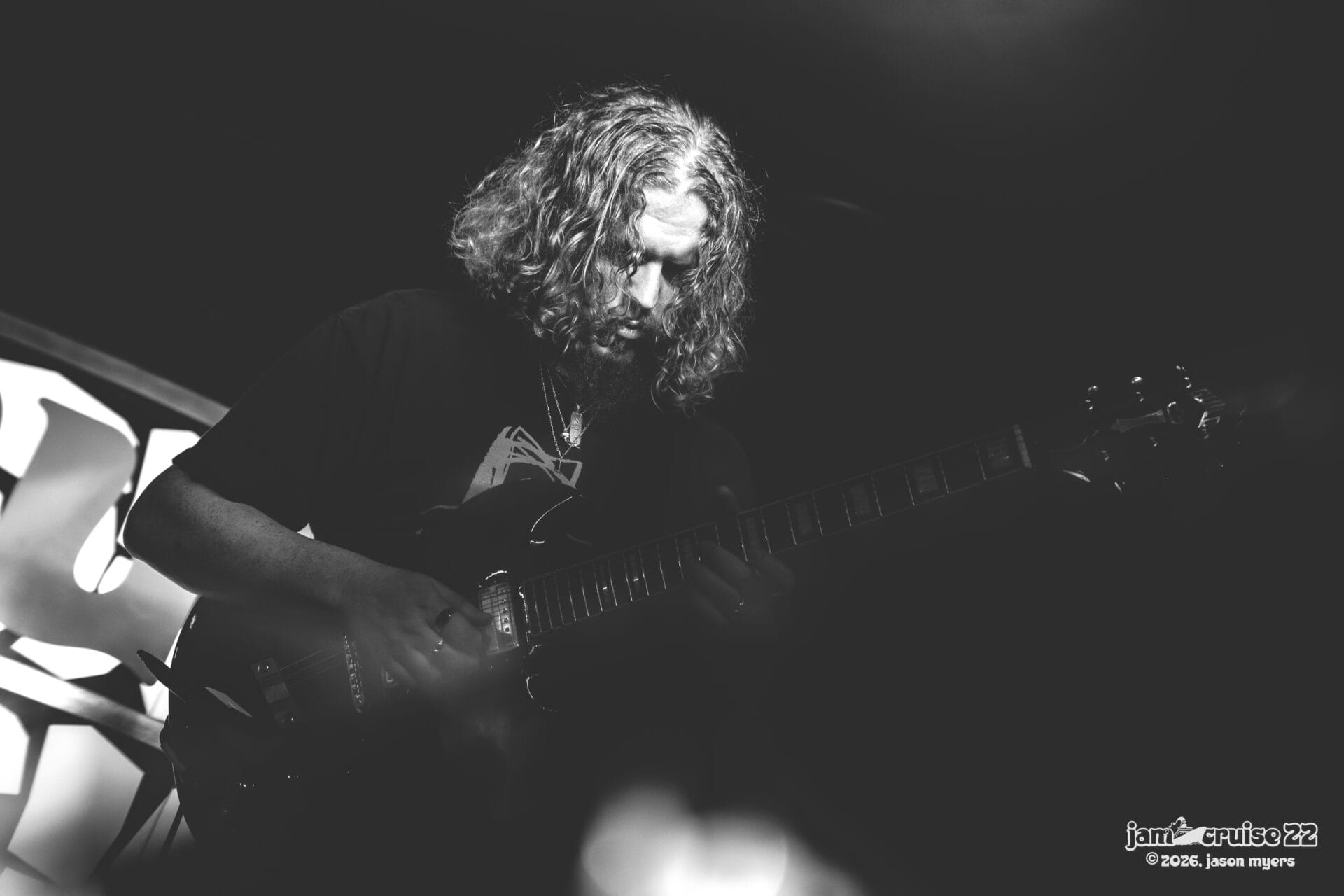
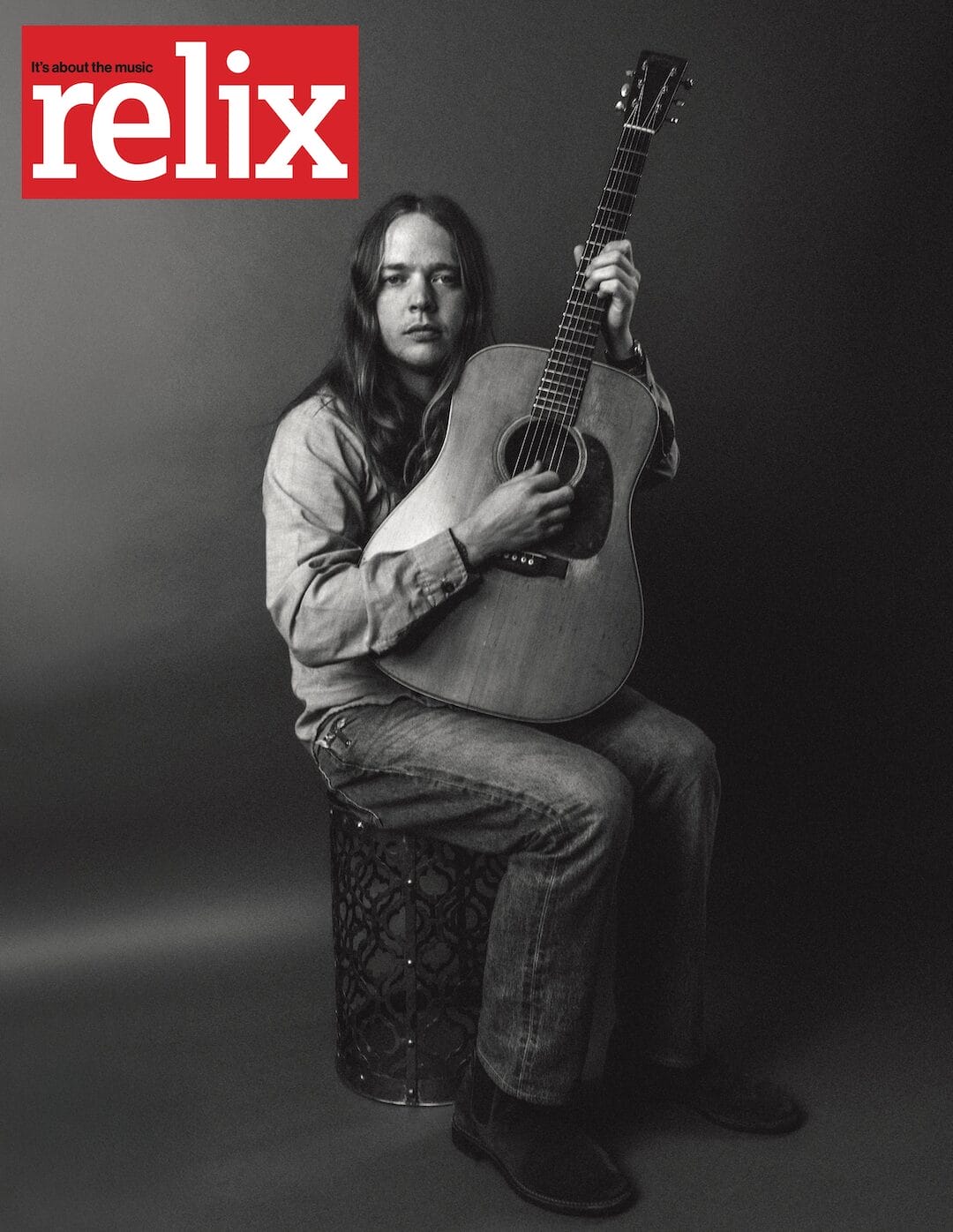
photo: Jason Myers
***
Dave Harrington tirelessly crosses between musical worlds. Since 2011, he’s devised the menacing and mesmerizing sonic architecture of Darkside, his groundbreaking electronic project with Nicolas Jaar, featuring Tlacael Esparza since 2022. In the eight years between their debut and sophomore albums, he became a fixture of New York’s experimental underground, simultaneously lending his talents to jazz, psych and noise groups before moving out to Los Angeles and joining in the West Coast’s newly burgeoning scene. There, he connected with friends from other venerable indie outfits to form Taper’s Choice, the self-proclaimed “subversive jamband” supergroup that’s given him yet another avenue for exploration.
Through all these ventures, Harrington has built up a deep catalog and a singular perspective, unified by his restlessly curious approach to improvisation that willfully unsettles the canonical limits of genre. While he serves as an organizing force among his peers, through his regional Pranksters outfits and countless other pop-up configurations, he’s eager to express his admiration for his vast network of collaborators. A decade and a half into his career, he’s still clearly enchanted by the magic that happens when open-minded artists have the chance to dive headfirst into uncertainty.
“Maybe it’s that I’m a dad now, and I like being close, but at least creatively, if not in some kind of collective cultural way, I feel like having music in your orbit that supports itself in some capacity is really important to me,” Harrington says of the homespun musical community working just outside his door. “It’s like whatever the farm-to-table analogy is for music. It’s nice that you can go buy lettuce from the guy who grew the lettuce.”
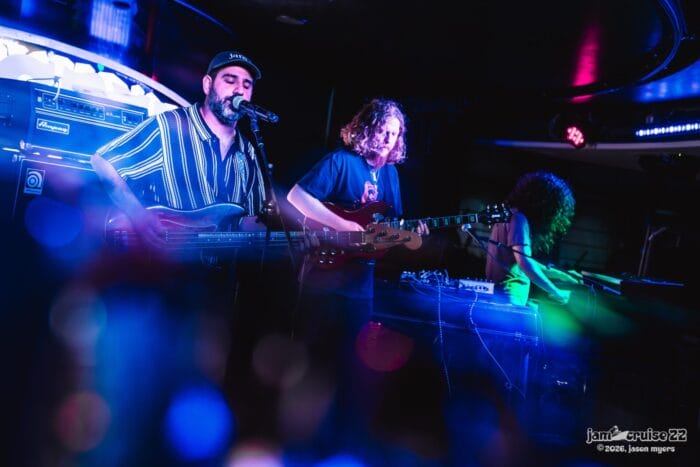
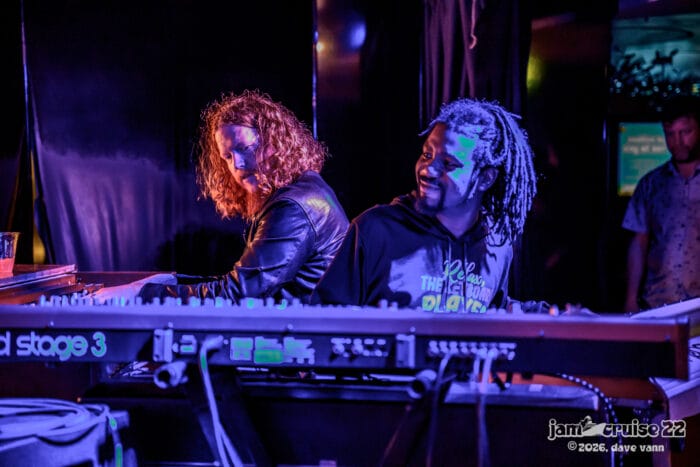
Last month, Taper’s Choice – also featuring Chris Tomson (Vampire Weekend), Alex Bleeker (Real Estate) and Zach Tenorio Miller (Arc Iris)—rode a rare tour down to the Sunshine State to set sail with Jam Cruise 22, where they swirled easygoing psychedelia with meticulous prog passages in two enthralling sets and Harrington led one of the festival’s time-honored Jam Rooms. Before the MSC Divina unmoored from Miami, while still acclimating to the live recordings from prior years and hourly safety procedures pumped through the PA, the guitarist, producer, composer, bandleader and multi-instrumentalist sat for a conversation that stayed close to the heart of the improvisational process and the musicians championing it today.
How was it touring with Taper’s Choice again? It’s been a while since you guys have been on the road this long.
Yeah, it’s been a while since we’ve done this many shows in this many days; I think we had one day off since we left. Part of that was because last year there was Darkside business for me, and also VW and Real Estate and Zach [Tenorio Miller] was working with WILLOW, so we looked at the calendar matrix and we were like, “Do a show in July then?”
So it’s been great. It’s been really fun. I mean it kind of goes without saying, but we definitely feel a lot better. The more we play, the deeper it gets, the lighter on our feet we can be. You know, the jams are more unexpected—territory is new and communication is faster and faster.
So how has that shifted over the time that you guys have spent together? When you’re building out improvisation, I imagine you’ve got some of the same anchor points and communication patterns with each other. Are those opening up?
Yeah, for sure. I think that because we all have different entry points into improvisation, or just jam in the broadest sense, I think that the language of whatever we do once we’re in an open field can be unpredictable. There’s plenty of songs in our book where it could go any number of directions on any night. It’s very unprescriptive.
We had one show where it was just surprisingly dark across the whole set. That was just what started happening. We kept getting into this kind of kraut-y, Pink Floyd-y territory that was just in the air that night, you know. Then the next night, it was much lighter and blissier. I think that can flip and happen more naturally the more that we play, and also the more that we’ve written new material and stuff— jumping off points.
You have so many different reference points from an eclectic, genre-agnostic range of projects. Do you feel that working in this jamband area can integrate all of those to mix and match freely, or does it have its own kind of confines?
I think it’s really open. The diversity of musical interests among the band is my favorite thing about being in this band. I feel like the Venn diagram of like, “I’m really into this,” there’s at least two or three people who can latch to that, and then for certain super iconic things, maybe three or four of us, but it’s not like we’re all obsessed with the same music. Everyone’s deepest influences are pretty different, and then there’s a lot of shared commonality.
So I never feel restricted in this. I think that there are paths of least resistance that I can take in front with the guitar in a more conventional jam kind of a way, and I love doing that, and my take on that is like, I’m never gonna be like that. What we’re listening to right now, it’s just not in my language. So even when I’m kind of aiming at an idea, it always comes out a little crooked, and that’s part of our sound. Then I can come in with something that’s very left of center, and we find a way to make it work.
When things feel kind of stable or predictable, or as though you’re shooting towards that path of least resistance, is there anything that you’ll do to kind of unmesh?
I think it just kind of happens naturally, but not conceptually. I think that we also all love, and even more on this run have loved locking into a groove and being a four-headed beast. You know, getting out of the confines of the guitar-drives-the-bus sort of thing, which is part of the quicksand of playing the guitar. What makes the guitar beautiful is the Gemini of the guitar. It’s like, you can take the wheel, but you don’t always have to. I feel like the guitar wants you to go, drive, then on this tour, some of my favorite jams have really been four-as-one.
And that’s something you find you’re coming by a bit more naturally now.
Yeah, just more material, more shows, it just kind of makes it easier to play more perceptively. There’s plenty of time for everyone to lead, and sometimes you need time to think.
How long is an average set running?
We never play less than 90 minutes. Sometimes we’ll do twofers, but on this run, we had our friends Rich Ruth opening for us. I’m wearing the t-shirt. It’s my favorite t-shirt. It says “Space Jazz” on it, and it’s black with white, so it’s about as Dave as a t-shirt could possibly be. I traded with Michael [Ruth] for one of our tie-dyes. So he was doing a set, and we were doing like one long set.
Do you feel like you’re doing anything to keep stamina or stay locked in towards the end of that?
It’s kind of what I’m used to. Darkside usually plays two hours.
And also heavy on the improvisation.
And very heavy on the improvisation. In a way, it’s very similar. I mean, the instrumentation is different, the tunes are different, the concept is a little different, so it has a different set of constraints on it. But yeah, a huge amount of improvisation. You know, everything else that I do, like, I play improvised stuff in LA all the time, and those gigs are always two sets. It’s usually 45 to an hour, you take a little break, and you’re back. The Taper’s set is more athletic than 45 minutes of jazz in a bar on the east side of LA, but I think I’m just kind of used to it now, and whether it feels long or short is unpredictable. Usually, if we’re locked in, it flies by.
So I’ve got some questions about what feels different from the spaces you’re creating with Darkside and your solo projects, like the quintet album from late last year…
I put out a lot of records.
The one with Spencer Zahn and Griffin [Goldsmith] from Dawes. I think it’s Chewing?
Oh yeah, Nik Ewing’s band. Yeah, Nik is a really good friend of mine. He plays in Local Natives, and he made this beautiful piano album, and then I mastered it for him. He wanted to put a band together and do a couple of shows, so he just called his pals, and I was one of them. So that band only played two or three shows, and one’s the record.
That exists in a similar space to a lot of your solo stuff: It’s slowly unfolding, and has a much more atmospheric character—as does Darkside. Not the case with a great deal of Taper’s Choice, which can be much more frenetic, packed and dense…
A lot more notes. A lot more to remember.
So how does this atmosphere that you cultivate figure in there?
It’s a part of the way that I improvise. So it pushes from that side. Just part of playing as many shows as I do with Darkside, and the kind of music that I do in Los Angeles with various groups, it’s part of the language in all that, so it’s part of the language of how I play. I think the best thing that it helps me get back to patience, and not trying to make stuff happen all the time. The more I can remember that—or the more that I don’t have to remember it, hopefully it just happens—I think it makes more room. Taking a little extra beat sometimes to get a sound together before I start playing. Like hearing something that Zach is doing, and then being like, “This is great. I don’t need to be doing it right now.” I’m making a little sound, like turn this thing on, pitch through this to the reverb, and be ready. Then I can enter an atmospheric idea and get involved with something groovy, or peaky, or whatever. So not always starting from notes, but starting from the sound.
Do you feel like patience is one of the core things you’re coming back to on stage at this point?
Yeah, and I think that I’m starting to understand more of the roles, what the options are for the jamband “lead” guitarist, you know, and I think that being in this band has been really amazing because it gives me an opportunity through learning the types of songs.
I mean, we write a lot of songs collaboratively, but like Chris [Tomson] writes all the crazy proggy shit, and [Alex] Bleeker writes these really great strummers that are kind of in the JGB lane that I love, and I haven’t ever had a band that has explored those territories. It’s all music that I love, but I’ve never had a chance to play it.
So part of it’s challenge. Part of it’s learning those languages. Now I feel like I’m trying to make it my own.
Has making it your own entailed going back to some of the different schools of jam lead guitarist and figuring out what they’re doing?
Yeah, I mean, I listen to JGB with my 3-year-old daughter almost as much as anything else. So like it’s all in there somewhere, you know? It’s all in my brain somewhere, but just getting to play inside things that are a little bit more genre-y than what I usually do.
I feel like for me, it’s more about understanding it deeply as a player, and then being able to kind of forget it and let it come out in its own way.
So you spoke to leading with sound rather than notes as a jam is building. Now I really loved your Premier Guitar Rig Rundown.
Oh yeah, that was fun for me. That was a big moment for me, I mean, that’s a real big moment for any guitar nerd.
That’s arriving in the pantheon. You’ve got this incredible beast of a set-up in that. What are you working with in Taper’s?
There’s a lot of stuff that I use with Darkside that’s specific to what I do with that band, but at the core of it is the same stuff that I’d use for Taper’s or for anything. I have a baseline board of very specific things that I don’t change a lot, that I use to build my own sounds. For years, I’ve kind of developed every now and then, maybe I’ll switch one thing out, add new stuff, and that goes with me basically everywhere. It’s not as mammoth as what I take on the road with Darkside, but Darkside is an electronic band, so you have to have electronic things.
You have a diverse field of influences, from avant-rock to free jazz and beyond. When you’re drawing on this lexicon, does it feel like you’re working with different threads that you’re putting together, or are they all naturally expressing a whole?
Sometimes they’re just there, and you don’t have to think about that much. But sometimes, I don’t mind being a bit of a collagist. Not exactly playing conceptually, but thinking a little bit. Maybe there’s something really fast going on, and Zach and Chris are playing a lot of notes, I’ll be like, “What if I do something like King Tubby?” Or, “Yeah, I’ll just play incredibly slowly, play just one note for a couple bars and put weird reverb on it.”
So I don’t know. Sometimes you think, and sometimes you don’t. You can’t stop yourself from thinking, but I don’t mind putting on like my own private conceptual hat—like what would so-and-so do here, or maybe I’m gonna just pull on this thread and do some of my Scofield-y shit right now. I’m not a trained guitarist; I mean, I’ve been a guitarist for a long time, so I think I’m getting closer, but a lot of my guitar playing developed just from playing on the road, because I was a bass player when I was a kid. A lot of my guitar developed from improvising gigs and Darkside touring, and at the beginning, that’s kind of an impression. Like, “Oh, maybe this would be good with a Ry Cooder thing.” That would open the door for me, and I still think about that stuff sometimes, because I don’t have a lot of preciousness about that.
For me, I’m interested in the big picture in the jam. And you know, I think there’s a version of me emerging, maybe, as someone who sounds like Dave Harrington, but he builds up as a kind of strange mélange of other guitar players.
Using a reference to elliptically speak to an individual quality, you’ve used that great Bill Frisell quote: “I like playing with singers because I always try to play like a singer.” How do you see that idea figuring into your approach?
That quote really stayed with me. I think about it a lot. That bit of Frisell-iness passes through my head while I’m playing. I think that quality is shared by Jerry, in large part. Bleeker told me, when we were first starting to play this music, as we were trying to find our way through longer jams and we hadn’t been playing together that much, he was like, “Jerry’s like Miles Davis.” “Okay, tell me more.” “Just the melodies. It’s not solos, it’s just playing melodies.” It’s a very simple idea, but I think about that one Bleeker quote all the time. Whether I’m in this band or not—I think about it when I’m back in LA playing free jazz.
It’s something that I try to actively think about, because that’s another thing about the quicksand of guitar: You don’t have to stop and breathe. You can just keep playing fucking notes. And sometimes that’s great, but that’s kind of the opposite of what Bill was talking about. You know, I didn’t start it consciously—I think I started doing it maybe just when I was practicing live—but sometimes I’ll sing when I’m playing. I’m a horrible singer, but when I’m playing guitar and improvising, it sounds like something between Oteil scat-singing plays and then Keith Jarrett going[squawking] behind the piano. If you were standing next to me during a show, you would hear that coming out of me. I think part of that too, is a reminder to breathe while you’re playing, and think about how that works, and let that influence you.
I had a friend who used to give me discounted yoga and Qigong lessons, and she really got me thinking about what I’m doing with my body. Sometimes I’ll just get lost in the jam and think about that. Like, “If I just stood up straight again, squared my shoulders, took a deep breath, listened to what was happening—ah, look, music! The path is clearer.”
Any other meaningful phrases coming to you regularly, in the realm of the Bleeker and the Frissell?
Bleeker has another saying that I love and think about: “There’s always a little more toothpaste in the tube, man.” I think about that while I’m playing, especially in this band and with him, a lot. Just when you think you’ve gone all the way, what happens when you just look around the bend, just go a little bit further, squeeze a little more toothpaste out? You can’t do it every time, and you can’t do it all night long, but sometimes that yields the extra bump to create something.
For the uninitiated, how would you introduce the sort of jazz-not-jazz Los Angeles scene?
It’s been a very lucky break in my life. When I left New York in 2019, I thought that I was leaving behind the opportunity for regular gigs and community. I’d been to LA, and I knew there was stuff there, and I’d played a few improv gigs with friends in LA, and I thought, “Oh, there’ll still be some stuff,” but I was so entrenched in this improv scene in New York, with like İlhan [Erşahin] and Kenny [Wolleson] and Joe Russo and Nels [Cline] and Yuka [Honda] and Spencer [Zahn] and Stuart Bogie and this whole community, and it was sad to leave that. Then I just got lucky that when I got to LA, it just started to blossom even more.
A lot of it came out of this scene around a club called ETA that doesn’t exist anymore, but then other places started getting into the idea that it was cool to have interesting music in non-venue spaces. So I’m lucky that I get to play at some really cool venues a lot, but some of the best gigs are set up in the corner at a bar. There’s a culture right now where people want to play the music and people want to come listen to the music. There’s an audience around bars, venues, restaurants and in-between spaces creating a space for that, because it’s a part of what’s going on now. It’s never like, “Don’t do anything too weird,” or “You have to play this kind of music.”
These pockets pop up and you hear these gigs are happening. Like Café Triste is this wine bar, and my friend Max Jaffe is playing there every Monday. They didn’t have music a few months ago, you know? It’s just that kind of organic thing. And there are other places, like Zebulon and Healing Force of the Universe. My personal favorite—other than Zebulon, which is an incredible club—but of the non-club/club hybrids is this bar that’s down the street from my house, where I play on the first Monday of every month with my trio: Jake Bellerose, who’s a fucking legend and Billy Mohler, who’s a virtuoso. They keep wanting to play music with me, and I just keep showing up, and we have a lovely time. It’s all very creative and quaint.
It’s a beautiful thing to be in a place where so many people are excited about making unpredictable, unclassifiable music, intended to be experienced.
Yeah, and the tendrils of that incubator of various people are starting to reach outside of Los Angeles. There are a lot of us who are gonna be at Big Ears this year. Big Ears has a heavy Los Angeles presence. That weekend, there will be no shows in LA, because everyone will be at Big Ears.
On your solo material: how does improvisation figure into your composing? While you’re out there with Taper’s, are you touching on things that make you think, “I want to come back to that later?”
No, I don’t like listening back to tapes of shows. I do like putting out live records, but it’s tricky for me. It usually goes best when I have partners in the band or a friend; I run a small label now with a dear friend of mine, and I’ll send him tapes and be like, “The jazz trio thinks there might be a record here from these tapes that we recorded at this gig. Can you listen to it and tell me what you think?” Because when I’m playing a show, I try as hard as I can to just be in it while it’s happening, and not step out and look in. You can only put your foot in the stream once, then once you’ve picked it up and put it back in, the stream has changed—that sort of thing.
So I keep that really separate, but I think that helps me as an exercise of listening. I think it helps my ear and my instincts get better if I’m really trying to be there.
Then composing is totally different. I’ve gone through all kinds of different phases, and it really depends on what I’m interested in. I made a record a few years ago, my last solo record, that was kind of a long-running project with a friend who’s an engineer and producer in New York, and we brought a bunch of players and kind of built it one thing at a time. I had some sketches, and we did some overdubs and came up with some more parts. Then I made another record that was all me alone playing every instrument. So I’d kind of start with the idea, and I’d sit, and write, and do the thing, and find it and build it. I don’t really have a method.
I think just improvising just helps you got going. It’s a nice tool to lean on. You can do the thing of just sitting down and playing some tones for 10 minutes, and you do that in your life enough that you can say, “Oh, that’s cool.”
That aversion to listening back, is that because you feel like it weighs on your ability to be present otherwise?
It’s tricky. I mean, I try not to be too stubborn about it, but I just don’t like listening back. It’s like it’ll never be like it was while it happened. And yes, it’s a recording, but it won’t tell you everything about why and how it was, and what it felt like. And so I don’t mean to be too heady or pretentious about it; every now and then I will, or I’ll hear a clip, but man, it just feels like the opposite project to me. Improvising is about the moment, and to go back to it.
I don’t know. Maybe I’m thinking about it self-reflectively: If I decide I’m not going to listen to it, then I give myself an extra dose of freedom to be even more risky in the moment, ’cause I can really commit to it. If you ignore that there’s a record—just say “That’s great, but it’s not important to me”—then maybe it’s easier. Because everything is documentation, documentation, documentation. That’s great, but I don’t know if that’s always great for music.
Closing streak here. Have you ever been on a cruise before?
Nope.
Did you expect that you would be on Jam Cruise?
No. Not necessarily, but there’s plenty of things in my career that I didn’t see coming. I like to say yes—the improviser’s motto. So here I am.
Is there anything particular you’ve done to prepare for this experience?
Nope. The other improviser’s motto. I got a band together for my Jam Room. We got here in the van today, but we’re on the boat. That’s about it. I’ll figure it out as I go. That’s what it takes.