Love Rocks’ Greg Williamson on the Legacy of Levon’s Rambles, the Heights of the House Band, and the Glory of a Rock Show That’s Not a Gala

Greg Williamson, Nicole Rechter and John Varvatos
***
“This is a journey that I never could have expected. You have to understand, everybody told us not to do this, and nobody thought we could succeed,” Greg Williamson says on the eve of the 10th Annual Love Rocks NYC benefit concert at Manhattan’s Beacon Theatre. Williamson was a real estate broker and music fan with no pertinent concert experience when he teamed up with events producer Nicole Rechter and fashion designer John Varvatos seeking to raise funds for the New York-based nonprofit God’s Love We Deliver.
Williamson acknowledges it was case of not knowing what he didn’t know. “That’s exactly why I pursued this,” he says, “because if I knew what I know today, I never would’ve thought that I could bring this together. I just had big eyes and I said, ‘I’ve got John, I’ve got Nicole, we’ve got a music director, we’re off.’”
As it turned out, their collective passion and purity of intent served them well in conceiving a fitting fundraiser for the exemplary organization that prepares and home-delivers medically appropriate meals for individuals enduring life-altering illnesses. This year’s event, set for Thursday evening will be anchored by an all-star house band under the direction of Love Rocks stalwart Will Lee, as well as a remarkable roster of performers that includes: Paul Simon, Billy F Gibbons, Elvis Costello, Warren Haynes, Hozier, Jon Batiste, Linda Perry, Goo Goo Dolls, Mary J. Blige, Trombone Shorty, Nile Rodgers & CHIC, Preservation Hall Jazz Band, Susanna Hoffs, and some stellar players to be named later. In addition, Whoopi Goldberg, Paul Shaffer, JB Smoove, Jeff Ross, Julianne Moore and Zarna Garg will also make appearances. While the show is sold out, a stream is available with all proceeds directed to God’s Love We Deliver.
Love Rocks’ three co-founders all remain volunteers, donating their time throughout the year to the cause. This is why Williamson explains, “I don’t think of myself as a promoter. I think of myself as a producer. That’s because I don’t do this as a job promoting concerts.” Still, even as he continues to work in real estate, he created the successful Soho Sessions series with Rechter, which also raises funds for charities via intimate performances by artists at a Manhattan commercial loft.
As Williamson considers the full sweep of his Love Rocks experience, he reflects, “Despite what may have seemed like long odds at first, a decade later we’ve raised almost $70 million and helped to feed six and a half million New Yorkers. Meanwhile, everybody from Cher to Alicia Keys to Jon Bon Jovi to Robert Plant and the list goes on, has played this show. The mentality we set forth from the beginning is that this isn’t about one, two or three people. This is about a group of people who really want to make a difference here in New York City, and God’s Love has been helping people in New York for 40 years.”
Since this is the tenth anniversary of Love Rocks, it seems like a fitting moment to step back and revisit its origins. What prompted you to set things in motion?
There were two initial musical inspirations for this show, although we never could have imagined what it would become.
I was a very early attendee of Levon Helm’s Midnight Rambles. I started going to those shortly after they started. What I got from the Rambles was the unique sense of building community around music. The artist was connected with the audience, the audience was connected with the artist, and I fell into live music in such a deep way. That cultivated my love of live music.
Eric Clapton’s Crossroads was another inspiration. During the first two years we even had a lot of those same artists.
What’s been unique about our show, though, is that it’s all centered around and flanked by a 21-piece house band.
Since you mentioned the house band, one of its notable aspects is that although Will Lee is the music director, a lot of the members also have performed that role in other settings.
It’s one music director after another. That’s an example of how we’ve created this incredible family and it’s all about love and music. Everybody just instinctually leaves their egos at the door and is in it together. I mean Michael Bearden was Lady Gaga’s music director. Larry Campbell’s been an MD for everybody. Same with Kraz. Andy Snitzer in our horn section is one of the people that leads Paul Simon’s band. Steve Gadd is Steve Gadd.
So this is a very unique band in terms of its size, the caliber of the players and the musicians, but also that they’re all MDs.
I would also point out that 95% of the players have returned year after year. There are a couple who may not be able to be there because they had other gigs or someone like Jeff Young, an incredible singer and keyboard player in Jackson Browne’s band, who passed away.
It’s a huge credit to Will Lee, how he runs the band, how he interfaces with everybody and how he makes everybody feel like an essential part of it, which they are. It’s a six piece horn section with six background singers, so it’s an embarrassment of riches, but we like it that way.
Something else about this whole thing is we never wanted it to feel like a gala, which it’s not, We also never really wanted it to feel like a benefit concert. We wanted it to feel like a real rock-and-roll show.
Stepping back again, can you talk about some of the early shows that helped you appreciate the power of live music? Is there a particular Ramble that comes to mind?
When I was 13 years old I attended my first Dead show [in June 1991 at Giants Stadium]. I saw a few of those and they were formative experiences for me. The Allman Brothers runs at the Beacon Theatre were also instrumental. Then it was seeing local bands like The Fab Faux in the very early days around New York City and going to places like the original City Winery.
As for the Rambles, what was really special besides the intimacy and Levon being there having that second act in his life, was the band. There were two band leaders in the very beginning. One was Larry Campbell and the other was Jimmy Vivino—two of my dearest friends who I’ve worked with many times throughout the years. Then there was Amy [Helm], of course, and Larry’s wife, Teresa. The original bass player was Mike Merritt, and the keyboard player who’s still up there now is Brian Mitchell. They also had a great horn section.
It’s hard for me to pick one specific Ramble, but in the early Rambles, they had a lot of surprise guests who truly were surprise guests. You were paying to see Levon Helm, so the surprise guest was gravy. But I remember seeing Rickie Lee Jones, Chris Robinson, Elvis Costello and many others.
Even with all the music I’ve seen since then, I would still say there was nothing quite like it. You were in somebody’s living room and you were watching this iconic figure from, in my opinion, the greatest band there was, no pun intended.
I could go on about this, but Levon’s voice had come back in such a unique way. So it was really inspiring to see those concerts. They remained with me when I was first thinking about Love Rocks and they continue to have an impact.
Returning to the development of Love Rocks, how did it first come together?
What happened is 12 years ago I got sober from alcohol. I was in the real estate business prior to that, and I’m still in the real estate business today, but something clicked inside of me. When I got sober, I shifted part of my obsessive and addictive mentality towards music.
My wife and I had been involved with God’s Love We Deliver, which is such a worthy, iconic and beloved New York City charity. They’re the only ones who do what they do in New York City. They’re cooking and home-delivering four and a half million meals a year to New Yorkers who are living with over 200 different life-altering illnesses. These are medically tailored meals that are individually customized because they know that if you have diabetes and I have HIV, we require different types of food. So the attention to detail and their overall mission is extraordinary.
So I had this idea to support what they do by starting what I thought could become the biggest and most badass benefit concert in New York City. I had no experience with anything like this but it seemed like a logical way to make an impact, by marrying music with a powerful cause.
At that point I brought in my friend Nicole Rechter, who’s an events planner, and she’s been instrumental in this entire journey. Not long after that, I had a mutual friend who knew John Varvatos and I just had kind of a sixth sense that he would be a great partner. I loved that he was deeply embedded in the music world, but not really in the music industry per se. I thought that was a great balance.
I also approached Will Lee to see if he would be our music director, and he was all-in. In addition to everything that he could offer on the musical side, I approached him because when I was getting sober, he had over 20 years of sobriety.
One thing I want to get across, even though you’re speaking with me, is that the reason this has been so successful is because it’s a giant collective. It’s been that way from the beginning, starting with John and Nicole, on through everyone who has been part of it, both onstage and off. That includes our advisory board and the incredible partnership of God’s Love We Deliver.
When this began I didn’t have experience, but I knew how to be efficient and thorough. As a music fan, I know how to put on things that I wanted to hear and I thought others wanted to hear. But above all else, I knew how to surround myself with people who are a lot smarter than me.
When you’re starting something new like this, it’s often helpful to land a notable artist at the outset, in order to establish the caliber of the event and signal what’s to come. Can you remember the first performer to commit back in 2017?
There were a few who were in around the same time that were significant: Aaron Neville, Jackson Browne, Derek Trucks and Susan Tedeschi. Then towards the very end, when we really needed one more big headliner, John Varvatos called me and said that he had landed Joe Walsh.
The first lineup was unbelievable. That year we put Marcus King on the Beacon Theatre stage for the first time. He was 17 years old, no one really knew who he was, and he did an unbelievable version of Sam Cooke’s “Bring It On Home to Me” with Warren Haynes and Bruce Willis.
I’m looking at it now but that first year’s lineup was Joe Walsh, Mavis Staples, Jackson Browne, Warren Haynes, Michael McDonald, Dr. John, Gary Clark Jr., Patty Smyth, Bruce Willis, John McEnroe, Derek Trucks, Keb’ Mo’, Aaron Neville, Lisa Fletcher, Marc Cohn, Anthony Hamilton, CeCe Winans and Susan Tedeschi, William Bell, Amy Helm, Blind Boys of Alabama, Jackie Greene, the late great Sam Moore, Catherine Russell, Joan Osborne, Tash Neal and Marcus King. I mean, it was insanity.
Speaking from my experience in creating a multi-artist event like The Jammys which I did with your Advisory Board member Peter Shapiro, it can’t be overstated how essential an efficient, friendly, professional crew is in setting the tone and making artists feel comfortable, which then translates to the stage. Can you talk about that aspect of Love Rocks?
We have a production team that’s extraordinary. My partner Nicole has said that at times during the show, some people are more focused on watching the production aspect because it’s so flawless.
My big takeaway over the last 10 years is that this is the fastest long show I’ve ever seen in my life. It’s a three-and-a-half to four hour show that goes by very quickly. Some of the reason for that is the artists are generally not doing more than two songs. We also have a house band that’s extremely tight, so there are no changeovers unless there’s a standalone band, which is rare. None of that could work without the production team, which is one of the keys and secrets to this incredible show.
Something else I would point to is that from the very start we knew we wanted to take great care of artists, the same way we wanted to take great care of everybody in the house band. Nicole has a day gig as a global events planner and works with a lot of CEOs. She is used to giving a level of service that is above and beyond what these artists are accustomed to, certainly at another benefit concert, but also on the road.
We’re incredibly organized. We’re passionate and meticulous about everything. The production team that we work with makes sure that everything is flawless.
A huge part of this is that it’s a great cause. Another great part of it is that the music and the artists that come on board are extraordinary. But one of the things that’s the secret sauce is we take care of people like very few others do.
From the moment they get there, whether it’s Hozier coming from Ireland, Robert Plant coming from the UK, Alicia Keys or Cher flying across the country or anyone else who’s participated, like Trey Anastasio, Dave Matthews, Mavis Staples, St. Vincent, or Dave Grohl, we have always tried to go above and beyond from the minute the artist arrives.
Robert Plant was here for four days and on one of the sizzle reels he says, “It feels like a great vacation.” We’re giving restaurant recommendations and making sure they have whatever they need to feel that way about the experience.
Keith Richards has come twice, which really hammers home the point. Keith Richards doesn’t do these things. He’s come twice because his team knows that everyone is going to be taken care of extraordinarily well.
Since the artists are donating their time and taking time out of their schedules to be there and support this cause, we’ll say yes to anything we can.
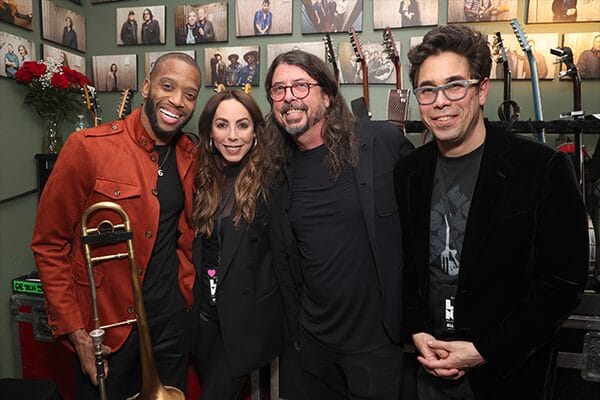
Trombone Shorty, Nicole Rechter, Dave Grohl and Greg Williamson at Love Rocks
Has there been something you were able to pull off that surprised even you?
Thinking recently, what comes to mind is that last year Cher did an outfit change on stage in between songs. We basically had a dressing room on stage where she went in and completely changed. We didn’t think we had the room on stage to do it.
It’s a 21-piece house band and there are two drummers and a conga player. So bringing in another drum set is next to impossible, but we’ve done that numerous times or a big piano.
One thing I’ve learned over the years is that some people who work in the concert business aren’t coming at it solely from a place of passion. Well, that’s not us. We are so passion-driven. I mean, we’ve worked as volunteers on this thing for the last decade 365 days a year. When you’re coming at it from that place, you’re going to go above and beyond in ways that others wouldn’t.
I imagine you have a very tight run of show with a curfew. Having said that, part of the live experience that everyone craves is the spontaneity that comes with someone like Bill Murray riffing or the music cascading in an unanticipated direction. To what extent have you been able to leave room open for that?
We’ve had moments for sure where hosts have been out there considerably longer than they should be out there, but there’s nothing you can do at that point. There also are times when we’ve gone over the curfew. Again, it’s not ideal, but it’s something that has happened.
There was a time where we had Martin Short, Bill Murray and Chevy Chase on stage together. Chevy was in the audience but wanted to come up and be with his two old buddies. It was interesting to see how that went because it wasn’t planned.
So yes, there are times that things run over. Yes, there are times where hosts may do things that are unanticipated. You just go with the flow.
Have you ever been in a situation where a notable musician who is not on the bill expresses avid interest in participating, almost inviting themselves into the show?
That happens every year and it can be uncomfortable. I think sometimes I overreact to it a little bit, at least in my mind, not outwardly. First of all, everybody’s coming from a good place and wants to be part of it. It’s flattering. Again, they’re donating their time. But maybe you’ve specifically not asked that artist because you had them last year or because you have something else in mind for this year or you’re thinking about them for next year.
Sometimes they’ll see an artist on the bill that they’re friends with or that they sing with. Again, they’re all coming from a good place, but it can be a little challenging. You have to make sure that you handle it in a way where nobody feels offended.
Earlier you mentioned the Marcus King appearance in 2017, when he made the most of a moment as an artist who was likely unknown to most members of the audience. Can you describe the balance you strike in assembling the roster of performers?
John Varvatos and I talk a lot about this. We love to have what we’ll call household names on the lineup and we love to have up-and-comers so that people learn about artists they may not otherwise know. We like to have a good variety and mix.
We’re always thinking about how a particular artist will resonate at the show and how they will fit into the overall cast of artists we have on the show. Some of that is trying to ensure that the artists respect and revere the others artists they’re playing with. We’re also striving to bring artists together where it doesn’t seem too odd that they’re on the same bill. Sometimes you see artists on a bill together and it looks like a mishmash. We never want it to feel that way, but by the same token, we want it to feel really interesting that a given artist is on the bill. So we take all that into consideration.
When you think back over the years to situations in which two artists were introduced at Love Rocks and created something really special together, what pops into your head?
Seeing the chemistry between Cher and Trey Anastasio last year was really great. Trey seemed to be over the moon being on the lineup with Cher and singing with her on the encore, and I think she really enjoyed him as well. So that was cool. I think Trey even sang about being on the bill with Cher at one of his solo shows subsequent to Love Rocks.
So that’s a recent one that pops out, but there have been so many times where artists have come together who have not worked together, as well as artists who love each other and are so special together, like James Taylor and Sheryl Crow singing “You’ve Got a Friend.” That was an incredible moment.
It was special for me when Jimmy Vaughan, Billy Gibbons, Doyle Bramhall II, and Gary Clark Jr. did a tribute to Jimmy’s brother and played “Pride and Joy.” I also think of Michael McDonald with the great New York singer Catherine Russell doing “Ain’t No Mountain High Enough.” Sam Moore, Derek Trucks, Susan Tedeski, and Jackie Greene performing “Lovelight” the first year was unbelievable.
So many more are now coming to mind, like Norah Jones dueting with Keith Richards on “Make No Mistake.” Or Sara Bareilles and Yola doing a beautiful version of Elton John’s “Goodbye Yellow Brick Road.”
There have been a lot of incredible collaborations over the years. It’s pretty magical, all those collabs. Another one that just occurred to me from last year is when Trey did “Good Times Bad Times” with Luke Spiller from The Struts.
So that’s the magic of the show and the intimacy of the show where everybody’s there for the cause.
I also have to go back to the house band. They’re at the heartbeat of everything and they’re the constant throughout the entire show. They’re in the Beacon all week. They get into the Beacon on Monday. We load in on Monday at 6:00 AM and the show’s on Thursday. The house band gets set up and starts making noise around 4:00 on Monday. Then on Tuesday they’re starting to go through songs without the guest artists, who start to arrive on Tuesday night. Then the guest artists continue to come in all day Wednesday and Wednesday night through Thursday, right up to the show.
It’s insane how quick the week goes, but the key is that house band—all these music directors and incredible players who booked this show a year out.
Given all that preparation, can you share your perspective on the fourth Love Rocks, which took place on March 12, 2020 just prior to the COVID lockdown?
We were the last show to happen in New York because of the pandemic. Nobody knew what was going on and not one artist bailed out. Every single artist was on board from Dave Matthews to the Black Crowes, to Leon Bridges, to Dave Letterman to Cindy Lauper and on and on. It was an extraordinary lineup.
We pulled everything off, but Cuomo had issued a mandate in the middle of that day saying there could be no audiences above 500 people. We had anticipated something like that might happen, so a few hours earlier we restricted the audience to core personnel—everyone working at the show as well as the family members of the artists and people like that.
That’s when we did our first livestream and the person who saved the day with the livestream was Peter Shapiro. He should be acknowledged for what he offered us on exceptionally short notice because he’s the reason that six years later we still livestream. That has become an essential component of the show because the thousands and thousands of clients of God’s Love We Deliver, are homebound and now they can watch the show.
What’s also interesting is that we were also the first show back to New York when the restrictions were lifted. So we bookended the pandemic. Our first show back was 2021, and the reason we were so eager to get back is that the concert was a much needed fundraiser. God’s Love didn’t have the luxury of us not continuing to do it with all the money that it raised for their clients and their services. But it was wild that we bookended the pandemic.
Since Love Rocks has such a storied history and stellar reputation, I would imagine some people have suggested that you should move into a larger venue. Although there would be additional expenses, there would also be increased ticket sales, which would translate into donations for God’s Love. Clearly you’ve made a commitment to the Beacon. Can you talk about that?
The concert is a magical experience and it would be a different thing if it wasn’t in as intimate and as iconic of a venue as the Beacon Theatre. Having said that, there is a responsibility to raise as much money as we can for God’s Love We Deliver, but we have managed to have incredible supporters who have given millions and millions of dollars of additional money to the concert without asking for extra seats. That has allowed us to stay in the theater, as well as raise the money we would’ve otherwise raised if we went to a larger venue.
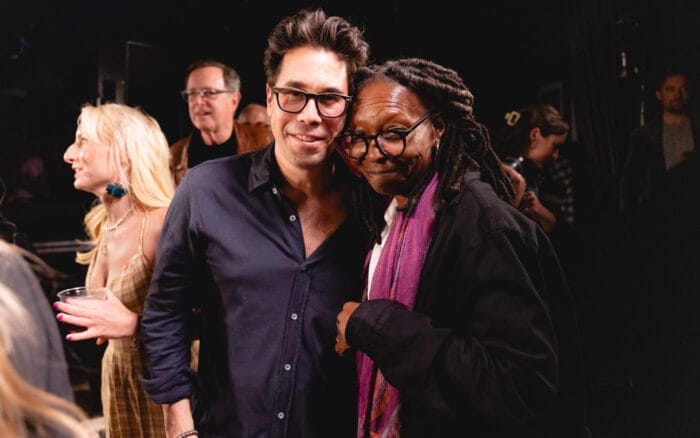
Greg Williamson and Whoopi Goldberg at The Soho Sessions
On the subject of intimate rooms, the Soho Sessions take place in a loft. What prompted you to launch that series?
Nicole Rechter, who’s one of my co-founders and co-producers of Love Rocks and I built the Soho Sessions about three years ago.
We’ve always loved that Love Rocks happens every year, but it only happens once a year and it’s for a single charity. This was an opportunity for us to do something 10 times a year. The beauty of the Soho Sessions besides the fact that it’s super intimate, is that each one can attach to a different charity. They’re not really fundraising gigs per se, they’re more like amplification events.
Soho Sessions gives a portion of the proceeds back to the feature charity of the night, and the people who are in the room are encouraged to contribute. But it’s really the ultimate cultivation event because the charity gets to play in front of celebrities, people in media, people in fashion, people in the music industry. It’s also unique because it takes place in a 3,000 square foot loft and you’re seeing people like Keith Richards, Paul Simon, Elvis Costello, Gary Clark Jr., Trombone Shorty and Nile Rogers & CHIC.
The fact that we get to connect with different charities for each one is incredible, and each one has a different story. We partnered with Bruce Willis’s wife, Emma Heming Willis, to raise awareness for frontotemporal dementia for Bruce Willis. That’s why Keith Richards, Mavis Staples and Norah Jones came. Another time we partnered with Kate Hudson to raise awareness for her mom’s charity, MindUP, and we had Goldie Hawn in the room. So each one is very magical. Each one has its own story. We had Paul Simon because we did one for the Stanford Initiative to Cure Hearing Loss.
Another thing I should add is that what’s really unique about the Soho Sessions is that oftentimes it’s the artist’s own cause. When artists show up for God’s Love, they’re all in, but they’re in a different way when it’s their own charity or foundation. That happens 95% of the time, but if they don’t have a cause that’s their own, we encourage them to do one that they’re passionate about. Then we’ll amplify that cause.
Marc Maron was on the bill just over a year ago. What were your thoughts on expanding into the comedy realm?
With Soho Sessions, Maron is a great musician and obviously an incredible comedian. I partnered with Jimmy Vivino on that, who’s close with Maron. We wanted to do a kind of Vaudeville night, which was a mix between comedy and music throughout the evening.
Marc hosted the whole thing and a comedian would come up and do five minutes. Then Kingfish would play three songs, and another comedian would come up and do five minutes. Then Jimmy Vivino and the band did a couple of songs with Kevin Bacon. Then Maron came back up, did a set and played with the house band before Kingfish came back and did three songs. So that was a really cool format, and I’d love to do more of it.
Finally, to your point of being a producer and not a promoter, I think some people will be fascinated to learn that you’ve maintained your day gig, if that’s the right way to describe it.
The only reason I wouldn’t call it a day gig is because all three of them are day gigs. I’ve been a longtime residential broker in New York City for over 20 years. I love real estate and I need to do something that earns money, but I think the common denominator across of this is people. There’s a lot of cross-pollination between everything I do in terms of the people I meet and the great experiences I get to have. I really thrive on connecting with good people. That’s what fuels me. It’s my energy source.