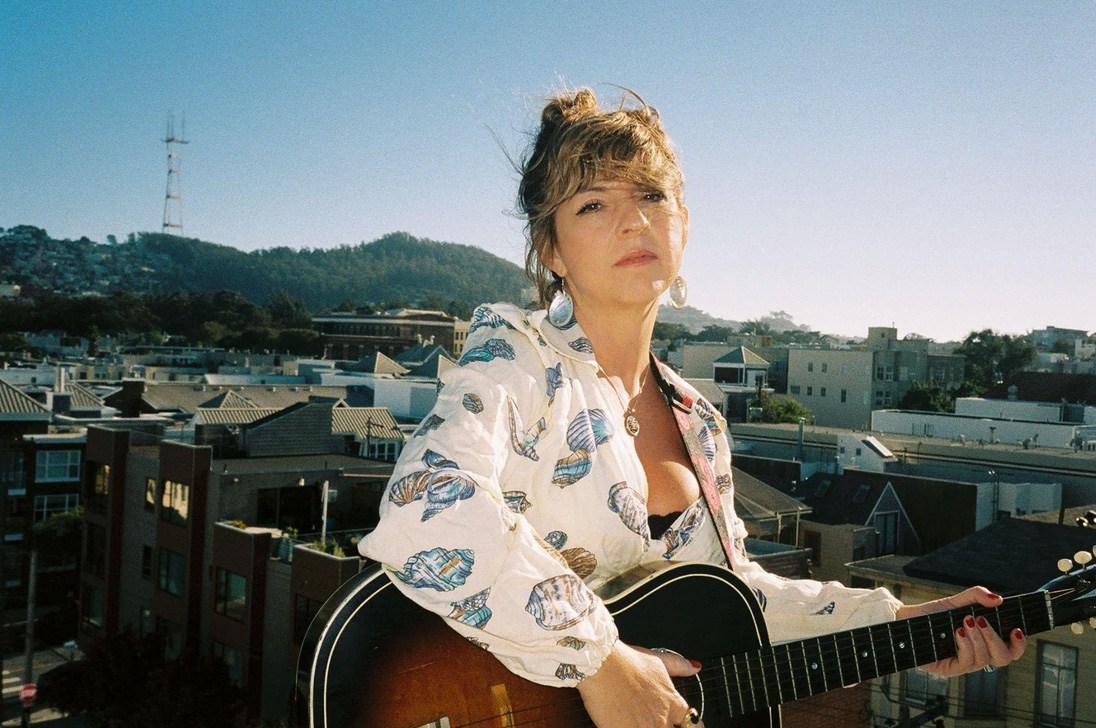
It’s not that Mikaela Davis defies expectations, it’s that she doesn’t countenance them.
Davis prefers to trust in the muse and her own instincts, which have propelled her forward, garnering the artist both critical approbation and public admiration.


This ethos has reached its creative apogee with her new album, Graceland Way.
It all began with Davis’ initial approach to the record, her second on the Kill Rock Stars label after 2023’s And Southern Star, which followed the 2018 Rounder release, Delivery.
“Usually when I’m going into the studio with a new album, all the songs are finished,” she explains. “The world of the album is clear, and I already know generally what I want it to sound like. But this was completely different from anything I’ve ever done.
“We started recording the album when there were only like four songs ready to go. Then while we were recording, I was continuing to write and finish songs. On some of the songs, we didn’t finish the lyrics until I was recording vocals. So it was really throw and go. It started off not being very precious. I didn’t know what was going to happen, which is a really great way to approach things.”
This manifested itself in a multihued palette of tinctures and tones. Davis says, “It’s a little bit alternative. It’s a little bit country. It’s like boot gaze—shoegaze for cowboys.”
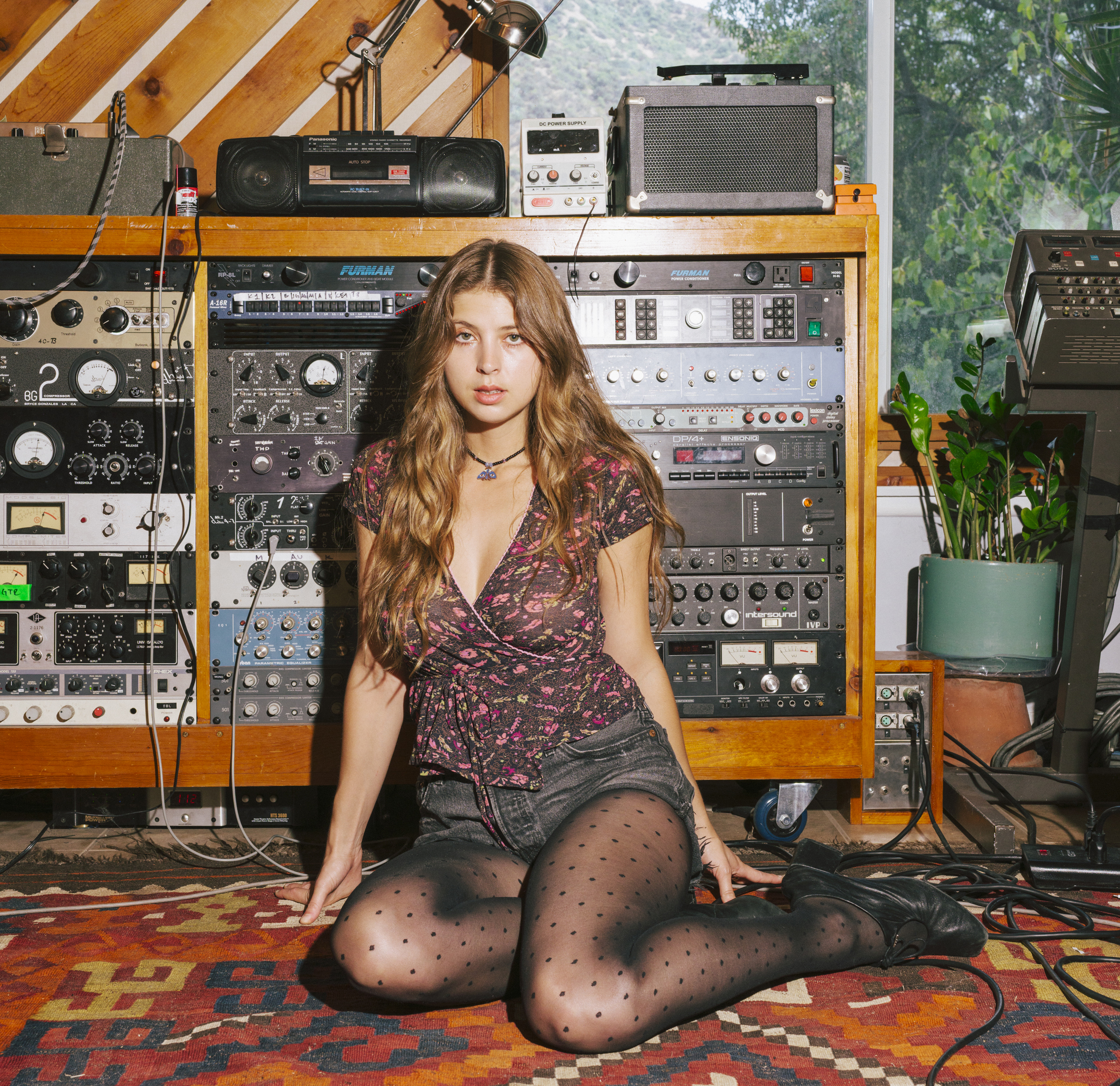
She also characterizes Graceland Way as “canyon country,” referencing the locale where the project came together. Davis and guitarist John Lee Shannon, who are based in upstate New York, traversed the country to record at the home studio of their Grateful Shred bandmate Dan Horne, which is located on Graceland Way within the Chevy Chase Canyon section of Southern California.
Photo: Matthew Reamer
“My good friend Dan, who produced this album along with me and John, had been telling me for some time, ‘You’ve got to make your next record at my studio.’ He would bring it up a lot,” Davis indicates, “Then at some point I was like, ‘Well, if you’re excited about the music, that’s all I need. I want to work with someone who’s excited to work with me.’ Again, I didn’t really come into it at the beginning with a clear concept or an idea. John and I went out there and we’re all good friends, so Dan essentially let us live at his house and write an album there, then record it whenever we had time.” Looking back on the process, she recalls that the absorbing “11:11” was one of the initial songs she completed. Davis remarks, “That’s one of my favorite songs on the album. To me it’s almost like a lullaby and is very melody-driven. I really wanted to add some new elements into my songs. We added some fuzz guitar to that one because I thought the juxtaposition of harp and fuzz guitar sounded really interesting, having it feel like a beautiful shoegaze situation.”
As she ruminates on the development of this track, Davis points to one of the defining sonic elements that she weaves into the fabric of her work—her principal instrument, which is the harp. She began playing it at age 8 and received a formal harp degree from the Crane School of Music in 2014. However, even if the scale of the instrument and its rarity outside of classical circles can render it an immediate source of curiosity, Davis has always approached the harp as just another color that she’s able to introduce. What’s more, by this point in her career, the instrument itself has become less of a talking point. To Davis’ steady listeners, the harp is almost ancillary to the totality of music it inhabits.
“The harp is such an interesting instrument because it’s chordal like a piano, so I can play chords and be playing a melody on top of it at the same time and can play rhythm, but it’s also plucked like a guitar,” she observes. “So there’s this really cool texture that’s not really in pop music, although I think it should be. It really lends itself well to being in this situation, even though it’s a classical instrument. It’s this cool texture that blends everything together really well.”
Davis then points to the myriad of ways she utilizes the harp on the new album. “With songs like ‘Junk Love’ or ‘Starlight Tonight,’ it’s playing the riff and it’s more upfront,” she says, “but sometimes it’s also just textural, playing the chords, and it’s like a rhythm instrument. So it can be the main instrument playing the solo—like the solo in ‘Wild Flower,’ where harp and pedal steel are doubling that solo—but then it can also just be in the background playing the chords.
“I look at it as just like any other person might think of what they’re going to write for the keyboard part or what the guitar part is going to be. The interplay between harp and guitar is pretty apparent on this record. John and I had a lot of fun creating those parts and how they fit together. We’re never just playing the same thing. It actually came really easily when we were writing those parts. It just made sense, so that was fun.”
Her songwriting collaboration with Shannon is notable, as they worked together on most every composition, then co-produced with Horne to craft an expansive aural environment that by turns can feel atmospheric, lush, pastoral or insistent. The new record also is a product of the pair’s personal relationship, as Davis recently wrote on the occasion of Shannon’s birthday: “We made Graceland Way together! He rode the highest wave and followed me into the riptide without hesitation! John is simply the best there is, my anchor. Collaborating artistically with your partner is one of the most rewarding and intimate acts on this planet. Creating something tangible, organizing sound together, what a life! May we continue to build this castle brick by brick forever and ever.”
Photo: Matthew Reamer
Davis names Tom Petty and Sheryl Crow as vocal touchpoints on the album. “I was just going for it and trying to make it sound as best as I could,” she offers. “I think that over the years, I’ve figured out how I want to present myself. There’s a thing that’s happened over the past decade where it’s become popular to sing very sweetly and have these beautiful, more low-key folk songs. But I feel like my voice is stronger than it has ever been and I wanted to sound as strong and powerful as possible, particularly on those fun rock-and-roll songs, where there are major keys and riffs.”
Graceland Way also embraces Davis’ proclivity for exploring new spaces, which the listener can discover over the course of the record. For instance, the second-to-last track, “Spring Petals In The Snow,” introduces an accordion ensemble, courtesy of James Felice. Davis notes, “He’s a good friend of mine, who’s in the Felice Brothers, another band in the Hudson Valley. I’ve done a few things with James and for ‘Spring Petals in the Snow,’ it was originally just piano and voice. I wanted to add another element to it, maybe even something jarring. So I asked him if he wanted to record accordion and I didn’t give him any direction. Then he sent it back to me and he was like, ‘I kind of created an accordion choir on the song. If you don’t want to use all of it, just pick and choose whatever you want.’ I used the whole choir, which I thought was cool. It added to the emotion of the song and made it feel really moving. It was exactly what I envisioned without knowing what that was going to be.”
Davis welcomed some additional voices as well. Madison Cunningham appears on “(Looking Through) Rose Colored Glasses,” which opens the album and was one of the earliest completed tracks, along with “11:11,” helping to set the tone for all that followed.
“I wanted ‘Rose Colored Glasses’ to have a prominent duet,” Davis details. “In my mind, it was like a Gram Parsons-Emmylou Harris situation. I wanted the duet to be a strong female voice, and I thought of Madison. I’m a huge fan. I love every record she’s ever put out. We’d been internet friends for a while, but we’d never met. She came over to Dan’s studio and recorded when we were all there. It was so fun to work with her on that. She just knocked it out of the park.”
“Wild Flower” is a co-write with a newer companion. “I saw Núria Graham play a show in New York City. I really loved her music, but I didn’t know her at all,” Davis says. “I reached out and asked if she wanted to write something together. So she took the train up from New York. I picked her up from the train station and she spent the weekend at my place. We wrote a couple songs together and had a blast. ‘Wild Flower’ is one of those songs and it’s another favorite of mine.”
Wednesday vocalist Karly Hartzman appears on “Junk Love,” which presents a series of confectionery metaphors. Davis really leans into it as she sings: “You’re a jawbreaker yeah you’re red hot baby/ Melt me like the rays of the sun/ Cinnamon sugar in the afternoon (uh-huh).” She explains, “It’s like a true pop song. I didn’t know if I could pull it off. People sometimes will ask me, ‘Why are you going in this different direction? Are you trying to write pop songs now? Are you trying to bring in a new audience?’ But I like popular music, so none of that applies to me. When John and I wrote it, I was obsessed with that song, but I didn’t know if I could pull it off. I was a little worried that maybe I would sound ridiculous singing it, even though I really liked it.
“We added drums last. We had worked it up with the drum machine and then our friend Josh Adams came in to play. I remember showing him the song and being like, ‘Yeah, this song is silly but I think it’s cool. Let’s see what happens.” He’s one of those drum players who is just a metronome and as soon as he laid down the drums that’s when everything clicked. Later on, we added those responses where I say, ‘There she goes again,’ and I added a ‘Fuck yeah’ in there because I wanted to have an explicit track on the album, which was kind of a callback to Britney Spears when she would do that sort of thing in her songs way back in the day. That’s what I remember on the radio.”
Speaking of the medium, Davis decries its current state via “Nothin’s On The Radio.” She expounds, “I started writing that song when I was driving across the country by myself to start a tour. I drove through the craziest storm ever, where snow was blowing sideways and I couldn’t see anything all the way to Arizona, where it was 90 degrees. As I went through all of that driving across the country, I was listening to a lot of Tom Petty. Then I just got this melody and this riff in my head, which is how that song started. I had different holding lyrics, but once I got to California, John and I finished that song together.
“We both grew up at the very end of the Golden Age of Radio. So it became this song about how radio’s so different now. Everything is bought up by these few really large companies and they’re pumping whatever artists that will line their pockets. It’s harder to find stations that are playing the freaks and the weirdos making experimental new music. When I was growing up, I got to hear Fiona Apple on the radio and discover her, along with other artists who were a big inspiration for where I am today. I was born in ’92, while John was born in 1985, so he really remembers that side of radio more than I do.”
Even though “Nothin’s on the Radio” evokes a specific theme, Davis’s artistic sensibility deters her from ascribing singular messages to any composition. “Why is it up to the artist to have this very specific concept of what their art or song is about? A lot of times it’s just coming to you from another fricking dimension or something you don’t even know. It was just given to you,” she opines. “I’ll go back and listen to songs I wrote 10 years ago and say, ‘It’s crazy that I wrote this song about something else, but now I hear this song and I relate it to my life in a completely different way.’ I think that’s what makes a song really great.”
Then she adds, “I heard this interview where somebody asked Robert Hunter what ‘Dark Star’ is about, and he just recited all the lyrics, then said, ‘What’s so difficult to understand there?’ I think that’s the best response ever, because those lyrics are very abstract and very descriptive and maybe you don’t know what the heck is going on there, but also maybe he doesn’t know either. That’s the beauty of songwriting.”
Photo: Matthew Reamer
Her reference to Robert Hunter prompts an inquiry as to the impact of the Grateful Dead on her songwriting. Davis has immersed herself in the catalog via Grateful Shred, and she originally tapped into the source when she appeared with Bobby Weir & Wolf Bros in 2018 and Phil Lesh & Friends in 2022.
“After learning the songbook of the Grateful Dead, it totally changed me. It altered the way I look at songwriting and lyrics,” she reveals. “I couldn’t tell you specifically what inspired me in any specific song because since learning this music and playing with Bob and Phil, they’ve become my favorite band. The music is just so deep and incredible. I really consider the songbook of the Grateful Dead to be a book of standards. There’s the Real Book for jazz players, and then there’s the songbook of the Grateful Dead for songwriters.
“I love that music and it’s definitely changed the way I look at incorporating ideas into my live shows. I mean, Phil loved classical music. When my bass player, Shane [McCarthy] met Phil once, he asked, ‘What should I listen to so that I can get better at the bass?’ Phil said, ‘Beethoven,’ which is so interesting. I mean Jerry came from this bluegrass world and I consider them to be more jazz than anything. While I was trained as a classical harpist, I relate it more to jazz. I’m still learning how to improvise on the harp. I still have no idea what I’m doing with that. I want to get better at improvising and learning how to play jazz on the harp, which is pretty hard because the harp is not a chromatic instrument.”
She recalls a discussion with Don Was prior to her 2018 appearance with Wolf Bros: “I told him that I had not improvised much at all on the harp and he just laughed and said, ‘Well, just remember you’re only ever a half step away from the right note.’ I thought that was pretty funny.”
Davis maintains an affinity for the live experience and continues to hone her approach in that setting. However, unlike And Southern Star, which featured her touring band, the new album is a discrete creative statement that she anticipates will generate new forms of expression over the months to come.
“I wanted to try something different and record this album out in California, which was really special,” Davis says. “I love the state and it’s so inspiring. Actually, a lot of people told me And Southern Star sounded like a California album, which kind of planted the seed. I would have loved to have the boys who play with me on tour recording with me, but the way this album came together really didn’t allow for that. Alex, my drummer, just had a baby and everyone’s so far away. John will be playing with me on the road, and Kurt [G. Johnson] who played a bit of pedal steel and guitar is the other member on some of these songs. But I’m really excited about how it turned out, and it’s just going to be really cool to see how these guys interpret the songs differently.
“It’s funny to think about this studio session and how these songs were all so new. I didn’t even know how to play them when I recorded them. So I’m excited to go into a tour with the band learning these songs along with me to see where that takes us. I know for a fact that from the first show of the tour to the last show of the tour, the show is going to be extremely different. Already from the one show we played in April, which was the first time we played most of these songs live, I’ve had all these ideas of what we could do differently next time. I’m really excited to see where that takes us.”
Although Graceland Way was named for the street on which it was recorded, the term carries associations with the longtime home of Elvis Presley as well as Paul Simon’s heralded 1986 album. However, as it applies to Mikaela Davis, the title may be best thought of as a process of nimble musical engagement and active curiosity.
As Davis characterizes the album’s narrative throughline, her words also properly encapsulate the process of creating the record and then sharing it with the world. “When I was putting together the track sequencing I realized that the needle threading through all of these songs creates this story of an anti-hero, who’s finding their way through life,” she reflects. “Then at the very end, you kind of realize that where they’re going isn’t a place at all, it’s just a state of mind. That relates to a lot of things, because you should aim to walk through life with grace. Everyone finds their own path, their own way.”