photo: JL Neveu
***
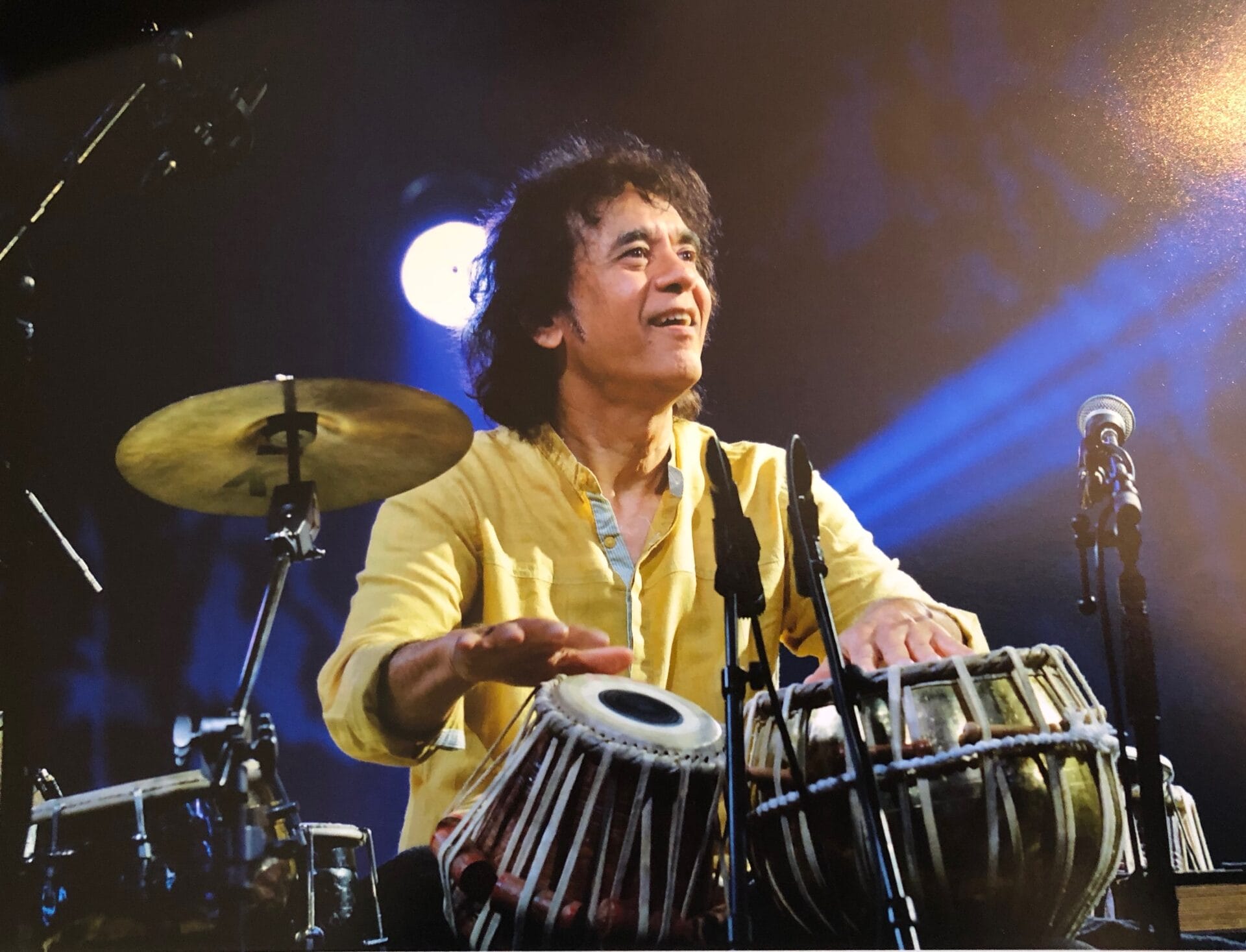
On Friday, March 6 an extraordinary assembly of musicians will gather at Carnegie Hall to honor the life and legacy of a remarkable artist. This singular figure is Zakir Hussain, the tabla maestro and cultural emissary whose work spanned genres and generations. Zakir Hussain Eternal: Celebrating 75 Years of Genius will pay tribute to the beloved Mumbai-born citizen of the globe, who passed away in December 2024.
“There will never be another Zakir. He's that special. He is the wonder of the rhythmic world,” declares Mickey Hart, who first met the percussionist in 1969, though Hussain’s father the renowned artist and educator Alla Rakha. Hart and Hussain would go on achieve collective acclaim through projects such as the Diga Rhythm Band and Planet Drum, which won the first-ever Grammy for Best Global Music Album.
“He was a cut above everybody and he wasn't just a musical hero,” Béla Fleck adds. “People who didn't even know that much about music knew about Zakir. He was like the Michael Jordan of the tabla. A lot of people who didn't check out basketball checked out Michael Jordan because he was so dynamic and amazing. Zakir was like that. He brought a lot of people to the music just by his sheer personality and class.”
Fleck had admired Hussain for a many years before he and Edgar Meyer collaborated with the percussionist on a triple concerto commissioned for the 2006 opening of the Nashville Symphony’s Schermerhorn Center. In February 2024, Hussain accepted two Grammys (Best Global Music Performance and Best Contemporary Instrumental Album) for As We Speak, the trio’s collaboration with flautist Rakesh Chaurasia, on the same occasion that This Moment, the final Shakti studio record, representing his longtime partnership with guitarist John McLaughlin, was named Best Global Music Album.
Zakir Hussain Eternal, which will take place a few days prior to the 75th anniversary of his birth, will commemorate the remarkable artist via performances by Hart, Fleck, Meyer, Charles Lloyd, Fazal Qureshi, V. Selvaganesh, Kala Ramnath, Jayanthi Kumaresh, Vijay Iyer, Marvin Sewell, Eric Harland, Nitin Mitta, Alam Khan, Harish Raghavan, Anantha R. Krishnan, Gerald Clayton, Marcus Gilmore, Swami Selvaganesh, Tessa Lark, Joshua Roman, Sikiru Adepoju and the Zakir Hussain Tabla Choir.
“My God, what a evening it’s going to be!” Hart proclaims. “There are going to be a lot of people there who are the best at what they do. Béla Fleck, who’s played with Zakir Hussain for many years and knows Zakir's music, will be playing with me in ensemble, as well as his own performance. Then there's Charles Lloyd, Zakir’s brother Fazal, Eric Harland, Marcus Gilmore, Edgar Meyer, and all kinds of wonderful, people from India and America, coming together. It’s going to be a once in a lifetime kind of night.”
**
Mickey Hart: Zakir and I became brothers of the groove. We were kind of thrown together and we became friends and fellow groovists, if you will. We liked each other from the very start when he came into my life back in 1969. Of course he's the premier rhythmist on the planet, so there’s that. It was a kind of a stunning meeting.
He was the son of my teacher Alla Rakha. Zakir and I met through his amazing father. One day he walked up to the barn, knocked on the door and said, "I am here to play. My name is Zakir.” I said, “I know who you are,” because his father said he was going to send him to me.
Remember, the tabla is one of the quietest of the percussion instruments, and not compatible with a drum set. Alla Rakha was from a different generation, so we couldn't really play together, but he said, "My son could play with you." Then some months later, Zakir showed up.
We got along so well together. I loved him. Being the son of Alla Rakha he rose to a prodigy status. He became a maestro, a master, a rhythm master supreme extraordinaire.
He wanted to get funky and I wanted to learn accuracy and rhythmic dexterity and to find the amazing places that rhythm can be found, performed, and understood at a high level.
Both Alla Rakha and Zakir eventually played on my first solo record, Rolling Thunder. They played with the rhythm of the rain on the roof to a beautiful teentaal.
Jerry and Zakir got along really well because Zakir understood Jerry’s advanced rhythm and vice versa. Jerry understood the brilliance of Zakir. The two of them smiled at each other rhythmically speaking. A lot of great stuff that worked its way into the Grateful Dead, like “The Eleven,” “Playing in the Band” and “Estimated Prophet,” all of these odd rhythms, were spawned from my meeting Alla Rakha and Zakir Hussain.
It was really astounding watching him perform over the years, knowing him since he was like 17. In some ways he surpassed Alla Rakha because he was young and he was listening to rock-and-roll and he became exposed to Western music and funk and all of that stuff.
Béla Fleck: The first thing I heard with Zakir was Shakti. Shakti had a big impact on certain bluegrass musicians, one of them being Sam Bush. I was already very aware of Shakti but when I was in New Grass Revival with Sam, he was a huge Shakti fan, so I became one too. I was already a big John McLaughlin fan with Mahavishnu, although I leaned a little heavier towards the Chick Corea side of fusion at that time with Romantic Warrior [Corea’s 1976 album with Return to Forever]. As for Shakti and the Indian stuff, like a lot of bluegrass people, I could relate to it because of the rhythm and the technique. So that was my first thing.
Later on, being out with the Flecktones, we would occasionally see Zakir at a festival like WOMAD. I remember we were on a workshop together where Future Man and Zakir did something, but I couldn't tell whether he was aware of who we were or just doing his job at the workshop.
Some years after that, Edgar Meyer and I were invited to write a piece for the Nashville Symphony’s brand new hall they were building, because they wanted local composers to christen the Schermerhorn Center with a new piece. We had just done a banjo bass concerto, a double concerto. So when they came to us, they said, "Why don't you do another one?" We said, "We don't want to do that again. We just did it like two years ago." Then they said, "What about a triple concerto?"
So Edgar and I came up with a list of possible people to do a triple concerto with and Zakir was on the top our list. We were both interested in Zakir because we felt we could learn things from him that we couldn't learn from anybody else. So we went after Zakir and basically begged him to consider writing a piece with us.
Zakir really didn't know us but he decided he would do it, and we were very happy to be working with him.
Then when we started getting together and writing for it, we discovered he was so much more than a percussionist because he had musical solutions to any question we had. I remember early on, there was this thing we had in seven and we had like nine beats left and we couldn't figure out the melody to finish this idea. So Edgar said, "Let’s see what Zakir thinks." He explained the situation to Zakir and it was almost like asking AI where you might say, "Here's the scenario, this is what we need. It needs to be this long. It needs to be do this…” and then AI spits it out. Well that's what Zakir did. He spit out an answer so fast it was almost like he couldn't have thought about it.
Edgar and I looked at each other because typically we take weeks to mull over ideas and Edgar said, "I can't imagine a better solution than that." I agreed with him, so I turned to Zakir and said, "Okay, I guess you're the lead writer now, pal." [Laughs.] But he did that over and over again.
Béla Fleck, Zakir Hussain, and Edgar Meyer (photo: Jim McGuire)
With The Melody of Rhythm, we decided that the idea was we were going to work with these Indian rhythmic compositions that have hints of melody in them but were not always things that could be sung. Edgar and I thought it would be cool if we got some great compositions from Zakir, then we wrote musical compositions based on the pitches that seemed to be implied by what he played.
I can remember when Edgar asked Zakir, “Can you play us a composition in 11?" Zakir did it and after that first one, Edgar was like, "Perfect. That's all we need." But I knew enough about Zakir to realize that he had an incredible depth of compositions either memorized or that he could make up spontaneously. So I asked for something else, at which point he gave us five more off the top of his head—compositions that were all in 11 that broke up differently, with a completely different math in them. It was the most elegant, simple, perfect solution you could think of and none of us could have thought of it.
Hart: He saw himself as a student. We both did—always have been, always will be. I'm constantly scanning for new rhythms and falling back in love with the old ones and always in some kind of a groove. We're rhythmists and we live for that. It’s what made Zakir grow stronger and more brilliant. So we were students, but he was also a rhythm master.
The people who know the most brag the least. He's always was humble, self-effacing and all that kind of stuff.
Fleck: It started with his excellent technique because he could fall in with anybody. He brought something that was very easy to interact with because his technique was so perfect, his rhythm was so solid and he could go in any direction.
He was also fun to be around. That's a great piece of collaborating with people. If you find somebody that's really a pleasure to be with, you want to be around them some more.
Zakir was also very relaxed. Chick Corea was like that as well. I was talking to Edgar Meyer, and I said, "I don't think I've ever met a genius improviser who was tense." Chick and Zakir shared that relaxed quality.
Zakir was so easygoing where we’d be in a conversation and he’d say, "All right guys,” moving the conversation onto the stage where it became a musical conversation. It was just very relaxed, and that fosters an environment where you feel free.
It was such a sunny experience. There was never a negative energy. It was always positive, always sweet. He was a problem solver. If you had a problem, he would say, "Call this guy. This is the guy who knows the answer." Zakir would drive to meet you and he would do anything for you.
He considered his job as an accompanist to be sacred and his main objective was that the soloist would be able to play well.
Of course he also knew he needed to kick ass too, and he enjoyed kicking ass. It wasn't that he minded blowing everybody's mind, it just wasn't at the top of his list.
Sometimes he'd be like, "I don't have to do the solo at the end." I was like, "Come on, Zakir, how could we not end the show with the coolest thing we can offer, which is you playing solo."
He enjoyed it. I wouldn't say he was egoless, none of us are, but he had a healthy balance. He knew when it was time to kick butt and show off, and he knew when it was time to support.
One of the things we would do near the end of the set was a song that featured the tabla because nothing could follow that. If time was running out and his big tabla solo was about to come, he would kind of look at me, “How much time have I got?” I'd look at the clock and flash it real quick—“Three and a half minutes” or whatever it was. He'd nod and then he would burn the house down for exactly three and a half minutes, landing the piece seconds before the curfew. So his sense of time, not just in terms of his beat or his rhythm, included his sense of the clock and how long a minute was, no matter how he was playing.
Giovanni Hidalgo, Zakir Hussain, Mickey Hart, Sikiru Adepoju (Photo credit: Jay Blakesberg)
Hart: Friendship is a really important part of the music. When you play with a friend there’s this mutual trust between each of you in the groove. That friendship fosters great music and we had such a friendship.
There was this slight, little one-upmanship in the kindest, gentlest, most loving way. If we were overdubbing, he would go out there and do something, then I'd go out there and do something where we’d go back and forth trying to amaze each other or uplift each other in the groove.
We always tried to make each other sound good. Zakir had the ability to blow anybody off the stage with his rhythmic dexterity, no matter who it was, but for the most part, he didn't. He never competed with me. If he did, it would completely consume me or anybody else.
He had that grace about him, that love about him, so he would never do that. He always made anybody he played with sound good. As someone who held such a supreme position in the rhythmic world, he was very graceful and gracious.
Fleck: He was such a warm person, always trying to be helpful and that goes into the music because he was one of the great accompanists of all time.
When he supported a soloist, he knew exactly how much to do. He could blind you with science if he wanted to. He could have taken you down where you became a puddle on the floor unable to play if that was the kind of person he was, but he wasn't.
He could always figure out exactly how much you needed to play at your best. For me, there were certain things I was very comfortable with rhythmically and he knew how to support them and push me to do just a little bit better than I normally could.
There are only a few other great accompanists like that. I think of Tony Rice in bluegrass, where everybody played better when they played with him. Another one was Toumani Diabaté. When I toured with him as a duo, he was also a spectacular accompanist, maybe even better than a soloist. Victor Wooten is an unbelievable accompanist. He listens and he doesn't try to derail. He's always involved in the conversation.
Zakir could create a bed for you to lie in as a soloist that was percolating and buzzing and full of energy. It was like a magic carpet ride. Once it started and you were playing with him and you were really focused on each other, you could go anywhere. It was completely borderless and his listening was so spectacular.
As a banjo player, I'm very much of a percussionist—like a pitched percussion instrumentalist in a way because the banjo has such sharp rhythmic attack. So if I can connect with a drummer or a rhythm player on the 16th notes, my life gets really, really simple and I don't have to think about the basics. I can go up to the stratosphere, but if we're struggling on those basics, then I have a hard time and I have to play more simply.
With Zakir, that was way out of the conversation. He had such rhythmic precision and was so far past the basics that we could go to the moon rhythmically.
Hart: With the Diga Rhythm Band it was Zakir’s idea to take the tablas and voice them as you would in a chord, like the root, the third, the fifth, the seventh, whatever the chord might be. So all of the tablas had different notes. They were playing a chord in unison at rapid speeds. I don't think that was ever done before using these very delicate instruments, but using them in a Western sense as in a chord.
So Diga was great love. It was our first rhythm band. That was what we first put together and what led to Planet Drum in 1990 when we assembled with Babatunde Olatunji, Airto Moreira, Vikku [Vinayakram], Flora Purim and Giovanni Hidalgo.
I remember the first time we played Carnegie Hall with Planet Drum [in 1991]. We had played across the country starting on the West Coast and winding up in Carnegie Hall. The night was amazing. I mean, the whole place was moving and I was worried for the balconies. As this was happening, I remember thinking, "Oh my God, this is it for Carnegie Hall." But it lasted through what was a really inspired performance.
I remember that night well, not just because of the performance but because I went up to the dressing room afterward where everybody was celebrating and I heard somebody crying. I looked around then I went to the corner where the crying was coming from and it was my mother. I went up to her and said, "Mom, what are you doing?" She said, "Oh, I'm so proud of you. " I said, "Mom, you can't cry here. Get a grip. I just finished playing nine nights at Madison Square Garden. Get a grip, mom, it's okay.” [Laughs.] To her, playing Carnegie Hall was it, because she was from another generation. I do remember the night, because we were at our best, we finished off really strong, and that was one hell of a band.
Fleck: Zakir treated partners and parents with a special kind of warmth. He was so nice to my mom and my family when they showed up. He treated them like family and it was just very cool.
Edgar and his family, we all went to India and Zakir was actually willing to take us out on the street. He said, "Come on, we're going to go for a walk." So we all get out of the hotel and we're walking down the street and at first a couple of people start to go, "Oh, look, there's Zakir!" They begin to follow us and pretty soon there's 10 people following us. Then there's 30, 40, 50, 60, 100 people following us. They're all reaching down and touching his toes out of respect because of what they think they about him.
I also had that experience with Oumou Sangaré in Mali walking through a bazaar downtown. She agreed to do that and we filmed it [for his 2008 documentary Throw Down Your Heart.] It started with just the two of us walking and pretty soon there was a whole village walking. Those are the two people I had that experience with.
Especially after Ravi Shankar passed, I think Zakir was the most beloved Indian musician. He was something else.
Hart: We were outlaws in the studio. We did things that were not done in the normal recording process and he was amazed at the freedom of it. We were all smoking pot and he was totally straight—Zakir didn’t drink, didn't smoke. So he was around a bunch of stoned hippies going crazy in the groove, and he loved it. He wanted freedom. Indian music is very strict. The way they play it has been totally locked in for centuries.
I think he wanted to break loose and get loose. He was young and he knew all of the classical Indian rhythms inside and out. I had a feeling that he was looking for adventure in his world, and he certainly found it. When he came here, we were on the edge of everything and we did it anytime, day or night.
We once stayed up playing for four days and nights. We went through what we called baptismal de Fuego—baptismal fire. You learn a lot about a person when you play with them for four days and nights. We went through all of these challenges which we set for ourselves, and we bonded as rhythmists.
Zakir was the man of order, I'm the man of chaos. Together we loved each other and we played together and that was our relationship. He loved my chaos and I loved his order. It was just one of those pairings, one of those meetings in life where we would have loved each other even if we didn't play together.
He was one of my best friends for all these years, and it'll be a deep, deep honor to be playing this night in honor of his greatness and his life, which was filled with beauty, grace and powerful rhythmic statements that moved millions of people.