39th Annual Tibet House US Benefit Concert Unites Elvis Costello, Kate Pierson, Allison Russell, Laurie Anderson and Many More at Carnegie Hall (A Gallery + Recap)
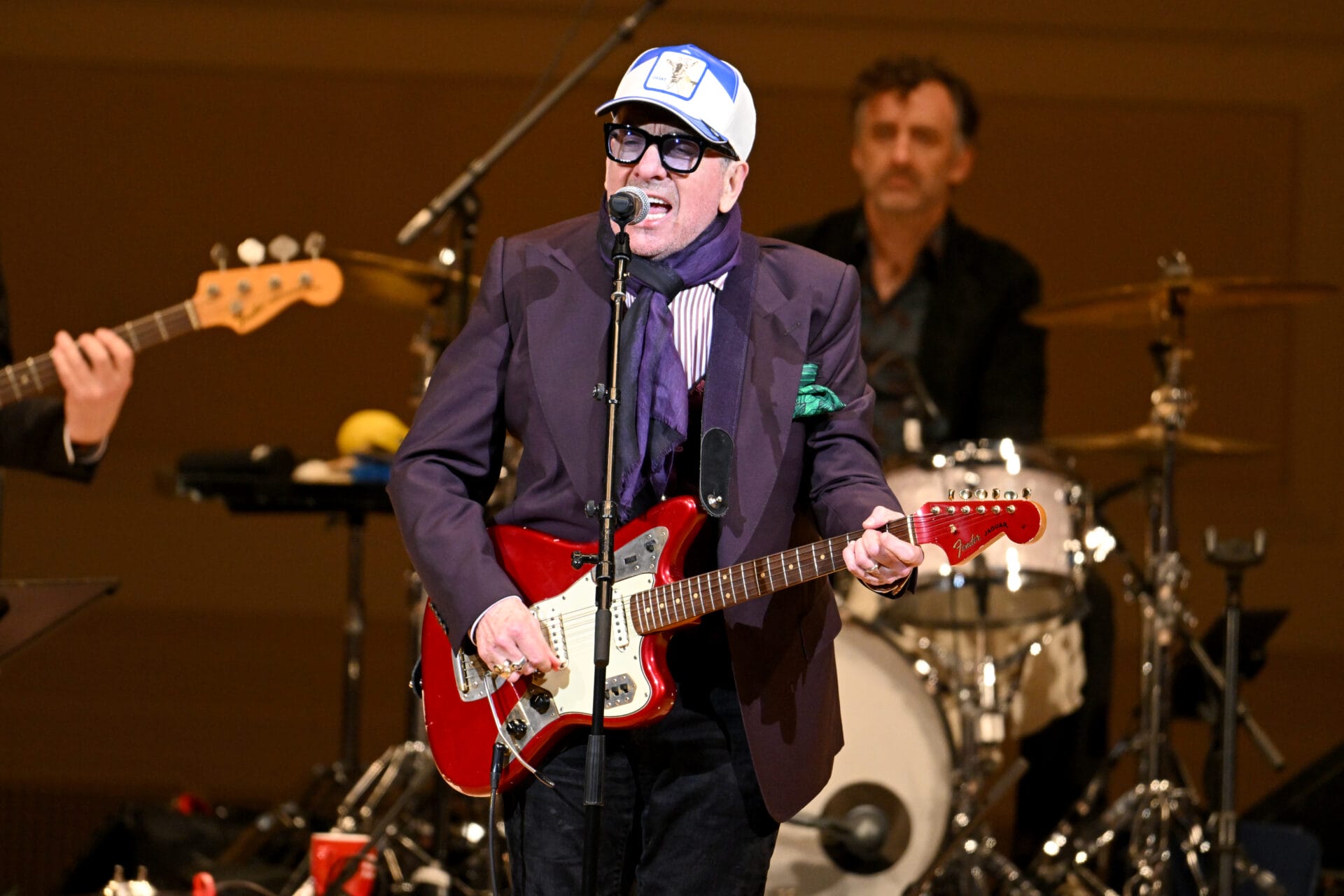
NEW YORK, NEW YORK – MARCH 03: (FOR EDITORIAL USE ONLY) Elvis Costello performs onstage during the 39th Annual Tibet House US Benefit Concert at Carnegie Hall on March 03, 2026 in New York City. (Photo by Noam Galai/Getty Images for Tibet House US)
On Tuesday, March 3, Tibet House US returned to New York’s Carnegie Hall to present its 39th Annual Benefit Concert. In the historic Stern Auditorium, the cultural advocacy organization observed the Tibetan Lunar New Year with a spiritual successor to the 617-year Tibetan tradition of Great Prayer Festivals, uniting an ensemble of high-profile performers spanning genres and generations to usher in the Year of the Fire Horse.
The 2026 Tibet House US Benefit Concert commenced with the customary invocation from the Drepung Gomang Monks, whose resonant chants and brightly rattling hand percussion stalled the rhythms of the city to match those of the body and mind. After a moment of rapt silence, the Philip Glass Ensemble emerged for “Train-Spaceship,” an excerpt from Einstein on the Beach pulsing with tightly wound brass flights pinned between a deep-bass synthesized undercurrent and fluttering soprano vocals. In conversation, the opening acts drew the room into a shared state of contemplation that has always been at the heart of the event.
In January, Glass was one of several high-profile artists to break with the John F. Kennedy Center for the Performing Arts amid Trump’s hostile takeover of the cultural institution; the benefit’s longtime co-Artistic Director (alongside Laurie Anderson) withdrew the premiere of his Symphony No. 15 “Lincoln” for its direct conflict with the “values of the Kennedy Center today.” Recognizing the political salience of Glass’s move, Tuesday’s event redirected the work’s message against authoritarianism today, with a reading from Lincoln’s Lyceum Address by Robert De Niro.
As these immortal words rang out, Tibet House co-founder and scholar Bob Thurman emerged to deliver opening remarks. Beneath a tapestry of the Potola Palace, Thurman spoke to the roots of the evening’s celebration, not in the suffering often misunderstood as the core of Buddhism, but in “the joy of being a live human being in a world in which there is the possibility of enlightenment.”
Thurman’s observation that Tibet House’s commitment to promoting kindness, love and wisdom is well served by artists “who channel their own openheartedness” was embodied by the inimitable Anderson, who emerged wordlessly until her fervent violin bowing bled into the sound of helicopter blades. “I can’t say that I was ready for the war that started this weekend,” she said, then opened up to the cold vision of a world in which “war is simply announced.” Dreamlike and severe harmonies whipped across her classic “Ramon,” accompanied by the house band and The Scorchio Quartet, then faded away as she pounded electronic percussion wired into her clothing and recited her three rules for life drawn up with her late husband Lou Reed: “Don’t be afraid of anybody”; “Get a good bullshit detector and learn how to use it”; and “Be very tender.”
Anderson welcomed a surprise guest appearance from “the President of the United States,” comedian and SNL cast member James Austin Johnson, and the two traded lines on a musical reading of Allen Ginsberg’s “Ballad of the Skeletons.” From this joyful reprieve, Elysian Fields stepped into the spotlight with their signature brand of dark, wilting glitz, with vocalist Jennifer Charles grasping in forceful whispers over Oren Bloedow’s gloaming guitar stabs on “Dream Within a Dream,” then enlisting Anderson’s minute and bold strings for the cooing pop-rock of “Lucid Dreaming.”
Christian Lee Hutson followed this full-band drama with an intimate solo acoustic treatment of an untitled, unfinished song. Hutson writes from a place of comfort in the everydayness of life’s anxieties, and he fills his subjects with such a depth of familiarity that when he sings, “I’ve been you and everyone else,” or “We can handle anything,” every pronoun feels capacious. He was joined just afterwards by his partner and collaborator Maya Hawke, and the newlyweds shared a voice through the cheery rumination of their first live rendition of “Devil You Know.”
Tenzin Choegyal, the Tibetan artist and activist, has brought the sound of the Tibetan nomads to the event for several years, and he spoke passionately on the life and poetry of the 6th Dalai Lama before adapting his final poem in exile, “White Crain,” into a soaring musical expression of love and longing. Whereas last year his invocation of the bodhisattva of compassion, “Snowy Mountains – Gangri,” was accompanied by the voices of The YindaYin Children of Tibet, Choegyal’s latest live rendition of the Glass collaboration featured the Resistance Revival Chorus. Before their rousing performance of Reverend Robert Wesby’s “Woke Up this Morning,” the massive ensemble of women and non-binary vocalists upholding a legacy of freedom singers declared that “peace is active, and there is work to be done.”
Allison Russell took the stage with a soul-stirring outpouring of “Hy-Brasil,” then welcomed her Hadestown castmates Kara Jackson, Morgan Dudley and Ganessa James for a brief treatment of the Tony Award-winning musical’s haunting closing number, “We Raise Our Cups.” Russell was joined by Toro y Moi for a tender duet of The Rolling Stones’ “Wild Horses,” carrying heaviness lightly over the house band’s loping, bluesy arrangement. For his time in the spotlight, Toro y Moi took to the grand piano for an understated adaptation of his recent indie-pop hit “Undercurrent,” which conjured up a moving sense of alienation and endurance, before leading the band through a boisterous take on Paul McCartney’s “Maybe I’m Amazed.”
“This is a crazy time,” Jesse Malin said as he met a roaring welcome from the crowd, “so it’s good to be here with so many people whose hearts are in the right places,” To express his gratitude and focus the audience’s enthusiasm, the singer-songwriter and New York icon offered a reflective and joyful rendition of his Sad And Beautiful World standout “Greener Pastures,” then stood from his wheelchair and brought the audience to its feet with a roaring run through “Meet Me @ the End of the World.”
Joining the program unexpectedly in place of Debbie Harry, Elvis Costello opened with a reinvented cover of Blondie’s “Picture This,” then reflected on the strangeness of opening a show on Saturday just after hearing that war had broken out. “Suddenly we’re in a different world,” he expressed, then matched the moment with “We Are All Cowards Now,” charged by a suppressed panic rarely cracking through the surface until a scornfully aching last passage. During “Which Side Are You On,” Costello paced away from the microphone now and again to strip away any pretense of performance and charged the crowd to put their hands up, before his crooked warble and searing guitar tone raced off into an unrelenting spin on “[What’s So Funny ‘Bout] Peace, Love and Understanding.”
Kate Pierson had the evening's last note with an enchanting version of The B-52s' "Revolution Earth" backed by the Resistance Revival Chorus. To channel the grandeur and poignance of the stacked program into a call to action, she welcomed the full ensemble of performers for the benefit concert's traditional grand finale of Patti Smith's "People Have the Power."
Get an inside look at the 39th Annual Tibet House US Benefit Concert in the photo gallery below from Noam Galai and Ilya Savenok for Getty Images, Courtesy of Tibet House US. To learn more about Tibet House and its mission to preserve Tibetan culture and ensure its future, visit thus.org.
NEW YORK, NEW YORK - MARCH 03: The Drepung Gomang Monks perform onstage during the 39th Annual Tibet House US Benefit Concert at Carnegie Hall on March 03, 2026 in New York City. (Photo by Noam Galai/Getty Images for Tibet House US)NEW YORK, NEW YORK - MARCH 03: The Drepung Gomang Monks perform onstage during the 39th Annual Tibet House US Benefit Concert at Carnegie Hall on March 03, 2026 in New York City. (Photo by Noam Galai/Getty Images for Tibet House US)NEW YORK, NEW YORK - MARCH 03: Robert De Niro speaks onstage during the 39th Annual Tibet House US Benefit Concert at Carnegie Hall on March 03, 2026 in New York City. (Photo by Noam Galai/Getty Images for Tibet House US)NEW YORK, NEW YORK - MARCH 03: Robert De Niro speaks onstage during the 39th Annual Tibet House US Benefit Concert at Carnegie Hall on March 03, 2026 in New York City. (Photo by Noam Galai/Getty Images for Tibet House US)NEW YORK, NEW YORK - MARCH 03: (L-R) Michael Riesman, Andrew Sterman, Sam Sadigursky, Peter Hess, Mick Rossi and Britt Hewitt of Philip Glass Ensemble perform onstage during the 39th Annual Tibet House US Benefit Concert at Carnegie Hall on March 03, 2026 in New York City. (Photo by Noam Galai/Getty Images for Tibet House US)NEW YORK, NEW YORK - MARCH 03: (L-R) Andrew Sterman, Sam Sadigursky and Peter Hess of The Philip Glass Ensemble perform onstage during the 39th Annual Tibet House US Benefit Concert at Carnegie Hall on March 03, 2026 in New York City. (Photo by Noam Galai/Getty Images for Tibet House US)NEW YORK, NEW YORK - MARCH 03: Robert Thurman speaks onstage during the 39th Annual Tibet House US Benefit Concert at Carnegie Hall on March 03, 2026 in New York City. (Photo by Noam Galai/Getty Images for Tibet House US)NEW YORK, NEW YORK - MARCH 03: Laurie Anderson performs onstage during the 39th Annual Tibet House US Benefit Concert at Carnegie Hall on March 03, 2026 in New York City. (Photo by Noam Galai/Getty Images for Tibet House US)NEW YORK, NEW YORK - MARCH 03: Laurie Anderson speaks onstage during the 39th Annual Tibet House US Benefit Concert at Carnegie Hall on March 03, 2026 in New York City. (Photo by Noam Galai/Getty Images for Tibet House US)NEW YORK, NEW YORK - MARCH 03: Laurie Anderson and James Austin Johnson perform onstage during the 39th Annual Tibet House US Benefit Concert at Carnegie Hall on March 03, 2026 in New York City. (Photo by Noam Galai/Getty Images for Tibet House US)NEW YORK, NEW YORK - MARCH 03: (L-R) Lorenza Ponce, Frederika Krier, Leah Coloff and Martha Mooke of The Scorchio Quartet performs onstage during the 39th Annual Tibet House US Benefit Concert at Carnegie Hall on March 03, 2026 in New York City. (Photo by Noam Galai/Getty Images for Tibet House US)NEW YORK, NEW YORK - MARCH 03: (L-R) Lorenza Ponce, Frederika Krier, Leah Coloff and Martha Mooke of The Scorchio Quartet performs onstage during the 39th Annual Tibet House US Benefit Concert at Carnegie Hall on March 03, 2026 in New York City. (Photo by Noam Galai/Getty Images for Tibet House US)NEW YORK, NEW YORK - MARCH 03: Christian Lee Hutson performs onstage during the 39th Annual Tibet House US Benefit Concert at Carnegie Hall on March 03, 2026 in New York City. (Photo by Noam Galai/Getty Images for Tibet House US)NEW YORK, NEW YORK - MARCH 03: Jennifer Charles of Elysian Fields performs onstage during the 39th Annual Tibet House US Benefit Concert at Carnegie Hall on March 03, 2026 in New York City. (Photo by Noam Galai/Getty Images for Tibet House US)NEW YORK, NEW YORK - MARCH 03: Jennifer Charles and Oren Bloedow of Elysian Fields perform onstage during the 39th Annual Tibet House US Benefit Concert at Carnegie Hall on March 03, 2026 in New York City. (Photo by Noam Galai/Getty Images for Tibet House US)NEW YORK, NEW YORK - MARCH 03: Tenzin Choegyal performs onstage during the 39th Annual Tibet House US Benefit Concert at Carnegie Hall on March 03, 2026 in New York City. (Photo by Noam Galai/Getty Images for Tibet House US)NEW YORK, NEW YORK - MARCH 03: Laurie Anderson performs onstage during the 39th Annual Tibet House US Benefit Concert at Carnegie Hall on March 03, 2026 in New York City. (Photo by Noam Galai/Getty Images for Tibet House US)NEW YORK, NEW YORK - MARCH 03: Tenzin Choegyal and Resistance Revival Chorus perform onstage during the 39th Annual Tibet House US Benefit Concert at Carnegie Hall on March 03, 2026 in New York City. (Photo by Noam Galai/Getty Images for Tibet House US)NEW YORK, NEW YORK - MARCH 03: Resistance Revival Chorus performs onstage during the 39th Annual Tibet House US Benefit Concert at Carnegie Hall on March 03, 2026 in New York City. (Photo by Noam Galai/Getty Images for Tibet House US)NEW YORK, NEW YORK - MARCH 03: Resistance Revival Chorus performs onstage during the 39th Annual Tibet House US Benefit Concert at Carnegie Hall on March 03, 2026 in New York City. (Photo by Noam Galai/Getty Images for Tibet House US)NEW YORK, NEW YORK - MARCH 03: Allison Russell performs onstage during the 39th Annual Tibet House US Benefit Concert at Carnegie Hall on March 03, 2026 in New York City. (Photo by Noam Galai/Getty Images for Tibet House US)NEW YORK, NEW YORK - MARCH 03: Allison Russell (C) and Ganessa James (R) perform onstage during the 39th Annual Tibet House US Benefit Concert at Carnegie Hall on March 03, 2026 in New York City. (Photo by Noam Galai/Getty Images for Tibet House US)NEW YORK, NEW YORK - MARCH 03: (L-R) Maya Hawke and Christian Lee Hutson perform onstage during the 39th Annual Tibet House US Benefit Concert at Carnegie Hall on March 03, 2026 in New York City. (Photo by Noam Galai/Getty Images for Tibet House US)NEW YORK, NEW YORK - MARCH 03: Maya Hawke performs onstage during the 39th Annual Tibet House US Benefit Concert at Carnegie Hall on March 03, 2026 in New York City. (Photo by Noam Galai/Getty Images for Tibet House US)NEW YORK, NEW YORK - MARCH 03: Toro y Moi performs onstage during the 39th Annual Tibet House US Benefit Concert at Carnegie Hall on March 03, 2026 in New York City. (Photo by Noam Galai/Getty Images for Tibet House US)NEW YORK, NEW YORK - MARCH 03: Toro y Moi and Allison Russell perform onstage during the 39th Annual Tibet House US Benefit Concert at Carnegie Hall on March 03, 2026 in New York City. (Photo by Noam Galai/Getty Images for Tibet House US)NEW YORK, NEW YORK - MARCH 03: Jesse Malin performs onstage during the 39th Annual Tibet House US Benefit Concert at Carnegie Hall on March 03, 2026 in New York City. (Photo by Noam Galai/Getty Images for Tibet House US)NEW YORK, NEW YORK - MARCH 03: Jesse Malin performs onstage during the 39th Annual Tibet House US Benefit Concert at Carnegie Hall on March 03, 2026 in New York City. (Photo by Noam Galai/Getty Images for Tibet House US)NEW YORK, NEW YORK - MARCH 03: (FOR EDITORIAL USE ONLY) Elvis Costello performs onstage during the 39th Annual Tibet House US Benefit Concert at Carnegie Hall on March 03, 2026 in New York City. (Photo by Noam Galai/Getty Images for Tibet House US)NEW YORK, NEW YORK - MARCH 03: (FOR EDITORIAL USE ONLY) Elvis Costello performs onstage during the 39th Annual Tibet House US Benefit Concert at Carnegie Hall on March 03, 2026 in New York City. (Photo by Noam Galai/Getty Images for Tibet House US)NEW YORK, NEW YORK - MARCH 03: Kate Pierson performs onstage during the 39th Annual Tibet House US Benefit Concert at Carnegie Hall on March 03, 2026 in New York City. (Photo by Noam Galai/Getty Images for Tibet House US)NEW YORK, NEW YORK - MARCH 03: Kate Pierson and The Resistance Revival Chorus performs onstage during the 39th Annual Tibet House US Benefit Concert at Carnegie Hall on March 03, 2026 in New York City. (Photo by Noam Galai/Getty Images for Tibet House US)NEW YORK, NEW YORK - MARCH 03: A view of the finale performance onstage during the 39th Annual Tibet House US Benefit Concert at Carnegie Hall on March 03, 2026 in New York City. (Photo by Noam Galai/Getty Images for Tibet House US)NEW YORK, NEW YORK - MARCH 03: A view of the finale performance onstage during the 39th Annual Tibet House US Benefit Concert at Carnegie Hall on March 03, 2026 in New York City. (Photo by Noam Galai/Getty Images for Tibet House US)NEW YORK, NEW YORK - MARCH 03: Morgan Dudley, Allison Russell, Ganessa James, and Kara Jackson perform onstage during the 39th Annual Tibet House US Benefit Concert at Carnegie Hall on March 03, 2026 in New York City. (Photo by Noam Galai/Getty Images for Tibet House US)