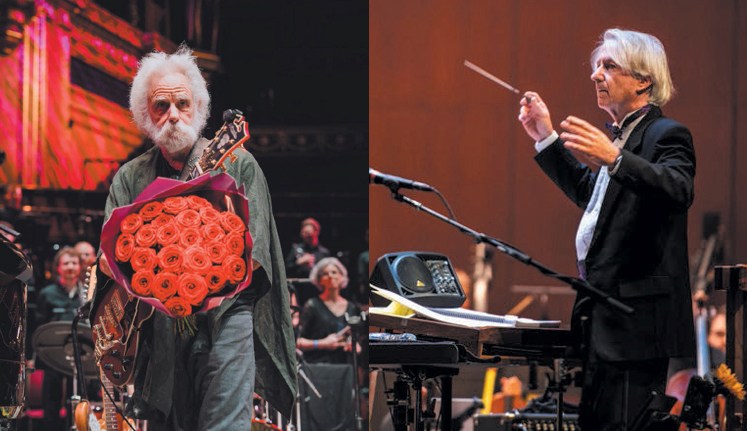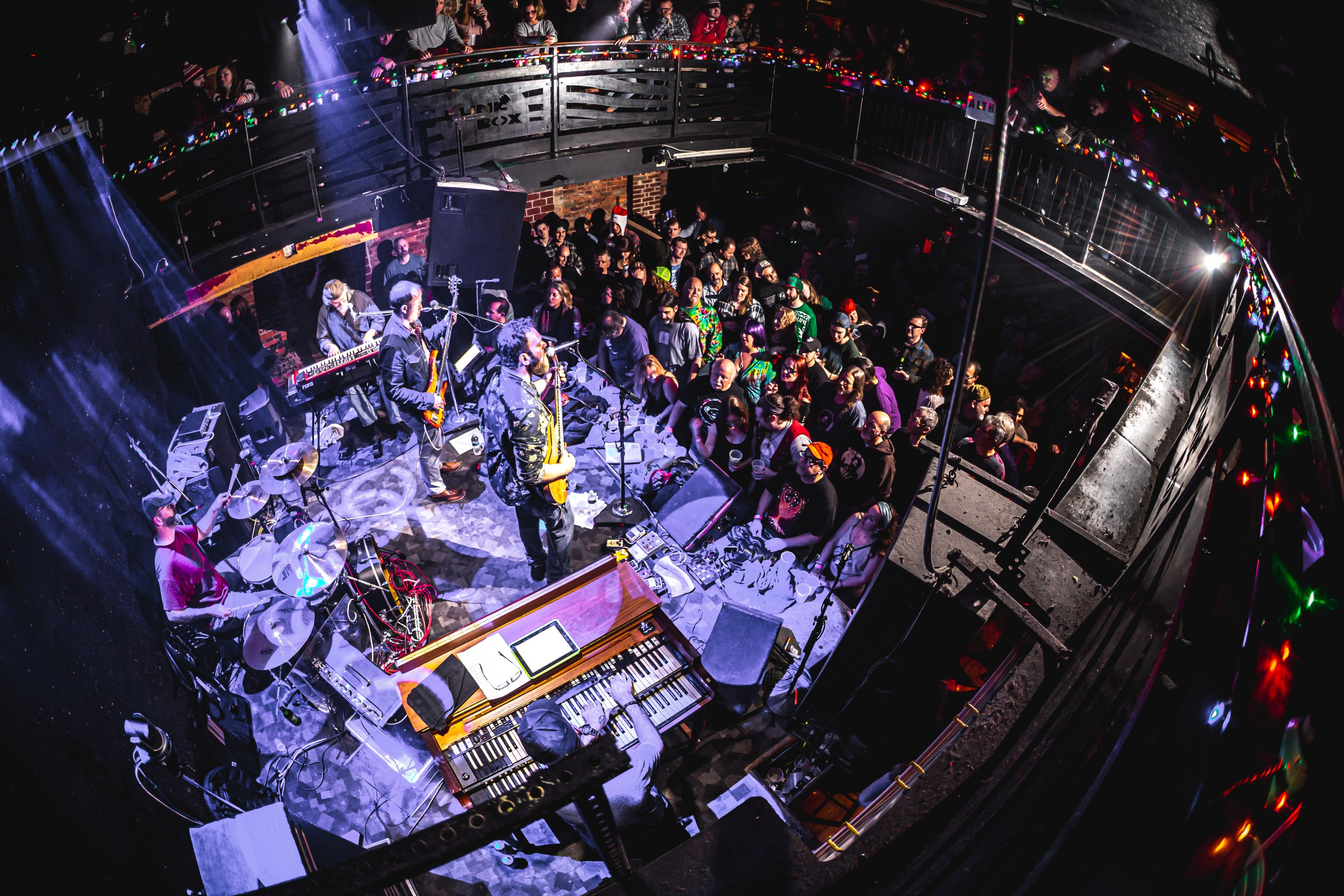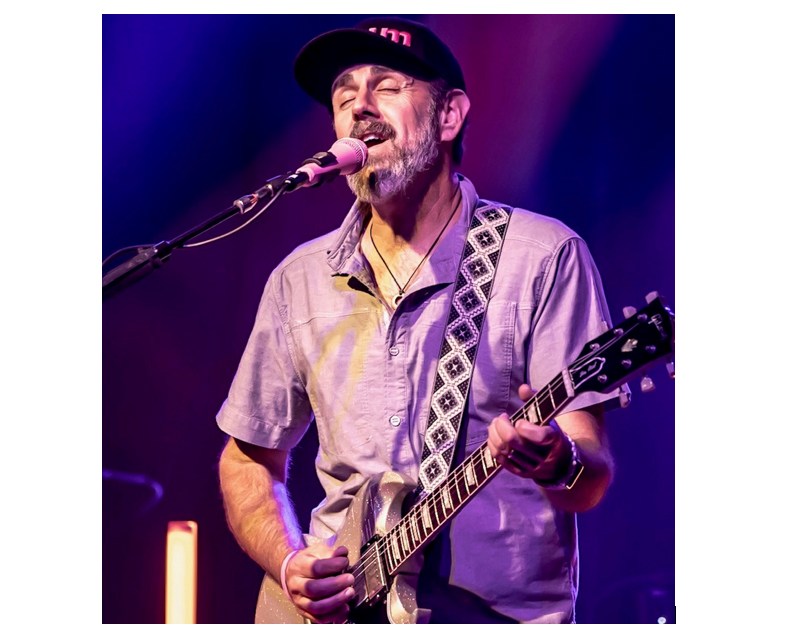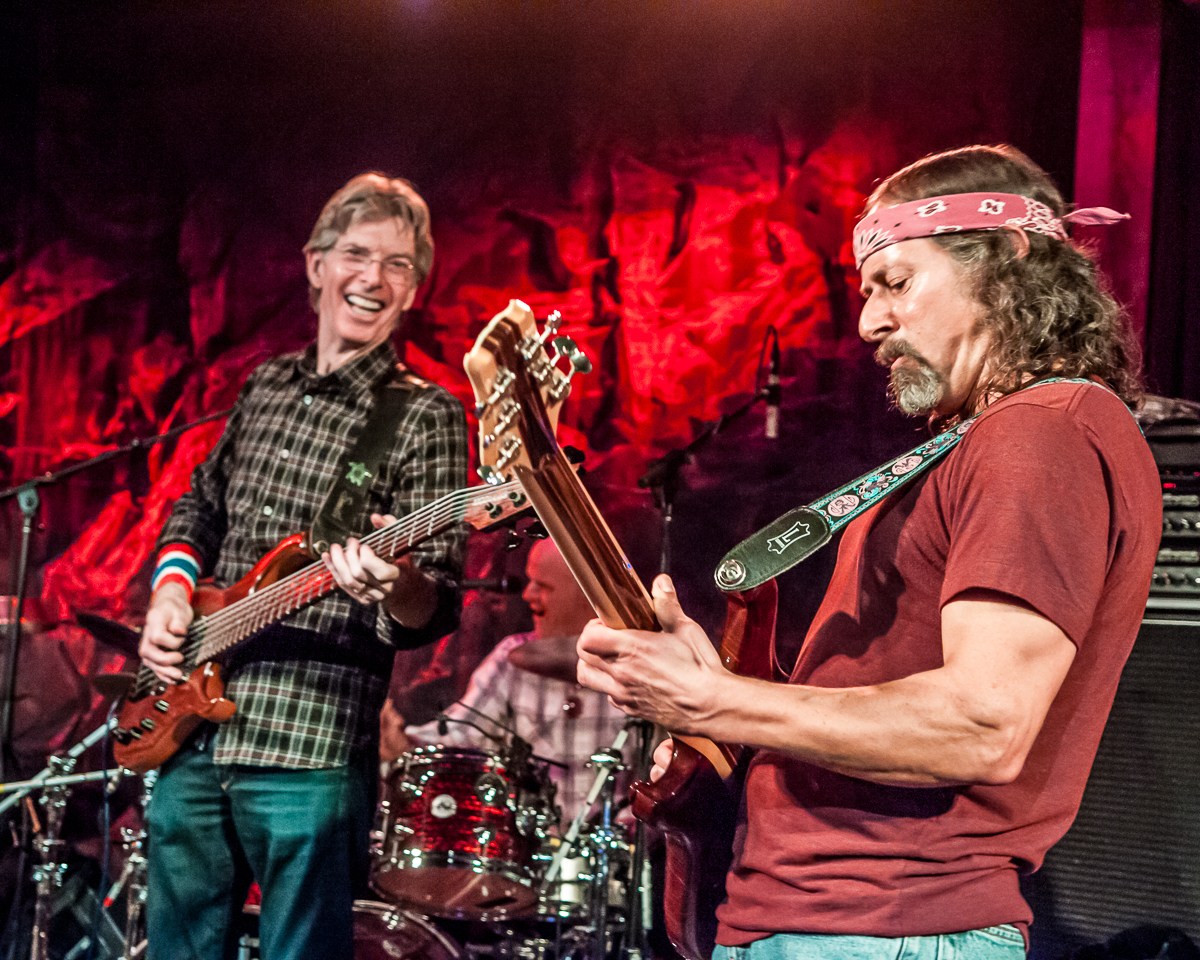
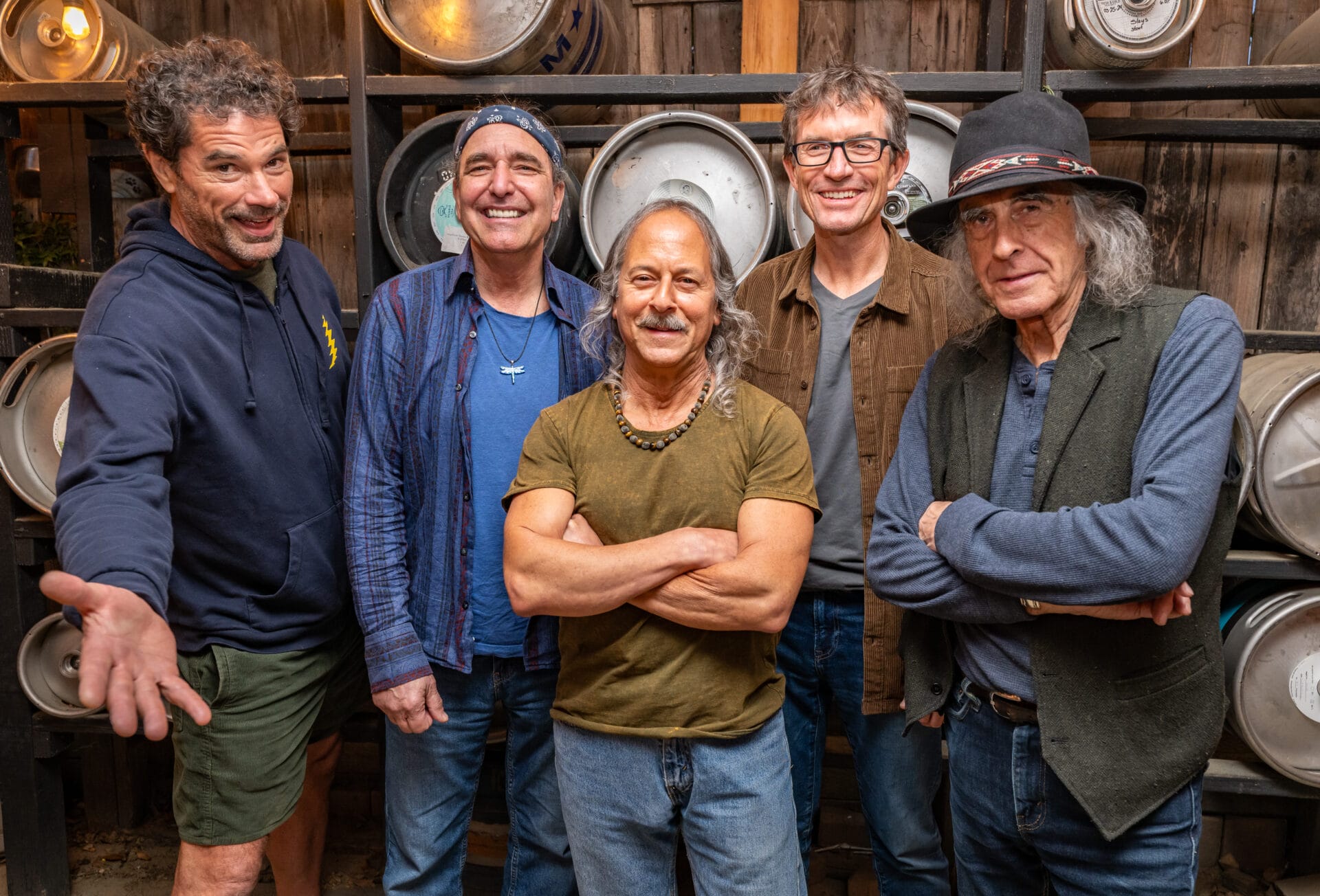
Skeleton Crewe: Jay Lane, Rob Barraco, Barry Sless, Stephen Inglis, Pete Sears (photo: Bob Minkin)
***
“In April 2024 Dark Star Orchestra played Hawaii for the first time,” keyboard player Rob Barraco recounts. “We were in Honolulu for two nights, and this guy Stephen Inglis opened for us. He played slack key Grateful Dead music and asked me to sit in. I was like, ‘Man, that's really good,’ but I had no idea about the depth of what he could do.
“Two days later, he called me up, and said, ‘Listen, I'm doing a bunch of shows in California in June with a friend of mine, and we were wondering if maybe you want to make it a trio.’ I said, ‘Well, who's your friend?’ He goes, “Barry Sless.” I went, “Are you kidding me? Barry's like my brother.’”
“So that's how it started,” Barraco says of their Skeleton Crewe project. “As soon as we sat down and started playing, we knew we had something really special. At first, we were playing Dead stuff along with some other covers. Then I was like, ‘Listen, would you guys be interested in doing some of the stuff I wrote with Robert Hunter?’ They were up for it and then Stephen told us, ‘I write too.’ As soon as I started to hear his music, I knew we knew had something.”
Music fans on both coasts can experience that something as the psychedelic slack key guitar rock collective takes to the road for a series of shows through the end of February. Actually, said fans can hear quite a bit more, as the original Skeleton Crewe Trio has since expanded to a quintet, with the addition of bassist Pete Sears and drummer Jay Lane.
As Barraco details the rise of the Crewe, his narrative dovetails with his own development as an artist, moving from jazz piano gigs, through his tenure in Timberwolf, Zen Tricksters, the Phil Lesh Quintet, The Dead and Dark Star Orchestra, while connecting with other consummate musicians, including Bob Weir and Robert Hunter.
You’ve described how you initially crossed paths with Stephen. At what point in your career did you first run into Barry?
I met Barry in the 90s when I was playing in the Zen Tricksters. I got a call from a promoter who asked me if the Zen Tricksters wanted open up a show in Huntington, Long Island, which is where I lived at the time, for this band the Dead Ringers.
I was like, “Well, who are they?” And he says, “Oh, Barry Flask and a bunch of other guys.” Well we did it, and that was the very first time I ever saw Barry. He got out of a car and as soon as I noticed him I was like, “Oh, another guy with a headband. I see what's going on here...” [Laughs.]
Then when I listened to their soundcheck, Barry just blew me away. His playing was really fresh because he wasn't trying to be the Jerry guy. He was just being himself, and it was really cool.
Over the course of the next few years, we'd run into each other, but it wasn't until the David Nelson Band came to New York and they opened up a show for the Zen Tricksters that I sat down and really talked to him. We hit it off and stayed in touch.
He came and played with the Tricksters a couple of times. I always wanted to be in a band with him, but it just wasn't meant to be at that time. Eventually I got a chance to play with him when we were both playing with Phil, and I was like, “I’ve got to be in a band with this guy, but he lives in California, I live in New York, how am I going to do this?”
Then he calls me up one day—this is probably in 2015 or 16—and he says, “I'm playing with John Molo, Pete Sears, and this young woman who lives in LA named Katie Skene and this has got your name written all over it.” I was like, “I don't know man. I live in New York. What am I going to do? Come out to California and do what?” He goes, “I'm telling you…” But I said, no. I told him, “I'm really busy. Dark Star is playing a lot.”
Then a couple of days later, I get a phone call. It’s Pete Sears and with that amazing English accent, he goes, “Listen man, I know you told Barry you didn't want to do this, but I’ve got to tell you, man, this is your gig. I hear you in it. This is an opportunity for you to really do your thing.”
Well how do you say no to Pete? So I was like, “Alright, fine.” I called Barry up and I told him, “I'll come out and let's see what happens.” He booked two gigs, we rehearsed for a couple of days and it was killer.
John Molo was in the band. We played with Phil forever, and he's one of my favorite drummers to play with. He's got perfect time and he can play in any style you can name. He can play hip-hop, he can play straight ahead jazz, he can play funk. He's just so good.
So that band was great, and we played around California but it really never got off the ground, which was kind of sad. Then COVID hit and that was the end of it.
As I recall, Phil pulled you into his orbit around the fall of ’99 because he was a fan of the Zen Tricksters’ studio album, A Love Surreal.
That's right. He was actively listening to all kinds of people to figure out who he wanted to play with. What we didn’t know at the time was that we had an ally in JC Juanis who was working for Jill [Lesh] and was a big fan of the Zen Tricksters. So JC Juanis slipped Phil one of our CDs and he put it on the top of the pile. That night Phil listened to it and immediately told Jill that she had to contact us the next day.
What's ironic about that is we were playing in San Francisco that same night. JC came to the gig and I had given him the CD seven months before that. I wanted him to review it for Relix [Note: Juanis was a longtime Relix contributor, writing the Bay Area Bits column for many years.] I had said, “I'm going to give you a second CD. I want you to pass it on to Phil. I’d love to get some feedback from him.”
Phil was my guy from the very beginning. It wasn't Jerry, it wasn't Bob, it was Phil. I always gravitated towards Phil’s thing and I said, “I'd love to know what he thinks about what we're doing.”
So JC comes to the gig and I asked him, “Did you ever give that CD to Phil?” He goes, “Yeah.” Then I said, “Did you ever hear anything?” He goes, “No,” and I got a little depressed.
The next day we're on our way to Oregon. This is before any of us has a cell phone, so we all ran to the phone banks. I called my girlfriend in Portland, who told me, “Hey, your booking agent called me this morning and he's desperately trying to get ahold of you.” I was like, “What did we screw up now?” And she goes, “No, he seemed pretty ebullient but he needed to talk to you.” I was like, “Alright...”
Then I looked over at Jeff. We lived together back in New York, and he had called home to get our messages. While I'm still on with my girlfriend, I turn around and I see that he’s got this death grip on the phone. Then he hangs up and goes, “You won’t believe who left a message on our phone. Jill Lesh! She called to say that Phil was really excited to play with us. Could we do some dates with him in San Francisco?” That’s how it started.
To me, the punchline in certain respects is that while he was familiar with your original songs, he wasn’t aware how well you knew his catalog.
The way we rehearsed was interesting. There were two scenarios. The first scenario was that me and Jeff were going to play with him at the Warfield. We were going to do three shows, then he was going to do a national tour. He had already signed on Steve Kimock and Warren Haynes, and I was going to be the keyboard player. So we rehearsed with Warren and Steve, then Jeff came and we rehearsed with him.
At one point when we were in the room, Phil walks in, he meets Jeff for the first time, and he says, “Okay, guys, I want to try a song of mine. It's quite a difficult song, and it's called ‘Unbroken Chain.’ I'm going to have Steve run it over with you.”
So I said to him, “We know ‘Unbroken Chain.’” He looked at us and he goes, “Unbroken Chain?” I said, “Yeah.” I look at Jeff and Phil goes, “Well, play it.” We didn't have a second guitar player in the Tricksters, so Jeff knew the Weir part and I knew the Jerry part. So Jeff started playing the Weir part, then I came in with the Jerry part, and Phil's jaw just dropped like, “What?”
This went on for a couple days. He’d suggest certain songs and we told him that we knew them. He’d say, “What do you mean you know that song? How could you possibly?” Then finally somebody tipped him off and said, “Those guy play in a band called The Zen Tricksters.” Phil responded, “I know, I've heard all their original music.” Then this guy told him, “Yeah, but that's not all they do. They play half Grateful Dead music.” At which point Phil was like, “Ohhhh…” It was a funny moment.
You were a Dead pioneer in many respects. Even prior to Zen Tricksters you were focusing on that music at a time when very few bands were doing so.
In the winter of ’79 when I joined Timberwolf, Keith was still in the band. Then all of a sudden he wasn't and it was Brent's initial foray. At that time the original Dead band was still playing—and they were playing their asses off—so it was kind of weird, but we loved the music so much.
I was a jazz pianist. That was really my thing. The music appealed to me because of the improv aspect of it, and as much as I tried to distance myself from the Dead, I just kept getting sucked into these Dead projects. The guys all knew, “Not only does he know the music, he knows how to improvise.”
How close did you come to pursuing a career in jazz?
I was very fortunate to have had a couple of different incredible teachers, and I was getting hooked up with some great players, but most of the jazz guys I knew at that point had to supplement their jazz gigs by doing weddings and stuff. So for five years, I played 500 weddings. That’s not something I enjoyed but I was married and had two small kids.
Then when these Dead bands came along, it was a much better fit. When I eventually joined the Tricksters we were writing a lot, so it was even more appealing.
Can you identify some of the artists who really lit you up during your formative era?
The guy who changed my life was McCoy Tyner. I heard McCoy for the first time when I was studying with this guy and after the lesson he told me to buy specific records—McCoy Tyner Sahara, Coltrane My Favorite Things and a live album by Oscar Peterson and Joe Pass.
I went to the record store, got home and the by the luck of the draw I put Sahara on first. I had never heard anything like that. Within eight seconds I knew exactly what I wanted to do with my life.
Of course I still have this incredible love for Coltrane, I just can't get enough. I am still learning and studying because what he did was so deep.
From that, I got into a lot of the avant garde stuff, like Carla Bley.
When I finally went to go see McCoy Tyner, he had a tenor player named George Adams playing with him, who was taking the harmonic and melodic ideas from Coltrane and bringing them somewhere different.
Then I was reading the paper one day, and I saw that he was playing at the Village Vanguard with a guy named Don Pullen. I had no idea who Don Pullen was but it was called the George Adams Don Pullen Quartet. So I went into the city and I walked in late, just as this guy Don Pullen was taking a piano solo. I literally dropped to my knees. I could not believe what I was listening to and witnessing.
Eventually, I took all of that and threw it into what I do. I can't play like Keith or Brent. I have to be me. I've been lucky because the guys I’ve played with have understood that. When I started playing with Phil, the very first thing he said was “I just want you to be you. Just play you, and we'll take it from there.” He dug my playing, and that meant so much to me.
There was a time when you were playing with both Phil and Dark Star Orchestra, who had different approaches to the material. Did Phil’s ethos ever lead you to accidentally take things too far with Dark Star?
There was an incident when I had been in Dark Star for about six months. We were playing in Washington DC and we were doing a ’77 or ’78 show. It was “Scarlet” > “Fire,” and at the end of the line “In the heart of gold band, heart of gold band…” during that era, Keith used to do this little pseudo montuno thing.
That’s what I was going to play but I had been studying with this guy doing all these salsa montunos and stuff. So when we got to that line, I just went off and it completely fucked up the drummers. When the set ended, the two of them pounced on me and were like, “What were you thinking? Why did you do that?” I told them I was really sorry.
Then it happened a couple of times after that. We’d be in the middle of a jam and I'd be taking it way too far out. At some point I realized, “I have a role to play here. I have a lot of leeway to play me, but I can't take it to that particular place. It can't be too extreme.”
A bit earlier you mentioned writing with Robert Hunter. Some artists have worked from his completed lyrics but you had a more intimate relationship with him. Can you describe the process?
We were playing the Greek with the Q and Hunter was opening the show. Hunter was sitting in his dressing room but I had not met him yet. So I knocked on the door and I said, “Hey, I want to introduce myself.” He goes, “I know who you are.” So I shook his hand, we started talking, and all of a sudden I said, “Listen, I’ve got a favor to ask you.” He goes, “I know what you're going to ask me…” because everybody in the world probably asked him.
I don’t know if I would have had the balls to ask but he was writing with Phil at the time. I had said to Phil, “I would love to write with Hunter.” He told me, “Don't worry, Rob. That'll happen one of these days. Just give it some time.”
I just couldn’t give it some time, so I took the bull by the horns and Hunter said, “Put three songs on a CD for me. The way I want you to do it is I want you to hum your melody, and then I want you to do a version with no melody, just the chord changes. Here's my address. Send me three songs.”
So I went home and I got to work. I did the two versions of each of the three songs, sent the CD to him in the mail and hoped for the best. Then, about a week later, I got an email from him that said, “Your music is speaking to me.” I could have just dropped dead right there on the spot. Of all the honors I've had in my life, that was the biggest. To be able to write with him, The Bard, oh my God!
So maybe a month later, he called me up and he said, “Are you going to be in California anytime soon?” I said, “Actually, I'm going to be in California next week. I'm going out for pleasure.” He asked, “Where are you going to be?” I told him, “I'm staying at Phil's beach house in Stinson Beach.” So he said, “Good, when you get there, call me. I want to get together with you.”
So we got together at his place, he handed me three sheets of paper and said, “They're in the order that you put them on the CD.” Well, I'm standing in his living room silently singing in my head to the melody. I had tears in my eyes because he just nailed it. He realized what I had in mind just from the tenor of the music, and he crafted these beautiful lyrics. I was blown away.
Finally, we were standing in the living room and I said, “Are you feeling adventurous?” He responded, “What do you have in mind?” I was like, “Well, I’ve got more tunes.” So he said, “Play me something.” I sat down at his piano, played him one of the tunes I was working on, and he asked me to sing the melody. So I started doing that and he was right on it. He got a piece of paper and began writing. Then he said, “Alright, do the same thing. Record two versions and send them to me on a CD.” I said, “Well, I already did.” At which point I pulled a CD out of my bag and I gave it to him. We had a good laugh about it.
That's basically how he wrote. He listened to the music and he wrote the lyrics. It was cool, and like I said, he really nailed it. Those lyrics are deep and funny.
The Skeleton Crewe is doing it all justice.
If I remember correctly, you nearly recorded those songs for Butch Trucks’ label.
That’s right. I had exited The Dead on New Year's Eve 2003/2004. [Note: The group had featured two keyboard players starting in 2002 with both Jeff Chimenti and Barraco, until making the decision to scale back the sound.] About a week later Warren called to check in and at one point he said, “Butch has a record label, and I told him about you and the stuff you wrote with Hunter. He's really interested. Do you mind if I give him your number?” I knew Butch because I sat him with those guys a lot while I was in the Q. So Butch called and he said, “Listen man, I would like to sign you. Warren has been telling me all about this. Do you have any demos you can send me?”
So I sent him the demos and he really dug it. Then he put me in touch with a guy who was working with him. They wanted to sign me, and I was definitely down to do it, but then time was going by and nothing was happening. Finally I decided, “I'm going to go in the studio and just start doing this thing. If Butch’s thing happens, great. If it doesn't happen, at least I've got something.”
So I hired a friend of mine to produce it for me. He brought in a bunch of great musicians, and we went in the studio and recorded all the tunes. Then, when I was just about done, I went to see the Allman Brothers in New Jersey where Butch came up to me and said, “I’ve got some bad news, man. The record label's done.” That was disappointing but at least I’d made the recording.
Jumping ahead, can you recall the first song you brought to Skeleton Crewe thinking it would be well-served by the band?
It was a song called “Old Coast Highway.” It's written about California, and I figured this band would be perfect for it. This tune went through an interesting evolution because when I originally wrote it, I had a groove that was very much “Brokedown Palace.” It had that kind of loping effect. Then when I went to make the CD, my friend the producer said, “Listen, do you want to make a Rob Barraco CD or you want to make a Grateful Dead CD?” I was like, “Well, of course I want it to be me,” and he told me, “Then you’ve got to come up with a different groove.”
So reluctantly I worked on it and came up with this other groove that I didn’t really love but it worked for what we did. Years later when we were out with the Skeleton Crewe playing this tune, after one of the gigs, I said, “Barry, what would you think if we played the tune like this? This is the way I wrote it.” So I played it for him, he really liked what he heard and we changed it for the band. It works much better the way it was originally written.
You described being taken aback by the depth of Stephen’s skill set. How would you describe what he brings to bear?
So Stephen is Hawaiian born. He was raised in Honolulu and learned how to play slack key from the masters. He captured their attention and they made him one of their own. He learned the entire repertoire and can sing in Hawaiian. It's just gorgeous. He has a beautiful voice and it gives me chills.
The sound of his guitar is so Hawaiian sounding. As soon as he strums, it's like, “Whoa, I might as well be in Maui.” But what I didn't know at the time is that he's an accomplished jazz player and a crazy Deadhead—he knows every Dead tune and has his own versions on slack key. Then I found out that he's this sick electric guitar player.
So he’s got a lot going on, and he's different. He's not a Jerry guy, he's his own thing. It really works with what all of us bring to the table. Everybody's got their unique little thing.
It clicked right away with the three of us, especially when we would do the tunes where Stephen would play slack key acoustic, and Barry would play pedal steel. It took you right to the Hawaiian Islands, but it was psychedelic.
Can you point to a specific Dead song you guys play that is particularly well-suited to the slack key guitar?
When he plays “Days Between” or “So Many Roads” it's beautiful. It’s almost like that stuff was written for slack key. He does it really well, and the first time I played with him that was what impressed me the most about him. I sat in and we did a beautiful slack key version of “Lazy River Road.”
Those final Garcia-Hunter songs really hold up.
I agree with you, especially “Days Between.” That song is a masterpiece. It’s well-written, it has a great melody, and of course Hunter's lyrics are just the most haunting ever.
How did Pete Sears come into the fold?
I saw Pete play for the first time when I went to go see Barry play with Moonalice. This is before they were even Moonalice. I think they were called the Flying Other Brothers.
I went to see them and I was listening to Pete, going, “Damn, who is this guy?” After the gig, I was talking to Barry and I was like, “What's his deal?” He goes, “Well, do you remember the Starship from the 70s? He was the bass player. But it's deeper than that. He’s played with Rod Stewart, he's played with everybody.”
Pete’s got deep history. He's a jammer, he’s unrelenting and he has harmonic knowledge. We were having a conversation one day when I first started playing with him and he started talking about music theory. From his way of looking at, I knew right away, “This cat is heavy. I want to play with this guy all the time.”
What led you to bring in Jay as well?
In 2024, Stephen called me up and said, “I’ve got offers to do some shows in Hawaii for Jerry's birthday.” We had already done some of the trio stuff but this was going to be a little different. So went to Hawaii, Pete was the bass player and it was great. We had Wally Ingram playing drums but then we had an opportunity to do a couple of electric gigs in the Bay Area, and Barry had been playing with Jay for a little while in Wolf Bros, so we did the gig with Jay. It was instantly “Boom! This is the unit right here.” So we approached them and said, “Do you guys want to do this thing with us? We want to play a lot of original music.” The two of them were all over it, especially Pete who told me how much he loved my songs.
There's a clip the band posted to YouTube that starts off with one of Stephen’s songs, then moves into “Slipknot” and then Brubeck’s “Blue Rondo à la Turk,” which is a surprising segue that just feels right. How did it come to you?
It's interesting what happened. Cotter [Michaels], Dark Star’s front of house engineer, would play that tune as going-out music when the gig was over. It's always been one of my favorites, but I had never learned it. I was talking to him one day and he said, “You should learn that.” I agreed with him and I began working on it.
Then, when I was with Stephen and Barry at our first rehearsal, Barry goes to me, play “Blue Rondo à la Turk.” I was like, “It's funny you should say that, I've been working on the song for four months.” He goes, “Play it with me. I'm doing this gig next week with a piano player here in town, and I've got to play the tune.” So we started playing it. Barry knew it pretty well, and it was fun to play it with another person.
Like I said before, when we first started doing this thing, we were doing a lot more Grateful Dead. So we were going to do “Help on the Way” into “Slipknot” and in the middle of “Slipknot,” I just got the wacky idea to just start playing that, and Barry lost it. He stopped and goes, “We’ve got to do that. We need to figure out how we can incorporate that in ‘Slipknot.’ It worked and it was the funniest thing. Now I envision a time when we'll play the whole tune as a unit, but deconstruct it, so you’d get different parts of it throughout the entire night in different tunes.
By the way, at the end of that “Slipknot” thing you described, we go into one of my Hunter tunes called “When You Say When.” I never knew Barry could sing but we got him to sing the third part in the harmonies, and it sounds really cool.
You had some common musical affinities with Bob Weir, particularly in the jazz realm. At what point did you first play together and was ever a point of discussion?
When the Q was still happening, Phil approached the band one day and said, “We're going to do a really weird gig in Mill Valley at Sweetwater, and we want to call it the Crusader Rabbit Stealth Band. I was like, “Alright, that's a cool name.” Then he said, “And Weir’s going to do it with us.”
I think this was before we were doing double bills with Ratdog and the Q. So I was like “Wow, I'm going to actually meet Bob.” He came to a couple of rehearsals and I really picked his brain, especially about McCoy Tyner because he had a thing with McCoy Tyner like I do. He loved McCoy's approach to playing when Coltrane was soloing—the way McCoy listens to the line that Coltrane's weaving and intersperses his changes. I can see how Bob was listening to Coltrane, picked that up and put it into the Grateful Dead.
Bob’s energy also was so beautiful and peaceful. He was a prankster, but he was quiet. Then when he spoke, it carried some weight.
Being around Bob elevated you—the way he walked through life as well as his playing. If I take myself back to the very first time I heard the “Dark Star” from Live/Dead, the thing I focused on the most was Weir’s playing because I had never heard a guitar do what he was doing. It was completely otherworldly and fit so perfectly with what Jerry and Phil were doing. I think Bob was the one who made me understand how those guys were doing it. He painted the picture for me and helped me to see how musicians can listen to each other and weave around each other. He was a master at that.
His songwriting was also something else. I mean, those are a few of my favorite tunes. “Playing in the Band” and “Weather Report Suite” touch me every time I hear them, and I love playing them, too.
Finally, bringing it back to Skeleton Crewe, what do you have in mind for 2026? Do you think you’ll record together?
We're definitely going to go into the studio and record. I would like to rerecord all the Hunter stuff with these guys because the people I played with originally didn’t have the sensibility that these guys have. Part of it is knowing a little bit about the Grateful Dead, and part of it is knowing a little bit about the jazz thing. Those guys were all session players. They were really good, but they didn't hear the music the same way I did.
So that's why I want to rerecord those songs. Then I have new originals, Barry's got some new stuff and Stephen's always writing. We really need to get this down.
I feel like this band has this cool, uplifting message and we’re trying not to be formulaic in any way. Our approach is that anything goes. We'll take this music wherever it wants us to take it.