It was around 3 a.m., over two years ago, when David Shaw woke up in a panic. The now 43-year-old musician, best known as the frontman for next-generation New Orleans favorites The Revivalists, has famously stayed clear of alcohol and hard drugs for going on two decades. And yet, in the middle of the night, he couldn’t shake the set of charged lyrics that came running through his head: “Well, I’m so bored, so bored of being sober/ Maybe I’ll go downtown, to some bar down on Decatur.”
He jumped out of bed and, while his wife continued to sleep, starting writing what would become “Get It Honest,” the title track and conceptual compass of The Revivalists’ sixth full-length album and first release in just over three years, which is slated to drop on July 24 via Concord Records.


“That song came to me in a dream, which is crazy,” Shaw says in early July, while sitting for a Zoom interview in his living room in New Orleans, a Frenchy painting positioned behind him. “The dream wasn’t necessarily about the song—it just kind of woke me up. I was thinking about these words and, next thing I know, I’m by my bedside, jotting them down. The next day, I finished the song.”
At the time, The Revivalists had recently issued their first album for Concord, Pour It Out Into the Night—which spawned the popular, anthemic single “Kid” and took the outfit to the top of the AAA charts—and Shaw and his wife had recently welcomed their first child. And the always commanding vocalist/guitarist was starting to cope with a new, decidedly middle-aged sort of pressure.
“It came at a time when it was a bit of a low period and I was thinking, ‘God, my life is about to really change.’ I started thinking, ‘Am I ready for this? Is our relationship strong enough?’ Thankfully, it is, but we worry about things that we might not need to worry about,” Shaw admits. “And this idea came from something I absolutely needed to get out, and I had to express the fact that it can be just straight-up boring not to have some of these outlets that I might have had before.”
He pauses for a moment to reflect a bit more deeply on his journey. “Obviously there’s a trade-off, and there’s so much more life. And my life is just so beautiful, but in some of these mundane moments where I normally would have just gone to a substance, I punked the feeling and was like, ‘Let me just sit with this.’ We’re all battling a little of that. It was this feeling of just like, ‘Oh, God, what do I do with myself?’ I’m certainly not writing a new book here, but it was something that had to come out and this really special song came out of that.”
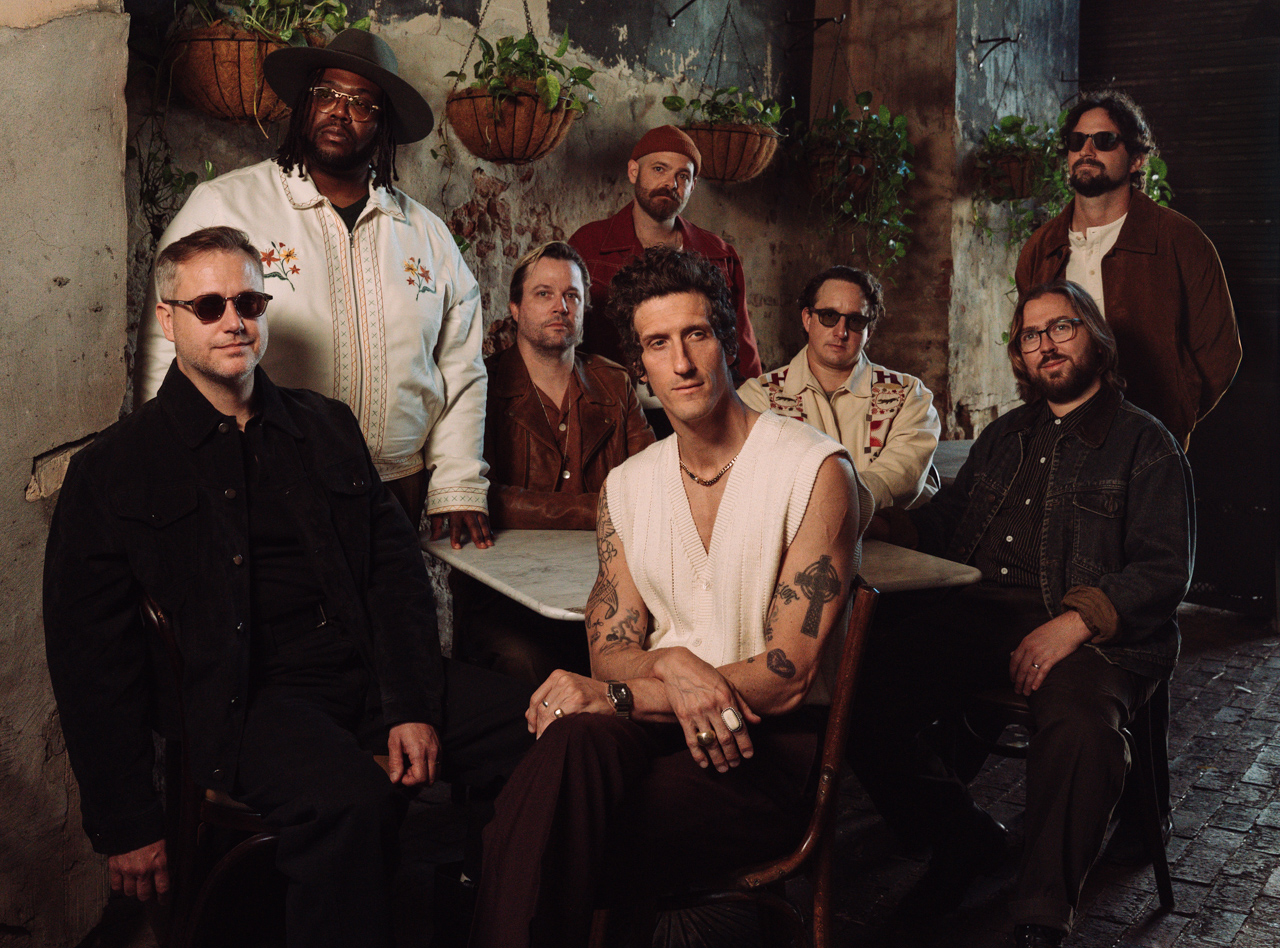
As its title suggests, Get It Honest is chock-full of deep, in-the-mirror reflections, which is fitting for a group of musicians in their late 30s and 40s who have been playing together for 20 years and are just over a decade removed from their surprise crossover banger, the Ben Ellman-produced “Wish I Knew You.” In the time since that single’s moment of impact, seven of the band’s eight members have become fathers and the ensemble—which also includes guitarist Zack Feinberg, pedal-steel player Ed Williams, saxophonist Rob Ingraham, bassist George Geka, drummer Andrew Campanelli, keyboardist/trumpeter Michael Girardot and drummer/percussionist Paulet “PJ” Howard—has moved into a steadier but no-less-pressure-filled stage of their career.
“That growth is in our lives, and it only makes sense for it to become a theme in the writing,” Revivalists co-founder Feinberg says in July, during a separate Zoom call from the New Orleans home he shares with his wife and young twins. “‘Lay It on Me’ is a song Dave and I wrote together when my kids were babies and what better metaphor for being a dad? It’s like, ‘Lay it on me, I can take it, just put it on me—I got it, I can carry this load, let’s go.’ All that, as far as my relationships and my family life and my work life, is an invitation to take it on.”
“We’re always writing, always exercising that hustle,” Shaw says. “Thankfully, that thing still visits me, and I’m very grateful for that. But with any big change in life, you’re gonna have things that you need to get out, skins to shed. So, for me, this was the album going into my child being born.”
The Revivalists’ music has long been fueled by their collective energy and passion, and their best offerings are both relatable and personable. Yet, Shaw notes that impending fatherhood pushed him to be more open with his writing, too.
“Before she was born, I was working some of that stuff out and thinking, ‘You’ve got to get ready; you’ve got to be able to be fully present,’” he says, calling out the benefits of the years he’s spent in therapy. “I thought, ‘The best thing I can give my child is a regulated nervous system. She doesn’t need a frantic daddy running around. I need to be a calm presence.’ So I did a lot of work in that area and started writing some things down that were much more personal, some things that I might have not written about before.”
Shaw’s sobriety has been a major throughline in his artistic journey. Around the time of his sophomore solo set, 2024’s Take A Look Inside, the frontman admitted that he had started to reconsider the guardrails he’d put on himself.
“I’m still exploring psychedelics,” he told Relix at the time. “It’s a very slippery slope, and I say that because people who have addictive personalities are very good at justifying certain things they do. I am very aware of that part of me—hyper aware. But then there’s the other part where it’s about the intention. If I order a Shirley Temple at a bar and the bartender makes it dirty and I take a big old sip of that and it’s got alcohol in it, the intent was for me to have a Shirley Temple. But if the intent was for me to microdose or heroic dose, and mine something in my psyche, then the intent was very different. It’s about being brutally honest with yourself and going, “Dave, what are you doing here, bud?’”
It’s a complicated subject and he elaborated a bit more during that 2024 interview, explaining: “For a long time, I felt like I was teetering on the edge. I was a tiger in a cage with a T-bone hanging out in front of me. I’m older now—I’m not gonna say that I have a handle on it all because I know that, unequivocally, the first time I take a sip of a drink intentionally, I’m partying—its fucking over for me. I might be fine for 3-4 months, but I just know, at some point, the hammer is gonna drop. So that is one thing that I’ve closed the door on, and there are obviously other things I’ve closed the door on as well. But, I was also like, ‘Man, I’ve got one life, and there’s certain things that I just don’t feel that bad about or that could possibly even help me.’ I was giving them a negative stigma, and I needed to assess them for myself.
Everyone’s got their own journey, and everyone’s got their own thing, and AA and NA are great. They help so many people. I just realized that I’m a hybrid of certain things, and that is fine with me. For a long time, I didn’t want to admit that—or I was scared of what people might think because people look at me like I’m this picture of sobriety, like I’m ironclad. In a lot of ways, I am. But, in a lot of other ways, I needed to be softer with myself, and I needed to be honest with myself. Maybe the T-bone’s still out there, but I’m not worried about it because I’m not in the cage anymore staring at it.”
That internal dialogue spilled over to Get It Honest. “It’s interesting being ‘sober-ish,’” Shaw muses now. “I don’t drink, and I don’t do cocaine and some of the harder situations, but I’ll still have some weed here and there, and some mushrooms every once in a very blue moon. But even with that, for someone who has an addictive personality like me, I need to watch myself very carefully. I think I’ve got a pretty good handle on it—I feel good about it—but it is a similar feeling that many people probably have. It’s always been the same—sit with it and just let it pass and, as you do that, you become stronger.”
“Get It Honest” faces that inner dialogue head on.
“It seemed like a song that needed to be heard and a song that I needed to sing,” Shaw says. “As I wrote the song, I felt better. And as I perform the song, I feel better. So music, in that way, has been such a gift to me. Sometimes I’ll write something and be like, ‘Oh, man, I don’t know if I can say this; I don’t know if I can sing this every night.’ And, usually, those are the ones that I should probably get around to finishing. This record absolutely was a continuation of the process of being OK with really getting certain things out there. There’s always been a ton of my life in our music—and a ton of truth in our music—but I’d always also be hiding bits of fiction in there and telling stories. You never want the full truth to get in the way of a good story. But, sometimes, all you want is the truth. And, honestly, that’s what this album is. There’s just so much of me, Zack, Andrew, George and PJ—all of us—in it. It was a bit of a distilled process.”
Feinberg agrees, noting that leaning into those themes—and embracing the changes that come with age—has actually enhanced their performances.
“As far as our personal lives, I can see the maturity and growth in many of us that has happened as we’ve taken on new responsibilities,” the guitarist says. “And it makes it more fun because, when you’re dealing with real things and then you’re going out and playing a concert, it’s like, ‘Oh, yeah, this is fun.”
***
The Revivalists’ rise through the live-music ranks has been both singular and organic. As the now famous story goes, Feinberg, who grew up in the New York suburbs, was riding his bike through the streets of New Orleans while studying at Tulane University when he heard Shaw singing and playing guitar on his front porch. They struck up a conversation and started playing music together, laying the foundation for The Revivalists’ earliest lineup. Feinberg, who came of age at the height of a golden age of Northeast jambands around the turn of the Millenium, turned the Ohio-bred Shaw onto a range of improv and funk-rooted acts. A recent area transplant himself, Shaw had earned a degree in business management with an emphasis in construction management and moved to New Orleans to help rebuild the city post-Katrina.
The band’s lineup coalesced over time around New Orleans, with some members bonding at workshops held at the famed club Tipitina’s, and then, through a grueling tour schedule, The Revivalists made inroads on the jamband and festival scenes. Though they naturally leaned in a more rock-oriented direction than many of their contemporaries and knew their way around a good hook early on, the group endeared themselves to the improv-forward crowd through their ability to stretch out their songs, regularly change up their setlists and collaborate with some of the genre’s biggest names. “Wish I Knew You” was a surprise breakout moment for The Revivalists, firmly placing them in the pop-culture conversation and even on the occasional CVS-type playlist, but they continued to circumvent the country as they always had, nurturing a dedicated fanbase along the way.
For Pour It Out Into the Night, the full band hunkered down in Guilford, Vt., with multi-platinum, multiple-Grammy Award-winning producer Rich Costey. The self-described “world’s most dangerous mixer,” Costey was an outside-the-box choice, known for his work with Fiona Apple, Vampire Weekend, Foo Fighters, Sigur Rós, Muse, Foster the People, Sam Fender and My Chemical Romance, among others. However, the resulting record appealed to both longtime fans and newer listeners, and The Revivalists have toured on the LP for the past three years. Along the way, Shaw has continued to develop a parallel solo career while Feinberg released the debut album under his name, Call It a Miracle, in 2025 and started playing select shows on his own, sometimes on his off dates while on tour with The Revivalists.
Feinberg says that he and Shaw started hashing out the idea for what would become Get It Honest over breakfast in the summer of 2024, when The Revivalists were in Jackson Hole, Wyo., for a wedding gig. Given their new family obligations and hefty tour commitments, comfort and time-management were paramount this time around.
“Whenever we start to make a record, it’s a whole big process and we have to pick the producer,” the guitarist says. “For Pour It Out Into the Night, we did phone interviews because it was around the pandemic and we had this whole list we went through. It could take half a year to pick the producer, and it takes that long anyway to get going, as far as compiling the demos and picking what songs to record and scheduling everything. A lot of us wanted to forego that whole process and expedite it as much as possible. I remember saying, ‘Rich was good, we all liked him, let’s just keep it moving because three years between records is long enough.’ And everyone was on board with that.”
“A big catalyst for choosing Rich was that there was a familiarity there that all of us loved,” Shaw adds, echoing his bandmate. “When you’re meeting someone new, there’s a certain thing that happens, and we already had this vocabulary, this social contract with Rich. He knows how everyone in the band works and these micro things about their personality, so that worked in our favor, especially with the theme of this album and some of the things we were hitting on.”
One marked difference this time around was that the members of The Revivalists involved the producer in their pre-production process early on.
“Rich zoomed in on a bunch of rehearsals in New Orleans, and we had some built-in pre-production rehearsals in Vermont with him present,” Feinberg says. “That was fun—we fleshed-out some of the tunes and test-drove some of the songs that were fairly complete already. We called it ‘speed dating,’ where we’d give a song a half-hour and you could try it out. We could put together a quick arrangement and see if it caught any sparks in this competitive environment. That was sort of a breakthrough for us.”
Away from their families and other responsibilities, the musicians fully immersed themselves in the sessions. “The benefit of going out to a remote place like this studio in Guilford, in the woods, is that we’re living there on the property without the distractions of everyday life, which is great,” Feinberg says. “We have a level of trust working with Rich. We know he’s got a handle it and puts a lot of care into it, and we know it’s a world-class studio. If you want a million-and-a-half-dollar signal flow with a vintage compressor and a Neumann microphone, then you can get as decadent as you want with that, and that’s fun. And it’s a comfortable place—it’s beautiful, it’s inspiring, it’s peaceful.”
They also felt comfortable with the producer’s pace, having already tracked a record at his Vermont property. “Rich’s workflow can be very slow at times because he’s very fastidious, as far as getting parts and things like that,” Feinberg says. “We understood that expectation, that piece of it, and we dealt with it. In our minds, we knew that was his process and that it’s for the best. We had a rapport, so the workflow was similar to the last one, but it was also a bit different, as Pour It Out Into the Night was coming out of the pandemic, so we started doing lot of pre-production in the abundance of time we had at home, when touring stopped. This time, it was just a little bit more of a regular schedule. We planned two or three weeks for pre-production rehearsals at our space in New Orleans. Then we had four or five days in Vermont, just rehearsals in the house we were staying in on the property, with Rich present, and we fleshed out the arrangements. But, once you get into the studio, everything changes anyway.”
Some of the material they brought in already had some notable outside fingerprints on it. Eric Krasno helped Shaw craft the track that eventually became “Razorblades and Runaways;” they finished the demo together and then the full band cut it live in the studio, with Shaw adding a set of personal lyrics on top.
“A lot of times, I don’t necessarily know what I’m writing about at the time. I just kind of let it come out and then I will piece it together,” Shaw says. “I’ll bridge the gap between certain things. That was one of those. It’s a love song to my daughter, but it’s also a goodbye to a life that I had and an ushering in of my new life and my new way of being—this new season. Maybe there’s still a lot of runways, but there’s no longer razorblades. So there’s this double-edged thing happening there, this duality that I’m juggling in that tune.”
Shaw notes, with a laugh, that a lot of the album was written in the twilight period when his daughter was an infant and he was recalibrating his understanding of time and sleep. “I didn’t necessarily do anything to get myself in the headspace, but I will say that I was able to get out of my own way,” he says. “I was just too tired. I would still go out and, sometimes, I’d be out there at 4 or 5 in the morning, and I’d just be totally dead. Or when I was in, I’d wake up at 4 am and be like, ‘I’m not going back to sleep and she’s gonna wake up in an hour or two. If I want to get anything done, now is the time to do it.’ Honestly, I’ve noticed that it’s a really special time, when the world is quiet. No one else is around. I don’t know what it is—maybe there is less energy in the world but you’re just able to connect a little more. Or, maybe, I’m just tired, but everything’s flowing through. And my propensity to judge things is just way lower.”
The Revivalists recruited a few of their regular collaborators for Get It Honest, too. New Orleans keyboardist Andrew Yanovski—who co-wrote “Say Goodbye” on their previous record—contributed to the sessions, working with Shaw and Howard on the album’s kick-off track “Heart Beat.”
“That’s one of my favorite songs I’ve written in a long time,” Shaw says. “I just love the melody. I love the way the chorus just slaps. Andrew’s a great writer and he plays in my solo band. He’s the sweetest guy.”
Meanwhile, Shaw and Chris Gelbuda, a Nashville-based writer and musician who recently joined Zac Brown Band, continued to hone the partnership they’ve been developing for going on 15 years. They ended up coming up with several ideas together.
“Chris and Dave co-wrote the song ‘Lost and Found,’” Feinberg says, describing one of the LP’s lead tracks. “I heard that song and, when I saw that the two of them wrote it together, I was like, ‘OK, this is real and representative of their relationship together.’ These are both people that have struggled with some substance issues, and they are both new parents. The chorus goes, ‘People like us get lost and found.’ It just felt like this real thing that they have both gone through.”
“It’s funny,” Shaw says. “I’ve done the whole ‘go to Nashville and write with the guys thing’ and the ‘go to LA thing.’ It’s cool, I like doing that and I’ll probably do more of that in the future, but I also just have these friends that I love writing with, especially for this album. I know these guys, I’ve been hanging with these guys, I’ll spend a weekend writing with these guys. It’s like, ‘These are my boys.’”
The singer/guitarist notes that the other members of the band contributed to the writing process as well, with Campanelli writing the standout “World Is Not Enough,” a tune Shaw says saw a few transformations. “It’s just a beautiful song,” he gushes. “It was this different song for a little bit and, once we got it into the studio, it really took on this new life. I’ve gotta really hand it to George and Andrew for locking in on this really special groove. They were just playing it, and we were all like, ‘This is sounding really good.’ It was one of those moments where we said, ‘Now we have a decision to make.’ That was the only song that underwent an entire metamorphosis. It went into the cocoon and came out a butterfly.”
The resulting set of music matches the raw honesty and emotional vulnerability of the stories they musicians were eager to dig into this time around.
“We wanted it to feel a little bit frayed,” Shaw admits. “We wanted it to, potentially, feel a little bit feral and definitely not overproduced in any kind of way. A lot of times our songs are written on the acoustic, and then the acoustic thing is pushed to the back or removed completely for other elements to make the song what it needs to be. But with this album, we wanted to let the acoustic guitar be the focus, be the center point because that’s who we are already.”
“It was natural evolution,” Feinberg says. “Dave and I always loved playing acoustic guitars and writing softer songs—Andrew as well. That’s always been a part of what we do. We certainly still love to play loud and rock, but this style of music is also definitely having a moment in popular culture. And so just by getting a little bit older and many of us having suffered different crises of one form or another over the years, we gravitated toward more of the acoustic side of things and that style served the songs this time around. But we also reserve the right to rock, and we will when we are on stage.”
This spring, The Revivalists played to their biggest audience yet when they made their annual appearance at the famed New Orleans Jazz & Heritage Festival. They also continued a newer Jazz Fest tradition by cramming into the Uptown New Orleans club Le Bon Temps Roule for a surprise evening set, which saw the capacity crowd stretch out onto Magazine Street.
It’s not lost on the band members how lucky they are that they get to play Jazz Fest every year, and that it’s their hometown festival, and this year, they used the occasion to bring their families. Feinberg describes their backstage trailer as chaotic and a lot of fun, with 11 band kids running around, even if that environment limits their ability to check out other acts while onsite. They also used the elevated forum to properly introduce “Heart Stop” and play “Lost and Found” for the sprawling crowd, two of the five Get It Honest tracks that have worked their way into the live show so far.
“The audience response is really good, and it’s freshening up the setlist,” Feinberg says. “We’ve been making it a point to keep the setlists changing show to show, so it stays interesting for us. We seek new inspiration in the same songs and we play things a little differently every time. The songs evolve as we continue to do them live. We’ll add a little sing-along section, little solo sections and kind of see where they go.”
“There were a couple moments, like when we were playing ‘Heart Stop,’ where we went into the chorus and you felt this physical gasp. I’m getting chills now thinking about it. It’s special because it’s involuntary,” Shaw says. “So the new music has been resonating. We have been getting a lot of messages about ‘Get It Honest.’ I need to say a little something about that song before we play it. It hits so hard. It needs a little Surgeon General's warning, so people know where we are coming from and aren’t like, ‘What did you just hit me with?’”
As they move through life as a group of dads, and gear up to release a new record, both Shaw and Feinberg say they are also learning to treat their bandmates with a little more kindness and understanding.
“We are just more thoughtful and caring to each other,” Feinberg says. “There’s still things that we’re constantly navigating and things that come up as a band. But we just try to treat everything that comes up with as much thought as we can. I try to be more careful with my words and actions than I have been sometimes. But we still like to joke around and have fun, and we still have the Arrested Development/adolescent thing going on a lot of the time. But we try to navigate that with tact and love.”
“We just have a lot more compassion for each other,” Shaw adds. “It’s like, ‘Maybe I won’t stick the knife in and dig it in a little bit.’ It’s like, ‘Maybe I’ll just take a step back and give my brother some grace.’ That moment, that energy, has infiltrated our camp a bit. Sure, everybody has their moments—we’re like brothers—but I really do think having children has just instilled in us this level of compassion that is much greater than where we were because we just understand where they’re coming from, their motivations, their worries, their hopes, the things that they want for their families. We all want the same thing, so there’s definitely more camaraderie that has evolved.”
Likewise, despite inching into their third decade as bandmates, Shaw and Feinberg still both clearly enjoy the rollercoaster ride life in a rock band provides. “A lot of times, it becomes this slog and, at some point, you just realize, ‘I’m just going through the motions here,’” Shaw says. “But I think we’re going the opposite way. It’s important for us to feel that because I didn’t get into this to just show up and punch the clock. I don’t care. I’m a cowboy. I’ll do whatever it takes to survive and it’s amazing to feel that within this group.”
They still simply love music, too. Shaw notes that, after The Revivalists wrapped up a round of Pacific Northwest dates in early July, he took advantage of some time off on the West Coast and brought his wife and daughter to the High Sierra Music Festival He went as a fan, taking in choice sets by Don Was, The Psycodelics—who he describes as a “fire band”—and the “mind-blowing voice” of Judith Hill.
“I was kind of like, ‘Let’s just keep this energy going,’” he notes of using his vacation to see more music. “I hadn’t been there in close to a decade and was like, ‘This is awesome!’ It was such a family-friendly vibe, and my daughter was in her element.”
Looking ahead, The Revivalists have some big gigs on the books coming up, including a string of dates opening for current country-soul-rock crossover act Red Clay Strays that will bring them to revered spaces like Philadelphia’s The Mann and New York’s Madison Square Garden.
“We were deliberating whether to take these dates because it’s a support slot and it’s only an hour—so it’s strong support slot. But we looked at the itinerary and realized it would get us into these bucket-list rooms,” Feinberg explains. “So we were like, ‘Let’s do this.’ And they are a great band. We had a date opening for them last July in Orange Beach, Ala., at the Wharf, and it felt great. Their audience and our audience seemed to have a lot in common. They’re from right up the road in Mobile. They sort of take issue with the country designation—they identify as a rock band and as a soul band, but they’re from the South and speak with a Southern accent, so you take whatever audience you can get, you know?”
Indeed, The Revivalists have long learned how to make the most of their opening spots, including for some the biggest bands in the world. “We kind of demand attention,” Feinberg says humbly. “With as many of us as there are on stage and the energy that we bring, for whatever reason, thankfully, we don’t find it too hard to connect with audiences. Our two experiences opening for the Stones were pretty good.”
They will also balance out those shows with festival plays, proper headlining spots and some smaller gigs at venues they simply enjoy visiting. Throughout the run, they will continue to work their new music into their sets while avoiding the trappings of a traditional promo campaign.
“We play things differently every night—we’ll get emotional in a solo and extend it and have fun and be loose,” Feinberg says. “There’s an openness to it and we like to see where it goes. We will be promoting the new album and are excited to play a lot of those songs every night, but then we’ve also been digging up some old ones and doing some fun new covers. We’ve been doing this really fun mashup arrangement that Dave came up with of Nirvana’s ‘Heart-Shaped Box’ lyrics over the chord progression and melody of Chris Isaac’s “Wicked Game.” We later found out that the name of the album “Wicked Game” is on is Heart Shaped World and, apparently, Kurt Cobain liked ‘Wicked Game,’ so it might have been in is mind when he wrote that one.”
They are also pumped to partner with Sixthman and present their first cruise, Otherside of Paradise at Sea, which will set sail aboard the Norwegian Jewel from November 3-7, routing from Miami, Fla., to Nassau, Bahamas. The Revivalists will turn in three distinct sets, promising deep cuts and special guests, while Dawes, Eddie 9V, Maggie Rose, Say She She, Neal Francis—who happens to be Howard’s old bandmate—and others will offer two shows each. The members of The Revivalists will flex their expanded universe a bit as well during the cruise, thanks to some side-project performances, including a Williams DJ set that will feature remixed versions of tunes from their repertoire.
“He played it for Andrew and I in the airport the other day,” Feinberg says, noting, with a wink, that they might not be bringing their children on this voyage. “He was like, ‘I’m working on this house remix of ‘Criminal,’ and I was expecting it to be his steel line over a house beat. But I put in the earbuds, and I was like, ‘Oh, shit, this is something completely different.’ It’s just the vocal. It’s really cool. It’ll be a bonding experience. It’s gonna be a big party. We’re gonna have fun connecting with the fans on a more personal basis at the craps table.”
Decades into their journey together, they have also started to understand their career arc a little bit—and fully realized that they are playing the long game.
“I think we’ve reached that point where we’re like, ‘OK, we can do more,’” Shaw says. “We can make our Morning Phase. We can make out Workingman’s Dead. And then we can make something else that’s different. We realized a little way through this one that we had a chance to make something that sounded really cohesive and that had a real theme and an identity. Our past records have had a bit of a multi-personality thing with a lot of different vibes. But for this record, the sonic landscape is much more cohesive. We’ve placed you in this world, and you shall stay there until the end of the record.”
Feinberg agrees, adding: “Even when we were younger, people would be like, ‘How do you guys do it—traveling so much?’ And it’s like, ‘It’s travel. It’s not like we are at war here. We’re traveling to play concerts. I enjoy it, and it was a choice that I made. I like it.’ We’re incredibly lucky that we get to do this and that we have an audience.”
He thinks back on the band’s trajectory and elaborates by saying, “Also, music is humbling on all levels. Even when The Rolling Stones play a new song, you see people walking out to go to the bathroom, and their new music is super good. We have an audience, they’re excited to see us and that’s amazing. It’s the best job. We’re super grateful for that.”