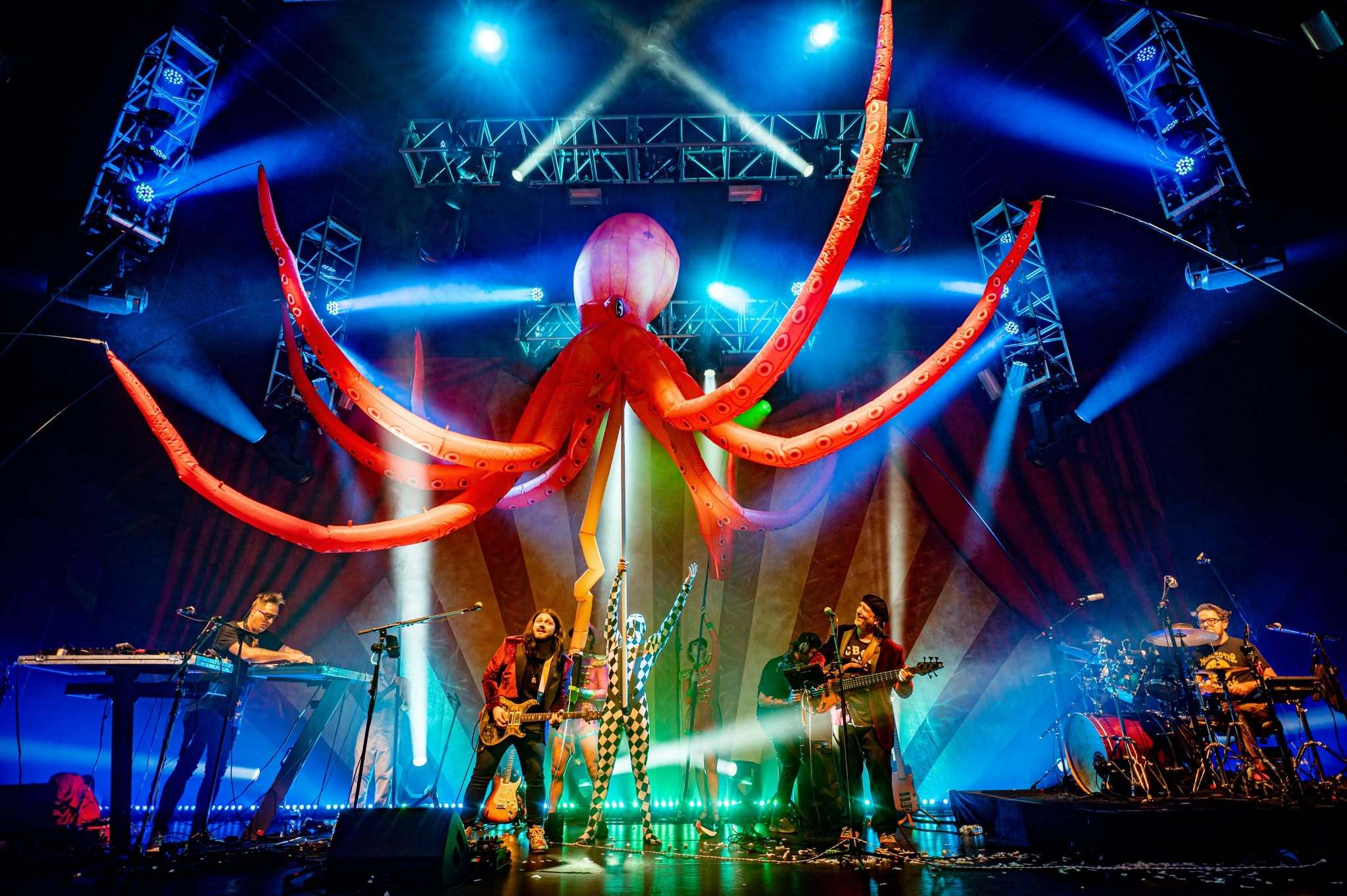

Eggy on Jam Cruise 22, photo by Dave Vann
Eggy’s esteem is no accident. There was no instant breakthrough where the music they’d dutifully crafted for years suddenly catapulted them to the major marquees they grace today. There’s been no surprise crossover hit, game-changing co-sign or single viral moment that put them over the top. The quartet’s recognition among the foremost purveyors of improvisational rock comes from a decade of unflagging commitment to the tradition that’s gradually, and rightfully, won them a devoted following. They don’t take it for granted.
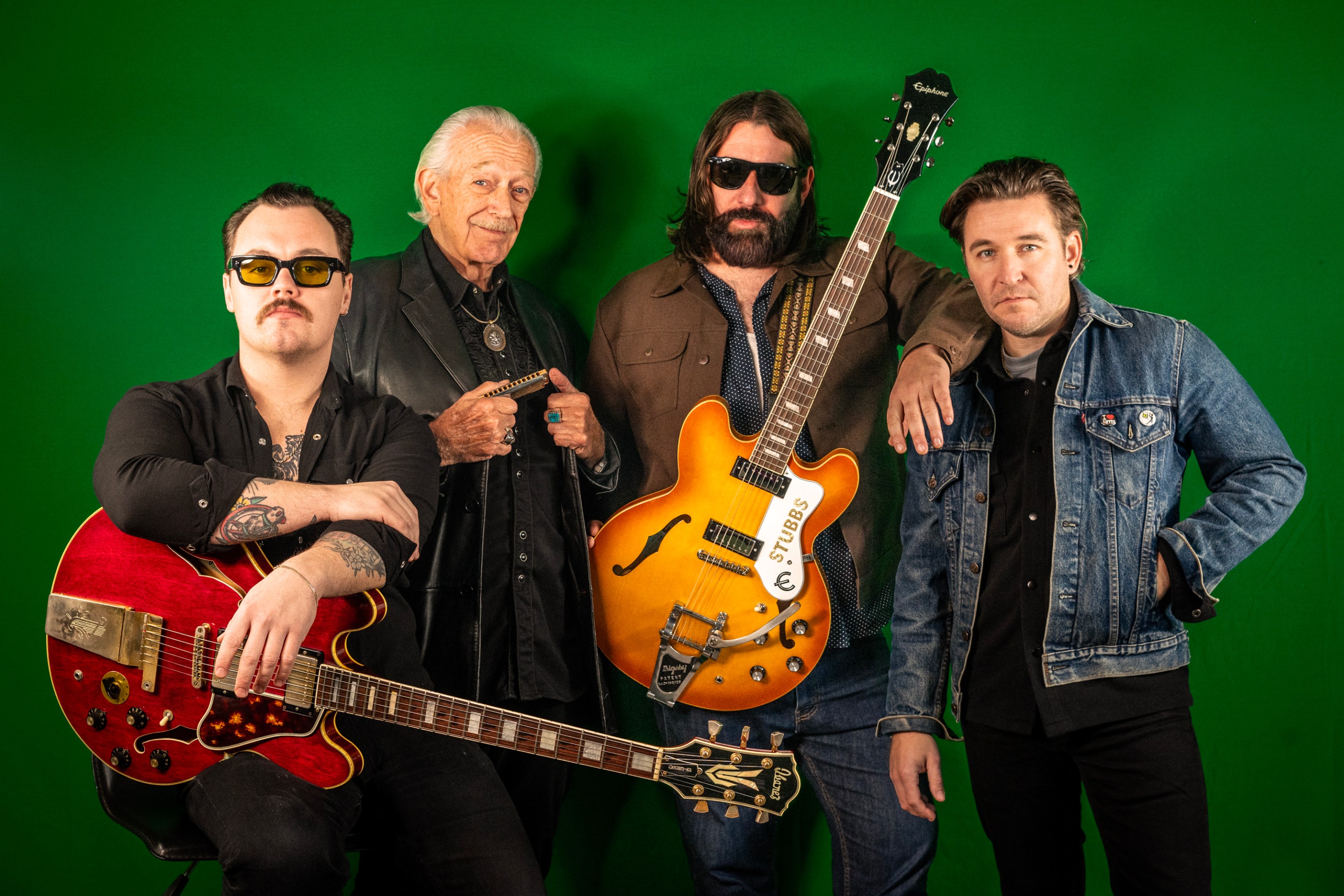
Since high school bandmates Jake Brownstein (guitar), Mike Goodman (bass) and Dani Battat (keyboards) formally united with former Berklee College of Music battle of the bands opponent Alex Bailey (drums) in 2016, they’ve built out their legacy with patience, intention and a commitment to resolving their individual perspectives in lush harmony. The musicians’ love for jam music and vision for their place in its lineage have spirited them along through countless achievements on stage and in the studio, and they’ve long outgrown the oft-applied superlative of “rising stars.” Ten years into their story, their acute awareness of themselves and their environment continues to fuel their evolution and allows them to share moments of deep listening and true presence with their audience.
“The band is feeling like we're finding a really cool pocket in what we're doing, and we’re more connected to each other than ever before,” Brownstein says. “Sometimes, you realize that you were in a moment in hindsight, like, ‘That was a turn of the page,’ but I think right now, we all feel very present in this new chapter, and we're able to experience it in real time. I can't speak for anyone else, but I really want people to come out and see what's happening right now, because I think it's a really cool moment in the band's timeline.”
In conversation, it seems like the local haunts and fan experiences at Eggy’s origins are much more to its members than a distant memory. While the atmosphere aboard Jam Cruise 22 naturally occasions reflective moments, the band’s reminiscences reach far beyond their first appearance on the floating festival in 2024—since which they’ve released their sophomore studio album, Waiting Game, and shared stages with the likes of Bruce Hornsby, Taper’s Choice, moe. and more—to the foundations of their creativity. Before their golden hour set on the Pool Deck main stage, the quartet sat with Relix to speak on their journey from being students of jam to simply being themselves, and what preserving that original curiosity brings to their music today.
What's new this second time on the boat? Is there anything that you feel you've learned from your first time, or anything that feels different about where you're at as performers?
Dani Battat: Well, they upgraded us to balcony rooms this time, so that definitely changes the nature of the experience, you know?
Alex Bailey: It's a big upgrade from what we had last time.
Mike Goodman: And we went from playing the Brews at Sea Stage and the Black and White Lounge to the Theater and the Pool Deck, which is amazing. We've covered some good ground in these two years.
DB: One thing that feels different, too, is that the first time, there was such a shock value of the whole experience and fear of missing out on anything. So you're like, "How do you stay up for a week straight?" Now, really valuing rest time aboard the boat is pretty much top priority.
AB: I also feel like having two more years of festival experience, touring experience, we know so many more of the musicians on the boat this time. We look at the lineup, and it's like, "Oh, friends, friends, friends, friends, friends..." So whether it's walking around and chatting with the artists, or whether it's in the Jam Rooms or sit-ins, there's just so much opportunity for collaboration, knowing so many people around.
On that, how does it feel compared to your typical festival? What are the major differences in how artists relate to each other, and the kind of communication that goes on before the collaborations?
Jake Brownstein: Barely anybody leaves. You know, so many times you're looking at a festival lineup thinking that you're going to be able to connect with a friend or band that you've been wanting to see, and you're like, "Well, we play Friday, and they play Sunday, and we're already out on Saturday." So to be able to share a space and really have quality time, even see music together, it's just awesome. And the spirit of collaboration is always strong on the boat. I feel like people are less precious about their set – like, "This is my set." You see a lot of people bringing on different people throughout the weekend.
DB: Yeah, and just about everyone plays twice. A beast plays twice with their project, so you know you'll get the chance to see them. There's always that opportunity. I was thinking, usually festivals are like ships in the night. So they were like, "Let's just put everyone on the same ship and make it easier." That's a little dad humor.
Let’s just keep throwing boat idioms in and pack this thing as tight as we can. I like the idea that it's so collaboration-forward that the ownership of a performance is deferred in that way—it becomes more about what we're all doing here together than what you're doing individually, right?
DB: I had that feeling last night watching George Porter with Leo Nocentelli, seeing Ivan [Neville] on keys and Stanton Moore on drums, and kind of having this realization that we're all in this great tradition that's intended to be passed down from generation to generation. Seeing the elder statesmen of this, especially in funk music, seeing George Porter—I imagine that guy's in his 70s [Editor’s Note: He’s 78], and there are people that are in their early 20s rocking this boat. The fact that there's a 50-year spread…It's such an amazing, powerful thing that it's like spanned such a long time.
I'm curious about what it's like for you to watch other artists. Are you engaging with it on an analytical level the whole time, like "How are they doing that? How can I do that?" Do you have to be conscious about turning that off? Where's the line between being a listener and a performer on the other side of the stage?
JB: I think for the most part, that level of listening as a musician becomes so innate that I'm not really processing the music that way anymore. When I was younger, probably early on in college, that was an exercise: How do you listen to music on a deeper level, and how do you absorb it, and be analytical, and understand what's going on? At a certain point, there's the curve; you start in this pure listening, where you're not thinking about any of that stuff, and then the journey of getting deeper into music and sort of thinking on that deeper level, and then, at least for me, there’s a return. There is a process that's going on there, but I'm not as self-aware of it anymore, so it doesn't interfere with my ability to dance, have a good time, and truly enjoy it as a listener.
And honestly, I'm always amazed that there are so many people, whether they're musicians or not, that are listening on that level. I think that's a huge draw of this musical world, is this depth to it that people are tapped into. So I certainly don't feel like I'm listening to anything differently than anyone else.
AB: I almost feel like this study used to be watching the show and trying to figure out what they're doing, and actually what they're playing. But now, the study is being in the audience and seeing how the music is making me feel, and how we might want to make people feel on stage—dancing along to it, and feeling it deeply as an audience member, and keeping in mind, "How do we make that happen for people out there?"
JB: Right, not dissecting specifically what they're playing as much as the moment that's happening. You asked what's different about being here two years later, and I think it ties into that. I feel a lot more, and I think the band feels a lot more in our own, and discovering what we are more and more. So listening to other people gathering the moment and the feeling, but not trying to figure out how they're doing it, and more thinking about…
DB: How we would do it. To jump off what you guys have been saying, it's not the specifics of the notes or anything that's happening in the music, but how it's being expressed, and watching people lean into the spirit and the freedom and really being inspired by that. Being like, "Wow, this person is just so them." There's so much collaboration, and so many times where it's like, you're gonna fill the role of guitar player from Tim Palmieri, and I'm gonna step in and take the organ over from Peter Levin, and I don't want to be him. I just want to lean into that same spirit that they are. It's inspiring to just tap into as much of yourself as possible and see people be so unapologetically themselves. "That could only be that person" is a way I like to think of it. When you hear John Medeski play, that could only be him. And rather than trying to know exactly how he's doing this thing, I just want that freedom to feel like I could do whatever I want the same way that he feels that he could do whatever he wants.
JB: To be able to absorb that and portray it, you have to feel it as an audience member first. Because really, it's like, "How is it affecting me?" You have to give yourself to the experience on that level. And it's so cool to have that opportunity so much on the boat.
Two threads here. First, in that same movement from listening for all the finer points to feeling it a bit more, do you feel that you've shifted from thinking about the details to trusting in something more innate in your improvisation with each other? Then, what do you do to tap into that deeper part of yourself?
MG: For the latter half of your question, I think it's sort of like meditation in that it's a practice. The longer we've been doing it, the more we play together, it becomes easier to jump right into that state, much like meditation, where when you start, you maybe don't ever get to that point. It takes you 10 minutes, it takes you an hour. But the more practice you get in it, you can jump right into that state. I think that playing and improvising together after all these years, it becomes a state that's easier to get into than not. I don't know if anybody else feels that way.
DB: Yeah, I'm thinking a lot about this question, because I'm trying to think of what I do to get into that place. And I feel like, with you guys, we have such a common language with one another at this point—I remember, I was talking to somebody after our set the other night who was like, "There was a moment where it sounded like you guys were all soloing, and then it all came together." And I was like, "Yeah, I love when it all comes together." But there's a lot of trust in it, and I think sometimes the simplest things need a little reminder, especially when there's a lot of moving parts. I think about myself... I sometimes just need little reminders of like, "You're right where you're supposed to be. Everything that you're going to do, as long as you make sure you're listening to one another, will be what it will be."
And just kind of allowing myself to give in to the moment. Like sometimes when you play festival, it's really chaotic, and you're playing some gear that's not yours, and something's gonna go wrong, and the sound is..." and just being like, "Yeah, that is gonna happen." Being really accepting of things and kind of "yes, and”-ing the situation. Even if sometimes you're having a shitty day, being like, "Yeah, and I get to go play music." I think that's part of my process. You just need a little reminder sometimes, like, "Everything else will be there when you get off the stage. This is the moment to just be you. You don't have to think about any of that stuff."
AB: It's a weird mixture of being really present and in your body, but also being in the ether of what's happening in the music and grabbing inspiration from places that don't require using your mind. A lot of times things start to go wrong when you turn on your brain, and when you start actually thinking about what you're doing, or how to make the jam better, or whatever it is. Yes, you need to be trying to push things to new places, and thinking about how to do that, but without using your brain in a weird way. I just know that sometimes the second that I think about physically, what I'm doing or technique is when it falls apart for me. So it's a strange cocktail of presence and non-presence.
DB: You have to channel that part of your brain that allows your heart to come through.
AB: It's more of the heart than it is the brain.
JB: You gotta be like a dolphin...
DB: Keeping up with the sea imagery.
JB: Where half of your brain can be shut off, and you can still travel.
AB: I thought you were going towards the echolocation.
JB: Yeah, well, that too. At the end of the day, it's not lost on us that we get to do what we love. So a lot of the time when I'm on stage, and I might be spinning my own wheels, I'm robbing myself of an experience that rarely reflects in the recording. You listen back like, "Man, why was I going through whatever was going on? Because this is amazing." Or times when you felt like, "I don't think anything was happening here," it's like, "Oh, no, I was probably just detached. I wasn't tuning in. There was something really special that was happening and I just wasn't seeing it." Which is very human.
But I think part of it is that I don't want to deny myself, or any of us, the release that music is supposed to give all of us. And you never want to put that burden on the audience. It's our job to allow people to feel release and joy and celebration, or reflection, or whatever the music can do for you. I have to remain open to allow other people to feel open.
In a very literal sense, when there's a sound issue, we get to travel with our own front of house, CJ [Portolese], who's been doing an incredible job, and we've been with him for, what, four years now? So I'm just trusting that he's making it sound good. You know, sometimes with a festival, it's a throw and go. You haven't even played a note together, and it's like, "All right..."
MG: "Go!" [laughter].
JB: Even the other night, Alex’s vocal was so loud in my mix, and when you would do a harmony that would just pop in every now and then, it was so loud that I was just cracking up. Just being like, "Whoa!"
AB: I think I saw that, yeah.
JB: I kept being like, "Should I turn it down?" But it was honestly kind of a fun reminder of the crazy thing that we get to do.
But I mean, we have so many conversations together on and off the stage. We've been better at finding the right times to go into that analytical perspective, where we feel like we can actually work on that type of stuff, and finding better ways to communicate what we want to see evolve in the music. Because at least for our band, some of it happens subconsciously – just in that magic that happens when you get four people together – and some of it's through conversation; being like, "Oh, this is, this is where my intuition is, and where are you coming from in that?" And, "Hey, I'm trying to better understand what you're speaking on," you know?
Like any relationship, it's an open dialogue, and good communication seems to always lead the way. So knowing that we have those conversations, knowing that we're all – you mentioned trust, that we're receptive to those types of things. So when we're on the stage, I can't expect all of those things to surface just because we talk about it, but knowing that we're all like on the same page lets you feel closer to it.
Beyond the past few nights alone, it's been a big year of collaboration; you had your Bruce Hornsby run, the Taper's Choice run, the moe. run...When you're sharing stages with people for the first time, without that foundation of consistency, is there something that you're listening for to make sure that you're connecting on the same level?
JB: Well, in the case of an artist like Bruce, it was honestly very funny, because I think he was probably flattered, but very impressed with how we were engaging with his music. And we're like, "Yeah, dude, because we're huge fans." I don't necessarily know what it's like to be in the seat until we're all up there as full participants in the music, but so much of it has been pivotal in how we look at what we do, and we've absorbed so much of it. It's the same thing with like a band like moe., where we're very grateful that we have the opportunity to play with people that have made a serious impact on our musical journey. No matter who we're playing with—I mean, last night, we got to play with Lebo and Tony Hall and Aron Magner—there's somewhere in the Venn diagram where we all fit, and why we're all here, so trying to just trust that we all speak that same language, and we're coming from similar places, and that we all have something to l contribute and add to it.
This has been a struggle that I feel like I've only been getting better at more recently. It's like, this opportunity, oftentimes, is not a favor to us. We're there for a reason, and we're there to do what we do, and to add our voice. So it's push and pull sometimes. One of the nights with Bruce, his old guitar player, Doug Derryberry, was in the crowd, so there was a little bit of a mental thing for me. Being like, "Okay, but I'm here now, and maybe you're watching me play with this band that you played with for 10, 15 years, and I'm only up there sitting in, I'm not like this replacement." Going through a little bit of "What would he do?", and having to be aware that some of that stuff has trickled in, but as Dani said, I'm not here to be this other person. I'm here to be myself, and maybe channel the spirit, but I don't have to think about channeling the spirit.
So it's never a straight line, but I think for the most part, I've gotten better at believing that I'm here to do what I do, and there's a reason why we're all here doing what we're doing; rather than trying to think about how I fit in, figuring that I already do fit in. So this is an opportunity for me to hear what somebody else is doing, but it's also an opportunity for them to engage with our voice.
One of the things that makes this scene so special is the shared support, which I think comes from that same common language and understanding. Back on Jam Cruise two years later, in a different place than you were the last time you were here, do you feel a responsibility to show support for newer acts in the same way that's always been passed down?
JB: I'm doing a Jam Room tonight. There's no right way or wrong way to have a moment like that, but the spirit of it really is collaboration, so I'm doing it all improv. There's no rules. People had reached out to me like, "What songs are you gonna be playing?" It's not gonna be like that. We're just gonna see what happens. And a lot of where that channeled from was sort of thinking about myself two years ago, standing on the side of the stage with my guitar. I didn't know people as well, and certainly people didn't really know us that much, and what we were about. It wasn't an intentional thing, and it might have just been within, but I remember feeling this barrier of like, "Well, I'm going to get on the stage, and what if I don't know those songs? And, "There's so many people that want to play. Should I be up here?" So for me, I think a lot of how I thought about going about the Jam Room was like, I want everyone to feel like they already belong, and that they can just jump in, and I think a lot of that was thinking about how that would make me feel – what would make me think, "Oh, this is an even playing field, and there's not like homework that I should have done." A deeper sense of belonging.
So I think it's super important as the band grows, outside of the boat. We've been afforded so many great opportunities, and we've gotten to connect with so many people who have made a real influence, both before we got to play with them, and certainly after. Bruce is a great example; I still catch myself in awe of how he's a hero-turned-friend. So it's super important to us to be able to continue to nurture those types of opportunities for people that are coming up, and see the Eggy in younger acts. Like, "Who's really going for it? Who's putting themselves out there?" There's so many times that I don't know if we were worth the ticket in that market, but what we were worth was the music that we played, and the spirit that we brought to it, and people being aware of how hard we were working to try to put ourselves out there. So as our stages get bigger, and we get the chance to foster that type of environment for younger bands, I think it's something that's super important to us.
MG: Nailed it. Couldn't have said it better myself.
We've hit a lot of the dimensions of this final thing, but flying – or sailing – under the banner of a jamband, what are the unique freedoms that provides, and are there any limitations to speak of?
DB: Being in the jamband world, it's this idea that you have this flexibility to go off the cuff in the moment, really play to the environment, and that that's appreciated. Because sometimes you're playing at 1 p.m., 5 p.m., 8 p.m., 1:30 a.m., and you're able to craft something that feels right for the experience. I think sometimes we can get in our own heads about stigmas, or expectations, or understanding that people create comparisons, and then realize everyone's gonna have their experience of you based off of their own experience of the world anyway. Someone's like, "You guys sound like Phish!" And you're like, "Man, we were trying not to," but that person loves Phish, so to tell you that is a way to express, "I love you as much as the thing I love the most." Okay, that's great! I fuck with that.
AB: I'll take that.
DB: There's so many acts that come to Jam Cruise, and everyone has their own favorite things. It's not like sports, you don't just have one team that you like. People are really such fans of the genre and the expression of it all that I think being a jamband is allowing yourself to be a little freer with what you do and not feel like you need to do it the same way. We couldn't do it the same way if we tried. It's why we all fell in love with this, too. It's something we love about Hornsby, like "Man, the way you sang this line one time was different." Just feeling that absolute cutting-edge of the knife moment is what we're all chasing as performers. No matter what any of us end up doing in the rest of our lives, the thing that we do together is trying to really be at the horizon that you see at the end of the sea, and just chasing that.
JB: I had a really great conversation with Alex Bleeker, who is both in Taper's Choice and Real Estate, so he has a very unique perspective of coming from the indie world and being a lover of jam music, and sort of the whole Taper's Choice project being all these people who have this completely different musical experience coming from a very different scene. It was cool talking to him, because I think everyone has heard before that, "Oh, the jamband world is really a community," and hearing it from him, he says that in the indie scene, it's sort of like, "Who's the new poster child?" So much of how that community operates is about what's next, who's in, and can I find it before you find it, and once it becomes mainstream, it's not indie anymore.
So he says the coolest thing about the jam world is the loyalty. People are really devoted, and when they love you, they love you, and they're with you, and they're there for the evolution. On a general level, they want to see more people come into it. I mean, we all know the jaded fan, or, you know, "You never saw Jerry," but I think that speaks to like the smallest percentage, and you're gonna find that in any scene. But for the most part, people want to see this music, get passed down from generation to generation, Grateful Dead for 300 years. There's a beautiful ownership of the music.
I think that also ties into why we have to be free, open, and loving to ourselves when we're on stage, because people really feel connected to it, feel their own ownership of it, and have their own voice in that conversation. It's just the most beautiful community, because its number one goal is to have it grow, and to be inclusive, and to have these experiences in a religious sort of way, like "You need to feel this thing that I'm feeling, and I want you to be involved and to transcend, and to just experience this greater thing." I've had that experience as a fan of music across so many genres, and I've had beautiful connections to so many artists. But I think what's most special about this scene is that it's meant to be experienced together. And that loyalty of being like, "I want to be a part of this journey."
People will come up to us like, "I saw you guys two years ago, you guys are so much better!" That's awesome. They're there for it. I remember talking to Marc Brownstein about when they were trying to figure out that special thing [The Disco Biscuits] do, where a lot of it is MIDI, with all their instruments really intensely connected to each other. He says, "We were trying to figure that out for years, even just with the technology, but people stuck with us as we were trying to figure this thing out in real time." So I don't think the goal is to be the perfect product, to be in the incubator until you're ready to go. You're there for when we're touching the magic, and you're there for when we fall, and that's the most special thing you could ever ask of a person.