Joe Henry Shares His _Reverie_
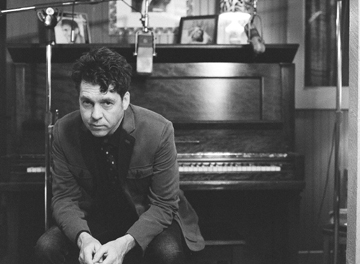
Earlier this year, Grammy award-winning producer Joe Henry took a few days out of his ever-busy schedule and gathered some of his favorite musicians – drummer Jay Bellerose, bassist David Piltch and pianist Keefus Ciancia – in his home studio to record his own music in an acoustic, mostly live setting. In anticipating of this album’s release, he hosted a private listening party (that included Lucinda Williams and Van Dyke Parks) to hear the final product, Reverie, which Anti will be releasing October 11th.
Before playing a vinyl version of the album, Henry introduced his acoustic, mostly live recording by calling it “a collision of sounds,” which became the record’s fifth instrument. The 14-song album certainly holds a loose, almost disheveled musical quality – but it never derails – as Henry (who played guitar) leads his band on an intriguing trek that visits blues, jazz, rock, art songs and other musical styles. It’s music that is hard to describe but interesting to experience. You can hear elements of artists who Henry has produced in past – like Mose Allison and Elvis Costello – in the music as well as shadow of Tom Waits.
After playing the just-over-60 minute album, Henry talked a little about Reverie and its creation. He related how, while deeply jetlagged in Spain, he visited the Picasso Museum. While looking at Picasso’s early work, he was inspired to make an album. “I wanted to do with songs what he was doing,” Henry explained, and you can “hear” a Picasso-like influence in Reverie’s songs. There is a deconstructed aspect to music similar to the way that Picasso’s Cubism reshaped traditional images. He said that he decided to “speak with only a few colors” musically on this project. However, Henry and his talented backing crew are able to do a lot with these “few colors.” Besides the principal players (Bellarose, Piltch and Ciancia), esteem guitar Mark Ribot, keyboardist Patrick Warren and singer Jean McClain stopped by to contribute, while Lisa Hannigan added her vocals from a Dublin studio.
Henry also had the idea to leave the windows open in his aboveground “basement” studio to bring the outside world into the music. The sound of Henry’s beagles barking and a neighbor’s yells as well as the near-ambient street sounds that filter in subtly between tracks, which bring a film soundtrack element to this piece. Henry said that when he took them out of the mix, the songs didn’t sound right. He also told the funny story of having to coerce city workers to move a loud woodchipper away from his corner while he was doing a session with Glen Hansard; however, he welcomed the extraneous sounds for this, his own project.
He spoke a little about individual tunes, stating that “Room At Arles” was for Vic Chestnutt while he wrote “Tomorrow is October” for Harry Belafonte, but Belafonte decided not to do a music project and urged Henry to record the tune. Henry admitted it’s “not a melody line I’d give myself.”
Henry also talked about how he likes to have songs reveal themselves, to be discovered in the playing. He asks his musicians to help him disappear into the song and “wait until the song is revealed.” He stated that “it is about the song, not me.” There certainly is a sense of discovery for the listener too as the music artfully makes quick moves, similar to improvised jazz. However, these tunes are far from improvised pieces. Henry calls himself as “relentless re-writer,” adding that “I make sure I believe in the songs” before recording them.
After hearing Reverie, there is little question that Henry believes in these songs, which offers listeners an adventurous, ambitious but fully satisfying musical experience.
Reverie Track Listing
Heaven’s Escape
Odetta
After The War
Sticks & Stones
Grand Street
Dark Tears
Strung
Tomorrow Is October
Piano Furnace
Deathbed Version
Room At Arles
Eyes Out For You
Unspeakable
The World And All I Know