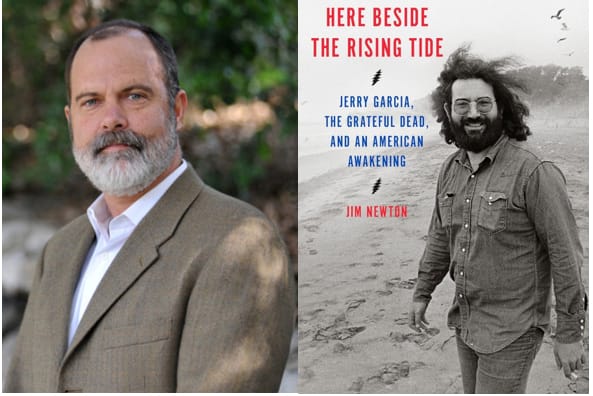
“I went to the US Festival in 1982 when I was a freshman in college. I’d grown up in Palo Alto and I’d seen the Dead a couple of times at that point, but they never really made that big of an impression on me. Then that morning, when it was Breakfast with the Dead, I was really struck by what I experienced,” reflects journalist Jim Newton, author of the new book Here Beside the Rising Tide: Jerry Garcia, The Grateful Dead, and An American Awakening. “It had been this hot, kind of miserable weekend in Southern California. Then when they came on it was cool, and Deadheads just sort of took the field. They were kind to each other, making sure people had water, and the whole atmosphere of the place changed. That’s the first time I can remember thinking to myself: ‘Boy, this would be worth writing about someday.’ As you’ll note, that was 43 years ago. So the precipitating idea for the book goes back that far, it just took me a long time to get to it.”
In the interim, Newton flourished as a journalist and educator. He spent a quarter century at the LA Times, starting out as a reporter, where he contributed to Pulitzer Prize winning staff coverage of the 1992 Los Angeles riots and the 1994 Northridge Earthquake. He later took on an editorial role at the paper, before commencing a teaching career at UCLA in 2015. There he also founded Blueprint, a magazine that explores public policy across the state. Contemporaneously, he wrote books, starting with 2006’s Justice for All: Earl Warren and the Nation He Made, which focuses on the California governor who went on to become Chief Justice of the U.S. Supreme Court. Subsequent works include Eisenhower: The White House Years (2011) and Man of Tomorrow: The Relentless Life of Jerry Brown (2020).
Unlike those prior monographs, which placed politics at the fore, while also offering cultural analysis, Newton flips the equation with Here Beside the Rising Tide. “I’m a political writer,” he notes. “That’s my day job, and it’s the natural place for me to start thinking about history. I also write about culture because they’re both part of a whole, but this is the first time I’ve put the culture part in front, which was harder for me to do. That intertwining of culture and politics was not new to me, it’s just that the emphasis was different.”
When you began working on this project, did you have an overarching thesis in mind?
The only real guiding principle I had was that I wanted to see Jerry Garcia in the larger context of the counterculture. I’ve been interested in counterculture for a long time. Tom Hayden was a friend and someone I knew here in LA, so I was interested in seeing Garcia and the Dead through that lens.
From there, the discovery part is always the most exciting part of researching a book for me, and that was unequivocally the case in this project. The truth is that while I admired Garcia, I admired him the way almost everyone does, which is to say from a hundred yards away. As a member of the audience, I never met him, I never spoke to him. So I didn’t really have a good sense of him as a person. I just had a sense of him as a magical musician and I knew there was something different about his artistry.
In terms of your engagement with the band’s music over the years, how active was your fandom?
I don’t presume to refer to myself as a Deadhead. For me, the sort of threshold for being a serious Deadhead is that you traveled with the band. I never did that, but I caught them at shows growing up in the Bay Area, when I was in college on the East Coast and in the years since.
My first shows were in the late ‘70s. I probably saw them 40 or 50 times total, everywhere from Red Rocks to New Haven to Atlanta. I mentioned the US Festival, and there were a few other places, like Washington, D.C. I was at the show in RFK Stadium that took place the day before Garcia flew back home and fell into the coma. That felt like the hottest day on earth, so I don’t blame him for having a bad reaction. So I guess what I would say is that I was always a devoted, appreciative fan, but I am not a Bill Walton 800-show kind of guy.
Although for the record, Bill Walton was nonpareil.
That’s absolutely right. [Laughs.] But, for instance, when I interviewed Mountain Girl, which I did a few times, at one point, I asked her how many shows she’d gone to, and she said, “You’d be surprised—not that many.” She said, “I had kids, and I would catch them where I could, but I didn’t travel much with them. It was usually Jerry going out on the road and me at home.” I don’t want to compare myself to her either, but I guess I would say I was appreciatively on the edges of that culture without ever being fully immersed in it.
Somewhat to that end, did you have a particular audience in mind as you were working on the book?
The way I thought about the audience for the book—the hoped-for audience, anyway— is sort of concentric circles. At the center of it, I really want Deadheads to see their experience in this, learn more about it and maybe think about it freshly. But moving out from there, I want it to appeal to more casual fans of the band, those interested in counterculture in the ‘60s and the ‘70s and those interested in California history and the politics of the period.
I also hope some fans of my other books might be willing to pick up a book on Jerry Garcia, just to wonder how it might connect to Dwight Eisenhower or Earl Warren or Jerry Brown.
So I imagine there being overlapping audiences, or I hope that’s true. I also hope it causes some folks who otherwise might not think of Garcia as a central cultural figure, or even a political figure from the period, to think freshly about him, too.
Was there a specific misconception you hoped to correct? Not necessarily in the larger sense, but maybe relative to a smaller story along the way?
My intention was less to correct a misconception than to rebalance some of the history. For instance, just to cite one example, Gitlin’s The Sixties is a great book about the politics of the ‘60s, the anti-war movement, the peace movement, the Civil Rights Movement, SDS and Weathermen. All of that is beautifully and personally handled in that book, but there’s very little California, there’s very little culture, there’s very little music. That’s not what he set out to do.
That’s not a criticism of his book, but what I was trying to do is suggest that all of that is part of this larger, incoherent, but undeniably connected culture of the period.
Then the other thing that I wanted to do—again, not exactly to correct anyone else but maybe to amplify—was to bring it into the present, and ask the question, “How much of this continues to inflect our lives today?” When I started the book, Trump was president. Then Trump wasn’t president, and by the time I finished, he was president again.
So some of these ideas about how to respond to a government that feels disconnected from American values and American history and disconnected from many of the people it purports to represent became more vivid as I was writing the final draft of the book. By that point, Trump was suddenly back on the scene and counterculture felt more relevant than ever.
One of the points that you emphasize throughout the book is that the counterculture is not monolithic.
Yes, that’s how I approached it. First of all, nobody has the right or privilege to define the counterculture for everyone else. I mean, there’s a lot of ways into that story.
The threads of the counterculture are unified by their conviction that the government did not represent them well. That included a new way of thinking about our relationship with the environment, a new way of thinking about the war, a new way of thinking about wars in general and then all these other offshoots. There are the cultural pieces of it, literary pieces of it, film versions of it. I also think some of counterculture is reactive to itself, so that there’s movement even within the movement.
What that helped me think through is the idea that if the counterculture is the very political New Left idea of Tom Hayden, SDS and Weatherman, then how does Garcia fit into that? He’s not really part of that, but if the counterculture is presenting an alternative way of living outside of a culture—that is responding to that culture and countering it— then I think you can see Garcia and the Dead as very much a part of that frame.
Another way of thinking about this is the difference between a radical and a bohemian. A radical is someone like a Black Panther, who’s there to change your mind, who’s there to tell you: “The way you’re thinking about the world is wrong, and here’s our alternative that we want you to subscribe to.” That’s a classic radical.
A bohemian is someone who says, “We don’t accept this society the way it is, but rather than dictate an alternative and recruit you to it, we’re just going to go live this other way. If you like it, you can join us. You can do it too.” They’re not evangelical in quite the same way, and to me, that’s where Garcia and the Dead f it into this. It’s about adopting values and living a set of values and presenting those, even inadvertently, as an alternative or a counter to the culture.
At one point, you quote Garcia, who says, “The government is not in a position of power in this country. The kind of power that they think they have is some pretty illusionary thing and exists only as long as people continue to believe in it.” Even if he’s not offering an alternative, that’s still a rather bold statement.
In some ways, it’s more radical than one that says, “The government is in power and we’re trying to oust it or change it.” Instead it says, “Forget it altogether. It has no meaning whatsoever to me.” I don’t think that’s a perfect theory of power, but it’s a very radical statement.
Since Garcia did not actively interject himself into the formal realm of party politics, some folks would suggest that he was not a political figure. However, you take a contrary view in the book.
If Jerry Garcia were sitting here right now, and you asked him if he was a political figure, then I have no doubt that he would say no. But I think if you engaged him in a conversation, you would quickly find yourself deep in discussion about what I would call politics—not the politics of campaigns or fundraising or elections but the politics of values. As someone who writes a lot about politics, the bottom line of politics is that it’s a competition or a marketplace of ideas and values. In that context, he’s very much a political figure, whether he thought of himself that way or not.
The Acid Tests and the value system that they promulgated resonated throughout the Grateful Dead’s history. There’s a formlessness that begins with the idea that the band could play or not play and either decision was valid. This also relates to the origins and development of the group, in which they weren’t picking musicians to fill a particular musical slot. It was more character-driven.
When I interviewed Huey Lewis, he pointed out that if you were forming a band today, you’d figure out what kind of music you wanted to play and then you’d find musicians who could help you make that particular sound. You’d build it around musicianship.
Well, that’s not the way the Grateful Dead came together. It was really about this shared exploration and then learning the music together. I mean, start with the fact that Phil Lesh was recruited to be their bass player and he didn’t have a bass. He didn’t even know how to play the bass. It doesn’t get more character-based than that.
I think that helps to account for their resilience and the diversity of musical influences they brought to it. It wasn’t five guys who got together and made a rock-and-roll band. It really is something more organic and complicated and interesting than that.
The Acid Tests are the perfect germination point for that. As you said, they didn’t even have to play or they played for a little bit and then they stopped. They thought of themselves as much a part of the event as they did the entertainment for the event. Their whole relationship with their audience came out of it, along with the willingness to experiment and to make mistakes—all of which was terribly charming about them.
I remember going to shows where I enjoyed watching them work through something that had somehow gone awry. Other times, they would make a mistake and sort of laugh it off. Even though they were serious about the music, they recognized that it was an unfolding act each time. It was exciting that no one knew how it was going to go.
You also focus on 1967’s Human Be-In at Golden Gate Park. Can you talk about its import?
In the first draft of this book, I started at the Human Be-In because it was such an important moment of inflection in countercultural history, although on the advice of my terrific editor, Ben Greenberg, I later reworked the opening for structural reasons.
The Be-In was styled as bringing together the New Left and the hippies—the tribes, as it were—but it was also something more than that. This idea of gathering in the field without one act to draw everyone, just to be together, is quite moving when you think about it. It was a very gentle expression of a culture gathering. It feels to me—and this is what I try to present in the book—that there were a lot of ideas in swirl leading into the Be In and coming out of it.
The people who were there and the people who were affected by it indirectly began to think of themselves as part of something, instead of just wondering whether they were on their own being concerned about culture or offended by it or reactive to it. There was a shared sense of purpose that emerged from that. It continued to be diverse and incoherent in certain ways, but I think the Be-In was sort of this magical interlude in the development of culture.
That was one of the reasons I went to San Francisco for the Dead & Company shows right before the book came out. There is something uplifting about being in Golden Gate Park and on the Polo Field that evokes the feeling that you’re back where it all began.
Ronald Reagan appears throughout the story, first as the governor of California during the band’s formative era and later as the president of the United States when the group hits a new peak of popularity. How consciously do you think they positioned themselves in contrast to him?
I would say they’re fairly steadfast. I mean, the music changes some, but as a value proposition—whether it’s the value of performance over recording, their relationship with their audience, the value of freedom, the value of community—things don’t change a lot with the Grateful Dead from beginning to end. But the backdrop against which they vibrate does.
In the 1980s, the larger political and social culture in the United States hardens. It gets meaner. It gets greedier and more inward-looking, and I don’t think it’s a coincidence that this coincides with a period in which the Dead become huge. I do think—and I remember feeling this myself—that the Dead became a place to go to get away from that. A Dead show was the antithesis of a Reagan rally.
You have Ronald Reagan advancing this idea of a kind of Western individualism backed up by the neutron bomb that’s as far as humanly possible from a Dead show and from the values of the Dead or San Francisco, even in that period.
So it feels to me, like that kind of reconnection with Reagan happens because the culture around them is hardening and they are staying true to something. For those people who still value the things that they value, they’re a life raft in a kind of unpleasant period and a rough sea. So I don’t think it’s a coincidence that they became big and attractive to people who were outside of that kind of core Grateful Dead culture and were repulsed by Reagan and what was going on around him. They are magnetic and an alternative to that. They’re a counterculture to that.
Thinking back to that era, there were some Deadheads who found the newcomers to be superficial in their fealty and drawn to the band almost as a matter of fashion.
This is all speaking in fairly broad strokes, but I think some people come to the Dead because they’re yearning for some kind of community, as well as music and culture and whatever they’re not finding in the Reagan years. They’re not finding that anywhere else and they’re serious about it. For them, this is a moment of eureka, of coming upon this culture that feels like it embodies something better than what’s out there.
Then there are other people who come to get high and to get away from their parents for the weekend—who heard about this thing called the Grateful Dead, where everybody gets wasted. So that part of it starts to take on its own weight by the ‘90s when shows got so big and so out of hand that the Dead really couldn’t manage it.
I think Garcia and the band generally just got overwhelmed by it. One of the things I feel like I took away from the reporting and research on this book is that counterculture works better when it’s smaller. It’s hard to maintain that kind of kinship, community and looking after one another when it gets too big.
That was true of the Haight during the Summer of Love and it was true of the Dead by the 1990s. These are hard enterprises to run at a big scale, and there is some sadness in that too.
But back to the original point: I think that those values are deep, not just in this culture, but generally through history. There are times when the broader culture embraces them, and there are times when the broader culture seems to turn away from them, with this very moment being one where the culture seems to be turning away from them. In those moments, the alternatives feel all the more attractive, and I do think the Dead were one of the small number of alternatives that you could go to in the 1980s and find some respite from the grind.
Certain critics of the Grateful Dead have suggested that because of the way the band stood outside mainstream society, whatever the Dead offered wasn’t substantive, particularly from a political perspective.
I’ve often heard the criticism, and I hear it still. I don’t think it’s correct. I think about what they presented in the form of a magical musical enterprise. They presented an alternative set of values that people could grab onto, and it has affected millions of people’s lives. It has affected my life. I’m a different person for having had the opportunity to experience the Grateful Dead as a young person. I believe that.
I hope I am a more compassionate person, a more patient person, a more engaged person, not because the Grateful Dead or Jerry Garcia had told me to be, but because they were and the people around them were. That has given shape and meaning to much of my life, and I am by no means the only person for whom that’s true. That is true for thousands and thousands, maybe millions of people. I just saw 60,000 of them in Golden Gate Park.
Not all those people ended up doing things of great consequence, but it doesn’t matter. What matters is that it affected them, and for the most part, I think it affected them in ways that they’re happy about. You don’t have to be Tom Hayden. You don’t have to run for office. You don’t have to pass a bill or lead a protest to have responded to something wrong about the culture. You can sometimes create art and have that be the response. I credit them with that.