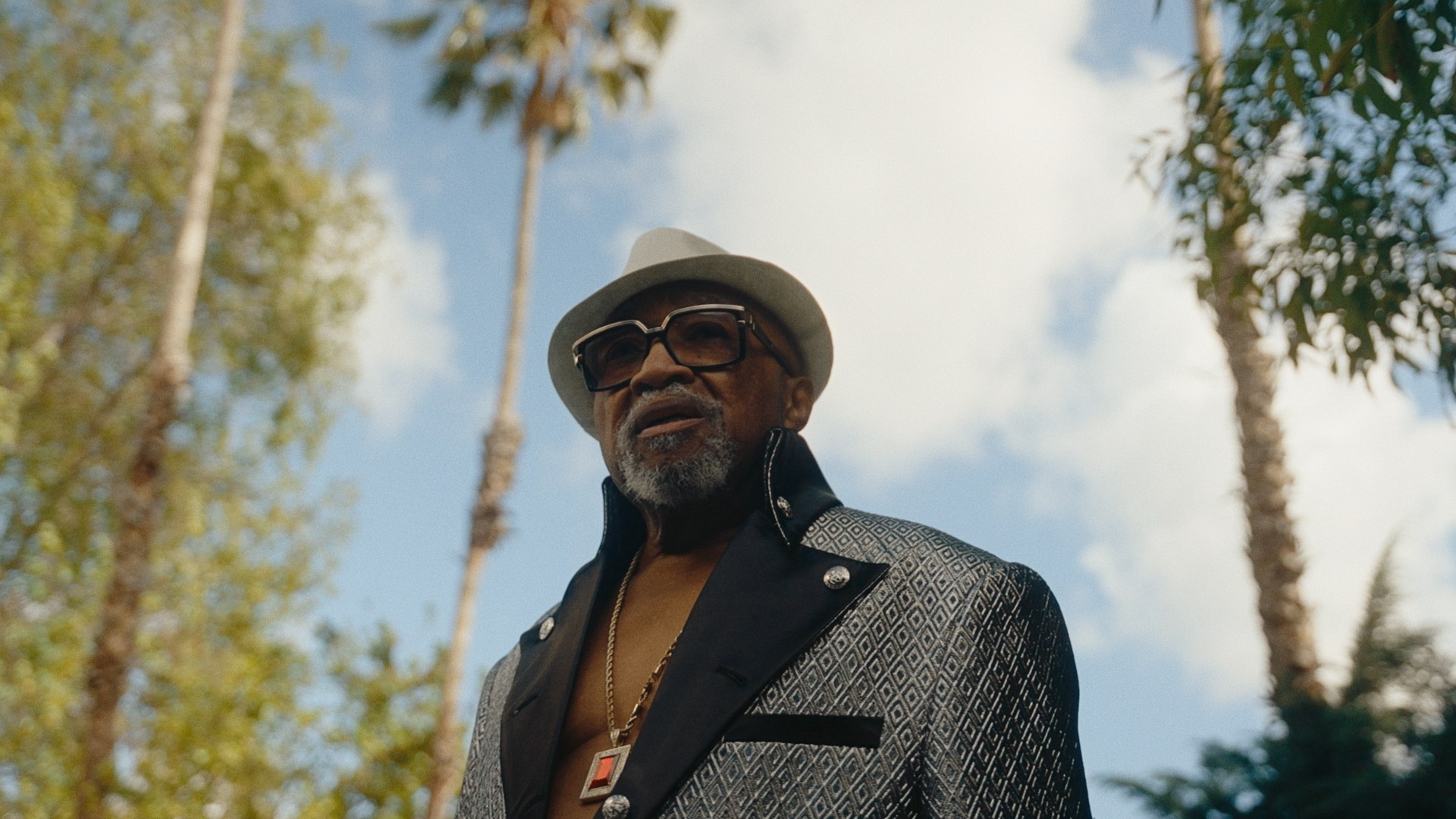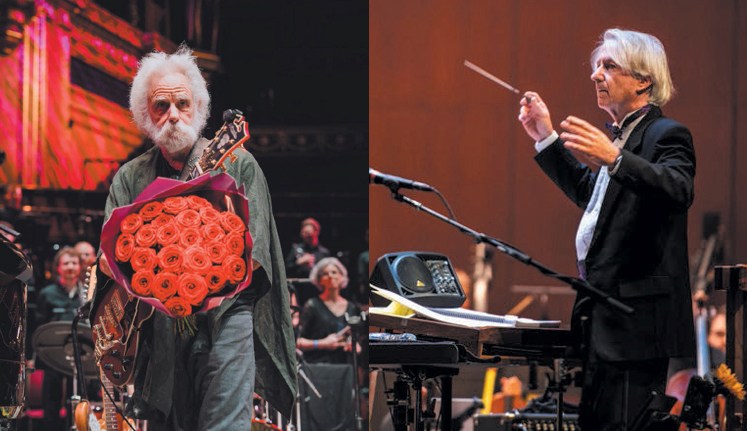
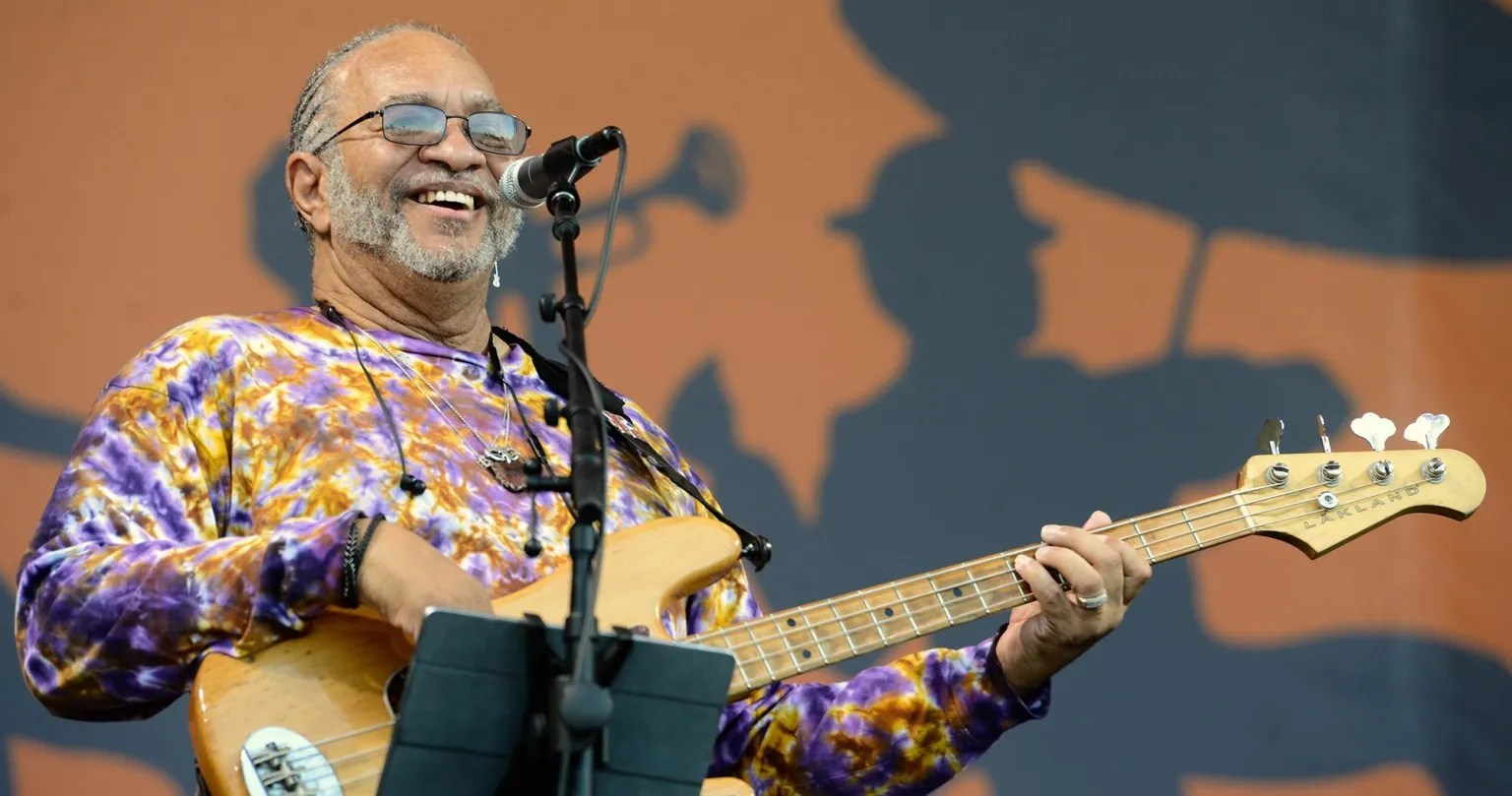
On April 8, George Porter Jr. will make his long-anticipated premiere appearance with the Louisiana Philharmonic Orchestra. The program will feature some classic songs from the storied bass player, along with a new composition written for strings that Porter began many years ago, then set aside while awaiting such an occasion to necessitate its completion.
The 78-year old musician remains active and energized. His regular Monday night performances at the Maple Leaf open with extended improvisational sequences, as Porter and the members of his longtime group Runnin’ Pardners feel out the room and the moment. Over the coming weeks, beyond his date with the LPO, the bassist will join numerous other artists in musical environments old and new, with the arrival of Jazz Fest season. As per usual, he will take the stage at the Fairgrounds during the final afternoon of the festival. Beyond this, Porter will dig in for two reunion gigs with the Meters, as well as Voodoo Dead, Daniel Donato’s Cosmic NOLA, the Daze Between Band, a trio with Johnny Vidacovich and Luther Dickinson, the Dead Funk Summit, the Shorty Turns 40 event, and the proverbial “more.” Meanwhile, he has been creating new music for two projects, even as he contemplates additional collaborative ventures.
“I’m still learning,” Porter says, which certainly accounts for his variegated endeavors. “New music comes to me, I’m hearing it and I’m also hearing ways to contribute to new artists and new experiences. I’m still a student, trying to collect new information and skills. So I keep my ears open, then play what is in my heart.”
How long had you been thinking about performing with an orchestra?
What first made me think about it was that Deacon John did one many years ago here in New Orleans. I never heard it, but I’ve heard about it. More recently, Lettuce did a performance with a symphonic orchestra, then they came to New Orleans and performed with our local orchestra.
Maybe a year or two after that, we were playing in a little room under the Orpheum Theater called the Double Dealer. The Orchestra’s home base is the Orpheum Theater, and the bass player from the orchestra Dave [Anderson] was there. He’s a fan and knows the guys in the Runnin’ Pardners. He said, "Porter, you ought to do something with the Orchestra." I told him, "Wow, you know what, I've been kind of bucket listing that idea for a while now.”
So what eventually happened was he mentioned it to his people and then Amanda [Bohren] from the Orchestra reached out to me and said, "We would love to do something with you because you're a local legend.” I told her, "Well, I don't know about the legend part but I think I have some songs that would go great with the symphony.” [Laughs.]
Originally Dave was going to work with me and arrange the songs, then he had some health issues. So now I’m working with someone else from the Orchestra on it. All of the songs will be familiar to people except for the final one which is going to be a new composition I started a number of years ago as a string arrangement that I’m calling called “Strings from the Heart.”
What initially inspired you to write that? Were you anticipating something like this might happen one day?
No, I was just playing around with GarageBand. This was a long while ago, and I never really knew what I was going to do with it. Then when this all came about, I said, "Wow, this might be a great time for it.”
What I’ll do is write chord formulas into the program and use the Band-in-a-Box to play those chord formulas. That way I can hear how one chord sounds against another chord. I can hear what a major chord sounds like next to a minor sixth. I can put in the chords and hear how they sound moving against each other. There are no melodies, I’m just hearing chords move from one to the next.
So with that one I was just playing with ideas. I think I had started with a mambo marching beat and the other parts were strings. I liked the way that felt, so I wrote the opening part with just the strings and the acoustic guitar. Then I wrote down the chord formulas as I was envisioning the chord movements.
The piece never got to any other concept musically, other than it was a nice piece of music that I have on my iPad. It was something that I looped and listened to every now and then to settle me down at night.
I want to close my performance with that, just an acoustic guitar and the strings. I also had the idea to do some spoken words on top of it. I was thinking that maybe Susan Cowsill could write a poem to fit around the thing, but the other night as I was sitting in the car listening to the song, I started talking into this little recorder I carry with me. I have to sit back and listen to the recording so I can find out how much of it is actually usable. [Laughs.]
As I understand it, you’ve been listening to classical music at night for many years now.
Back in my drugging days, that was the only thing that helped settle me down. I’ve been sober since 1988 but back then I joined one of those symphonic record clubs where you get five albums upfront and they continue sending them to you every quarter or so. That was about the only music that I would listen to other than the music that I was playing.
It’s still hard for me to relax and listen to music. Relaxing and listening to music is kind of like an oxymoron. I play hard, so I listen to easy stuff when I want to unwind. Some of it is synthesized, and some of it is floating and modal.
Beyond the composition you’ll be performing with the orchestra, have you been working on other songs as of late?
I have 10 pieces of music I’ve written that are earmarked towards a project that I’m hoping to record with John Medeski, John Scofield and Herlin Riley. I have 10 pieces of music already written, although with those guys, I also want to do some jamming. So I have the 10 songs but we may use four or five of them, then I’d like to record us while we play and see what comes of that.
That quite a quartet. I imagine it’s a challenge to lock down everyone’s schedules.
We’ve been talking about it. I also hope that Donald Harrison Jr. will be a part of it. We’re still figuring things out.
In addition to all of that, you have a new project that’s going to debut on April 28 at the Threadhead Cultural Foundation event. How did that come about?
It seems like every year I get invited to play the Threadhead party. It’s called the Patry. While I was on the way home last year, Denise [Sullivan, George’s partner] was in the car and she said that the boss had asked her, "So what’s Porter going to do next year?" I looked at her and I immediately said, “How about doing an all-girls band?”
She really liked that idea, so when I got to the house that night I immediately called Mia Borders and Susan Cowsill. After I contacted the two of them, I reached out to Keiko Komaki, the organ player. I didn’t think of a drummer right away but eventually we connected with Jazmine Butler, who was one of Russell Batiste's students. So those will be the five pieces.
I sent Mia a couple of songs and she’s written lyrics for them. Then last week she sent me two songs of her own that really fit the band. I want to do something that nobody’s heard, so while the set won't be all new material, it will definitely have at least four or five brand new pieces of music.
I'm not going to play any Runnin’ Pardners or Meters music. I might lean on some other New Orleans artists, like Earl King or maybe Dr. John. Then Susan suggested the Sly Stone song “Everyday People.” The other day I was in the car listening to one of the new pieces that I wrote called “Hear You,” and while it was fading out, I started singing “Sometimes I'm right and I can be wrong…” So I said, "Those two songs need to be together." I hadn’t thought about it until that moment in the car.
You have so many other fascinating gigs slated for Jazz Fest. On opening day, April 23, you’ll be at the Maple Leaf with Johnny Vidacovich and Luther Dickinson. You’ve been playing with Johnny for well over 50 years and you also have a close relationship with Luther. How will that night unfold?
Well with that Johnny Vidacovich gig, there's no discussion. You go in and you start playing at 8:00, then you stop playing at 11:00. It'll be what it's going to be. Johnny will tell some poems over a pocket. He'll give up a couple of poems and Luther will set up some grooves and we'll play around with all that. We’ll talk with each other before the gig, we just won’t talk about the gig. We’ll go on stage and start playing, then at some point we’ll stop playing. [Laughs.]
How about Voodoo Dead? What’s the process like for you ramping into that one?
Steve Kimock has been calling me about this one for many years now. I’ve kind of moved up in the organization. When we go overseas, to Japan and stuff like that, I'm the front singer in the band.
This year Jackie Greene is back. He hasn't been on the gig in a while. Ivan Neville is also doing it. Papa Mali has been doing the gig for the last couple of years, coming in and doing one or two songs.
The way that one works is the morning of the show, we'll do a load in and set up, then just run through some songs. We'll run through heads. We'll run through how we get into a song and how we get out of it, then everything in the middle will be what happens in the middle. That's pretty much how it’s always worked out.
We'll go in there early, do a soundcheck with whoever the guest artist will be, and run through a couple of things with them. With Ivan, I'm not yet sure exactly how he’s been plugged in there because even though it’s Voodoo Dead, there's more Dead than Voodoo. Papa Mali brings most of the Voodoo that gets played, although maybe Ivan will tip it.
I just love playing with the Kimocks and that’s another project I have in mind. I want to go up to the studio for a few days with Steve and Johnny. We’ll turn on the tape, play for three or four hours, take a break, then go back in and play for three or four more hours. Then we’ll come back and do it again the next day. We won’t listen to anything we’ve played until we’re done. I know the atmosphere that happens with the Kimocks and myself, so it would be like the Grateful Dead playing jazz.
Do you have a favorite moment from past Voodoo Dead gigs?
When Jeff [Chimenti] the keyboard player from Dead & Company was on the gig I had a lot of fun because he helped guide me through some of those Dead things that I was unfamiliar with. He gave me the Grateful Dead book with like 500 songs. I don't think we’ve played a quarter of those songs but I have them on my iPad.
I’ve also always enjoyed playing with Johnny Kimock on drums. We’ll hold down a pocket that gives everyone else a lot the freedom to do all sorts of things.
On April 30 you’ll perform with Daniel Donato at his Cosmic NOLA event where you first appeared a couple years ago.
I didn't know who Daniel was at first, then I got a call from someone who said, “Hey, this new band wants you to come play with them.” That’s how I first found out about them. They're very tight, and they like to jam, so that’s going to be a fun one.
When I dropped into that gig in 2023, it ended up being kind of funny. Both Bill Kreutzmann and myself had been invited to come to sit in with Daniel. Billy went on stage first and they did three songs, except one of those songs was “Dark Star” and it was like a 47-minute version of that song. Billy told me he thought it was the longest version of that song he’d ever played. So I was there waiting for Billy to play three songs and I think when he finally stopped playing and I got up on stage about an hour and 15 minutes had passed. [Laughs.]
Denise is a big fan of Daniel. So whenever somebody reaches out about me doing something with him, she says, "Yes, you'll be there."
You’re also on the roster of artists at the Shorty Turns 40 event. When do you first remember seeing Troy and how old do you think he was when you first played with him?
When I first saw him, he was about two and a half feet off the ground carrying a trombone that was bigger than him. He would be out and about with his older brother, who would bring him everywhere. Whenever you’d see James, you saw Troy.
The first time I played with him, was when he was 11 or 12. By then he had gotten to be about the same height as the horn.
Finally, I know a lot of folks have been talking about the two Meters reunion shows. Had that been in consideration for a while?
I think it had been on Zig’s mind. By the time they asked me, everyone else had already signed on—not only Zig and Leo but also Ivan and Cyril. I’m pretty sure they knew that I wasn’t interested unless they had everybody.
I was willing it to do it but I had some conditions. The most important to me is that I didn’t want to play the same 15 songs it seems like we’ve always played during these reunions. When we were doing the original reunions with Artie, one of the ideas I had was that we would play a run of shows in which we would perform each of our albums. Every night we’d play one of the albums and we’d supplement that by playing some additional songs and doing some stretching. We could have done eight gigs together that way because I believed we weren't utilizing the catalog. Unfortunately, I couldn’t convince everyone of that at the time.
What I’d like to do now is move away from those same 15 songs. Zig and Leo have agreed that there are about eight songs we should play in any set. So that’s left me with plenty of other songs that I can plug into it. With Cyril being on the gig, there are songs that he recorded with the Meters that have never been performed with the band. So I made a couple of suggestions and I also suggested a couple songs that Leo did on the records. We’ll see how it comes together.
Speaking of the Meters, a few years ago some master tapes from Allen Toussaint’s studio surfaced at a Los Angeles flea market. That led to the release of Leo’s Another Side album, which he’d originally recorded in 1971. Were there any Meters tapes in that stash?
Yes, there were about six reels. I was out in California for a Runnin’ Pardners gig at The Mint, and afterwards a couple of us went up this guy’s studio. It was about a 45-minute drive from downtown up to the hills, and we sat down and listened. There were at least eight or nine instrumental tracks with no titles that we could identify as the Meters.
What’s also interesting is that some of these Meters instrumental tracks have piano parts on them, along with Art’s organ. So I’m thinking that Allen must have overdubbed some piano because that was not something that happened while we were in the studio. Gary Brown also plays saxophone on some of them and that has to be overdub stuff.
Back then, we’d record 15-20 songs, but only 12 made the record. Then the other songs just kind of disappeared. None of us heard any more about them. Allen had a studio in his office that was wired from downstairs. There was a split from downstairs in the main room up to his room. I think he had a 16-track recorder in his room, so he could pick and choose what he wanted to hear, and then he could do whatever he wanted to do with the stuff. I have no way of knowing if that’s what happened, but it makes sense to me. He took what he wanted from the sessions and added these overdubs.
Do you think any of those tracks will see the light of day?
It’s unclear. Zig’s opinion is that Warner Bros. owns that stuff because we were signed to the label. So he didn’t want to move forward and he sort of shut that down. Personally, I don’t think Warner will care that much about it but I don’t believe they’ve been contacted.
What’s your assessment of the music?
Here’s what I’ll say about it. The harshest critic in the Runnin’ Pardners is our soundman Joe Kalb. Well he came up to this guy's house with us, and everyone was losing their minds, including him. Joe said, "Man, that's some of the best shit y'all ever done."