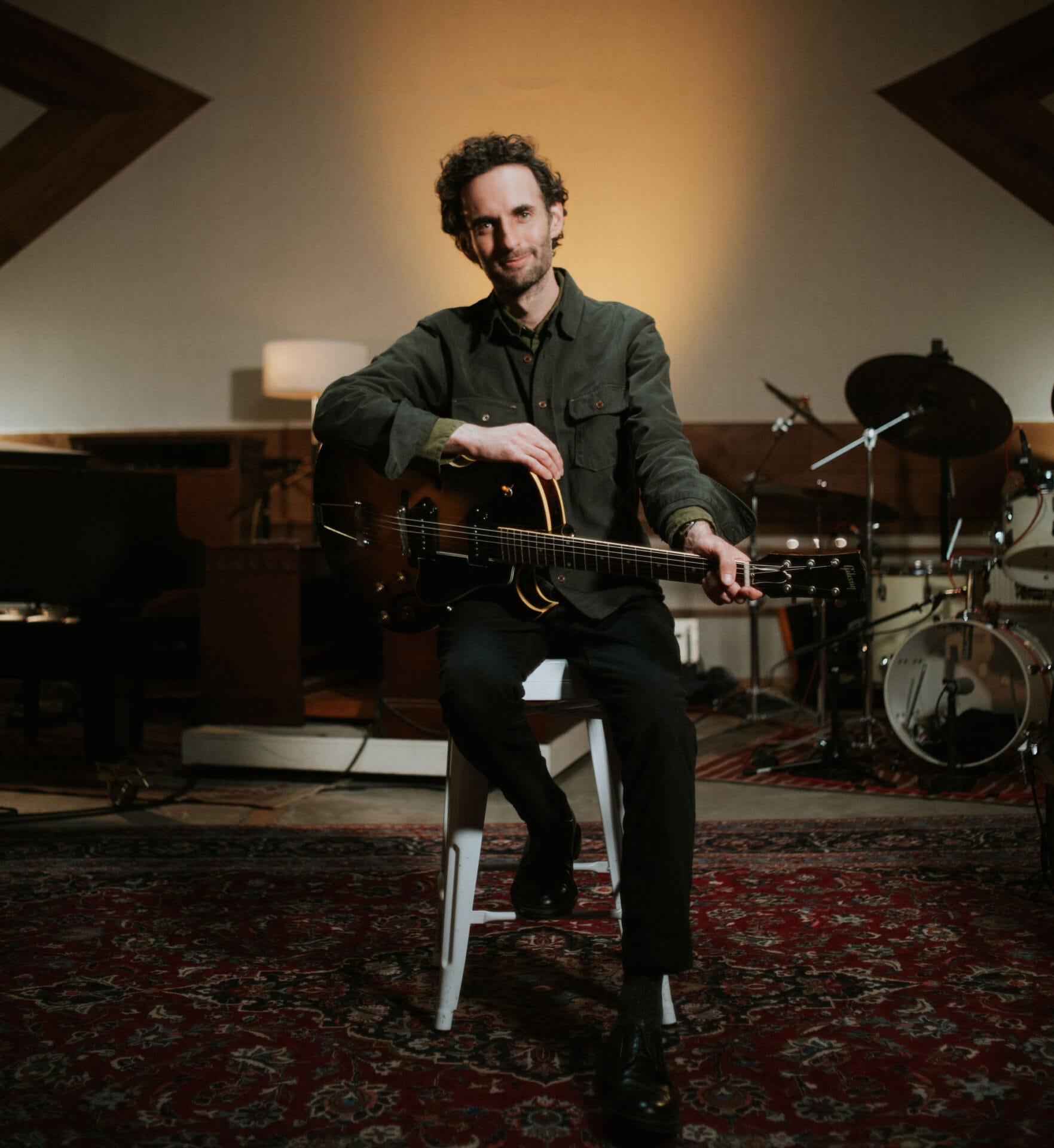
Over the last several years, Julian Lage has become one of the most distinct sounds in jazz guitar, rivaling such contemporary masters as Bill Frisell, Marc Ribot and John Scofield. Like those luminaries, he’s developed his own unique voice on the instrument—a voice that’s soft, patient and full, all at the same time. It’s a combination that’s earned him seven Grammy nominations over the years and numerous collaborations, including jazz giants Charles Lloyd, John Zorn and Gary Burton.
His latest project is a quartet with John Medeski, drummer Kenny Wollesen and bassist Jorge Roeder—their debut album Scenes From Above arrived in January on Blue Note. The 9-song, 42 minute album features Lage leading the three through gorgeous instrumentals that run the gamut of playful and introspective, with Medeski and Lage playing as if they’ve done so together for decades (they haven’t). The quartet has live dates confirmed into the fall—go see this show if you can; the interplay between the four is phenomenal.
What's the story behind Scenes From Above and getting that band together?
We had been in each other's orbit through John Zorn's music for years. We played primarily around The Bagatelles, which is a book of music, with some 300 songs Zorn wrote. He divvied it up into 30 bands who each played 10 songs. We’d do these 12-hour marathon shows. John Medeski was a part of those, as was I. So we spent a lot of time on the road together for that, and it kept occurring to us both that we should try something.
Kenny Wollesen and Jorge Roeder being the rhythm section is no small part of that, too. All four of us come from a deep Zorn lineage. In a way, it was a band that was waiting to happen.
Do you hear the Zorn ethos seeping in at times on this?
You know, it's hard to say. Zorn is so close to all of us on a personal level. I'd say stylistically, it's rather different. The structures are more aligned with a jazz group, or almost like a singer-songwriter. Simple declarations of melodies and solos. It’s not as experimental as Zorn, but the ethos of Zorn that I know to be true is that Zorn is coming from such a place of love and a deep spiritual connection to music. That part of it is probably a thru-line to Zorn’s music. The tendency would have been to say, “Well, it's organ, it's Medeski. It's gonna be a funk record.” But instead, it’s a poetic record . . . medium tempo music and beautiful melodies and space.
How does the organ and guitar play together?
The organ is wild. The Hammond B3 is not one thing. I know so little about it and what it's capable of. I don't know the first thing that's going on with John. None of that really matters. He's making decisions that are musical. The guitar and the Hammond occupy similar vocal worlds, or they have a similar voice. They're powerful, they can sustain. As for me, I don't think of myself as a guitar player that really uses much in the way of effects. It's a rather puritanical sound. So in many respects, I'm barely scratching the surface.
Do you think of your guitar playing as having a distinct voice?
Absolutely, it's something that I think about. We are innately ourselves, and it's our job to reinforce or reveal whatever the truth might be. If you're playing music that isn't really sympathetic to you, if you're playing with musicians who aren't sympathetic to you, there's a distance that enters a picture, and it clouds that voice. In all the years of my teaching and working with fellow guitar players, I've never heard anyone who didn't have their own voice. That's part of growing up and growing into your playing.
You’ve done a lot of guitar duo work with Nels Cline. What’s it like with just two guitar players, facing each other, playing whatever comes out?
It has a unique power to it. I'm not saying it's unique to me, but it has a unique power to it, where if the way you metabolize music is always through a duo with another guitar player, it just is a fabulous space. There's a really thin line between being an accompanist and a soloist. There's no hierarchical stuff going on. You're not a lead guitar player, you're not a rhythm guitar player, you're everything. You're just a sound maker. And you also get to spend time playing, but losing yourself in the sound of the other person. You're in service to the other player and they're in service to you.
You recently sat in with the Tedeschi Trucks Band. How did that come about?
Our mutual friend Mike Elizondo was the one who hooked it all up. He produced their most recent record. Nels was playing and sitting in with them at the Beacon, and Mike was there for this release celebration week. He texted me late and said, “Hey, I'm with Nels and Derek. We're talking about you. Do you want to come down and play on Friday?” All these years, I've never met Susan or Derek, although I'm a great admirer.
What do you see in Derek and his guitar playing?
The joy and love and beauty that Derek has always brought to the world through his music is so profound. That is a person in service to a much greater service.
Derek played Jerry Garcia's Tiger guitar during that run. Have you ever played a guitar with a notable lineage?
I have many times in my life. The last one I remember spending time with was Charlie Christian's guitar that he used on Solo Flight, a real seminal recording for the entire history of jazz guitar and electric guitar. That was my equivalent of playing Tiger. I played Keith Richards’ ’59 Les Paul a couple weeks ago, the one that he brought to the stage for the first time when the Stones toured America. Money aside, hopefully, the point is that these guitars show us why these players played the way they played and made the music they made. There's real, deep lessons. I could only imagine with Tiger that Jerry made certain decisions based on what that guitar did. It's a heavy guitar. It's a bright guitar. Jerry had that miraculous way of having such clarity and such volume.