“I was in a band called Mixel Pixel for a long time. We did some tours with the likes of Montreal, Man Man and different kinds of indie rock bands. I never liked being on stage though. I preferred being in the merch booth, talking to people after the show and making posters for our band. Then I started making posters for other people's bands, as well,” remarks artist Rob Corradetti, creator of the psychedelic art brand Killer Acid.
“One summer there was a weekly music series in Brooklyn at McCarren Pool and I just started making posters for it,” he recalls. “I didn't get invited to do it but I would go down there with my posters, stand outside and sell them. At first they were like, ‘What the hell are you doing?’ But after I met with them, they decided it was cool and let me continue to do it.
"I've always had this attitude of do what you want and apologize later. Don't wait for someone to give you a handout. Just go and do what you want to do and see if the door will open. That's kind of what I've been about.”
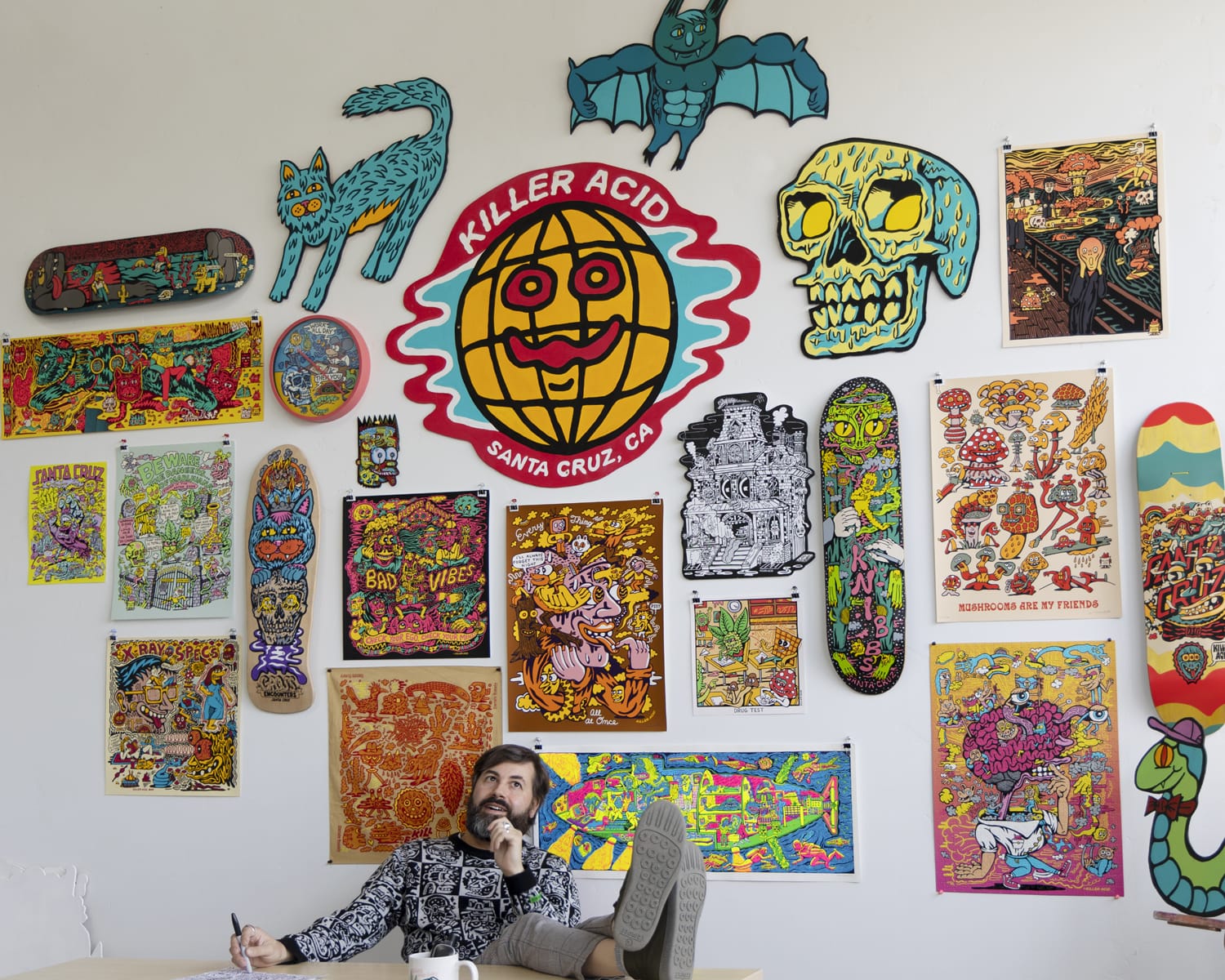
With Killer Acid, Corradetti has applied this approach to numerous sets and settings. He currently conceives bright hued, playful designs for blotter art, clothing, stickers, skateboards, prints, home goods and other items.
He also continues to work in the music space. However, as he explains, “The thing about posters, is I don't do a ton of them. Killer Acid, the brand, takes up 95% of my time. So I try to do two to three music posters a year and try to make them pretty special. I keep them limited, so I'm not pumping out a music poster every week or something.”
His recent efforts include posters for Phish, Goose, Billy Strings, and a celebration of the Grateful Dead’s 2/21/71 performance at The Capitol Theatre. Corradetti explains, “I feel like the jamband world kind of found me and gave me opportunities. I love going to Phish shows. I really appreciate that music and it's such an enjoyable experience. So that's why I like working with those bands. There's no other music that gives such attention to the posters. It's also a collector's market that's very appreciative. If you put in maximum effort, they're going to notice.”
Others have noticed as well, as the artist recently received a Clio Award for his Phish 2025 Hollywood Bowl poster. He notes, “I was super happy to win an award for my efforts, but I didn't really realize what it was until I saw Sterling Cooper win one while rewatching Mad Mad last month... then I felt psyched!”
As for the Killer Acid aesthetic and ethos, Corradetti observes, “I grew up in the ’90s, so irony and sarcasm are fun things to play with. But I also came to a point in my life where I felt that the world needs more positivity, more happiness. I want to try to spread positivity within reason. Looking at it realistically, the world is cruel and there are a lot of terrible things, but I want to try to make people happy. That's a really simple concept to me, but I think it tends to work. There's a genuine desire to bring joy to people, and that's our primary mission. It's pretty much 100% of what I aim to do, but it has to be through my distorted lens.”
As you think back on your early days as an artist, can you talk what propelled you forward and to what extent you see a creative continuum from that period to the present?
I would say I'm still doing what I fundamentally set out to do, even though at the time I didn't know where it would lead. I started becoming an artist in high school and that's where I began with pop culture and music culture.
I grew up in Delaware and I would go to the local record store—like a lot of kids go to the local record store or the local head shop to see where the culture was and to learn about new music.
I was obsessed with music. I was obsessed with culture. This was during the ’90s, when there was so much great music coming out. I was in junior high when Nirvana came out, which was an important cultural moment for me.
When I was a kid, I wasn't trying to be somebody. I was just listening to every kind of music I could find. I didn't really care about, “Oh, I'm punk, so I can't listen to Grateful Dead.” I don't know why, but I just never had that. I never had a friend group that was particular like that. Maybe we predated the clique-ish kind of mallrat culture that said, “If you like The Breeders, you can't like Pink Floyd.” Both worlds to me were available. I remember going to Lollapalooza and seeing George Clinton and Courtney Love in the same bill. It seemed like there was a mishmash of great music happening. I never really considered any of that being off limits.
I had a group of friends in high school who were all Deadheads and they were into Pink Floyd and classic rock. To me, there were two cultural things happening at once. There was a revival of all that '60s stuff. We would listen to Chocolate Watchband. We would listen to a lot of early psych rock and garage rock, too. So I was kind of listening to all that music and influenced by all of that stuff simultaneously, which is kind of what gave me an interesting perspective on creating work that was commercially viable. Looking at the Grateful Dead, looking at rock music, I wanted to make t-shirts. I wanted to make things that were relevant to people that they would care about. So that's kind of how I started out.
I had a project in high school called Craggy Sun. It was just me, drawing these weird psychedelic, mostly black and white drawings. Then I discovered this hippie print shop in Ocean City, Maryland, so I went down there and got a job. I started printing shirts with them and they started making shirts for me. Then I had them in my car all year and I would sell them out of the back of my car to people at the park or whatever. That gave me my first taste of “OK, you can turn this artwork in a notebook into a t-shirt.”
Then fast forward like 20 years and I was in between projects, so I kind of wanted to recreate that original project that I started when I was 17, 18. So that’s how Killer Acid started back in 2010.
I was like, "I'm just going to leave music aside, stop messing around with other painting and I'm going to try to do my psychedelic brand full-on. Just do it and make a name for it.”
So that's kind of how it started and the name was based on some song lyrics. There was a song lyric that said “killer Acid” in it. My friend was looking through some of our lyrics one night and he said, "What about Killer Acid? That's a pretty good brand name." I was like, "Yeah, that is pretty good."
It was psychedelic, but our first logo was like a skeleton hand and a little acid bath thing. So it was kind of meant to be both dark and humorous. I've always tried to maintain the duality of it. If I want to make something silly, I make something silly. If I want to make something serious and more edgy, then that's also allowable.
As a kid did you have any expectations as to where it would all lead?
I didn't really know much. I was like The Fool starting out in the karmic journey and I was willfully kind ignorant to most things. I didn't have a very worldly perspective and I didn't know what could happen. I think there's something with that folly, something with "Okay, I'm going to go do my art and stuff." That was all I really wanted to do, and it was hard. I had to self-finance, and everything was fought for.
I worked in New York for 15 years before I was able to become successful doing this stuff. That was part of it to me. It was making it on my own, doing it my own way.
During that 15-year period, what were you doing to support yourself?
I was doing photo retouching, advertising work and packaging design. When you're on the JetBlue airplane and they give you the TERRA Chips, I worked on those bags.
One time while I was on an airplane a few drinks deep, after they handed me the chips, I mentioned that I had designed the bags. The response was “Oh that's nice, sir." [Laughs.]
It's funny to think about that, but to me that's all part of my story. I was doing whatever I had to in order to stay in New York. Once I got there, it was like, “How do I stay here?” Part of that was having to work hard.
So whenever kids come up to my table and ask me, "Hey, what do you recommend for me as a young person?" I'll tell them, "Go to the big city." I don't know if it's the same now with how the internet is, but I'm like, "Go to the big city, learn your trade, meet a lot of people, join an art collective. Go do all these things, and that's going to help you grow." That's what I realized.
At that time I was into an underground comic and music scene. There was a comic book store in New York called Desert Island that opened in the mid 2000s. It became the central kind of hub for a lot of underground comic artists in New York City, who were selling their work there. They had a once-a-year comics festival and it was always a wild thing. Charles Burns would be there, Robert Crumb would be there. Art Spiegelman, Gary Panter, all these major dudes would be there.
This independent festival was the place to be in comics in New York. There were a couple of those and they were always deeply inspiring to me in learning how to make stuff. I’d also be motivated to make stuff for these festivals.
That's always been sort of the crux of Killer Acid, too. It's fiercely independent. Everything is independently self-financed and generated. Part of my ethos has been to retain as much control over the copyright and the work as I can.
When it comes to some of these music things, it’s work for hire, but most of the things that I've made, I actually own. Sometimes I license them out, but I don't really sell my work per se, I just kind of keep it in house.
That's always been part of my ethos too and I think that comes out of the '90s punk thing.
As you’ve said, going back to high school you were inspired by all sorts of music. You recently did a poster for the anniversary of a Grateful Dead show at the Capitol Theatre. Can you recall your entry point into the music of the Dead?
Someone gave me Aoxomoxoa on vinyl and I had it in my bedroom in high school. I would come home after being out and smoking weed or whatever, and I would lay down and look at my lava lamp and I listen to that album. I loved it. It would blow my mind as a 16-year-old kid.
So that was my entry into Grateful Dead. Then I had a lot of friends who were Deadheads and they would go to the shows. They would go up to the Spectrum or whatever and see them. I was lucky that I was able to see them once when I must have been 18.
Then I was actually living in San Francisco for the summer when Jerry died. I remember all of the celebrations and being on Haight Street where there was a lot of wild energy.
I also went to this blotter art show put on by Mark McCloud, who's become a friend of mine. Timothy Leary was there signing blotter sheets to raise money for his cancer treatment. I handed him a cassette of collage-and-noise music my friend and I had made on a 4-track in high school. He was like, "Oh, thanks kid." [Laughs.] At was the same at the show I bought a Red Alice blotter sheet by Mark McCloud signed by Tim which I later regretfully traded to a hippie in Newark, Delaware for an 8th of kind bud. In retrospect that was a horrible deal, but I'll try and get another one.
Anyway, I feel like I caught the tail end of all of that and then tried to put myself into it to some degree. So even as an 18 year old high school kid, I was able to at least witness some of that.
When a band approaches you to work on a project, how much guidance do they typically offer?
I think the best art directors offer you a window into what they expect. They give you parameters and they say, "This is the idea I have.” That really helps me and can spark the initial inspiration, because then I'm already looking at someone's perspective on what they want me to make. I don't have to do 10 different sketches and be like, "Which one do you like?”
With the Goose poster I did last summer, they said, "We want you to do a circular poster." To me, that's part of the project that made it exciting. I was like, "Oh, we can do a weird shaped poster. Okay, cool." So I drew a circle and then the question was “Well, okay, what can I fit in this circle?" It all kind of goes from there.
How about with the Cap poster?
Well in that case Chris [Kovach] saw another design I had done that was Grateful Dead-inspired, which became a starting point. So I'd already done something exploratory.
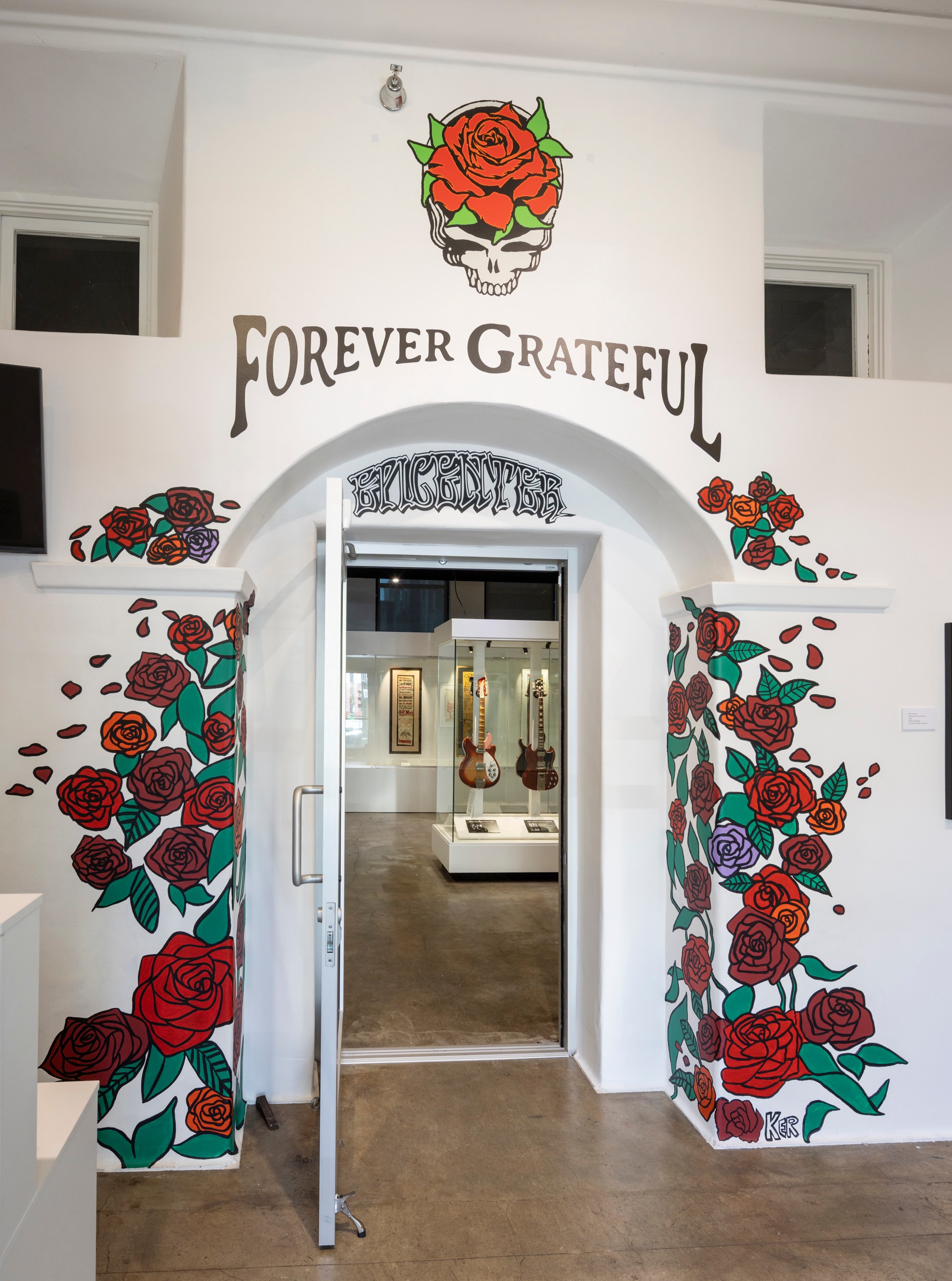
With the Grateful Dead, part of playing around with them is using some of their iconography. So you might want to use a skeleton, a skull, a stealie, roses, bears—some of the elements from their universe. At one point I’d like to do a Mars Hotel drawing, but I might have to wait until I'm a little more known in the Grateful Dead art community before I get to pull off something like that.
The bears are not my personal favorites when it comes to Dead iconography, but I'm all for a three-eyed bear.
Yeah, I mean, that was the thing. I also felt like I was bending the rules a tiny bit because I was like, "What are these bears doing?” So there’s a bear playing an Atari game that has this high score, which is the date of the show. To me, I think it's funny to ask what these bears do in their spare time.
I don't want to be sarcastic about these bears. I want to be kind to them but it’s also thinking about what they could be doing. I like them on shirts when they're hang gliding or playing basketball.
I actually made a comic about this. It's about the marching bears, who have been contracted for 10,000 years by the Grateful Dead to always be marching. Anytime a hippie is tripping, the Bears have to be marching and they’re getting exhausted.
When you're making a poster that features a particular band will you typically listen to that artist’s music while you're working on it?
I've listened to enough Grateful Dead that I don't need to listen to Grateful Dead. I would say I listen to Grateful Dead at least once or twice a week. I'll put on a live show when I'm working.
It becomes part of your soul once you eventually listen to enough of this music. That’s true if I’m doing a Grateful Dead or Ween design or some band I'm intimately familiar with. If I could ever do a Velvet Underground design, that would be true as well.
When it comes to a band like Goose, I prefer to see them live. I feel like a jamband has to be experienced live. It's hard to listen to their studio albums and be like, "I know what to do.” It's really good to go to the show and experience the whole thing because without the show, something's missing. So I enjoy going to these shows and seeing what’s going on. Hearing the music live for me really works for a poster. So I try to go to the shows for inspiration.
I find that your designs often nod to American cultural signposts, particularly in the corners and margins. Is that a goal you set for yourself when you visualize a project?
It depends. Some things are personal to me and some things are more related to a cultural touchpoint or made out of love for something. For instance, I loved The Simpsons growing up. So I drew this series of Simpsons characters and then Matt Groening bought them from me.
It was a funny irony that just as Matt Groening bought some of my Simpsons work, I was getting cease and desist letters from Fox/Disney. That all happened within a couple of weeks where I was meeting Matt Groening, he was complimenting me on my Simpsons riffs and buying a print, then Disney tried to take down my artwork off the internet.
With something like that, I riff off stuff. I always try to put my own spin on it.
I’ve seen some short-form animation of your work. Are you at all intrigued by the prospect of doing something a little bit longer?
Yeah, I have a couple things I've storyboarded or written out—some plot lines and characters. I would love to do that. It's really just about having the time to work on it. As you said, I do have these short-form animations with a couple of animators that I work with, but it'd be really fun to put that all together into a big picture.
That’s complicated because I usually have things booked for four or five months out. I could squeeze something else in, but I don't want the work to suffer. I spend a lot of time thinking about things. I like to have mental time and space, so it’s not just, "Oh, I have to sit down and draw all this.” I need a few weeks to meditate on something, decide what it is, then present it. That way I can go through all of the mental machinations over what I really want it to be.
I imagine that ideas are constantly flitting into your mind. Do you have a process to receive them?
I journal daily and I have a few different journals. One that's just for journaling and that one is for artistic ideas—so I'll do sketching and come up with words, then I'll put it in there.
There's this David Lynch book, Catching the Big Fish, that I subscribe to 100%. It's about revisiting these ideas and letting them come into focus. It’s like you're looking at a Magic 8 Ball, the image is coming into focus over time and you're applying positive mental projection into it, but letting it form on its own.
Sometimes it shows up fully finished in one day and sometimes it takes me literally a year, and I'm like, “Oh yeah, I remember that thing I was thinking of a year ago.” Then the final puzzle piece comes for that, so I just lock in, write it down and that becomes the piece or the image.
I definitely subscribe to transcendental meditation. The root of my creativity is filtered through the routine of that.
You started out an individual, creating art to share with others. Now you have a few folks working on Killer Acid with you in order keep up with demand. Was that a challenging transition?
For me, it kind of goes back to the Grateful Dead. They built this family. I don't know how they did it, I don't know how it started, but you attract certain people who want to help. I find people who have ideas and figure out how they fit in. Sometimes I’ll teach them how we like to do things.
It required time and energy, but it slowly morphed into this. I wasn't trying to force it.
It was weird, because at first I was like, “Oh, I'm going to work really hard to give away my autonomy.” But now that I've gone through that for a few years, I feel like I do have a lot more freedom to be creative and to work. I'm not worried about nitty gritty things in the business. I have good people on it. It's a benefit.
After all that time in New York, now you're in Santa Cruz. What led you there and what does it offer you?
I moved because my wife got a job out here, and I always really wanted to live in California. Santa Cruz is kind of the spot we wanted to end up in because of the surf, skate and all the art culture here. It's a great little town. There's a lot of artists per capita for how small it is. There's always some weird stuff going on.
I love hiking. I love riding my bike. So those are things I do at least every other day. I'm always out doing activities, clearing my mind. To me, that's very important for creative processes—just being able to get outside and exercise and be mentally clear. So I can go outside, run around, then come home and draw some weird shit. It's kind of the dream, man.