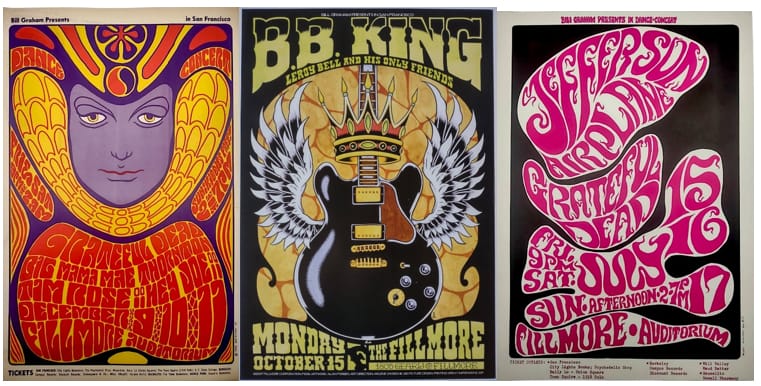
Just over a month ago, the Gabba Gallery in Los Angeles opened an exhibition of Fillmore posters on an epic scale. While the event is titled Echoes of Gen X: The Art of the Fillmore (1980s–2000s) the prints and concert ephemera span all the way back to Bill Graham’s earliest days promoting events at the hallowed San Francisco venue in 1966.
“You see all these crazy moments of history now cemented in time,” Gabba Gallery owner Jason Ostro remarks. “It's been an incredible experience so far. We have a lot of walk-ins to this show, which is really nice. People are coming to see all these concert posters and the history of rock-and-roll, hip-hop, electronica and jambands. I mean, you name it, they played at the Fillmore.
“We've got the gallery broken up into years and people are gravitating to the eras that were really special to them. But everybody who comes in stares at the stuff from the early Bill Graham days. They look at the old handbills, they look at the old tickets and see that things have changed so much. The tickets used to be just an image of the poster with a little tag at the bottom that said $2 or $3. Back then they’d have concerts that would start at 9:00 PM and go past sunrise with guarantees of eggs and pancakes in the morning.”
The Fillmore posters weren’t designed for purchase by collectors. Then, as now, they were printed in limited runs and handed out to exiting concertgoers. As a result, extant pristine copies, particularly from the early years are hard to come by. The Gabba Gallery has nearly 1,000 items out for display and the exhibition will run through April 11.
Ostro also speaks to the personal import and impact of these posters. “The Fillmore never sold their prints,” he says. “No matter whether it's the 60s, 70s or the present day, there might be 100 at the door when you're walking out. So if you're at an event and you're given some kind of crazy memento, especially if it has the band's name, the venue's name, the date and everything else, there's your history. Everything that you just experienced in those couple hours can be sunk into that piece of paper. It carries deep meaning.”
The Gabba collection was originally amassed by Dana Marver, who has own special emotional connection to the material. Marver’s life has been entwined with music, initially performing in bands as a pre-teen during the mid-1960s, promoting concerts before he was old enough to sign legal contracts and gigging in various settings on through the present. From an early age, his passion also extended to memorabilia, although he recently decided to scale back due to health issues.
Jason Ostro and Dana Marver
“Dana's an incredible musician who can pick up any instrument that he wants to play and figures it out,” Ostro offers. “From the moment I first went down there, he’d pick up a guitar or a bass or he’d sit down at the piano to demonstrate something I’d never heard.
“He’s also a consummate collector in the sense that he finds artists he really loves and he digs in deep with them. When I first walked into his place, I was amazed by how much stuff there was. There'd be a wall of Beatles items and there'd be this record store hanging promotion for The Who Live at Leeds. Then there'd be something on another wall with pictures of Robert Plant and Jimmy Page and both were signed. There wasn’t an inch of space in his house that wasn’t covered with rock-and-roll and music history but it wasn’t haphazard, it was carefully organized. So from the moment I walked in, I was blown away. When somebody's got so much history and so much love and passion for one area of music and art and the way that they combine together, I really think that has to be celebrated.”
***
How did you come to be a concert promoter at age 17?
Dana Marver I'm from St. Paul-Minneapolis, and one of the greatest venues was called the Minneapolis Labor Temple. They had been running since the early 1900s, and they'd get people like Ray Charles. Then some hippies took it over and they ended up having the Grateful Dead, who played for free.
They would get the Summer of Love San Francisco groups, and they'd get Ten Years After and Deep Purple. It was the greatest venue.
I saw the Allman Brothers there when they first came out. There were only a hundred people there. I was 16 at the time and it was just mind-blowing to me.
Anyway, they ran the venue out of business due to a Tony Williams Lifetime concert. If they would've called it the Jack Bruce Group, like Bill Graham did at the Fillmore, they probably would've done just fine. But people in Minneapolis didn’t really know John McLaughlin yet, and they were surprised that Jack Bruce from Cream was in the band. I was there and it was incredible but I don't think there were 50 other people who showed up. They were running on a shoestring budget and they ran it down to the ground.
So I had the idea of running it myself. I talked to my mother because I was not old enough to sign the contracts. The first band I did there was Savoy Brown, who turned into Foghat. I just loved Savoy Brown and I got to book the bands I loved, which was a lesson learned. You don't book the bands you love necessarily, you’ve got to book the bands that the people love.
The best was Johnny Winter. I had just seen them recently. This would be 1970, and Edgar was in the band. But what they sent me six months later was the McCoys with Rick Derringer. This was when Johnny Winter switched over to Johnny Winter And. So that was a surprise.
There were all sorts of things going on that night. One was Johnny Winter wouldn't go on stage unless I could get him some wine. Well, in Minnesota, they have blue laws. Where do you get wine on a Sunday? It just so happened my brother had been making wine three days earlier, so we gave it that to him, and Johnny ended up with the runs. But you have to do what you have to do. [Laughs.]
How long were you able to keep that going?
DM: It ran for months and months. Unfortunately, I was working with a booking agent who wasn’t doing me much good. So I had to let him go, and he ended up starting a petition against the club saying it was too loud. The city ended up putting a curfew on me, and I couldn't live with a 10 o'clock curfew because the only way I could make it work was to have two shows a night. My last show would've been The Allman Brothers who I had gotten for a $2,000 flat rate but I had to cancel them. That was a downer point in my life.
The last show I did was a double bill with Alice Cooper and The Amboy Dukes, who had Ted Nugent. It was an incredible show, although there were a couple of weird things about that night. One was that Nugent was dressed in a Tarzan outfit, and when he jumped down from his Fender Showman amps, he had no underwear on. I thought, “Oh my God, they're going to close me down.”
Plus, we had a little misunderstanding because I didn't figure out in advance who was going to start the show and who would end it. We had a little war going on that and it was getting late. Finally, my mother started yelling at Nugent. Eventually we figured it out that Alice would be the headliner for the first show, and then Nugent would be the headliner for the second show.
But what an education for a kid. There I was 17 years old, picking up Alice Cooper at the airport. I mean, the looks we got when he was walking down the runway with a champagne glass of Southern comfort. The stuff I saw was amazing.
As a musician myself, I played fraternity parties when I was 14 and toga parties and stuff. That was another form of education. I was a union musician, so my name was listed as a drummer and I was getting calls to play at strip clubs that were paying $200 a week, which was great money in 1968.
I'd have to ask my dad if I could play, and that did not go over well. But I also was playing some of the bigger nightclubs, opening up for The Trashman who did “Surfin’ Bird” and The Castaways, who did “Liar, Liar.” So we’d draw a mustache on me and that would help a little, but I really looked like a kid.
Was there a formative live music experience that set you on your way?
DM: Like most of the people in the world, it was watching The Ed Sullivan Show and The Beatles on Ed Sullivan, February 9th and 16th, 1964. Right then and there I knew I wanted to be the drummer. I wanted to be Ringo.
I had already set up my drums in between the stereo, so I would mimic Ringo. I self-taught myself and I was a drummer for many years. Then Led Zeppelin came along and I didn't have the foot for Led Zeppelin, so I ended up playing all the other instruments.
As far as the live show goes, it was seeing The Beatles in 1965. I saw them at the Metropolitan Stadium in Minneapolis, and it was life-changing, although I was already jamming with people. By the time I was 12, I had a band. My older brother was in the band and everyone else was about 6 years older than me. They were already in high school and one was in college. So for a number of years that's what I did.
Then when I was 15, I started a booking agency called Dana Productions. All the fraternities and sororities at the University of Minnesota needed bands but they didn't want union bands because they're too expensive. That would've been like $250 or $300. Well I could get them bands for $150 or $200. I used my friends' bands from high school and I took the best gigs for my band.
So because of that agency I already making connections. Then at the Labor Temple I met the booking agency where I originally got Savoy Brown and Johnny Winter. When I let them go, I did the booking. I connected with Diversified Management in Detroit, and they had a lot of bands. They could get me anybody. Booking bands was very political at the time. Not just anybody could get the bands. If you were the first one to book that band into a city, you almost had a little monopoly on it. Had I had kept going, I probably would've had Alice Cooper, for example.
In the late '70s, I did eventually buy into an agency that was one of the largest agencies in Minnesota, and we booked into 23 states and Canada. But in addition to the booking and management part, I also loved playing and continued to do so.
At what point did you begin to collect memorabilia?
DM: Back in the day, I really liked picture sleeves on 45s because you could see what the band looked like. Album covers were cool, but sometimes you didn't get the best pictures. So I enjoyed collecting picture sleeves, especially The Beatles, Stones and the British invasion.
What an exciting time to be alive. A kid, me, in my teen years, 63, 64, 65, I mean, it was absolutely incredible. You had the British Invasion, you had Motown all coming at once. Then you had the California surf scene, the Beach Boys, and it was so exciting.
What happened for me was my brothers were going to college. This was ’67, the Summer of Love. I had one brother at NYU and another brother at Stanford on the West Coast. So when they'd come home at Christmastime, whoa!
I learned about the San Francisco scene with the Grateful Dead, Country Joe and the Fish and Quicksilver. From there I discovered Bill Graham and the Fillmore, which was something else.
I went to see Bill Graham speak. This was when the movie had just come out after the Fillmore closed [Fillmore: The Last Days (1972)]. I thought Bill Graham was the greatest. He was a hard businessman, but what he did and produced was incredible. He was also the first guy to really have a series of posters. I even liked the boxing style posters with the bold lettering. If it was a Motown show, they'd have pictures of Stevie Wonder and Martha Reeves and the Vandellas. That was art to me.
Then you look at what Bill Graham did with the first Fillmore poster in the vintage series [BG-1] with the Jefferson Airplane. It was no longer that boxing style with big black lettering. It was a little different. By the third poster that they did, I think that was The Blues-Rock Bash, you had to look at the poster at an angle to make sure you read it right. It was starting to go psychedelic. It was cool as heck because you're putting art to music and that was just another level of what I really loved.
Years later, I found a connection to the Filmore. I found it through a record store where I was able to buy posters from someone who worked at the Fillmore. This was at a time when people were getting posters from former or current workers.
I was always a collector and then in the '90s I really seriously started collecting everything because I was a completist. I had to have every Fillmore poster. I always figured there'd be a lot of people like me, but there weren’t.
Then, even later than that, because people knew who I was and what I was trying to do, I had an opportunity to buy the complete inventory of posters that was at Amoeba Records in San Francisco. I had a partner on that, and there were almost 100,000 pieces, including some other posters, but I ended up with maybe 40,000 Fillmore posters. What had been happening was that Amoeba had been taking posters and handbills for trade. Someone would come down with Fillmore posters and trade them for records or CDs. That had been going on for decades and I was the first one to get their old inventory. It was pretty exciting.
Did you have a complete run of posters?
DM: I had a complete run of the new series but not the vintage series, although I had already been collecting those. With the vintage series, the search would be for the first printings of everything because there were multiple printings.
Do you have a personal favorite from any era?
DM: Some people really love the Skull and Roses, FD-26 [from the Grateful Dead shows promoted by Family Dog at the Avalon Ballroom on 9/16-17/66]. That's not the big love for me. I really like the BG-105, the Flying Eyeball by Rick Griffin. Not that I'm the biggest Hendrix fan. I saw him three times, but I love John Mayall who was on the bill and Albert King, who I booked.
I did two Albert King shows. That was something. I'm a little guy. I'm like five-feet five-and-a-half inches. When I'm depressed, I'm a half-inch shorter. Well Albert King is about six-foot-five. When he got out of the phone booth at the Labor Temple he towered over me. He had a diamond in his tooth and he was intimidating.
Another guy who tried to intimidate me was Bowzer from Sha Na Na. I booked them and they came in playing jazz at the soundcheck. I couldn't even tell who they were. Then when they went in the bathroom to put lard in their hair, Bowzer turned to me and started getting on my case—"Oh, you little hippie, you long-haired hippie." He was getting into the act and there were TV cameras in there, so I finally had to say to him, "Bowser, I'm paying you. Look to be a little nicer.” It was funny.
When you promoted shows, did you make posters for them?
DM: I did not. We didn't think ahead. The Labor Temple did have some posters before I got there but that was something I completely overlooked, I'm embarrassed to say. We had handbills though. The handbills were not terrific works of art, but there were some things on them and I have not released mine to the public yet. I didn't have many of them, but I’ve got some, and I should probably let them all go.
As a practical matter, where did you store all those prints?
DM: At my home. I had a four car garage and my 450SL hasn't seen the inside of the garage in 25 years. So I turned that over and put in flat files.
I was not a great businessman, I did it for the love. It was a hobby that went horribly out of control. I had serious depression and I needed something that would make me want to get up every day in the morning and be excited. So I found that, and I'm very fortunate I did. Collecting was that, where you're always in on the hunt. For me, the hunt could be picture sleeves of the British invasion or other things that were hard to find.
Throughout this period, you were also a working musician?
DM: Oh yeah, absolutely. By then I had moved out here to Carlsbad [Calif.] and at one point country was very hot. Everyone wanted to be a weekend cowboy, so I played five nights a week. It was fun.
Now I've built a huge room in the house that has a stage in it, so I can have jam sessions or rehearsals. I had a 10-piece horn band that was all Motown called Fingertips. We all fit on the stage here. So that's what my life was. I kind of lived in a museum.
Eventually what happened was I had a health scare. I had lung cancer. Thankfully they found it in the first stage but they took out half my lung.
Then two months later I fell and broke my hip. Not a really smooth move, if you know what I mean. So it was a bad year, but it got me thinking. My family didn't want this stuff and it would be one heck of a burden to put on them. So that's really what this is about.
I had a problem deciding what to hold back, but eventually I held back about 1500 posters. I’m not sure what I was thinking but I’ve always been on the chase. I’d be checking out who was coming to The Belly Up, which is a great nightclub here in Southern California. Then I’d meet the bands and have the Fillmore posters for them to sign.
Who doesn't sign a Fillmore poster if you're on it? Even someone like Steve Miller who doesn't like signing anymore, if you tell him you have a ’68 Fillmore poster, he’ll come over to sign. It was like a golden ticket. Who's going to say no?
Los Lobos happened to be a staple at the Fillmore in the new series. They would play almost every New Year's for a while. So I brought 11 posters when they played at The Belly Up. Afterwards, they were doing signings and I put out all 11. That’s a lot but they were like little boys going around to each Fillmore poster. Apparently no one had ever done that to them, putting each one out in front of them and they signed every one.
I did that to a bunch of people because I had all the posters, so why not? I did that to Carlos and I did that to Satriani, people like that. It was about the fun.
When you finally saw the exhibition at the Gabba Gallery was there an image that really struck you for one reason or another?
DM: It was the Yardbirds for some reason. I just loved the Yardbirds. There's one—and I don't know the number of it offhand—but it had the picture of all five of them, including Jeff Beck and Jimmy Page. It wasn't even a super work of art, except how they put the picture in there, and I just love it. I also like a lot of Rick Griffin posters.
In the new series, I like Emek and Jermaine Rogers. Jermaine stayed with me for three days when he did his first Comic-Con in San Diego. I helped him get his booth materials, then over a couple years, I would store those materials for him. Every time he'd come back in town, I would have the materials and I would drop them off at the Civic Center.
It was fun, and with Jermaine it was interesting because I'm the age of his father. I'm just an old kid who never matured, which is what has kept me going.