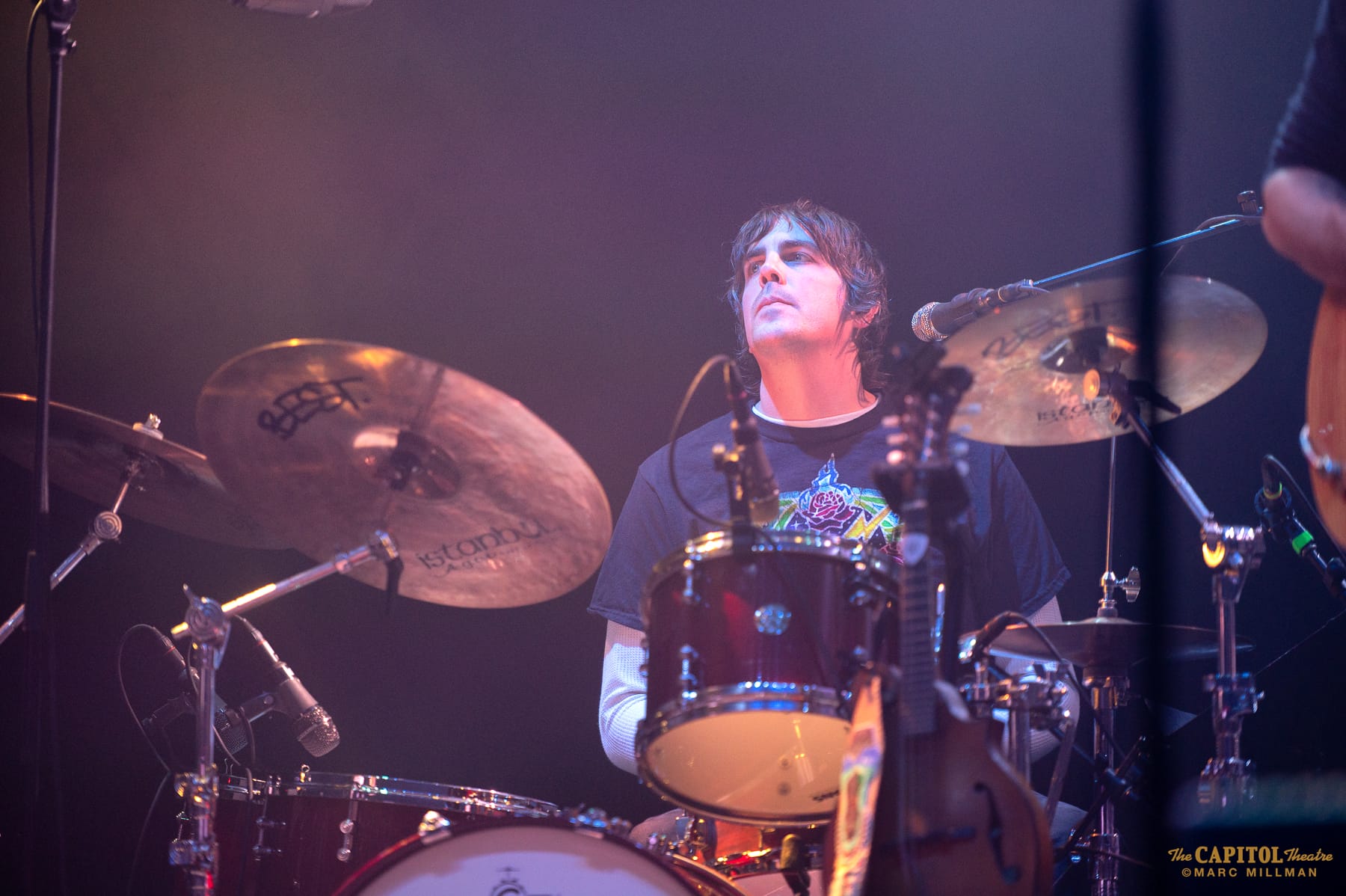
“I’m self-taught. I never had a lesson,” Alex Koford admits over Zoom, before sharing some pertinent family history.
“On my mom’s side, my grandfather was a jazz trumpeter in the Navy band and a member of some sort of Bay Area musician union. Then, on my dad’s side, my grandmother was a Danish opera singer. She was in the conservatory and touring around Europe; that’s how she met my grandfather. He was actually an OSS spy, pre-CIA. The story is that a Danish colonel, a friend of hers, said, ‘Hey, I have a friend I’d like you to meet,’ and introduced them. He started going to see my grandmother perform, and she ended up getting pregnant with my father.
“So, there’s music on both sides of my family. My dad also played, and my uncles. My dad’s half-brother was still living at my grandmother’s house, and that’s how I started playing drums. When I was a kid, I’d go over and play on his drums in the garage.”
The singer, songwriter, and multi-instrumentalist, who currently resides in the Bay Area, gives credit to his kin, but their close friendship with Phil Lesh and family was another formative layer in Koford’s musical upbringing, directing his tenure at Terrapin Crossroads, which bred natural musical crossover that functioned as the bedrock of his career.
Learning firsthand from the Grateful Dead’s bassist, Koford excelled in inspired projects like Grateful Shred, all the while supporting his mentor in The Terrapin Family Band, a group he’s still a part of when he’s not honed in on his original efforts.
The subject’s latest chapter amalgamates his Deadhead roots with a necessity to craft his own sound. “Mercury” features long-lived lyrics coined by Robert Hunter, passed to Lesh and gifted to Koford, who wrote the music as a compliment to the sun’s closest planet.
In the following conversation, Koford recounts the saga that led to studio time with John Keane and Dave Schools in Athens, unreleased Hunter songs, and the inexplicable timing of the lyricist’s passing and a power outage.
“I know Phil wanted us to do our own thing," the drummer asserts. "It was never about recreating anything. It was all about bringing what you have to offer to the table and putting your stamp on it, so the original music side of that is really important. More people should be writing original music.”
How did you enter Phil Lesh’s musical orbit?
I grew up with the Leshs. Our families are super intertwined. My aunt was best friends with Phil’s wife, Jill, from their teenage years on. And when they all started having kids, we just grew up as a family.
I grew up going to shows. I don’t remember anything from Jerry’s time because I was 4 when he died. But, I remember everything after Jerry: The Dead, Other Ones, Phil Lesh & Friends.
Then, in 2012, when Terrapin [Crossroads] started, I just got a job there with no intention of playing music. They knew that I liked music and playing, but I don’t think they’d ever heard me play, or had any reason to think I would jump in and play with Phil. I just got a job cause I was kind of struggling at the time and needed something to do, and they thought being around music would be good for me.
I was putting wristbands on people and handling ticketing for Great Room shows. Then that year, pretty shortly after, I went to the beach—the Leshs had a beach house—and we went to record American Jubilee’s EP. I still wasn’t in the band, but I went to hang out with them as friends. That was Ross James, Brian Lesh, Alex Jarvey, the engineer at the time, and Scott Harvey. They were going to do this acoustic/folk album and I ended up putting Ross’ cowboy boots on to stomp in time as my first introduction to playing music with them.
I had taken mushrooms and was having this free, fun experience while recording their music for the first time. There wasn’t any intention of me joining the band, it just kind of happened cause we were all there together. I think it was “El Paso,” one of Ross’ songs, and I stomped for them. That kind of developed into us being a band: American Jubilee.
I played drums with them and we started to do some small tours. We were playing weekly at Terrapin and that turned into the Terrapin Family Band. Everything at that time was just unfolding naturally. There wasn’t necessarily a plan, at least that I was aware of.
As soon as Brian, Grahame, Ross, and I were all playing music together, I think all the ideas started coming. We started getting better, and Phil started working with us a little more, developing and helping us out.
Where does Sunday School land on the timeline? [Sunday School was a passing of the torch, lessons led by Lesh, where selected players learned Grateful Dead music from the ensemble’s founding bassist.]
Sunday School came later. As far as I remember, Sunday School was once we were the Terrapin Family Band, and we were doing more with Phil. We started getting into the tunes more with him, where we would talk about harmonies, really break things down, and discuss all the vocal parts. Out of everyone in the Grateful Dead, Phil really had a grasp on harmony and theory—what the music was about. It was his mission to teach us that.
Thinking back on your family’s lineage and the way it lent itself to your own entry into the Bay Area music scene, there’s a kismet edge to your status as a musician. I feel that same notion permeates the reason we're here now. Can you talk about when and how you were gifted unreleased Robert Hunter lyrics from Phil?
It was around 2015-2016, early to mid-Terrapin years. The way that happened was Phil came to us. We were working with him, established the Terrapin Family Band, and had already performed some shows back east with him. He had this grand idea: He came to us with this project, Hunter had given him a set of lyrics for the planets, and Phil, being Phil, loved all things space. He had this really cool idea to take each song from these planet lyrics that Hunter had given him and write a song. Each planet has a frequency; it vibrates at a certain number of hertz, and you can connect that to a mode or chord. Phil had the idea of taking each planet, taking their mode, and writing a song in that mode. It was a big undertaking.
When we got the lyrics, I started writing that song. “Mercury” just came to me. It's another one of those things I can’t explain. I had the lyrics, I loved the lyrics, and then that song just poured out, chords poured out. I didn’t feel I had the right to change anything with the lyrics. It just fit into place like a puzzle. And I went with it. It’s really long. I’m not going to torch the lyrics, they’re too good to tamper with. But that project with Phil never happened.
And that song bank is also the source of “Jupiter”?
Yes. There’s a whole set and a lot of untapped material.
Shifting gears, my understanding is that you had an exceedingly memorable story playing “Mercury” with your band in Philadelphia.
The first time I played with my band, Colonel and the Mermaids, in Philadelphia, Hunter passed away on September 23, [2019] and the show was on the 24th. It was the day that the news broke. [We were playing “Mercury”] and there’s this part in the song, “I even ask directions of the lightning, but it won’t say ‘cause it don’t talk,” and when I got to that line “I even ask directions of the lightning,” the lights kind of flickered in the venue and then went out. We were on stage playing, looking at each other like what happened? Do we keep playing? I wasn’t thinking that was Hunter in the moment, but the line and everything are something that keeps coming back to me.
While you haven’t released it yet, Dave Schools played producer on the track when you took it to the studio.
I was working with Schools. We met in 2017, when my band opened for Cosmic Twang, which was Ross and Scott Law’s band. I was on that gig, it was Ross James, Scott Law, Dave Schools, Neal Casal, and that might have been it… I just loved and respected Neal so much, and his songwriting, and Dave. I begged Ross, I was like, “Please let me open the show.” He said, “We don’t have any money, we can’t pay you,” and I was like, “We’ll do it for free. Just give me the opportunity to open the show with my original music.” I wanted Neal and Dave to hear it.
So we did, and that night Dave kinda said to me, “What can I do to help? I really like it…” So that started a friendship. He had a small budget to make an EP. So Dave took me to Athens, and we started working with John Keane, an amazing producer.
We went to John Keane’s studio, and he put Duane Trucks on drums, Jay Gonzalez from the Drive-By Truckers on keys, and Dave and me. Then we recorded some of my music. That was the first time we worked together, and we made a little EP. Some of that music came out under Colonel & The Mermaids, and it's since sort of disappeared from streaming platforms but I do have copies of the 7-inch vinyl that people can still purchase.
How did your relationship with Schools progress?
We lived close to each other in Sonoma County, so Dave and I formed a really good friendship; we’d meet for lunch and hang out. Then when the pandemic hit, I had this idea to get it [to the studio] and make this record. I had performed it a few times as a trio and was having a lot of fun in that space. I went to Dave and said, “Hey, can we get into Prairie Sound Recording Studios and make this record?” I have this concept to go in and track everything live as a trio, maybe embellish some stuff here and there, but really make it a live record.
Dave liked the idea, so he went and booked the studio time. We went in, and he produced the full record. That whole record was recorded and “Mercury” just happened to be on there because it was in the repertoire of songs that I was performing. There wasn’t a grand plan. It just happened to be a song. I didn’t know if it was going to make it on the record cause it’s long and I was going to have to kill some darlings. If it was going to come out on vinyl, “Mercury” was probably going to have to be one I put to the side and maybe do something else with. But it was recorded in that batch.
Then I got to the finish line, shopped it around a little bit—this was all during the pandemic, so things were a little but weird to begin with. Being who I am, I got discouraged. I put it to the side and it sat for years and years. There have been times when I’ve been like, “Man, I’ve got to put this out. I can’t put it out. I have to put it out.”
I just feel there’s so much significance in Hunter’s lyrics. That song, it means so much to me. It would be a shame for it to continue to sit.
Everyone wants more Hunter lyrics.
Me included. There must be so many out there that we’re still unaware of.
I’m still fixated on the planet concept. Are you aware of a song for each one?
There are a few missing for some reason. I don’t know why, but there are some incredible sets of lyrics. “Mars” is unbelievable. That one’s not released. Grahame did “Jupiter,” and I’ve done “Mercury,” and also “Luna.” But “Luna” is just a demo.