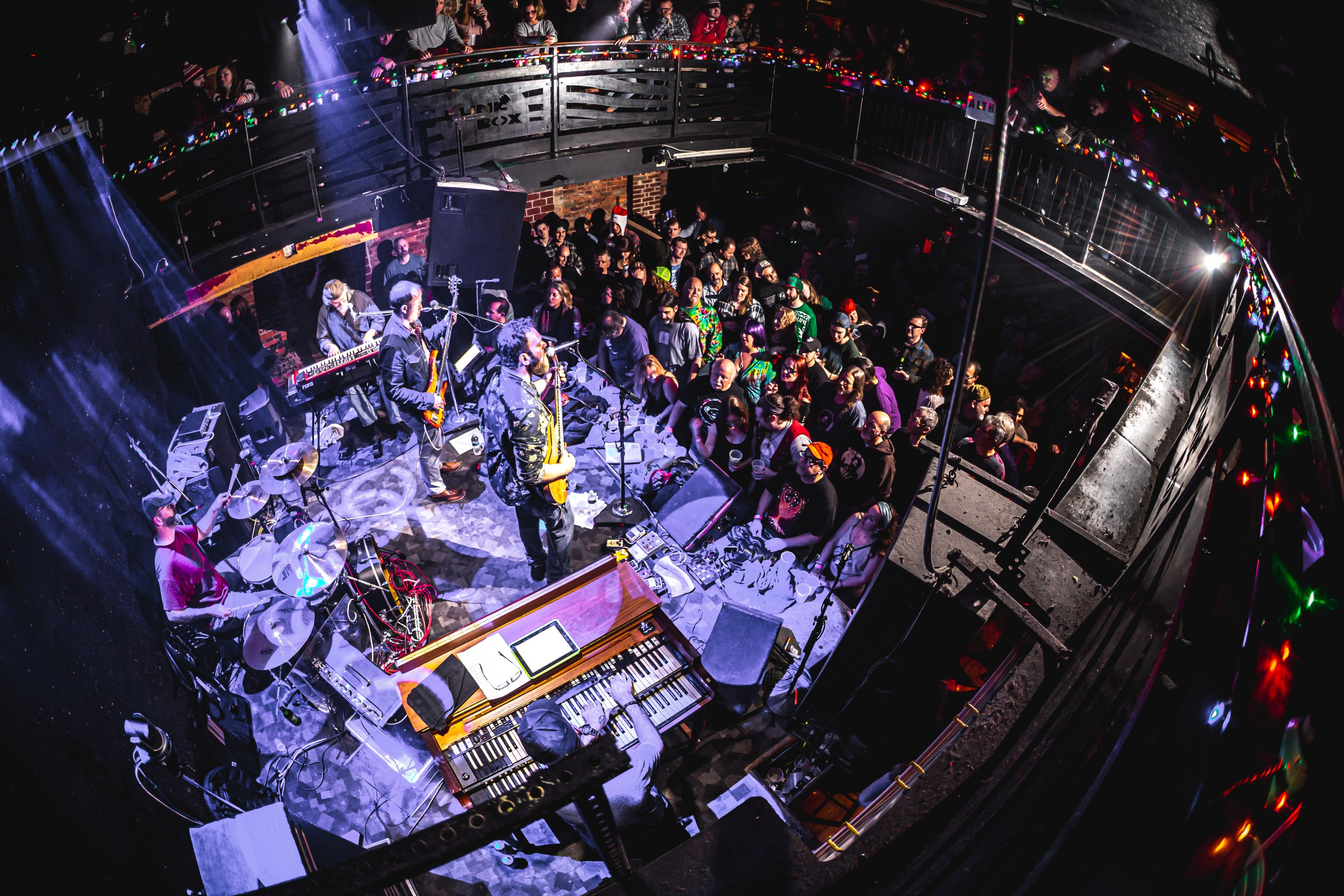
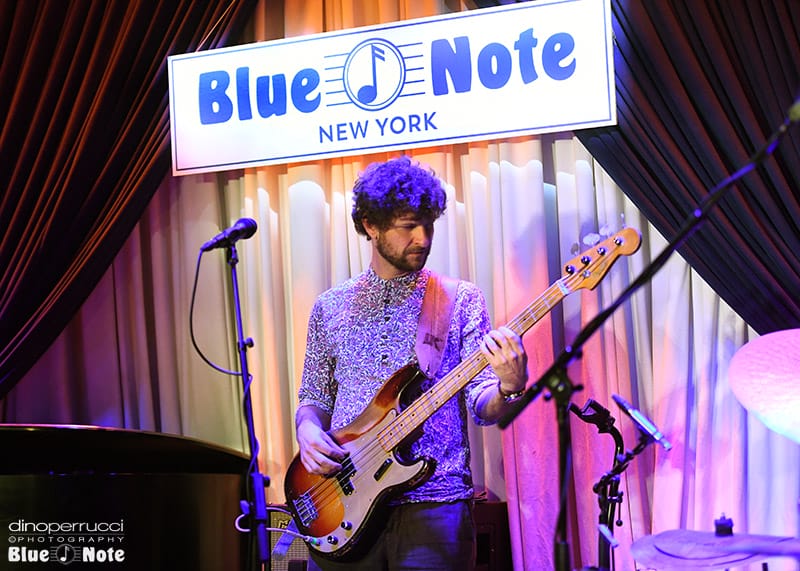
Michael League is used to wearing many different hats, but these days, perhaps the best way to describe the Snarky Puppy co-founder, noted bassist and prolific songwriter is as a curator. As he speaks with Relix, League, who formed Snarky Puppy in Dallas but ascended to international acclaim while based in New York, is partway through a residency at the Manhattan Blue Note that will stretch through most of January. During the extended run, he will play in numerous different configurations, blurring the lines between sounds primarily classified as jazz, funk, folk and world music and debuting a slew of new original material.
Then, from March 13-15, Snarky Puppy will stage the 10th-anniversary edition of their GroundUP Music Festival in Miami, where they will play multiple shows of their own and host full sets by Patrice Rushen, Isaiah Sharkey, Alain Perez and Julian Lage. Throughout the weekend, they will also collaborate with an eclectic mix of guest artists, including Flying Lotus, Rushen, Rickie Lee Jones, Bilal, Lage, Sharkey, Arooj Aftab, Perez and Varijashree Venugopal during the Snarky Puppy Family Dinner shows. Snarky Puppy will also promote their latest release, their 2025 record with the Metropole Orkest, Somni, and the bassist is also actively working on releasing his final collaboration with David Crosby.
Here, the Grammy-award-winning musician discusses his various curatorial roles, his friendship with Croz and why he sometimes feels more like Neil Young than a jazz trumpeter.
Let’s start by looking ahead to your GroundUP Music Festival in March. You had already been presenting multi-band, festival-like situations on stage and in the studio for years before launching an official festival over a decade ago, so it made sense that you would eventually put together a proper festival under the Snarky Puppy banner. But, in addition to some more “proper” sets by Snarky Puppy and some other artists, one unique thing about GroundUP is that you and your bandmates will actually back many of your guest musicians during the festival. Has that collaborative nature always been part of the event’s ethos?
The whole ethos behind the GroundUP [label] from the beginning has been about trying to bring creative music and creative musicians—no matter how known or unknown—to the ears of open-minded listeners. The motivation behind the creation of the label and the festival is just a continuation of that exact same philosophy. From the very beginning, our goal has been to find artists that are not so visible, not so well-known, but are amazing and create a space for them to play and cultivate an audience. It’s more exciting [for fans] to hear people they’ve never heard of than to hear people that they have heard of.
We did the second Family Dinner album [in 2016] and effectively, what we’ve been doing the last couple of years at GroundUp Miami is we’ve been adopting the format of the Family Dinner, using Snarky Puppy to back up different singers. I remember for Family Dinner we did a song with this Swedish neo-trad group called Väsen. We did one of their songs, and then, immediately after that, we played with an Afro-Peruvian singer, Susana Baca, and Charlie Hunter was on guitar and bass. It was extreme cultural whiplash, but the people in the band are pros, and they understand how to be adaptable and flexible and tasteful. It’s challenging, but it’s also inspiring because then you leave the gig, and you’ve learned new things, and you’ve added new tools to the box. I don’t think we’d have done it any other way.
When people think about Snarky Puppy, they think about the members of the band and are like, “OK, well, those people are playing with Snarky Puppy.” But every person in the band has actually spent much more of their lives playing with people other than Snarky Puppy. We’re all session musicians, we’re all sidemen, we’re all trained and well-practiced at playing the right thing, the right part, in the right way for different artists. So, by nature and by trade, the individuals in the band are chameleons, so it’s not really a departure to do a concert in which we’re playing behind Rickie Lee Jones, Flying Lotus and a singer from South India.
It’s what we’ve been trained to do our whole lives—to be session players and be adaptable and flexible and versatile. That’s not to say it’s not a challenge. It’s a lot easier to offer an hour and a half of the same kind of musical emotion or style than it is to switch every two or three songs, but one of the things that makes Snarky Puppy interesting is that all the individual members are curious about, and excited about, challenging themselves to stretch and expand their horizons.
In addition to being a collective comprised of session musicians and rubbing elbows with all sorts of amazing players, Snarky Puppy has performed at a unique mix of traditional festivals over the years, from jazz celebrations to more rock and jam-oriented events and folky song-swaps—in the U.S., Europe and elsewhere around the globe. Looking back, were there certain festivals that you attended or played at during your formative years that influenced the approach you have taken with GroundUP?
In the area where I grew up, there really weren’t any festivals. Like most white, middle-class kids in the U.S, I grew up in a suburb. I was close enough to D.C. that, when I turned 16 and I could drive, I’d go into the city and find whatever jazz gigs I could find and that would let a minor in and I’d go to those, but I didn’t grow up in a culture of going to jazz or jam festivals. My festival experiences began when I started playing them, so seeing the wide variety in experience that occurs from one festival to another, I just started taking mental notes, like, “I hate this, I love this.” And with GroundUP, I just tried to take all the things that I love from all my favorite festivals around the world and implement those ideas—and I also tried to remember what not to do.
It’s fun to play a big festival, for sure—North Sea Jazz, Montreux or Bonnaroo—but my favorite experiences have always been at small festivals, so the impetus for doing it the way that we do it is knowing that growth can be amazing, but we want to do a small festival that does not grow. That was important to me. I don’t ever want to expand the size of the footprint that we have, I don’t ever want to expand the number of tickets we sell. If the festival becomes super popular, I just want to improve the quality but not the size. So those kinds of ideas came out of smaller festivals that we played. There are a million things I could say that I stole from other festivals that resonated with me and that we tried to implement, but when you’re in leadership role or have ownership in any sense, in any walk of life, you’re gonna constantly be in this battle, this conflict between your ideals and the temptation of convenience and profitability. I’ve been really stubborn as our festival director can attest to—I’ve been more stubborn than he would like, in terms of not caring how many tickets an artist will sell. If I don’t believe in them, I don’t want them at our festival. If they’re great, but they’re a dick, I don’t want them because I don’t want dicks at our festival. In the same way, it would be so much cheaper if we hired a PA that didn’t sound as good and all these kinds of things.
I don’t want to make it sound like I’m completely uncompromising, but I feel that I am very hyper-aware of the slippery slope that you start going down when you start making concessions that contradict your mission statement. As a result, we spent eight years losing money. But now it feels like we’re in a good place, and we have a good structure, plan, format and system. Above all that, we have the trust of everyone who’s ever been to our festival. We’re not there to take their money, rip them off and give them a subpar experience. We’re putting the experience first for both the artists and the ticket holders.
This year, you will also be showcasing the new Snarky Puppy album, Somni, which came out in late 2025. That record is your second collaboration with the Metropole Orkest and was recorded live in the Netherlands. Since the music was written for a specific situation, has it been a challenge to perform the material on the road thus far, heading into the festival setting?
I wrote the music for Somni with the Metropole Orkest in mind because that was how we were going to record it and perform it initially. But I was very intentional in making sure that I wrote things that the band could play without them because, when we did Sylva [Snarky Puppy’s 2015 collaboration with the same ensemble], I didn’t think about that. And as soon as the orchestra was elsewhere, we couldn’t play any of those songs. So, in this case, I really was very clear with myself about making sure that I was writing things that the band could play and would sound good without another 52 people behind us. So, we tried that out in Latin America a couple of months ago on the first tour since the release of the album, and it went beautifully. I breathed a huge sigh of relief playing that stuff live with just the band and seeing that it worked, so we’ll be playing all the new songs from the record for sure at GroundUP.
The way that we did it on tour in Latin America was that we were just slipping songs into the set, treating them as independent things. But for the festival, maybe one night we’ll just do the whole record, and then the next night we’ll do nothing from that record. To be honest, I won’t even think about that until the week of the show.
Shifting gears to another curatorial role, you are in the middle of an extended run of shows at New York’s Blue Note. You are playing with an incredibly diverse mix of artists in your old hometown, showcasing the breadth of your musical interests. When Blue Note asked you about the possibility of staging a residency, how did you start to piece it together?
The first time Blue Note reached out to me about potentially doing this, it was two years ago—maybe more. It was a long time coming, and it took a long time to be able to carve out almost a month of my schedule to be able to do this, and also to be able to coordinate with all the different other artists that I knew I wanted to work with. But we finally got it together, and the Blue Note was really cool with what they allowed me to do. They were very open-minded, and they were very communicative about it, too. We went back and forth with different ideas.
For me, the whole thing was that I just wanted to make sure that I’m creating a situation in which I’m able to invite my favorite musicians in the world to play. But I also really wanted composition to be a big part of what we were doing, so I created some groups that I would want to write for, and then I wrote songs for them. So there’s quite a bit—nine or 10—new, original songs that are being premiered this month with the various groups.
The residency kicked off with some of your closest collaborators—drummer Jason “JT” Thomas, guitarist Mark Lettieri, trumpeter Jay Jennings and keyboardist Bobby Sparks—doing a night billed as the Snarky Puppy Dallas Funk Quintet. That felt like an appropriate place to begin the series since Snarky Puppy coalesced in Dallas before moving to New York.
That was super fun, and I couldn’t really think of a better way to start the residency than with four other people that I’ve spent the better part of the last 20 years with. The residency goes to a lot of different places, musically, and I thought it would be nice to start with something that just kind of establishes the roots of where I come from as a musician. I grew up in a lot of different places, but I would definitely say that, musically, I grew up in Dallas. That’s where I formed my sound and my musical accent reeks strongly of Texas. So that gig was all about just bringing Texas to New York and showing those roots. So the repertoire was 100% comprised of songs by Texas composers, except one song that I had written—but, in a way, I guess I am a Texas composer. We did Freddie King songs, Roy Hargrove songs, Fathead Newman songs. We did a lot of stuff to honor the greats from the great state of Texas, so it was really special. I didn’t feel like I was in New York those nights—I felt like I was back in a bar in South Dallas.
The band formed when I was a student at the University of North Texas, and then, years later, we added people Robert "Sput" Searight, Bernard Wrightand Bobby Sparks—people from the Black music community in Dallas—that’s really where the band formed its sound.
But then we moved to New York, and we met people like Cory Henry, Keita Ogawa and Marcelo Woloski, so we added members there. And, of course, being in New York and playing on the scene here totally transformed everyone on an individual level. So, like with anything, what we do is a hybrid of foundations, roots, scenes and musical accents.
Throughout the Blue Note run, you have put together several different small combos, several of which highlight different drummers, bassists and guitarists. How did you approach putting together these different ensembles, which bring together players from different scenes and corners of your expansive universe?
I’m just a big fan of musicians in general, and I wanted to create some situations in which people could come and express themselves musically and show their personality through the vehicle and the format of a band, and also compositionally. So I wrote songs for the group that we just did with Nate Wood, Mark Guiliana, Wayne Krantz and Rachel Eckroth for two nights. [Those dates were billed as Between Two Drummers.] I wrote songs with those four people in mind, thinking about what they would enjoy playing and what would give them the freedom to do what they like to do. I did the same thing for the second two-drummer band, with Antonio Sánchez and Kendrick Scott [slated for Jan. 24].
For me, as a bass player, I’m not thinking, “Who should I call that’s gonna support me and make me sound good?” The nature of my instrument is supportive. So I was thinking the other way—who can I invite that I can put in a situation to sound really beautiful and where I can be supportive? I was thinking about who I was a fan of listening to. The main thing is that every single person that’s gonna walk on stage this month is either a hero of mine or someone that I’m a huge fan of. So the diversity of experience from night to night is really extreme. We have a really intimate duo with Bill Laurance, where I play oud, and then there was last night where there were two drummers, a guitar player and distorted Fender Rhodes—and we have everything in between. We have people from a lot of different countries. I’m just trying to create a balanced meal for people. The way I think of it is that if someone’s gonna come every night, how do I make sure that they don’t ever get bored?
Throughout your career, you have also made inroads in the folk and singer-songwriter communities, working with both emerging artists and legends like David Crosby. During the Blue Note stand you have demarcated a few sets as “songwriters circles” to empathize that side of your repertoire.
I don’t really draw a line between instrumental music and vocal music with lyrics. When people ask, “How is it that Snarky Puppy did what it did in the world of instrumental music and blah blah blah,” the best answer I can come up with is that we put the focus on the song and not the solo, which was a common thing in jazz music for decades. It’s not like we did something revolutionary in that sense. But, at a certain point, in the jazz world—and not for everybody, of course—jazz predominantly became about the solo and not what happens on either side of it, which is the composition, the melody and the chords. I’ve always felt that I was a song guy. And, for me, something on a Snarky Puppy record is probably more similar to something on a Neil Young record than it is to something on a modern jazz record from 1994. I don’t really draw a line between those things and, as a result, I find myself working with lots of songwriters.
There’s also a misconception that, if you’re a jazz musician, you want to play a lot of notes and you’re not concerned with space—as if jazz calls for a certain set of skills and other styles of music call for a different set of skills. A good musician is gonna recognize what skills are necessary for the environment and not just go and be a jazz guy on a folk song or be a folk guy on a jazz song, which also doesn’t sound good. I love the song as a creature. And I’m really excited about both of these songwriter nights because they’re just incredibly gifted composers, but also different from each other. On the second one, we have Genevieve Artadi, who has her very distinct style of pop that she does with KNOWER and in her solo project. Then you have Varijashree Venugopal, who comes from South India and is composing somewhat within South Carnatic parameters, from South India, but is also breaking loads of rules and has a jazz vocabulary. And then you have people who are more idiomatic songwriters, like Lizz Wright, Becca Stevens, Chris Morrissey, Victoria Canal and Lau Noah, but they’re all outside of the box compared to what you would consider to be a typical singer-songwriter. They all have their own sounds and are brilliant writers. So I’m just trying to represent all those things and ask, “What is a songwriter?” A songwriter is many different things and not just about having someone strumming 1, 4, 5 chords.
You and David Crosby first connected on Twitter, which led to him being part of a Family Dinner record, and from there you began working on new music together. During his final years, you were not only one of his closest collaborators in the studio but you, Becca Stevens, Michelle Willis and Croz also toured as The Lighthouse Band. How much music is still in the vaults waiting to be released and how has Crosby’s ethos continued to influence your compositions?
There’s actually an entire record that’s fully mixed that hasn’t been released. That was the last record that David recorded that I produced with Fab Dupont. Becca Stevens, Michelle Willis and Aaron Sterling are on it, but that record is tied up right now in music-industry red tape. But we’re working on liberating it because David would be pulling his hair out knowing that this record hasn’t come out yet. He was immensely proud of it, and for me, it’s one of the more interesting records of his whole career, just because of how open he was to taking chances, sonically and compositionally. So I’m really looking forward to that record coming out eventually.
God, he used to just email me, Becca and Michelle song lyrics. He’d wake up one morning, write something and just send us lyrics and be like, “Turn this into a song.” I feel like, at some point, when I have some time, I also want to go through all that stuff and finish these ideas that he sent us.
He just left an immense mark on me personally, and I know for sure on Becca and Michelle as well—and on the world in terms of the way that he approached music. I mean, he really is the person, more than anyone else, that put color in American folk music. He’d put in these harmonies, taking things from the jazz world and bringing them to the folk-music world. He was unrestricted and unconfined in his vision. So, in that way, I relate to him more than I relate to some tenor player that only wants to play “Giant Steps” at 400 beats per minute. I feel like I’m more part of David’s tribe, even if what I’m known for sits more in the jazz world. David and I related to each other incredibly well and became like family, as did Becca and Michelle. The four of us were this weird misfit family.
Over the weekend, we lost another musician who brought color to folk music, Bob Weir. Crosby, of course, has a deep connection to the Grateful Dead, personally and professionally, and Snarky Puppy has toured on the post-Dead jamband circuit. What impact has Bob and the Dead’s music had on your own compositions and improvisational approach?
I never met Bob. Snarky Puppy played a couple of festivals or bills that he was also on, but I never met him personally. But I grew up listening to Workingman’s Dead and American Beauty. It’s funny, people assume that I would be a bigger fan of the electric Dead stuff than the acoustic stuff, but I never really related much to the electric stuff. At the same time, I always really loved their acoustic music, especially Workingman’s Dead. I still listen to that record.
And though I never came into contact with Bob, Crosby was friends with all those guys and Jerry’s all over his records, and he’s in there in different ways on their records in some cases. I feel like I picked up a bit of everything that David experienced through him, including Bob’s connection to The Beatles. David was so close with them, and they formed a part of who he was at a certain point, so I think we were picking up all that stuff secondhand. It’s amazing how strong of a culture it was in that era, when you compare the Laurel Canyon scene of the late ‘60s and early ‘70s with what is going on today. Those people had No. 1 records in the same category as the singers who have Top-10 songs today. It’s crazy to compare that scene, that culture and that community to what we have today. Everybody today in the Top 10 feels like they’re on a different island. They’re totally separate and apart from each other. But they’re also using the same producers and writers.
But at that moment, these people were literally going over to each other’s houses at night and making music together. Joni Mitchell, Crosby, Stills, Nash & Young and Mama Cass Elliot were having dinner together on Saturdays and showing each other their songs. It’s outrageous. And I think they had a big influence on each other, and that’s why that scene was as rich as it was. It wasn’t just people assembling groups of writers in studios to make hits.
These days, people make this distinction that pop is something different and that you can’t hold it to the same standard. You can’t compare people in the Top 10 in ‘26 to people in the Top 10 in the ‘60s or the ‘70s, but you should because the Top 10 is the Top 10. It’s the highest-selling, most-listened-to songs of a certain moment. It’s like, “Why did we just become complacent to accept that if it’s in the Top 10, it’s OK that it sucks?”
People have proven in past generations that you can write some of the best songs ever written, and they will still reach No. 1. So why do we just accept that era’s gone, and it won’t come back? That’s why I judge popular music harshly. I think that when you start saying, “Well, it’s OK that it’s not good,” it takes the pressure off of us to try to be better, to do better. It lets you off the hook. One of my goals, ever since I was a kid, was that I want to contribute to something that facilitates good music being popular on a massive level. I don’t want to feel like, “I’d like to write the song this way, but it’s not gonna sell, so let’s simplify it and compromise it.”