“What a blessing it is that Phil, Bobby and Billy made such concerted efforts to collaborate with so many different musicians of different generations, and how encouraging they were to have us musicians play their songs expressed through our unique identities,” Disco Biscuits keyboard player Aron Magner proclaims, on the afternoon after appearing at the Joy Theater in New Orleans for the Busted Down in Bourbon Street event as a member of Grahame Lesh & Friends, alongside Oteil Burbridge, Daniel Donato, John Kadlecik, John Molo, Kanika Moore, Bill Payne and the Preservation Hall Horns.
Magner has witnessed this initiative from a variety of perches over the years. In 2014, he began his tutelage with Grateful Dead drummer Bill Kreutzmann as a member of Billy & The Kids, joining Tom Hamilton and Reed Mathis. This past December his jazz trio released SPAGA Plays Dead, offering a unique take on the catalog. A month prior, Magner and Cloudchord issued their 9-song Deadtronica debut, and tonight the pair will appear in NOLA at Chickie Wah Wah for what Magner describes as “our first real show.” The keyboardist is also part of the Dead Aces project that will premiere May 31 at the Maybe It Was The Roses Music Festival in Ventura, CA where Don Was, Mark Karan, Reed Mathis, Dave Ellis, John Molo and Magner will honor Bob Weir.
The adept artist has much more in the hopper as well. On Friday, he’ll be in North Carolina for two fully improvised gigs with Michael Travis and Jay Lane. Meanwhile, the Disco Biscuits remain active more than 30 years into their career with a series of summer dates, including a tantalizing Powdered Down acoustic performance at the Telluride Jazz Festival.
As he contemplates his Tuesday night appearance with Grahame Lesh’s all-star cast, Magner identifies “China Doll” as a highlight, pointing to his synergy with Bill Payne. He notes, “Bill and I, by default, think as one keyboard entity. It was fascinating how we would both support the energy of the song’s phrases approached as one keyboard player.”
Then Magner speaks both to that evening and the ideas that informed it, by remarking, “There are always new things to learn about these songs, new ways to play them, and vastly contrasting personalities interpreting them. To me, that’s the fun of these Grateful Dead gigs. Sure I love the songs, community and culture. But it’s the continued evolution of these songs and their song characters that continues to amaze me.”
Back when you were a high school student playing jazz cocktail gigs as a solo pianist, how deep was your appreciation of the Grateful Dead? Did you have any aspiration or expectation that you’d engage the music on the level that you do these days?
My knowledge of the catalog was pretty solid by the time I was a late teenager. I loved The Grateful Dead for long enough and collected tapes for long enough that I knew these songs, but I never really translated them to piano.
I would blend a couple of Grateful Dead songs into these cocktail gigs you're talking about, but just for fun. It really wasn't until I played with Billy in 2014, where I really had to dig into the catalog, make some notes and be like, "Okay, I know how this song goes in my head, but my fingers have no idea what key it's in.” So I definitely had to submerse myself in that catalog.
Now, I'm at the point I where have the majority of the catalog down. Although every now and again when I do a Grateful Dead project, I’ll have the opportunity to play a something that I haven’t played before. That happened with Grahame when I learned we were playing “Run for the Roses.” I’d never played “Run for the Roses” before and I was psyched.
I associate “Run for the Roses” with the first time I saw Jerry Garcia. I saw the Jerry Garcia Band before I saw the Grateful Dead, and that song is tied into the memory of seeing Jerry for the first time, and smelling weed all around me for the first time. All these things are associated with “Run for the Roses.” So it was fun to see that I would be playing that.
Can you point to something that really surprised you back in 2014 when you began digging in?
I continue to find a plethora of surprises and Easter eggs in this music. I find those surprises not just in learning a song or going back and watching a version on YouTube, which is always super fun. To be able to learn these songs or refresh my memories on a song that I haven't played in a while and then play along to a show from ’87 on YouTube which is perfectly remastered and looks better than any video from 1987 I've ever seen is crazy and amazing.
But since this music continues to evolve and musicians continue to evolve, I also have been influenced by very minute things that Dead & Company will do, like a re-harmonization of a bass note, a chord change or something small that clearly is an inside thing where the band draws on their musicianship. It’s something that probably wasn't done on the fly, but was likely discussed in a practice or backstage. Even with a little thing, like a re-harmonization, I’ll be like, "Oh my God, that's such a cool interpretation, "
I just saw Oteil last night at a little place in New Orleans, and he did a version of “China Doll” that he sang with completely different chord changes and a completely different melody, and it was incredible. So these songs do continue to grow. They continue to evolve. It's not just like, “Oh, I just learned something about that song.” I'm always learning something about these songs.
I dug into “Looks Like Rain” because I wanted to play it for a solo piano set on Jam Cruise. I asked Kanika [Moore] to sing it and it really brought down the house. This was weeks after Bob had passed away, but the song is so beautiful in and of itself. It was the confluence of stripping down a beautiful song into its bare bones and a singer who was interpreting the song in a way that was completely her own.
I think that music is meant to evolve. You have these traditional songs that get passed down from generation to generation, and they get interpreted differently from artist to artist. That's what's supposed to happen and that's how things evolve. We see it before our very eyes with the Grateful Dead catalog.
Even in our same generation, we've seen music itself evolve, not just because of the technology that's been available to us in our lifetime, but because our world is becoming more globalized. Now we have the internet where we can study somebody else's music, whether it's in a different country or just a different state through YouTube, even if just 17 people watch it.
There are some incredible musicians out there, known and unknown. We all influence each other. In turn, that influences the music we play, the music we perceive and the music we put out.
How would you characterize Billy’s initial guidance regarding the nature of the catalog?
Billy was as free as you can possibly want a musician to be. Hamilton compares it to riding the rapids. Billy will start off the song in whatever tempo he wants, and if we're starting off in Class Five rapids, then that's how we're starting off. But what Billy loves about the Kids is that we have as much freedom as he's looking to have in a band where he can go anywhere—he can lead or he can follow. He emphasized this freedom we should have in improvisation and to let it all go and to have big ears. Billy was great with that.
What is Grahame’s approach in this regard?
While Bobby and Billy also did this, I feel like Phil led the initial charge with a determination to reach out to all these musicians, a large majority of whom were unfamiliar with the Grateful Dead catalog and bring them into this collective. It was a special thing to be curious about what would happen if a specific musician who we all revered and respected, interpreted the Grateful Dead, even if they didn't know any of the music.
I think that is an absolutely beautiful thing to repeat and bring all these musicians in. I've become friendly with so many different musicians because of this catalog, simply because of the band leaders putting together these shows.
Grahame is continuing what his father had kind of started, by bringing these people into our scene through this music and getting them to express their musicianship while soloing over Grateful Dead chords.
Cory Henry was at rehearsal the other day. As a keyboard player he is truly our Michael Jordan. It was fascinating because our Michael Jordan was given a handicap, which was that he didn’t know the songs. Now, of course, all he needed was some chord changes or to watch us play a verse and a chorus.
When we played “Help” > “Slip,” the “Slipknot” section passes by so quickly and Cory was like, "What is going on here?" Then he just crushed it in his own voice. He sounded like Cory Henry playing a solo over “Deal,” which was incredible.
I think that bonds us together as musicians who would not otherwise have had an opportunity to collaborate together and I think that sustains this songbook.
Grahame is continuing to do what Phil did, but these Grahame Lesh & Friends shows also feel very different than Phil & Friends. It feels like there are a lot of new faces, which means that the music has more places to blossom.
It's a really unique thing to put together, show after show, a stellar lineup of musicians and have to reinvent that wheel rather than just having a single group that you know is available. It’s much more challenging the way that he’s doing it and I think it’s commendable.
He's also very inclusive. He understands that in his role as band leader, we’re all in the band together. So in a way there is no band leader, even though he’s the band leader. This means we're not constantly looking to Grahame and asking, “What do you want?” It's a collective of musicians up there on stage doing the thing that we have been training to do.
What's really cool is you would figure that we would not be set up for success if you bring in a collective of musicians, some of whom haven't played the material before and most of whom haven't played together before. However, because of everyone’s musical prowess and the professionality of the people Grahame selects, it really comes together. No one wants to speak over somebody else, even if there are multiple keyboard players like with me and Bill Payne.
I think that we really demonstrate the things that we musicians have been preparing for our whole professional careers, which is big ears and big participation—allowing other people to speak and being supportive of them when they take the ball.
We're utilizing all those powers that we've collected with our individual bands and demonstrating that professionalism on a stage with different musicians. The fact that it works every time I do these kinds of projects, constantly amazes me.
On Thursday night you’re bringing Deadtronica to New Orleans. Can you describe its origin?
The origin was simply Cloudchord, my co-producer, getting excited about the word Deadtronica. It was almost a joke about a genre at first, then with our passion for this catalog it actually became something.
We're willing to hear this music in so many different incarnations with so many different Grateful Dead cover bands, whether that’s in 200 person capacity bars or 5,000 capacity venues.
So being that I come from an electronic world and being that it is a digital world right now, Cloudchord, who also produced The Biscuits’ Revolution in Motion album, felt that Deadtronica was out there for the picking. We need Grateful Dead music that is electronic.
The first couple of tracks we worked on were “Shakedown” and “Feel Like a Stranger,” which are a little bit more on the money, if you will, in terms of an interpretation of a Grateful Dead song. These are songs that sound a little bit more like the Grateful Dead songs that you know, but with a remix of an electronic beat.
Some of the other songs are a lot more re-harmonized, like “Casey Jones,” which is in a different key and the chord changes are different.
But the way it all started out was with curiosity. I was curious to see what “Shakedown Street” would sound like with an electronic beat behind it. Then Cloudchord made an example, sent it over, and I started painting on top of it. That was how it began and once we got a taste of that our curiosity took over.
Curiosity is what drives my creativity. I’ll have an idea and I’ll have to know what it's going to sound like. Unfortunately, it might take me three days in order to get just the smallest glimpse of that, but because I’m curious about it, I have to see something through. Then, three days later, I’ll be like, “Oh my God, this has legs.” That passion has been ignited. For me, whenever I can see something in my mind's eye and I can get a glimpse of what it's going to be like in the future when the legwork is actually done, that's when I know that it's going to be good.
So we just kind of continued with the mentality of, "I'm curious to see how ‘Victim or the Crime’ tuns out.” After we got two songs done, then I started putting up what I called scaffolding of the ‘Victim or the Crime’ remix. That’s a song some people don’t necessarily like so I took it on as a challenge. I put up the scaffolding of the remix, then sent it back off to Cloudchord.
We've been doing this collaboratively, where one of us will start a remix and send it to the other person, then we'll just trade these files back and forth as we continue to push the ball downfield. It has been a beautiful collaborative process because of that. There have been several songs that he started and I finished, and several that I sent to him and he finished. That goes both ways. It’s been great.
Also, the band meetings only have two people, so we make decisions really quickly. [Laughs.]
Did you always have the expectation of doing this live?
When we finished the nine song collection that we put out as Deadtronica Vol. 1, we didn't really have much of a plan for it. In fact, we almost still don't, and that's deliberate. I kind of wanted to come up with the music first and then see where it goes as opposed to putting a cart before the horse and booking a bunch of shows without the music.
So we just did five more songs that have not been played yet or released yet. It’s been fun now that we understand how to do this better because we've already gone through the process of the first nine songs. From here, we’ll continue to tackle the catalog. I don't think the goal is to do every song, it’s more like we’ll be struck with an idea like, ‘What would ‘Let the Good Times Roll’ sound like as a house track?” Then we’ll express it.
I don’t know where this goes. I would hope that Deadheads hear this music as an homage, first and foremost. Some of the songs are a departure. They may take a couple of listens to in order to reframe how we re-harmonize them. “Casey Jones” is a perfect example. We all know the song “Casey Jones,” but in our version of “Casey Jones,” not only is it put under a house track, but we also completely reharmonized it. Now it's in a minor key. The chord changes are different. We make it sound a little bit more modern, however the melodies and the vocals are extracted, so it is Jerry singing the exact notes that Jerry sang. It is definitively Jerry singing that same “Casey Jones” melody, we just put different chord changes behind it.
I've noticed that when I play these songs for somebody for the first time and that first line from Jerry comes out but it's over different chords, it takes a second. It's almost dizzying until you get your balance for a second. You have to wait one more loop to be like, “Okay, that's the chord change. Okay, that's the melody. I am starting to understand how they work together.” That’s because it's different, but of course they work together and a little bit of trust that has to go into that.
At first when you hear it, you might think, "Whoa, that's not ‘Casey Jones.’" You have to be like, "I guess I'm being taken on this train ride." Then by the time, you get to the second line of the chorus where it is not so startling, you're willing to accept it for what it is, which is reimagined and reinterpreted. I find it fascinating that it takes a little while to reframe, and it’s a little bit like a trust fall. You have to be like, "Okay, got it.” You have to be reaffirmed that it's going to be okay, and it is.
So that's kind of where we're at with Deadtronica. We just started putting together a live show. We've played two shows before, but they were almost just previews. I feel like Thursday at Jazz Fest will be our first real show, and then we've got some more shows throughout the rest of the year. Hopefully we’ll release these next five tracks once we can get clearance on some of them.
Three years ago during Jazz Fest season, you played your initial SPAGA Plays Dead gig. What prompted that?
First and foremost, I realize that it might seem a little silly that I put out two different Grateful Dead albums back-to-back in different genres, but they are both very much through the lenses of who I am as a musician.
SPAGA has been a band since 2019. It is my piano forward jazz-esque project with some incredible Philly-based musicians who really just propel me to a different stratosphere of musicianship. Playing with them has been a game changer for me, in terms of how to play in group dynamics, how to be a supportive player and how to be just a professional player.
I've learned so much by playing in a trio with those two, and I'm so appreciative of that. But as I say it’s jazz-esque and at the end of the day, the majority of people out there aren't necessarily looking for that, even though we're down here at Jazz Fest and the Disco Biscuits are playing Telluride Jazz Fest and all that. I guess it begs the question, what is jazz? But SPAGA put out an album, some singles, a live album and stuff like that.
At some point I thought it would be interesting to hear what we could do with the Dead material and see how people would respond to it. I thought it would be interesting because the other two band members, Jason Fraticelli (bass) and Matt Scarano (drums) were mildly familiar with the Grateful Dead catalog. So it was kind of cool in the same vein that we were talking about earlier with the Lesh family bringing in musicians who wouldn't necessarily be familiar with the catalog. This provided a little bit more of a blank slate by not being influenced by 157 different versions of “Estimated Prophet.”
I also thought that if I want to get people to listen to what Aron Magner sounds like on piano, and I want people to get to listen to what SPAGA sounds like as a trio, then maybe they’ll be intrigued by an album of SPAGA arrangements of Grateful Dead.
When we do these SPAGA Plays Dead shows, it's not all Grateful Dead. We obviously pepper in some SPAGA originals. Also, SPAGA Plays Dead is not something that this band will become, it's just our current album.
So I went through a list, picked some songs and arranged them. A few of those arrangements are very different from what you'd be used to. I don't think it's such a departure that you wouldn't be able to pick out what song it is, but the arrangements are definitively different.
It's a way of being like, "Hey, I love this songbook as much as you do. Come check out this songbook that you're going to feel familiar with.” However in doing that, I’m also hoping to open up listeners’ ears to something else as well.
There are a few atypical song selections on the album. What led you to interpret “Heaven Help the Fool” and “Eep Hour?”
“Heaven Help the Fool,” has always been a favorite of mine since the Grateful Dead did it as an instrumental on Reckoning. I think the chord changes were beautiful. To be honest with you, I'm way more familiar with the Reckoning version than the Bobby and the Midnites version, which actually does have lyrics. But I've always loved that song and nobody plays it. So as a musician who dabbles in Grateful Dead catalog with lots of different projects, it is kind of cool to go create digging and find the ones that people haven't done.
That was my impetus for “Victim or the Crime,” and that was definitely part of my impetus for “Heaven Help the Fool” and “Eep Hour.” I do the same thing with Benjy [Eisen] when we're trying to think of cool back catalog songs or even Dead adjacent songs that nobody has done before when we're doing Billy & the Kids shows. It amazes me how there's always something there. Dead & Company did it a little bit too. Phil definitely did it. Somehow you're still able to find those songs, like “Rockin' Pneumonia and The Boogie Woogie Flu” where it’s like, "Oh God, I forgot about that song entirely. It's on one random Europe ’72 album."
From New Orleans you’re off to North Carolina with Michael Travis and Jay Lane. How did that come about and what can people expect at these shows?
Travis gave me a call wanting to do an all improv thing, and that's kind of where my heart is right now. I feel like at this ripe age of 50, that I would rather play an all improvisational set and really get into some high level language than have to learn a whole bunch of songs that I may or may not have played before.
So that was kind of almost an immediate yes, especially because Travis has so much prowess with his electronics. His ability to loop as a multi-instrumentalist and the technology that he and Jason Hann had incorporated with EOTO is super cool and pretty high tech.
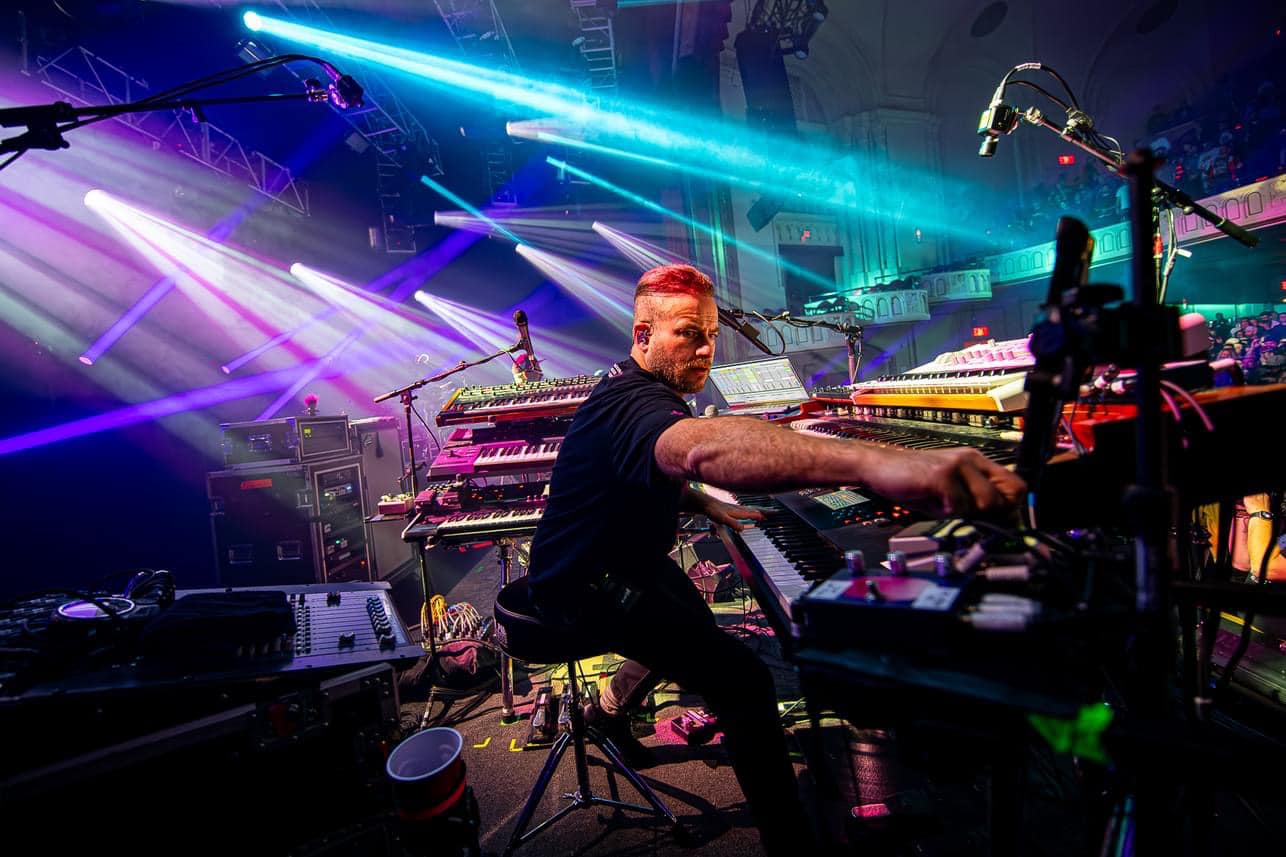
I had recently rebuilt my spaceship station of keyboards to be able to harness their powers. I also have looping capabilities, but MIDI looping capabilities. So I could turn my Virus, that white synth that sits on top of most my projects, into basically 16 separate Viruses and loop them. I’ve also got some hardware that gives me a faster mobility to work around all that stuff.
I've been dialing that in with the Biscuits over the last couple of years and have been very curious to see how I can take that space station and hook into somebody else's. Shockingly, we did it and we didn't have any rehearsal the day before. We went right into gig number one last month without testing any of the electronics or even knowing what we were going to sound like.
So talk about going into a gig with musicians with trust fall confidence in their abilities, that's really what happened here. We did it and it was awesome. Being able to express this technology with improvisation, with collaboration, was just fascinating to me.
Jay Lane rose to the occasion by bringing in a whole kit of electronic drums. I guess at Sphere he was also on this similar kit. There's a new DW kit that looks like drums, but when you play it, it's got mesh heads, so it doesn't create much sound at all. Then the pickups are in the heads, and that gets transformed into an electronic drum sound through computer software that he has.
I think it's awesome to be able to play 90 minutes of purely improvisational music on that sort of level.
Finally, I know it’s a little ways out but have you started working on Dead Aces yet or perhaps even another new project to follow?
Dead Aces is definitely still in my future. I’ll be thinking about what that's going to be like. I’ve got to sit down and really listen to the Ace album so I can start to think about what that wants to be.
I've got a lot of other projects that I'm also working on right now. I've got some ideas that haven't taken that step out of the box yet where they begin to become reality.
If you're looking for parting words, I do have some thoughts for our community of improvisational aficionados. We’re a real music community that has supported each other for a few decades now. In the jamband world there are a lot of fantastic versatile musicians, so this is a collective call to action to support the bands that we all love by doing the things that we need to do to really show our fandom. These are challenging times for all of us but if it’s possible, buy tickets in advance and bring out a few friends who have never seen your favorite band to show them the passion that you have for this music.
Right now we’re at a point where everything is crazy expensive, the margins are really slim and we're seeing everywhere, whether you're in the jamband scene or not, musicians up and down the pole asking, "Is it worth it anymore going out on the road?"
This is a moment where we all need to be supportive of each other on a human level but I also hope we can be supportive of the scene that we've cultivated over all these years.